




Easy Reading Comprehension Questions for Grade 1 Students
Read the story below and answer the questions that follow.
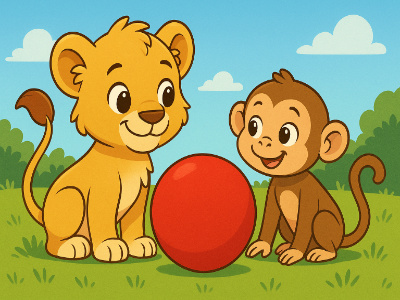
Leo the lion cub had a new toy. It was a big, bright red ball. He loved to push it around the grassy field. It was his favorite toy, and he did not like to share it.
One sunny morning, his friend Mia the monkey came to play. “Hi, Leo! Can I play with your red ball?” she asked with a smile.
Leo hugged his ball tightly. “No, it’s mine!” he growled. Mia felt sad and went to sit under a tree alone.
Leo tried to play, but it was not fun by himself. He looked at Mia sitting all alone. He felt bad. Playing together is more fun than playing alone.
Leo rolled the ball over to Mia. “Do you want to play with me?” he asked. Mia’s face lit up. “Yes!” she chirped. They played with the red ball all day and had a wonderful time together.
Answer the following questions:
A. Tick the correct option.
1. What new toy did Leo the lion cub have?
(a) A blue kite
(b) A big, red ball
(c) A yellow car
2. Who is Leo's friend?
(a) Mia the monkey
(b) Zippy the zebra
(c) Ella the elephant
B. Fill in the blanks with words from the story.
1. Leo loved to push his ball around the grassy ______________.
2. Mia felt ______________ when Leo did not share the ball.
3. They played with the red ball all ______________ and had a wonderful time.
C. Write ‘True’ or ‘False’ for the following sentences.
1. Leo liked to share his ball at the beginning of the story. __________
2. Mia the monkey had a new toy. __________
3. Leo and Mia had fun playing together. __________
D. Answer the following questions in one sentence.
1. Why was it not fun for Leo to play by himself?
_________________________________________________________________
2. What did Leo do when he felt bad for Mia?
_________________________________________________________________
E. Rearrange the actions in the correct order (1, 2, 3, 4).
F. Choose the correct word to complete the sentence.
1. Leo was a lion (cub / man).
2. Playing together is (more / less) fun than playing alone.
G. Yes or No Questions.
1. Was the ball blue? (Yes / No)
2. Did Leo and Mia become happy at the end? (Yes / No)
Answer Key
A. Tick the correct option.
1. (b) A big, red ball
2. (a) Mia the monkey
B. Fill in the blanks with words from the story.
1. field
2. sad
3. day
C. Write ‘True’ or ‘False’ for the following sentences.
1. False
2. False
3. True
D. Answer the following questions in one sentence.
1. It was not fun for Leo because he missed his friend / he was alone.
2. Leo rolled the ball over to Mia and asked her to play.
E. Rearrange the actions in the correct order (1, 2, 3, 4).
(2) Leo says the ball is his.
(4) Leo and Mia play together with the ball.
(1) Leo gets a new red ball.
(3) Mia asks if she can play.
F. Choose the correct word to complete the sentence.
1. cub
2. more
G. Yes or No Questions.
1. No
2. Yes
How This Worksheet Helps You Learn?
This Class 1 Reading Comprehension Level I Children’s Story worksheet helps young learners practice core English skills through a simple, engaging story and accessible activities. Designed for Grade 1 students, this free printable worksheet builds early comprehension using picture-based questions, fill-in-the-blanks, and matching exercises. Children gain confidence as they answer questions and work with clear, uncluttered layouts, making at-home or classroom reading practice fun and productive.
Ideal for parents and teachers alike, this Grade 1 story worksheet PDF supports vocabulary, main idea recognition, and story sequencing in a calm, supportive format. By providing both the reading passage and structured comprehension activities, this comprehension worksheet for class 1 is suitable for daily practice, homework, or extra support during holidays.
Usage Tips for Parents and Teachers
- Encourage your child to read the short story aloud and identify new words together.
- Guide students to circle, fill in, or match answers by using the visuals for hints.
- Check answers using the provided answer key to build confidence and self-correction skills.
- Use the worksheet on a tablet or device for digital practice, or print for hands-on learning.
Explore Related Worksheets
- Class 1 English Worksheets for more foundational English practice.
- Class 1 English Marigold Worksheets Chapter 1 to reinforce NCERT reading skills.
- English Comprehension Worksheets for Kids to extend comprehension across levels.
- Class 1 English Marigold Worksheets Chapter 4 Poem for poetry-based comprehension.
- Class 2 English Marigold Worksheets Chapter 4 for children advancing to the next grade.
What You Learned
On this page, you discovered a Grade 1 reading comprehension worksheet featuring a simple children's story, easy questions, picture match activities, and an answer key, all in a ready-to-use PDF format. The practice worksheet is specially designed to strengthen reading confidence, vocabulary, and the ability to understand short stories. With clear instructions and visual support, this class 1 reading comprehension PDF promotes successful early English learning at home or in the classroom.
FAQs on Class 1 Reading Comprehension Worksheet: Short Story with Questions
1. What is reading comprehension for Grade 1?
Reading comprehension for Grade 1 is the ability to understand a simple story or passage after reading it. It involves developing basic skills to grasp the meaning of a text, not just read the words.
Key skills include:
- Identifying the main characters and the setting (where the story takes place).
- Recalling the sequence of events, such as what happened first, next, and last.
- Answering simple “who,” “what,” and “where” questions about the story.
- Understanding new words through vocabulary building exercises related to the passage.
2. What are good comprehension exercises for a Class 1 student?
Good comprehension exercises for a Class 1 student are typically engaging, visual, and focus on fundamental understanding rather than complex analysis. These activities are designed to make learning fun and effective.
Examples found in a comprehension worksheet class 1 include:
- Reading a short story or simple passage with easy-to-follow language.
- Answering multiple-choice questions (MCQs) to check for understanding.
- Fill in the blanks activities using words directly from the story.
- Picture-based questions that require matching images to words or events from the text.
- Arranging jumbled sentences or pictures to reconstruct the story's sequence.
3. What skills does this Class 1 reading comprehension worksheet help build?
This worksheet is designed to strengthen several core skills that are essential for early literacy and academic success in young learners.
The primary skills it helps build are:
- Reading Comprehension: The main goal is to improve the ability to understand a children's story with questions.
- Vocabulary Building: Introduces new words in context, making them easier to remember.
- Attention and Focus: Encourages children to concentrate on the text to find answers.
- Analytical Skills: Teaches children to extract specific information from a passage.
- Following Instructions: Activities like “circle the correct answer” build the habit of following directions carefully.
4. How can I use this reading comprehension worksheet at home with my child?
This practice worksheet is designed for easy use at home to provide extra reading support between school lessons.
Here is a simple way to use it:
- First, download and print the free PDF worksheet.
- Have your child read the short story aloud to practice their reading fluency.
- Guide them through the questions, encouraging them to look back at the story for answers.
- Use the included answer key to review the work together and explain any corrections.
5. Is this Class 1 reading comprehension worksheet printable and free?
Yes, this worksheet is completely free and designed to be easily printable for home or classroom use. You can get the Reading Comprehension Grade 1 PDF free download without any cost.
This makes it a convenient resource for:
- Parents looking for extra practice worksheets.
- Teachers needing supplementary materials for their students.
- Quick and accessible homework for kids.
6. Does this story-based worksheet include an answer key?
Yes, a complete answer key is provided with this story-based worksheet. Including a worksheet with an answer key is important for effective learning.
The benefits include:
- Allowing for quick and accurate checking of answers by parents or teachers.
- Enabling students to self-correct their work, which reinforces learning.
- Building confidence as children can see their correct answers and understand their mistakes.
7. What kind of activities are in this children's story worksheet for Grade 1?
This worksheet contains a mix of fun and educational activities designed to test comprehension in various ways and keep young learners engaged.
The worksheet typically includes:
- A short story for Grade 1 that is simple and interesting.
- Comprehension questions in formats like “circle the correct answer.”
- Fill in the blank exercises to reinforce key details and vocabulary.
- Picture-based activities such as matching an image to a corresponding word or event from the story.
8. What reading level is expected for Grade 1?
The expected reading level for Grade 1 involves understanding simple sentences and short paragraphs, with a focus on high-frequency words. The material in this worksheet is aligned with this level.
A student in Grade 1 is typically working on:
- Reading short sentences and a simple passage for grade 1.
- Recognising common sight words automatically.
- Decoding CVC (consonant-vowel-consonant) words like 'sun' or 'mat'.
- Following a basic plot in a short story from start to finish.
9. How do visuals in this worksheet help with story comprehension?
Visuals such as illustrations and pictures play a vital role in helping Grade 1 students with story comprehension. They act as important cues that support the text.
Visuals help by:
- Providing context to help children understand the story and new vocabulary.
- Making the worksheet more engaging and less intimidating for young learners.
- Breaking down the information into smaller, more manageable parts.
- Supporting visual learners through activities like match the picture exercises.
10. Can this Grade 1 English worksheet be used on a tablet?
Yes, absolutely. This Grade 1 English worksheet is provided as a PDF, making it compatible with most digital devices, including tablets and smartphones.
While it is a printable reading comprehension PDF, you can also:
- Open and read the worksheet directly on a tablet for on-the-go practice.
- Use a PDF annotation app to complete the exercises digitally.
- Preview the worksheet on your device before deciding to print it.
