



What Do Copepods Eat and Why Are They Important to Marine Ecosystems?
A copepod is a tiny crustacean found in oceans, lakes, rivers, and even underground water. Though most copepods are only a few millimetres long, they are among the most abundant animals on Earth. These small creatures play a huge role in aquatic food chains and help keep water ecosystems healthy. Learning about copepod facts, copepod habitat, and copepod importance shows how even the smallest life forms can support the entire planet.
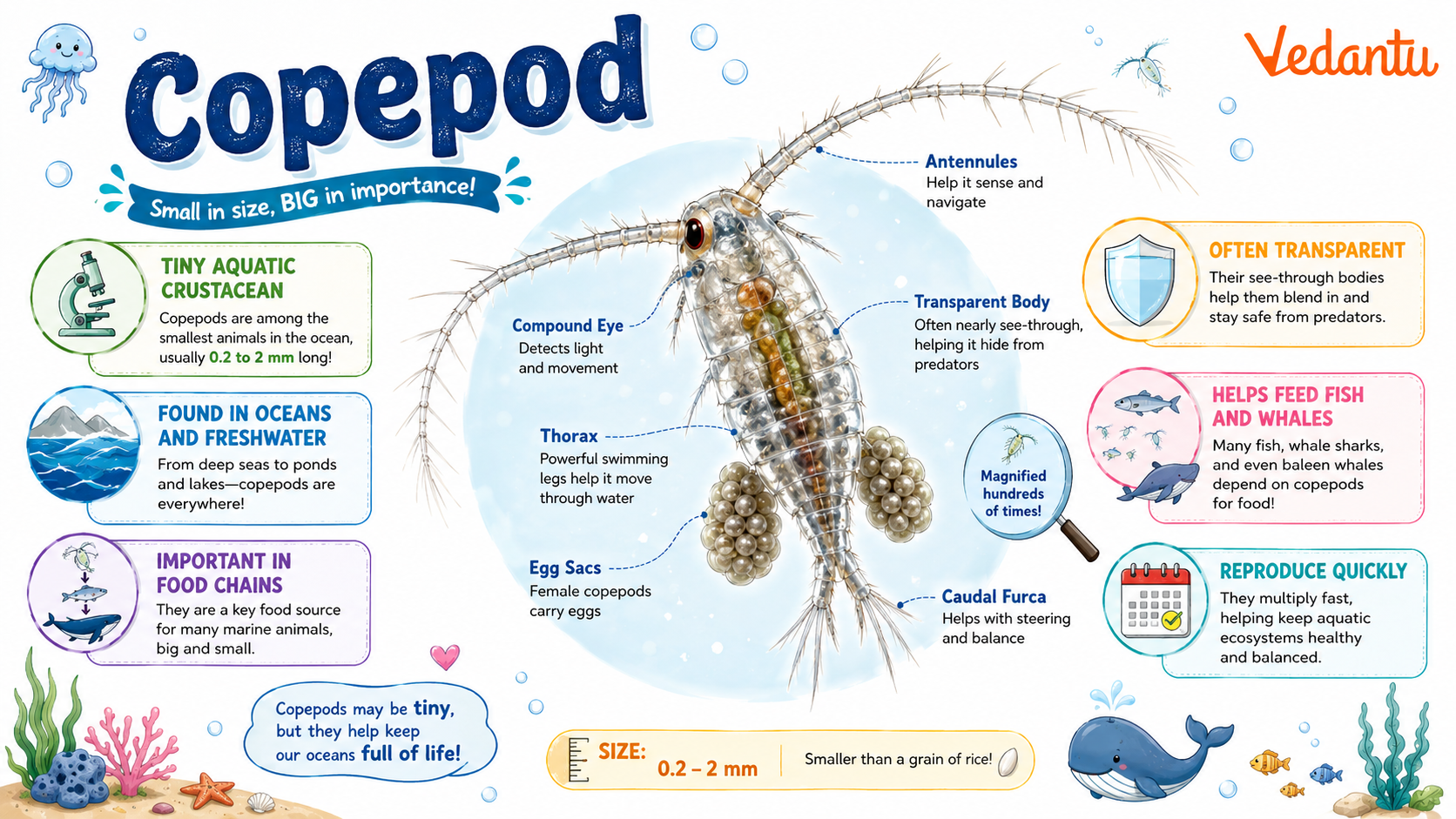
Quick Facts About Copepod
| Feature | Details |
|---|---|
| Common Name | Copepod |
| Animal Group | Crustacean (related to crabs and shrimp) |
| Scientific Subclass | Copepoda |
| Size | 0.5 mm to 2 mm (most species) |
| Habitat | Oceans, lakes, rivers, ponds, underground water |
| Diet | Phytoplankton, tiny algae, small organisms |
| Lifespan | Few weeks to several months |
| Importance | Major food source for fish and marine animals |
Appearance and Physical Characteristics
- Small, tear-drop shaped body
- Single red or dark eye in the centre
- Long antennae used for swimming
- Segmented body with a hard outer covering (exoskeleton)
- No large claws like crabs
Habitat and Distribution
- In all oceans of the world
- In freshwater lakes and ponds
- In rivers and streams
- Even in underground caves and wet soil
Marine copepods are especially important because they form a huge part of ocean plankton. In fact, they are considered one of the most numerous multi-celled animals on Earth.
Diet and Feeding Habits
Most copepods eat phytoplankton (microscopic plants and algae).
They use their tiny mouthparts to filter or capture food particles from water.
Some copepods eat smaller zooplankton and tiny animals.
They pass energy from microscopic plants to fish, whales, and seabirds.
Behaviour and Lifestyle
- Mostly free-swimming and part of plankton.
- Some species attach to fish as parasites.
- Many migrate vertically in water—moving up at night and down during the day.
- Respond quickly to light and water vibrations.
Copepod Life Cycle
- Egg Stage: Females carry eggs in sacs attached to their body.
- Nauplius Larva: The egg hatches into a tiny larval stage with few body segments.
- Copepodid Stages: Several growth stages where the body becomes more developed.
- Adult: Fully formed copepod ready to reproduce.
The copepod life cycle involves multiple moults, where they shed their exoskeleton to grow bigger.
Types and Diversity
Mostly marine and important plankton species.
Found in freshwater and marine habitats.
Live near the bottom of water bodies.
Attach to fish and marine animals.
Importance and Role in Nature
Young fish depend heavily on copepods.
Help move carbon from the surface to deep ocean.
Connect microscopic plants to large animals.
Their presence shows ecosystem balance.
Amazing Copepod Facts
- They may be the most numerous animals on Earth.
- Some glow in the dark (bioluminescent species).
- They can detect tiny vibrations in water.
- Whale sharks and small fish feed on copepods.
- They have been around for over 500 million years.
- Some species survive extreme cold Arctic waters.
Fun Facts for Kids
FAQs on Copepod: The Tiny Crustacean Powering Ocean Life
1. What is a copepod?
Copepods are tiny crustaceans that live mostly in water and are an important part of the aquatic food chain.
- They belong to the group zooplankton.
- Most copepods are found in oceans, seas, lakes, and ponds.
- They are related to crabs and shrimp.
- They are usually only 1–2 millimeters long.
- They help feed fish, whales, and other marine animals.
2. Where do copepods live?
Copepods live in almost every type of water habitat on Earth, from deep oceans to small freshwater ponds.
- Found in saltwater oceans and coral reefs.
- Live in freshwater lakes and rivers.
- Some species survive in underground caves.
- Others live in wet soil or damp moss.
- They are common in both cold polar waters and warm tropical seas.
3. What do copepods eat?
Copepods mainly eat microscopic plants and animals in the water, making them key players in the marine food web.
- Feed on phytoplankton (tiny floating plants).
- Eat microalgae and bacteria.
- Some species eat other zooplankton.
- Parasitic copepods feed on fish or marine animals.
- They help transfer energy up the aquatic food chain.
4. Why are copepods important?
Copepods are important because they support marine ecosystems and help control carbon in the ocean.
- They are a major food source for fish, whales, and seabirds.
- They connect phytoplankton to larger animals.
- Help move carbon dioxide from the surface to deep ocean waters.
- Support commercial fisheries.
- Keep aquatic ecosystems balanced.
5. Are copepods harmful to humans?
Most copepods are harmless to humans, but a few can carry parasites or affect fish farms.
- They do not bite or sting people.
- Some freshwater copepods may carry parasites like Guinea worm.
- Parasitic copepods can harm fish in aquaculture.
- They are generally safe in natural water bodies.
- Most species are beneficial to ecosystems.
6. How big is a copepod?
Copepods are very small and usually invisible without a microscope.
- Most measure between 0.5 to 2 millimeters.
- Some deep-sea species grow slightly larger.
- They have a teardrop-shaped body.
- Long antennae help them swim.
- Despite their size, they are extremely abundant.
7. How do copepods reproduce?
Copepods reproduce by laying eggs that hatch into tiny larvae.
- Females carry egg sacs on their bodies.
- Eggs hatch into nauplius larvae.
- Larvae molt several times as they grow.
- They develop into adult copepods after multiple stages.
- Reproduction rates can increase in warm water.
8. What are the main types of copepods?
The three main types of copepods are Calanoida, Cyclopoida, and Harpacticoida.
- Calanoida mostly live in open ocean waters.
- Cyclopoida are common in freshwater habitats.
- Harpacticoida live on the sea floor.
- Some species are free-living.
- Others are parasitic copepods.
9. Can you see copepods without a microscope?
Most copepods are too small to see clearly without a microscope.
- They appear as tiny white specks in water.
- A magnifying glass may help you spot them.
- Scientists use microscopes to study details.
- They move in quick, jerky motions.
- Large groups may look like cloudy water.
10. How do copepods move?
Copepods move by using their long antennae to jerk or hop through water.
- They swim with quick jumping motions.
- Use antennae like paddles.
- Some crawl along the sea floor.
- Their movement helps them escape predators.
- This motion gives them the nickname "water fleas".
