



Why Did the Dire Wolf Go Extinct? Size, Habitat, and Key Facts
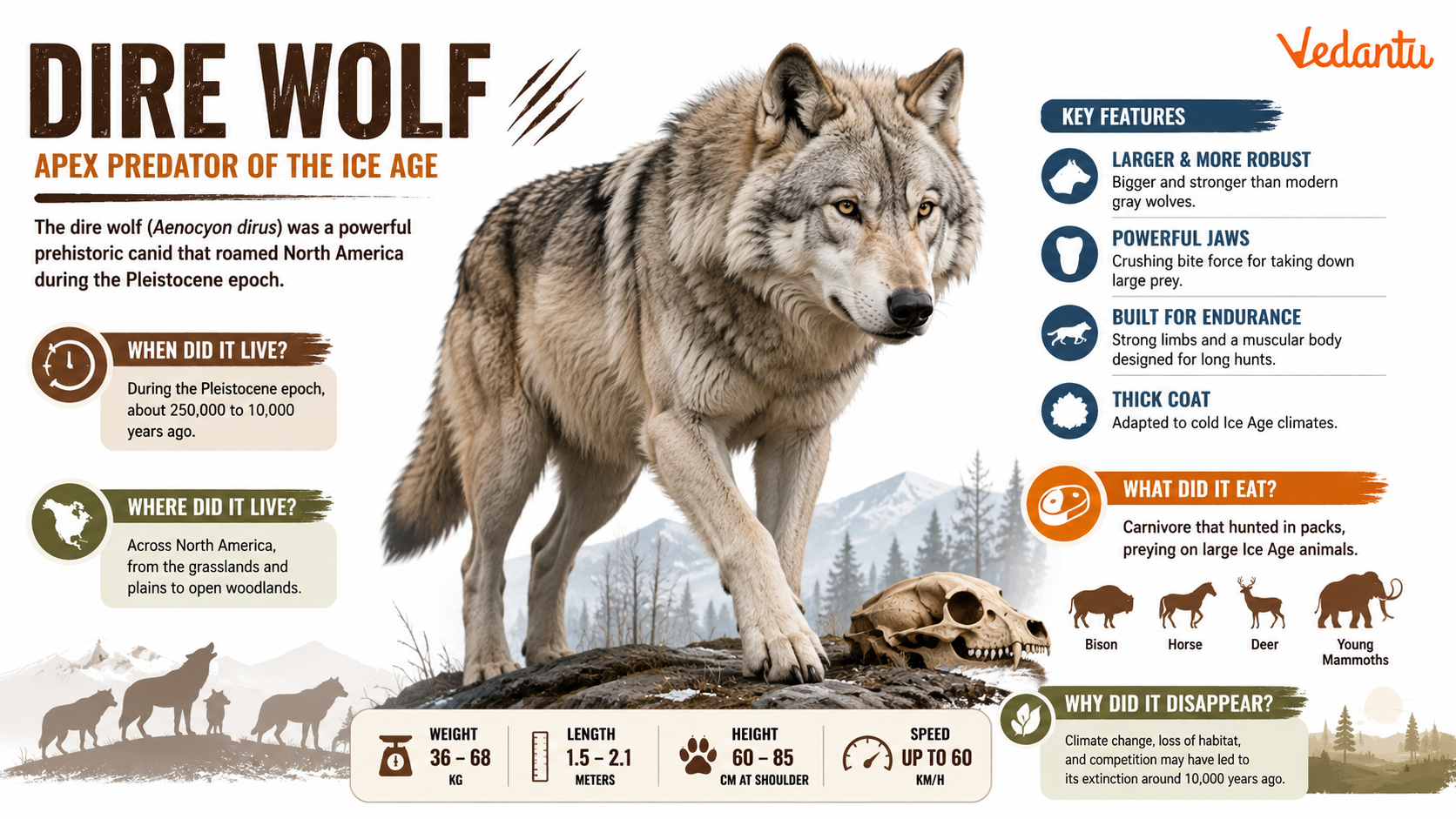
Quick Facts About the Dire Wolf
| Feature | Details |
|---|---|
| Common Name | Dire Wolf |
| Scientific Name | Aenocyon dirus |
| Animal Group | Mammal |
| Time Period | Late Pleistocene (Ice Age) |
| Length | Up to 1.5 meters (about 5 feet) |
| Weight | 60–70 kg (heavier than gray wolves) |
| Habitat | Plains, forests, grasslands of the Americas |
| Diet | Carnivore (meat-eater) |
| Conservation Status | Extinct |
Appearance and Physical Characteristics
- Large and muscular body.
- Thick fur to survive cold Ice Age climates.
- Broad skull with strong teeth for crushing bones.
- Long legs built for running and chasing prey.
- Likely had grey, brown, or dark-colored fur.
Dire Wolf Habitat and Distribution
- Lived mainly in the United States, Mexico, and parts of South America.
- Preferred areas with large herbivores to hunt.
- Adapted to cold Ice Age climates.
- Often shared territory with saber-toothed cats and early humans.
Dire Wolf Diet and Feeding Habits
- Hunted bison, horses, camels, and giant ground sloths.
- Used powerful jaws to crush bones.
- Likely hunted in packs, like modern wolves.
- May have scavenged dead animals when needed.
As a top predator, the Dire Wolf helped control the population of large herbivores and maintained balance in the ecosystem.
Behaviour and Lifestyle
Dire Wolves probably lived and hunted in groups for better success.
Working together allowed them to bring down large prey.
Packs likely defended their hunting grounds from rivals.
They were fast runners and active predators.
Dire Wolf Life Cycle
- Birth: Female gave birth to live pups.
- Pups: Young ones depended on parents for food and protection.
- Growth: Pups learned hunting skills by observing adults.
- Adult Stage: Became full pack members and hunters.
- Lifespan: Estimated 6–8 years in the wild.
What Made the Dire Wolf Special?
Importance and Role in Nature
- Maintained balance among large herbivores.
- Part of the prehistoric food web.
- Helps scientists study climate change and extinction.
- Provides clues about evolution of modern wolves.
Amazing Facts About the Dire Wolf
Interesting Facts About the Dire Wolf
- Their name “dirus” means “fearsome” in Latin.
- They were about 25% heavier than gray wolves.
- They likely competed with early humans for food.
- Climate changes may have reduced their prey supply.
Fun Facts for Kids
FAQs on Dire Wolf: The Ice Age Giant Predator Explained
1. What is a Dire Wolf?
The Dire Wolf was a large, prehistoric wolf that lived during the Ice Age and is now extinct.
- Scientific name: Aenocyon dirus
- Lived about 125,000 to 10,000 years ago
- Was bigger and heavier than today’s gray wolf
- Famous from fossils found in North and South America
2. How big was a Dire Wolf?
The Dire Wolf was larger and stronger than most modern wolves.
- Weighed about 130–150 pounds (60–68 kg)
- Stood around 3 feet tall at the shoulder
- Had a bigger head and stronger jaws than a gray wolf
- Had thick fur to survive the Ice Age climate
3. Where did Dire Wolves live?
The Dire Wolf lived mainly in North America and parts of South America.
- Fossils were found in the La Brea Tar Pits in California
- Lived in grasslands, forests, and open plains
- Shared habitats with animals like mammoths and saber-toothed cats
4. What did Dire Wolves eat?
The Dire Wolf was a carnivore that hunted large prehistoric animals.
- Ate bison, horses, and young mammoths
- May have hunted in packs like modern wolves
- Used strong jaws and teeth to crush bones
- Sometimes scavenged food from other predators
5. When did the Dire Wolf go extinct?
The Dire Wolf went extinct around 10,000 years ago at the end of the Ice Age.
- Climate change reduced its habitat
- Large prey animals also became extinct
- Early humans may have competed for food
- Other wolf species adapted better
6. Are Dire Wolves related to modern wolves?
The Dire Wolf was related to modern wolves but belonged to a different species.
- Scientific studies show it was not a direct ancestor of the gray wolf
- Belonged to the species Aenocyon dirus
- Separated from other wolves millions of years ago
- Looked similar but had genetic differences
7. How do scientists know about Dire Wolves?
Scientists study fossils to learn about the Dire Wolf.
- Thousands of bones were found in the La Brea Tar Pits
- Skulls and teeth show strong biting power
- DNA studies reveal genetic differences from modern wolves
- Fossils help scientists understand its size and diet
8. Did Dire Wolves live with humans?
Yes, early humans lived at the same time as the Dire Wolf.
- Both existed near the end of the Ice Age
- Humans hunted large animals like bison and mammoths
- They may have competed for the same prey
- No evidence shows Dire Wolves were domesticated
9. What is the difference between a Dire Wolf and a Gray Wolf?
The Dire Wolf was larger and more heavily built than the modern Gray Wolf.
- Dire Wolves had stronger jaws and bigger teeth
- Gray Wolves are slimmer and faster
- Dire Wolves are extinct; Gray Wolves still live today
- They belong to different species
10. Why is the Dire Wolf famous today?
The Dire Wolf is famous because of fossils and popular culture.
- Many fossils were found in the La Brea Tar Pits
- Often featured in books and TV shows like Game of Thrones
- Known as a powerful Ice Age predator
- Popular topic in paleontology and prehistoric studies
