



How to Identify Heteropteran True Bugs and Understand Their Life Cycle
Heteropterans are a fascinating group of insects commonly known as “true bugs.” They belong to the order Hemiptera and are recognised for their unique half‑leathery, half‑membranous wings. From water striders that walk on water to shield bugs found on plants, heteropterans live in many different habitats. Their sharp mouthparts help them pierce plants or prey. Let’s explore amazing Heteropteran facts, their habitat, diet, life cycle, and importance in nature.
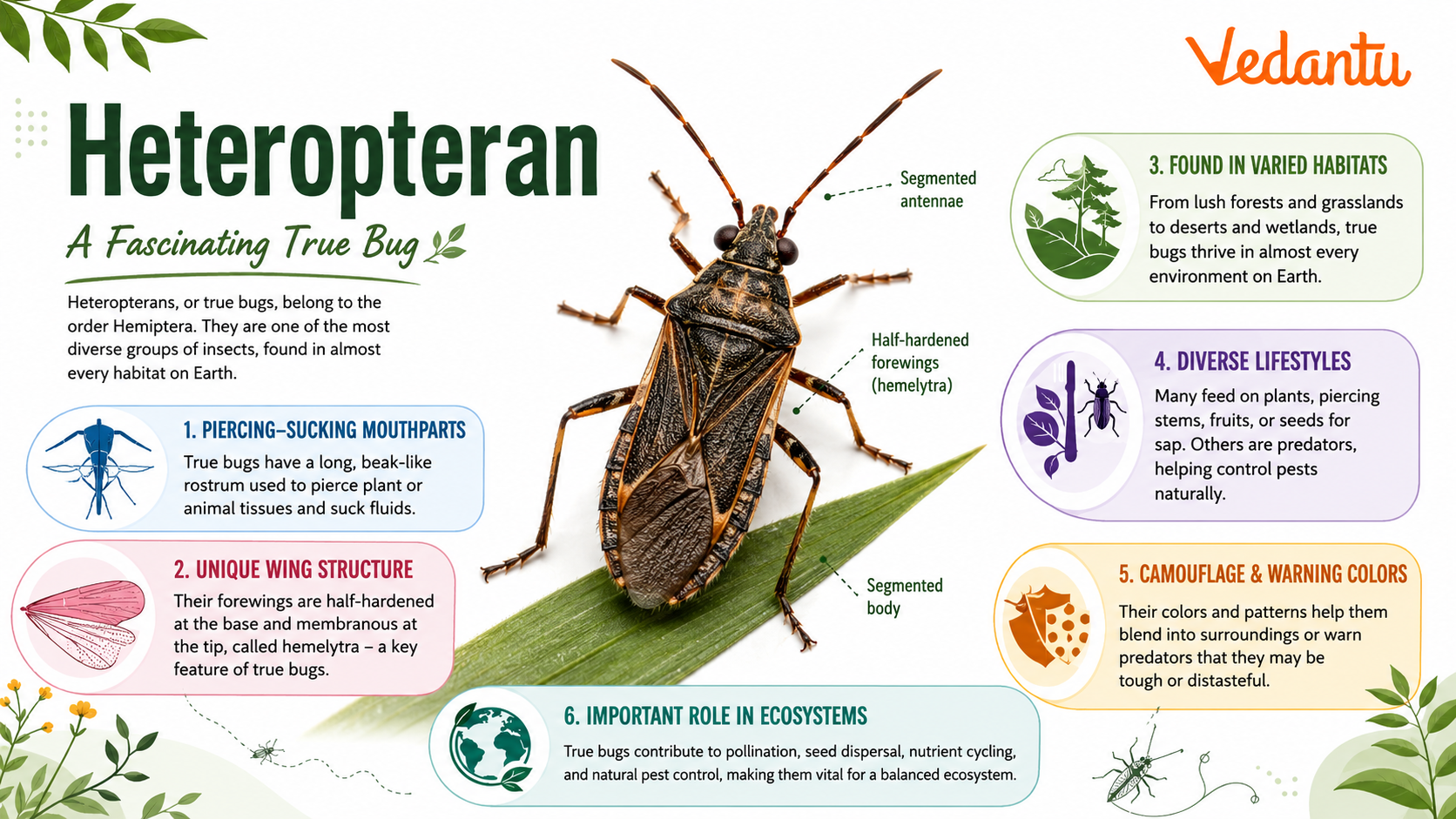
Quick Facts About Heteropterans
| Feature | Details |
|---|---|
| Common Name | True Bugs |
| Scientific Group | Suborder Heteroptera |
| Animal Group | Insects (Phylum Arthropoda) |
| Body Parts | Head, Thorax, Abdomen |
| Wings | Forewings half leathery, half membranous |
| Habitat | Gardens, forests, ponds, rivers, fields |
| Diet | Plant sap, insects, small animals |
| Life Cycle | Incomplete metamorphosis |
Appearance and Physical Characteristics
- Body divided into head, thorax, and abdomen.
- Have long antennae for sensing surroundings.
- Special piercing-sucking mouthparts called a rostrum.
- Forewings called hemelytra – half thick and half thin.
- Most species are small, but sizes vary from a few millimetres to several centimetres.
Habitat and Distribution
- Found on every continent except Antarctica.
- Live in forests, grasslands, farms, gardens, and wetlands.
- Some species are fully aquatic and live in ponds and lakes.
- Others prefer dry land and hide under leaves or tree bark.
The Heteropteran habitat is extremely diverse. Water striders glide across water surfaces, while shield bugs rest on plant leaves. Their adaptability allows them to survive in tropical, temperate, and even semi-arid climates.
Diet and Feeding Habits
Many heteropterans suck sap from plants using their sharp rostrum.
Some species hunt small insects and help control pests.
A few species feed on animal or human blood.
They act as both predators and prey in ecosystems.
Behaviour and Lifestyle
- Some are solitary, while others gather in groups.
- Many release a strong smell to defend themselves.
- Aquatic species can trap air bubbles for breathing underwater.
- Most are active during the day.
Heteropteran Life Cycle
- Egg Stage: Female lays eggs on plants or in water.
- Nymph Stage: Young ones look like small adults but without fully developed wings.
- Adult Stage: After several moults, they develop wings and become reproductive adults.
The Heteropteran life cycle shows incomplete metamorphosis because there is no pupal stage.
Types and Diversity
Known for their shield-shaped bodies.
Walk on water using surface tension.
Fierce predators of other insects.
Feed on blood and live near humans.
Importance and Role in Nature
Predatory species reduce harmful insect populations.
Birds and reptiles feed on them.
Maintain balance between plant and insect populations.
Help scientists understand insect evolution.
Amazing Heteropteran Facts
Interesting Facts About Heteropterans
- Their wings lie flat over their backs when at rest.
- Many species show bright warning colours.
- Some can fly, while others cannot.
- They communicate using chemicals and vibrations.
Fun Facts for Kids
- Not all bugs are beetles — true bugs are heteropterans!
- Some can skate across ponds like tiny ice skaters.
- They taste plants using their special mouth tube.
- Baby bugs look like mini adults.
- Some wear bright colours to scare predators away.
FAQs on Heteropterans Explained: Identification, Types, and Ecology
1. What is a Heteropteran?
Heteropterans are a group of insects commonly known as true bugs that belong to the order Hemiptera.
- They have special piercing and sucking mouthparts.
- Their front wings are partly hard and partly soft, called hemelytra.
- Examples include stink bugs, bed bugs, and water striders.
- They are found on land, in water, and on plants worldwide.
2. Why are Heteropterans called true bugs?
Heteropterans are called true bugs because they share special body features that define the insect group Hemiptera.
- They have a needle-like rostrum (beak) for sucking fluids.
- Their wings are divided into hard and soft parts.
- They undergo incomplete metamorphosis (egg → nymph → adult).
- This makes them different from other insects often mistakenly called “bugs.”
3. What do Heteropterans eat?
Heteropterans eat plant juices, small insects, or even blood, depending on the species.
- Plant-feeders suck sap from leaves and stems.
- Predatory bugs eat small insects like caterpillars.
- Some species, like bed bugs, feed on blood.
- They use piercing-sucking mouthparts to get liquid food.
4. Where do Heteropterans live?
Heteropterans live in many habitats, including land, freshwater, and near plants.
- Some live in gardens, forests, and farms.
- Water bugs and water striders live on ponds and lakes.
- Others may live inside homes, like bed bugs.
- They are found on every continent except Antarctica.
5. What are examples of Heteropterans?
Common examples of Heteropterans include several well-known true bugs.
- Stink bugs – known for their strong smell.
- Bed bugs – feed on human blood.
- Water striders – walk on water surfaces.
- Assassin bugs – predators of other insects.
6. How do Heteropterans grow and develop?
Heteropterans grow through incomplete metamorphosis, which has three life stages.
- Egg – laid on plants or surfaces.
- Nymph – looks like a small adult without wings.
- Adult – fully developed with wings.
- Nymphs molt several times before becoming adults.
7. Are Heteropterans harmful to humans?
Most Heteropterans are harmless, but some can cause problems.
- Bed bugs bite and cause itching.
- Some plant bugs damage crops and gardens.
- Predatory species help control pest insects.
- Many are beneficial for the ecosystem.
8. How can you identify a Heteropteran?
You can identify a Heteropteran by its unique body structure and mouthparts.
- Front wings are half hard and half membranous.
- They have a long piercing-sucking beak.
- Most have a triangular shape on their back called the scutellum.
- They usually have a flattened or oval-shaped body.
9. What is the difference between Heteropterans and other Hemipterans?
Heteropterans differ from other Hemipterans mainly in their wing structure and habitat.
- Their front wings are partly hard (hemelytra).
- Many live on land or water surfaces.
- Other Hemipterans like aphids have fully soft wings.
- Both groups share piercing-sucking mouthparts.
10. Why are Heteropterans important in nature?
Heteropterans are important because they help balance ecosystems as predators, prey, and plant feeders.
- Predatory true bugs control harmful insect pests.
- They serve as food for birds and other animals.
- Some species help scientists study insect behavior.
- They are part of biodiversity in many habitats.
