



What Did Iguanodon Eat, How Big Was It, and Where Did It Live?
Iguanodon was one of the most famous plant-eating dinosaurs that lived millions of years ago. It was among the first dinosaurs ever discovered and helped scientists understand prehistoric life. With its strong legs, beak-like mouth, and a unique thumb spike, Iguanodon was both fascinating and powerful. Learning about Iguanodon facts, habitat, diet, and life cycle helps us explore how dinosaurs survived during the Early Cretaceous period.
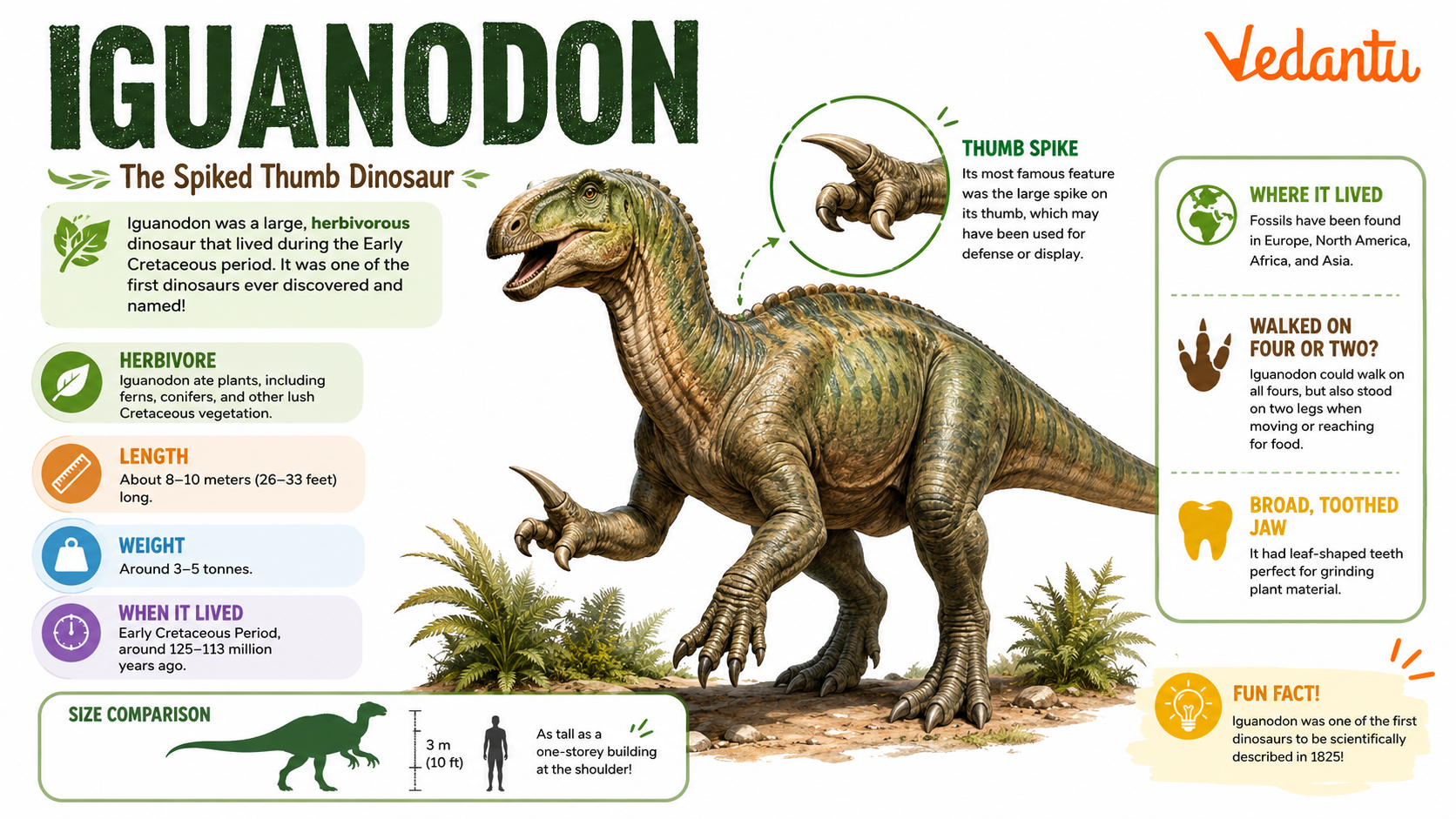
Quick Facts and Statistics
| Feature | Details |
|---|---|
| Common Name | Iguanodon |
| Scientific Meaning | “Iguana Tooth” |
| Animal Group | Dinosaur (Ornithopod) |
| Time Period | Early Cretaceous (about 125–140 million years ago) |
| Length | Up to 10 meters |
| Weight | 3–5 tons |
| Diet | Herbivore (plant-eater) |
| Movement | Walked on two or four legs |
| Fossils Found In | Europe, North America, Africa |
Appearance and Physical Characteristics
- Large and heavy body with strong back legs.
- Could walk on two legs (bipedal) or four legs (quadrupedal).
- Long, stiff tail to balance its body.
- Beak-like mouth for cutting plants.
- Flat teeth for grinding leaves.
- Sharp thumb spike on each hand.
Iguanodon Habitat and Distribution
The Iguanodon habitat included forests, river plains, and coastal areas. It lived in warm climates during the Early Cretaceous period.
- Lived mainly in Europe (Belgium, England, Spain).
- Fossils also found in North America and Africa.
- Preferred areas with lots of plants and water sources.
- Likely lived in herds for protection.
Diet and Feeding Habits
Iguanodon diet was completely herbivorous.
Ferns, shrubs, leaves, and low-growing plants.
Used its beak to clip plants and teeth to grind them.
Important plant-eater and prey for large carnivorous dinosaurs.
Behaviour and Lifestyle
- Likely lived in groups or herds.
- Could run on two legs when escaping predators.
- Used its thumb spike for defence.
- Communicated using body movements and possibly sounds.
- Spent most of its day searching for food.
Iguanodon Life Cycle
- Egg Stage: Iguanodon laid eggs, like most dinosaurs.
- Hatchling: Baby dinosaurs hatched from eggs and were much smaller.
- Juvenile Stage: Young ones grew quickly to avoid predators.
- Adult Stage: Fully grown adults reached up to 10 meters long.
What Makes Iguanodon Special?
Used as a defence weapon against predators.
Could walk on two or four legs.
Perfect for grinding tough plants.
One of the first dinosaurs ever scientifically described (1825).
Importance and Role in Nature
- Helped control plant growth in its ecosystem.
- Provided food for large carnivorous dinosaurs.
- Important for scientists to understand dinosaur evolution.
- One of the key dinosaurs that shaped early paleontology studies.
Amazing Iguanodon Facts
Interesting Facts About Iguanodon
- Iguanodon was one of the three dinosaurs used to define the word “Dinosauria.”
- Early models showed it standing upright like a kangaroo, which was incorrect.
- It had strong arms to help gather food.
- It lived during the time when flowering plants were beginning to spread.
Fun Facts for Kids
FAQs on Iguanodon: Complete Guide to This Plant‑Eating Dinosaur
1. What is an Iguanodon?
Iguanodon was a large plant-eating dinosaur that lived during the Early Cretaceous period, about 125 million years ago.
- It was one of the first dinosaurs ever discovered and named.
- Its name means "iguana tooth" because its teeth looked like those of an iguana.
- It was a herbivorous dinosaur that ate plants and leaves.
- It is often mentioned in People Also Ask queries like "Was Iguanodon a herbivore or carnivore?"
2. When did Iguanodon live?
Iguanodon lived during the Early Cretaceous period, around 125–113 million years ago.
- This was long before humans existed.
- The Earth had warm climates and many forests.
- Other dinosaurs like Hypsilophodon and Baryonyx lived around the same time.
- It is commonly searched under "Iguanodon time period" and "Cretaceous dinosaurs."
3. What did Iguanodon eat?
Iguanodon was a herbivore, meaning it only ate plants.
- It used its strong teeth to chew tough leaves.
- It likely ate ferns, shrubs, and cycads.
- Its beak helped it clip plants easily.
- This answers common searches like "What did Iguanodon eat?" and "Iguanodon diet facts for kids."
4. How big was Iguanodon?
Iguanodon was a large dinosaur that could grow up to 10 meters (33 feet) long.
- It weighed about 3–5 tons.
- It was about as long as a bus.
- It could walk on two legs or four legs.
- Size-related queries include "How tall was Iguanodon?" and "Iguanodon size comparison."
5. What is special about Iguanodon’s thumb?
Iguanodon had a sharp thumb spike that made it unique among dinosaurs.
- The spike may have been used for defense against predators.
- It could also help in breaking open tough plants.
- Early scientists once thought the spike was a horn on its nose.
- This is often searched as "Iguanodon thumb spike purpose."
6. Who discovered Iguanodon?
Iguanodon was discovered by Gideon Mantell in 1822.
- He found fossil teeth in England.
- It was one of the first dinosaurs ever named.
- The name Iguanodon was officially given in 1825.
- Common queries include "Who found Iguanodon?" and "History of Iguanodon discovery."
7. Where have Iguanodon fossils been found?
Iguanodon fossils have been found in Europe and other parts of the world.
- Many fossils were discovered in Belgium in 1878.
- Fossils have also been found in England, Germany, and Spain.
- These discoveries helped scientists learn about dinosaur skeletons.
- Search terms include "Iguanodon fossil locations" and "Where was Iguanodon found?"
8. How did Iguanodon move?
Iguanodon could walk on both two legs and four legs.
- It ran on two legs when moving fast.
- It walked on four legs while eating plants.
- Its strong back legs helped it move quickly.
- This relates to "Did Iguanodon walk on two legs?" and "Iguanodon movement facts."
9. Was Iguanodon a carnivore?
No, Iguanodon was not a carnivore; it was a herbivore.
- It had flat teeth made for grinding plants.
- It did not hunt other animals.
- Its beak and jaw were perfect for plant-eating.
- This answers "Was Iguanodon a meat-eater?" and "Iguanodon herbivore or carnivore?"
10. Why is Iguanodon important in dinosaur history?
Iguanodon is important because it was one of the first dinosaurs ever studied by scientists.
- It helped scientists understand what dinosaurs looked like.
- It was one of the three dinosaurs used to create the word Dinosauria in 1842.
- Its fossils improved knowledge of dinosaur skeletons and behavior.
- It is often searched as "Why is Iguanodon famous?" and "Iguanodon facts for kids."
