



What Does the Jungle Babbler Eat and How Does It Live?
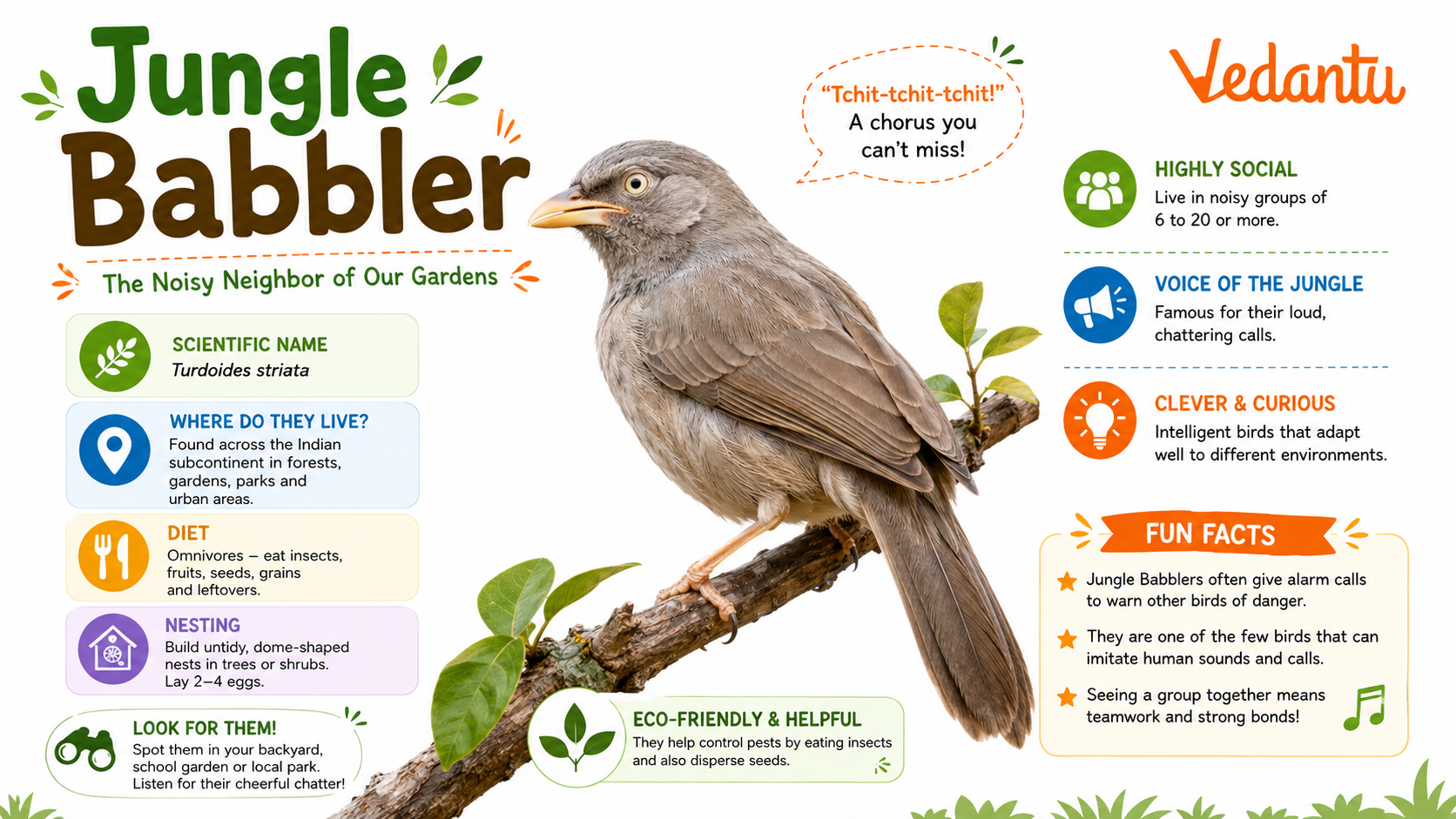
Quick Facts About Jungle Babbler
| Feature | Details |
|---|---|
| Common Name | Jungle Babbler |
| Scientific Name | Argya striata |
| Animal Group | Bird |
| Size | 20–25 cm long |
| Weight | About 60–90 grams |
| Diet | Insects, fruits, seeds |
| Habitat | Forests, gardens, villages, urban areas |
| Lifespan | Up to 6–8 years (in the wild) |
| Famous For | Loud chattering and group living |
Appearance and Physical Characteristics
- Medium-sized bird with a slightly long tail.
- Body colour is dull brown or greyish-brown.
- Pale yellow or creamy eyes.
- Strong legs for hopping on the ground.
- Short, slightly curved beak.
Habitat and Distribution
- Tropical and subtropical forests.
- Gardens and city parks.
- Farmlands and village areas.
- Bushy and shrubby regions.
Diet and Feeding Habits
- Insects like ants, beetles, and caterpillars.
- Small fruits and berries.
- Seeds and grains.
Behaviour and Lifestyle
Life Cycle of Jungle Babbler
- Nesting: Builds cup-shaped nests in bushes or small trees.
- Eggs: Female lays 3–5 blue-green eggs.
- Hatching: Eggs hatch after about 13–15 days.
- Chicks: Both parents and sometimes other group members feed the chicks.
- Adult Stage: Young birds grow and stay with the group.
Flight Adaptations
- Strong wings for short-distance flights.
- Lightweight body covered with feathers.
- Tail feathers that help in balance.
- Sharp eyesight to spot food and danger.
Sound or Call
- Loud chattering sounds.
- Sharp alarm calls when predators are near.
- Continuous talking within the group.
Importance and Role in Nature
Amazing Jungle Babbler Facts
- They are active throughout the year and do not migrate long distances.
- Group members help raise each other’s chicks.
- They take dust baths to clean their feathers.
- They can recognise alarm calls of other birds.
- They sleep close together at night for safety.
- They are commonly seen in Indian cities.
Fun Facts for Kids
FAQs on Jungle Babbler (Seven Sisters) – Complete Guide
1. What is a Jungle Babbler?
The Jungle Babbler is a small, social bird commonly found in India and South Asia.
- Scientific name: Argya striata
- Belongs to the Leiothrichidae family
- Known as the “Seven Sisters” because they move in noisy groups
- Has brown feathers and yellow eyes
- Famous for constant chattering sounds
2. Why is the Jungle Babbler called the Seven Sisters?
The Jungle Babbler is called “Seven Sisters” because it usually moves in groups of six to ten birds.
- They rarely live alone
- They communicate with loud, continuous calls
- Group members help each other find food
- They protect one another from predators
3. Where do Jungle Babblers live?
The Jungle Babbler habitat includes gardens, forests, and urban areas across South Asia.
- Common in India, Nepal, Sri Lanka, and Pakistan
- Found in scrublands and open woodlands
- Often seen in city parks and backyards
- Prefers warm, tropical climates
4. What does a Jungle Babbler eat?
The Jungle Babbler diet mainly includes insects and small creatures.
- Eats insects like ants and beetles
- Feeds on fruits and seeds
- Sometimes eats small lizards
- Searches for food on the ground in groups
5. What does a Jungle Babbler look like?
The Jungle Babbler bird has a simple brown appearance with bright eyes.
- Plain grey-brown feathers
- Striking yellow or pale eyes
- Medium-length tail
- Strong legs for ground movement
6. How do Jungle Babblers communicate?
The Jungle Babbler sound is loud and chatty, helping the group stay connected.
- Makes harsh chattering calls
- Uses different sounds as warning signals
- Communicates while flying or feeding
- Rarely stays silent
7. How do Jungle Babblers build their nests?
The Jungle Babbler nest is built in trees or bushes using natural materials.
- Made from grass, twigs, and roots
- Usually placed in low branches
- Females lay about 3–5 eggs
- Group members may help protect the nest
8. Are Jungle Babblers friendly to humans?
The Jungle Babbler is generally comfortable living near humans.
- Common in gardens and balconies
- Not aggressive toward people
- May come close while searching for food
- Adapts well to city life
9. What are some interesting facts about Jungle Babblers?
There are many fun and surprising Jungle Babbler facts that kids enjoy learning.
- They are rarely seen alone
- They take dust baths to clean feathers
- They work together to chase predators
- They have strong group loyalty
10. Is the Jungle Babbler endangered?
The Jungle Babbler conservation status is currently listed as Least Concern.
- Not considered endangered
- Population is stable in many areas
- Adapts well to changing environments
- Protected under wildlife laws in India
