



Where Do Kudus Live and What Do They Eat in the Wild?
The Kudu is one of Africa’s most beautiful and eye-catching antelopes. Famous for its long, twisted horns and elegant body, the kudu moves quietly through forests and savannas. These gentle herbivores are masters of camouflage and can disappear into bushes within seconds. Learning about Kudu facts, habitat, diet, and characteristics helps us understand how perfectly they are adapted to life in the wild.
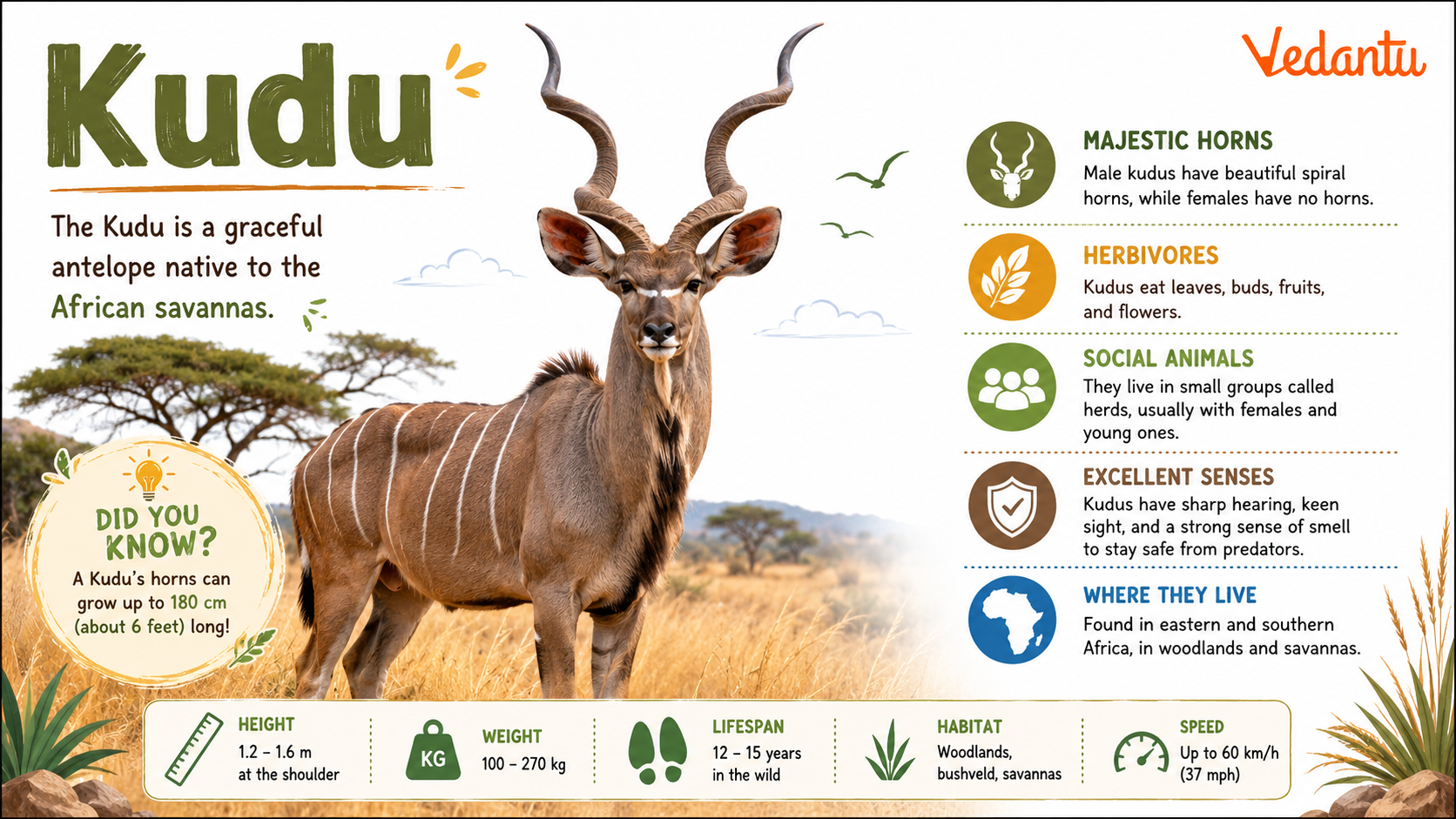
Quick Facts and Statistics
| Feature | Details |
|---|---|
| Common Name | Kudu |
| Scientific Name | Tragelaphus (Greater and Lesser species) |
| Animal Group | Mammal |
| Type | Antelope |
| Height | Up to 1.5 meters at the shoulder (Greater Kudu) |
| Weight | 120–300 kg (males heavier) |
| Lifespan | 7–15 years in the wild |
| Habitat | Woodlands, savannas, bushlands |
| Diet | Leaves, shoots, fruits |
| Conservation Status | Least Concern (Greater Kudu) |
Appearance and Physical Characteristics
- Large, slender body with long legs.
- Light brown to grey coat with 6–10 white vertical stripes.
- Big ears that help detect predators.
- White markings on the face and a small beard under the chin.
- Males have long spiral horns that can grow over 1.5 meters.
Kudu Habitat and Distribution
The Kudu habitat mainly includes:
- Woodlands and thick bush areas
- Rocky hills and dry riverbeds
- African savannas with plenty of shrubs
Kudus are found across eastern and southern Africa, including countries like Kenya, Tanzania, South Africa, Namibia, and Zimbabwe.
Kudu Diet and Feeding Habits
Kudus are herbivores. They only eat plant material.
Leaves, young shoots, herbs, fruits, and flowers.
They are browsers, meaning they eat from bushes and trees rather than grass.
They can survive in dry areas and sometimes get enough water from plants.
Behaviour and Lifestyle
- Usually shy and quiet animals.
- Active mostly in early morning and late afternoon.
- Females and young live in small groups.
- Adult males often live alone or in bachelor groups.
- They freeze and hide when they sense danger.
- Excellent jumpers – can leap over 2.5 meters high!
Kudu Life Cycle
- Mating Season: Usually during the rainy season.
- Pregnancy: About 8 months.
- Birth: A female usually gives birth to one calf.
- Calf Stage: The baby hides in bushes for safety during its first weeks.
- Adult Stage: Males grow large spiral horns as they mature.
What Makes the Kudu Special?
Unique twisted horns used in fights between males.
Body stripes help them blend into sunlight and shadows.
Can clear high fences with ease.
Large ears help detect even slight sounds.
Importance and Role in Nature
- Help control plant growth by feeding on shrubs and leaves.
- Serve as prey for large predators like lions and leopards.
- Support biodiversity in African ecosystems.
- Important species for wildlife tourism and conservation.
Amazing Kudu Facts
Interesting Facts About Kudu
- Their name comes from a local African word.
- Only males have long spiral horns.
- Kudus can rotate their large ears independently.
- They are more active during cooler parts of the day.
Fun Facts for Kids
FAQs on Kudu Animal Guide: Species, Behavior and Natural Habitat
1. What is a Kudu?
A Kudu is a large African antelope known for its long spiral horns and white body stripes.
- Kudu are wild animals found in Africa, especially in savannas and woodlands.
- There are two main types: Greater Kudu and Lesser Kudu.
- They belong to the antelope family and are plant-eaters (herbivores).
- Kudus are famous for their tall bodies and beautiful twisted horns.
2. Where do Kudus live?
Kudus live in the dry savannas, woodlands, and bushlands of eastern and southern Africa.
- They are commonly found in countries like Kenya, Tanzania, Namibia, Botswana, and South Africa.
- Kudus prefer areas with trees and shrubs for hiding.
- They avoid open grasslands with no cover.
- They need access to water sources, especially in dry seasons.
3. What do Kudus eat?
Kudus are herbivores that mainly eat leaves, shoots, fruits, and grass.
- They feed on leaves and branches from trees and bushes.
- Kudus also eat wild fruits and pods.
- During rainy seasons, they may graze on fresh grass.
- They can survive long periods without water by getting moisture from plants.
4. Why do male Kudus have long spiral horns?
Male Kudus have long spiral horns for protection and fighting during mating season.
- Only male Kudus grow horns.
- The horns can grow up to 6 feet (1.8 meters) long.
- They use horns to fight other males for female attention.
- The spiral shape makes them look impressive and strong.
5. What is the difference between Greater Kudu and Lesser Kudu?
The Greater Kudu is larger, while the Lesser Kudu is smaller and darker in color.
- Greater Kudu are taller with longer horns.
- Lesser Kudu are smaller and have more visible white stripes.
- Greater Kudus live in southern and eastern Africa.
- Lesser Kudus are mostly found in eastern Africa.
6. How fast can a Kudu run?
A Kudu can run up to 60 miles per hour (96 km/h) to escape predators.
- They use their strong legs to run and leap.
- Kudus can jump over 8 feet (2.5 meters) high fences.
- Their speed helps them avoid predators like lions, leopards, and wild dogs.
- They also hide quietly in bushes for protection.
7. Are Kudus endangered?
Kudus are not currently endangered, but they face threats in some areas.
- The Greater Kudu is listed as Least Concern.
- Main threats include habitat loss and hunting.
- Protected national parks help keep populations safe.
- Conservation programs support African wildlife protection.
8. How big is a Kudu?
A Kudu can grow up to 5 feet tall at the shoulder and weigh over 600 pounds.
- Male Greater Kudus are larger than females.
- Males can weigh between 400–600 pounds (180–270 kg).
- Females are smaller and lighter.
- Their long legs help them move easily through thick bushes.
9. What are a Kudu’s main predators?
Kudus are hunted by large African predators.
- Lions are their biggest threat.
- Leopards hunt young or smaller Kudus.
- African wild dogs may chase them in groups.
- Humans also hunt Kudus in some regions.
10. Why are Kudus important in the ecosystem?
Kudus play an important role in keeping the African ecosystem balanced.
- They control plant growth by eating leaves and shrubs.
- They are a food source for large predators.
- Their movement spreads seeds across the land.
- They support biodiversity in African savannas and woodlands.
