



Where Do Lions Mane Jellyfish Live and How Big Do They Really Get?
The Lion’s Mane Jellyfish is one of the most fascinating and largest jellyfish species in the world. Famous for its long, flowing tentacles that look like a lion’s mane, this sea creature drifts gracefully through cold ocean waters. It may look soft and beautiful, but it is also a powerful predator. Learning about Lion’s Mane Jellyfish facts, habitat, diet, and life cycle helps us understand how important these amazing animals are in marine ecosystems.
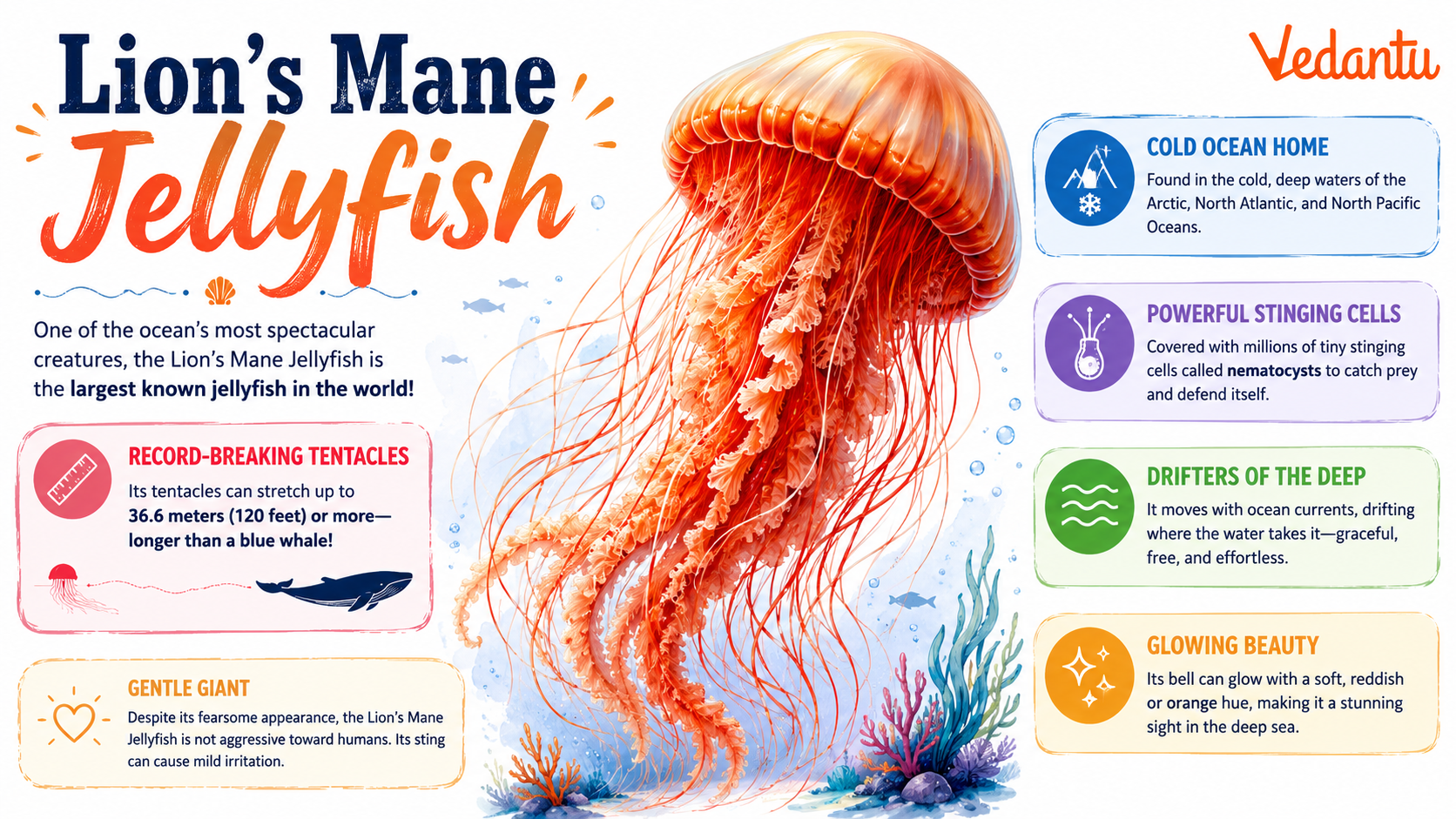
Quick Facts and Statistics
| Feature | Details |
|---|---|
| Common Name | Lion’s Mane Jellyfish |
| Scientific Name | Cyanea capillata |
| Animal Group | Invertebrate (Cnidarian) |
| Size | Bell up to 2.3 meters wide |
| Tentacle Length | Up to 36 meters long |
| Habitat | Cold, deep ocean waters |
| Diet | Fish, plankton, small crustaceans |
| Lifespan | About 1 year |
| Conservation Status | Not Evaluated |
Appearance and Physical Characteristics
- Bell Shape: Round, umbrella-shaped body.
- Colour: Ranges from orange and red to yellow and light brown.
- Size: One of the largest jellyfish species in the world.
- Tentacles: Hundreds of long, thin tentacles grouped into clusters.
- Body Type: Soft, gelatinous, and transparent.
Habitat and Distribution
- Found mainly in cold waters of the Arctic, North Atlantic, and North Pacific Oceans.
- Prefers deep and offshore waters.
- Sometimes drifts closer to shores due to ocean currents.
- Lives near the surface but can also move to deeper layers.
Diet and Feeding Habits
- Carnivore: Eats fish, small jellyfish, plankton, and crustaceans.
- Hunting Method: Uses venomous tentacles to sting and paralyse prey.
- Feeding Style: Tentacles bring food toward the mouth located under the bell.
- Role in Food Chain: Both predator and prey (eaten by sea turtles and some fish).
Behaviour and Lifestyle
- Mostly solitary creatures.
- Drift with ocean currents rather than actively swimming long distances.
- Use gentle bell contractions to move slowly.
- Defend themselves using stinging cells called nematocysts.
Life Cycle and Reproduction
- Egg Stage: Females release eggs into the water.
- Larva Stage: Fertilised eggs develop into tiny larvae called planulae.
- Polyp Stage: Larvae attach to a surface and grow into polyps.
- Young Jellyfish (Ephyra): Polyps release small jellyfish.
- Adult Stage: Grows into a full-sized Lion’s Mane Jellyfish.
The Lion’s Mane Jellyfish life cycle shows a complete transformation from tiny larvae to a giant floating predator.
What Makes the Lion’s Mane Jellyfish Special?
It is considered the largest known jellyfish species.
Tentacles can stretch longer than most whales.
Stinging cells protect it from predators and help catch prey.
Its flowing tentacles look like fiery strands underwater.
Importance and Role in Nature
Helps maintain balance by feeding on small fish and plankton.
Sea turtles and some large fish eat jellyfish.
Provides shelter for small fish that swim among its tentacles.
Population changes can signal shifts in ocean health.
Amazing Facts About Lion’s Mane Jellyfish
- It can grow bigger in colder waters.
- Its sting can be painful but is rarely deadly to humans.
- It has eight groups of tentacles.
- It does not have a brain, heart, or bones.
- It senses light and movement using simple nerve networks.
- Its body is about 95% water.
- Some small fish are immune to its sting.
Fun Facts for Kids
FAQs on Lions Mane Jellyfish: Fascinating Facts About the Ocean’s Largest Jellyfish
1. What is a Lion’s Mane Jellyfish?
The Lion’s Mane Jellyfish is the largest species of jellyfish in the world, known for its long, hair-like tentacles that look like a lion’s mane.
- Scientific name: Cyanea capillata
- Belongs to the Scyphozoa (true jellyfish) group
- Has hundreds of thin, stinging tentacles
- Lives in cold ocean waters
- Also called the giant jellyfish or hair jelly
2. How big can a Lion’s Mane Jellyfish grow?
The Lion’s Mane Jellyfish can grow bigger than most sea animals, with tentacles longer than a blue whale.
- Bell (body) can reach up to 7 feet (2 meters) wide
- Tentacles can grow up to 120 feet (36 meters) long
- It is considered the largest jellyfish species on Earth
- Size depends on age and ocean conditions
3. Where do Lion’s Mane Jellyfish live?
The Lion’s Mane Jellyfish habitat is mostly in cold, northern ocean waters.
- Found in the Arctic Ocean
- Common in the North Atlantic Ocean
- Seen near coasts of Canada, Alaska, and Northern Europe
- Prefers cold and deep marine environments
4. Are Lion’s Mane Jellyfish dangerous to humans?
The Lion’s Mane Jellyfish sting can hurt humans, but it is usually not deadly.
- Tentacles have stinging cells called nematocysts
- Can cause pain, redness, and skin rash
- Severe allergic reactions are rare
- Swimmers should avoid touching stranded jellyfish
5. What do Lion’s Mane Jellyfish eat?
The Lion’s Mane Jellyfish diet includes small sea animals that get trapped in its tentacles.
- Eats small fish
- Feeds on zooplankton
- Consumes shrimp and tiny crustaceans
- Uses venom to paralyze prey before eating
6. How do Lion’s Mane Jellyfish catch their prey?
The Lion’s Mane Jellyfish catches prey using its long, sticky, and venomous tentacles.
- Tentacles drift in the water like fishing lines
- Nematocysts release venom when touched
- Prey becomes stunned or paralyzed
- The jellyfish moves food to its mouth using oral arms
7. Do Lion’s Mane Jellyfish have brains or hearts?
The Lion’s Mane Jellyfish does not have a brain or heart like humans do.
- Has a simple nerve net instead of a brain
- No heart or bones
- Body is made up of about 95% water
- Moves by pulsing its bell-shaped body
8. How long do Lion’s Mane Jellyfish live?
The lifespan of a Lion’s Mane Jellyfish usually lasts about one year.
- Starts life as a tiny larva
- Grows into a polyp attached to rocks
- Transforms into a free-swimming medusa (adult jellyfish)
- Most die after reproducing
9. Why is it called a Lion’s Mane Jellyfish?
The Lion’s Mane Jellyfish gets its name because its tentacles look like a lion’s thick, flowing mane.
- Long, hair-like tentacles surround the bell
- Tentacles can be yellow, red, or orange
- The largest ones have the thickest “mane”
- Name reflects its wild and majestic appearance
10. What are some fun facts about Lion’s Mane Jellyfish?
There are many amazing Lion’s Mane Jellyfish facts that make this sea creature special.
- It is the largest jellyfish species ever recorded
- Its tentacles can sting even after it dies
- Small fish sometimes hide inside its tentacles for protection
- It has been around for millions of years
- It is an important part of the marine ecosystem
