



Markhor Habitat, Diet, Behavior, and Conservation Status Explained
The Markhor is a strong and graceful wild goat known for its long, spiral-shaped horns. It lives high in the mountains and is the national animal of Pakistan. Famous for its climbing skills and unique appearance, the Markhor is one of the most fascinating mountain animals in the world. In this page, explore amazing Markhor facts, its habitat, diet, characteristics, life cycle, and why it is important for nature.
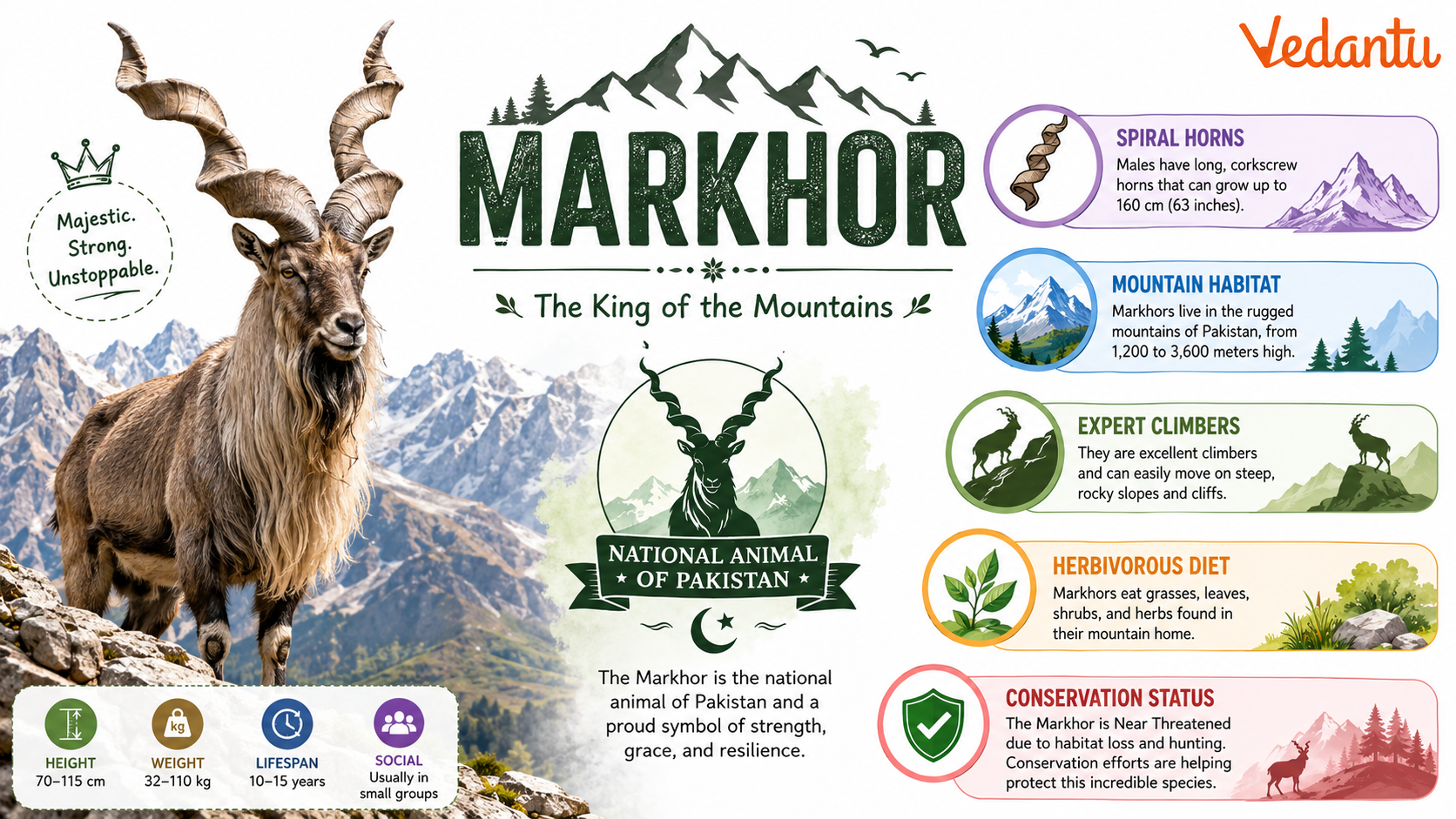
Quick Facts About Markhor
| Feature | Details |
|---|---|
| Common Name | Markhor |
| Scientific Name | Capra falconeri |
| Animal Group | Mammal |
| Type | Wild Goat |
| Height | 65–115 cm (at shoulder) |
| Weight | 32–110 kg (males heavier) |
| Lifespan | 10–13 years (wild) |
| Habitat | Rocky mountains and forests |
| Diet | Herbivore (grass, leaves, shrubs) |
| Conservation Status | Near Threatened |
Appearance and Physical Characteristics
- Spiral Horns: Long, corkscrew-shaped horns that can grow up to 1.5 meters in males.
- Strong Body: Muscular legs built for climbing steep cliffs.
- Thick Coat: Brown to grey fur that keeps them warm in cold mountains.
- Beard: Males have a long black beard under the chin.
- Sharp Hooves: Help them grip rocky surfaces easily.
Habitat and Distribution
The Markhor habitat includes high mountain areas with rocky cliffs and open forests.
- Found in Pakistan, India, Afghanistan, Tajikistan, and Uzbekistan.
- Lives at heights of 600 to 3,600 meters above sea level.
- Prefers dry, rocky slopes and sparse forests.
- Moves to lower areas during heavy snowfall.
Diet and Feeding Habits
Markhor diet: They are herbivores and feed only on plants.
- Grass
- Leaves
- Shrubs
- Twigs
- Fruit (seasonal)
They graze in the morning and evening. During winter, they eat dry leaves and bark.
Behaviour and Lifestyle
Females and young live in herds. Adult males often live alone.
Mostly active during early morning and late afternoon.
Can jump and climb steep cliffs to escape predators.
Snow leopards, wolves, and humans.
Life Cycle and Reproduction
- Mating Season: Late autumn to early winter.
- Gestation: About 135–170 days.
- Birth: Usually 1 baby (kid), sometimes twins.
- Young Stage: Kids can stand within hours of birth.
- Adult Stage: Mature in 18–30 months.
What Makes the Markhor Special?
Importance and Role in Nature
- Helps maintain plant balance by grazing.
- Important prey for snow leopards and wolves.
- Supports eco-tourism in mountain regions.
- Represents wildlife conservation success in some areas.
Amazing Markhor Facts
Interesting Facts About Markhor
- The spiral pattern of horns differs slightly among subspecies.
- Older males have longer and more twisted horns.
- They chew cud like cows and other goats.
- Their eyesight helps them spot danger from far away.
Fun Facts for Kids
- Markhor babies can run soon after birth.
- They are expert mountain jumpers!
- Their horns grow every year.
- They look like magical goats from storybooks.
- They love climbing high rocky hills.
FAQs on Markhor: Fascinating Facts About the World’s Largest Wild Goat
1. What is a Markhor?
The Markhor is a large wild goat known for its amazing spiral horns and mountain climbing skills.
- Scientific name: Capra falconeri
- Belongs to the wild goat species family
- Famous for its twisted, corkscrew-shaped horns
- National animal of Pakistan
- Lives in high mountains of Central and South Asia
2. Where do Markhors live?
Markhors live in high, rocky mountain regions with steep cliffs and dry forests.
- Found in Pakistan, Afghanistan, India, and parts of Tajikistan
- Prefer Himalayan and Karakoram mountain ranges
- Live at heights of 600 to 3,600 meters
- Choose rocky areas to stay safe from predators
3. Why is the Markhor the national animal of Pakistan?
The Markhor is Pakistan’s national animal because it represents strength, bravery, and wildlife conservation success.
- Symbol of courage and resilience
- Important part of Pakistan’s mountain ecosystem
- Population increased due to conservation efforts
- Shows success in protecting endangered species
4. What do Markhors eat?
Markhors are plant-eaters (herbivores) that feed on mountain vegetation.
- Eat grass, leaves, and shrubs
- Also feed on pine needles and tree bark
- Change diet depending on the season
- Search for food on steep mountain slopes
5. Why does a Markhor have spiral horns?
The spiral horns of a Markhor are used for fighting and showing strength.
- Males use horns to compete during mating season
- Horns can grow up to 160 cm long
- Females also have horns but smaller ones
- The twist pattern makes them unique among wild goats
6. Is the Markhor endangered?
The Markhor was once endangered but is now listed as Near Threatened thanks to conservation programs.
- Threatened by poaching and habitat loss
- Protected by wildlife laws
- Community conservation programs helped increase numbers
- Still needs protection to survive in the wild
7. How big is a Markhor?
A Markhor is one of the largest wild goats in the world.
- Length: about 132–186 cm
- Height: around 65–115 cm at the shoulder
- Weight: between 32–110 kg
- Males are larger and heavier than females
8. What animals hunt Markhors?
Markhors are hunted by powerful mountain predators.
- Main predator: Snow Leopard
- Also hunted by wolves and lynx
- Young kids may be attacked by large birds of prey
- They escape by climbing steep rocky cliffs
9. What is special about the Markhor’s name?
The name Markhor means “snake eater” in Persian and local languages.
- “Mar” means snake
- “Khor” means eater
- Local myths say it can kill snakes
- In reality, it mostly eats plants
10. How do Markhors survive in mountains?
Markhors survive in mountains because they are strong climbers with special body features.
- Have strong muscular legs
- Sharp hooves for gripping rocky surfaces
- Excellent balance on steep cliffs
- Thick fur to stay warm in cold weather
