



What Is a Moth? Identification, Habitat, Diet, and Life Cycle Explained
Moths are fascinating flying insects closely related to butterflies. There are over 160,000 known species of moths around the world, making them one of the largest groups of insects on Earth. While many people see moths fluttering around lights at night, these insects play a very important role in nature. From pollination to being food for other animals, moths are tiny but powerful contributors to the ecosystem.
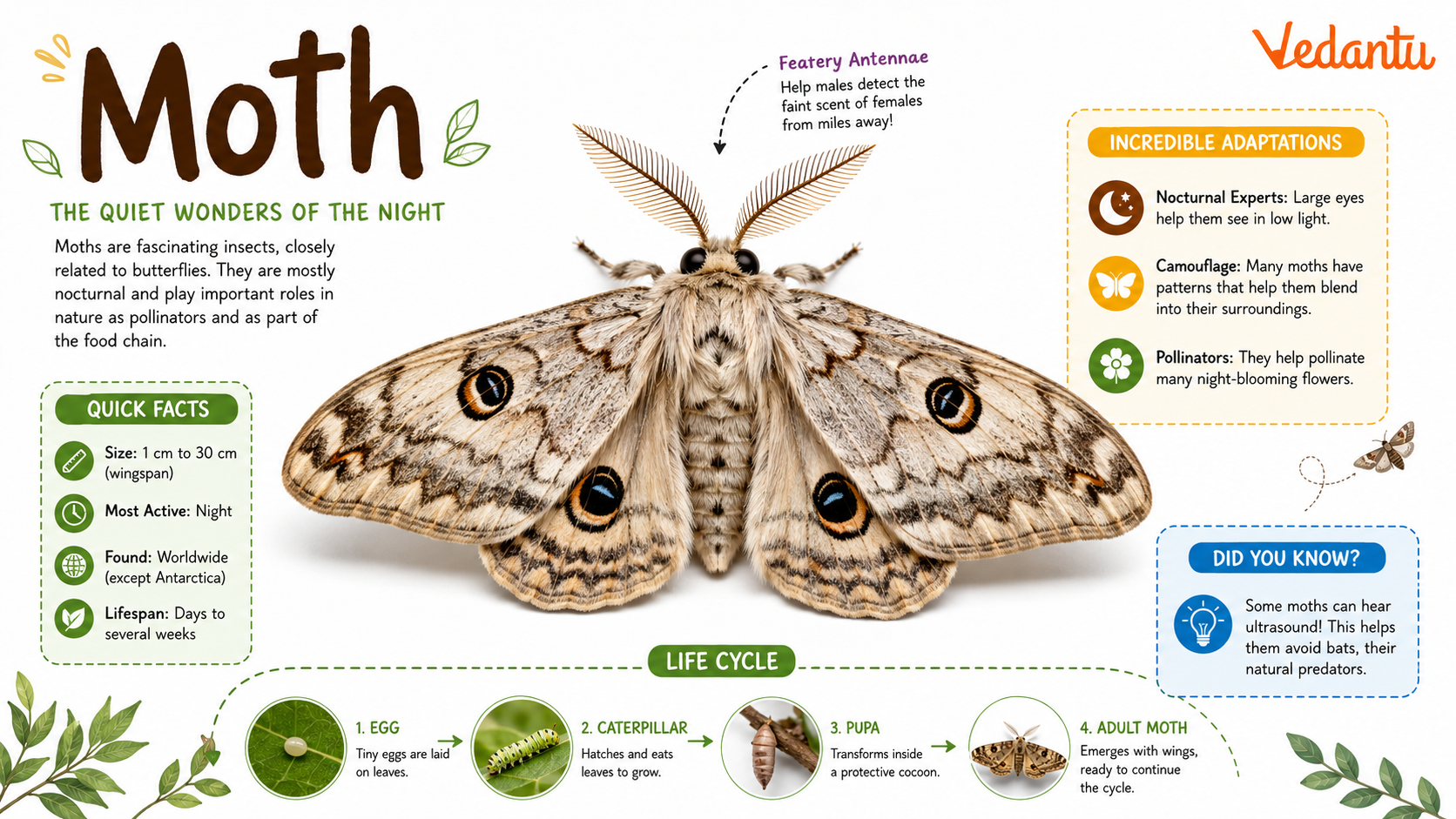
Quick Facts About Moth
| Feature | Details |
|---|---|
| Common Name | Moth |
| Scientific Order | Lepidoptera |
| Animal Group | Insect |
| Number of Species | 160,000+ worldwide |
| Habitat | Forests, grasslands, gardens, deserts, and even cities |
| Diet | Nectar, plant leaves (as caterpillars) |
| Activity Time | Mostly nocturnal (active at night) |
| Life Cycle | Egg → Larva → Pupa → Adult |
Moth Characteristics and Appearance
- Have two pairs of wings covered in tiny scales.
- Usually have feathery or comb-like antennae.
- Body is thick and furry compared to butterflies.
- Colours range from dull brown and grey to bright yellow, pink, or green.
- Some species have eye-like spots on wings to scare predators.
Moth Habitat and Distribution
Moth habitat is incredibly diverse. These insects can live almost everywhere except extremely cold polar regions.
- Tropical rainforests
- Grasslands and meadows
- Mountains and deserts
- Gardens and urban areas
- Near farms and agricultural fields
Moth Diet and Feeding Habits
Most adult moths feed on flower nectar using a long tube-like tongue called a proboscis.
Moth larvae (caterpillars) mainly eat plant leaves and sometimes crops.
Some moths do not eat at all as adults. They live only to reproduce.
Moths are an important food source for birds, bats, frogs, and spiders.
Behaviour and Lifestyle
- Mostly nocturnal and active at night.
- Attracted to light sources like lamps and bulbs.
- Use camouflage to hide from predators.
- Some species migrate long distances.
- Communicate using chemical signals called pheromones.
Moth Life Cycle
- Egg: Female moth lays eggs on leaves.
- Larva (Caterpillar): Hatches and eats leaves to grow quickly.
- Pupa (Cocoon): Forms a protective covering and transforms inside.
- Adult: Emerges with wings ready to fly and reproduce.
What Makes Moths Special?
Use moonlight to navigate during flight.
Wing patterns help them blend with tree bark and leaves.
Help pollinate many night-blooming flowers.
Some moths can hear bat sounds and escape quickly.
Types and Diversity of Moths
- Silk Moths: Known for producing silk (e.g., Bombyx mori).
- Hawk Moths: Fast flyers, often hover like hummingbirds.
- Tiger Moths: Brightly coloured with bold patterns.
- Luna Moths: Large, pale green moths with long tails.
Importance of Moths in Nature
Help plants reproduce by spreading pollen at night.
Essential prey for birds, bats, and other animals.
Silk moths are used to produce natural silk.
Changes in moth populations show environmental health.
Amazing Moth Facts
- There are more moth species than butterfly species.
- Some moths have a wingspan as large as a dinner plate.
- Atlas moth is one of the largest moths in the world.
- Certain moth caterpillars can produce silk threads.
- Some species mimic leaves, snakes, or even bird droppings.
- Many moths rest with wings flat instead of upright.
Fun Facts for Kids
FAQs on Moth: Fascinating Facts, Life Cycle, and Species Guide
1. What is a moth?
A moth is a flying insect closely related to butterflies and belongs to the order Lepidoptera.
- Moths have scaled wings, long antennae, and soft bodies.
- They are usually active at night, making them nocturnal insects.
- There are over 160,000 species of moths worldwide.
- Like butterflies, they go through complete metamorphosis.
2. What do moths eat?
Moths eat different foods depending on whether they are caterpillars or adults.
- Moth caterpillars mostly eat leaves, plants, and sometimes crops.
- Some species, like clothes moths, feed on wool and fabric.
- Adult moths usually drink nectar from flowers.
- Some adult moths do not eat at all and live on stored energy.
3. What is the life cycle of a moth?
The moth life cycle has four stages called complete metamorphosis.
- Egg – The female lays tiny eggs on plants or fabric.
- Larva (caterpillar) – The larva eats and grows quickly.
- Pupa (cocoon) – The caterpillar forms a cocoon and changes inside.
- Adult moth – The fully grown moth emerges with wings.
4. Are moths harmful to humans?
Most moths are harmless and do not bite or sting humans.
- They do not spread diseases.
- Some moth caterpillars may damage crops or garden plants.
- Clothes moths can damage wool, silk, and natural fabrics.
- Very few species have tiny hairs that may cause mild skin irritation.
5. Why are moths attracted to light?
Moths are attracted to light because they use natural light sources like the moon to navigate.
- Artificial lights confuse their navigation system.
- They try to keep a steady angle to the light, which makes them circle bulbs.
- This behavior is called positive phototaxis.
6. What is the difference between a moth and a butterfly?
Moths and butterflies are similar insects but have key differences.
- Moths are mostly nocturnal; butterflies are active during the day.
- Moths have feathery or straight antennae; butterflies have club-shaped antennae.
- Moths rest with wings flat; butterflies fold wings upright.
- Moths often spin cocoons; butterflies form chrysalises.
7. Where do moths live?
Moths live in many habitats around the world, from forests to cities.
- They are found on every continent except Antarctica.
- Common habitats include gardens, forests, grasslands, and homes.
- Some species live in deserts, while others prefer tropical rainforests.
8. What are some common types of moths?
There are thousands of moth species, but some are especially well known.
- Luna Moth – Bright green with long tail wings.
- Atlas Moth – One of the largest moths in the world.
- Clothes Moth – Known for damaging fabrics.
- Hawk Moth – Fast flyers that hover like hummingbirds.
9. How long do moths live?
The lifespan of a moth depends on its species and life stage.
- The caterpillar stage may last several weeks.
- The pupa stage can last days to months.
- Adult moths usually live from a few days to a few weeks.
- Some species, like the Luna Moth, live only about one week as adults.
10. Why are moths important to the environment?
Moths play an important role in ecosystems as pollinators and as food for other animals.
- Many moths help with pollination, especially at night.
- They are a food source for bats, birds, and small mammals.
- Caterpillars help recycle nutrients by eating plants.
- They support biodiversity in forests and gardens.
