



Why the Olm Is Unique: Habitat, Adaptations, and Lifespan Facts
The Olm is one of the most unusual animals in the world. It is a pale, blind amphibian that lives deep inside dark underground caves. Often called the “human fish” because of its pinkish skin, the Olm spends its entire life in water. It survives in complete darkness and can live for decades! Let’s explore interesting Olm facts, its habitat, diet, characteristics, life cycle, and why it is so special.
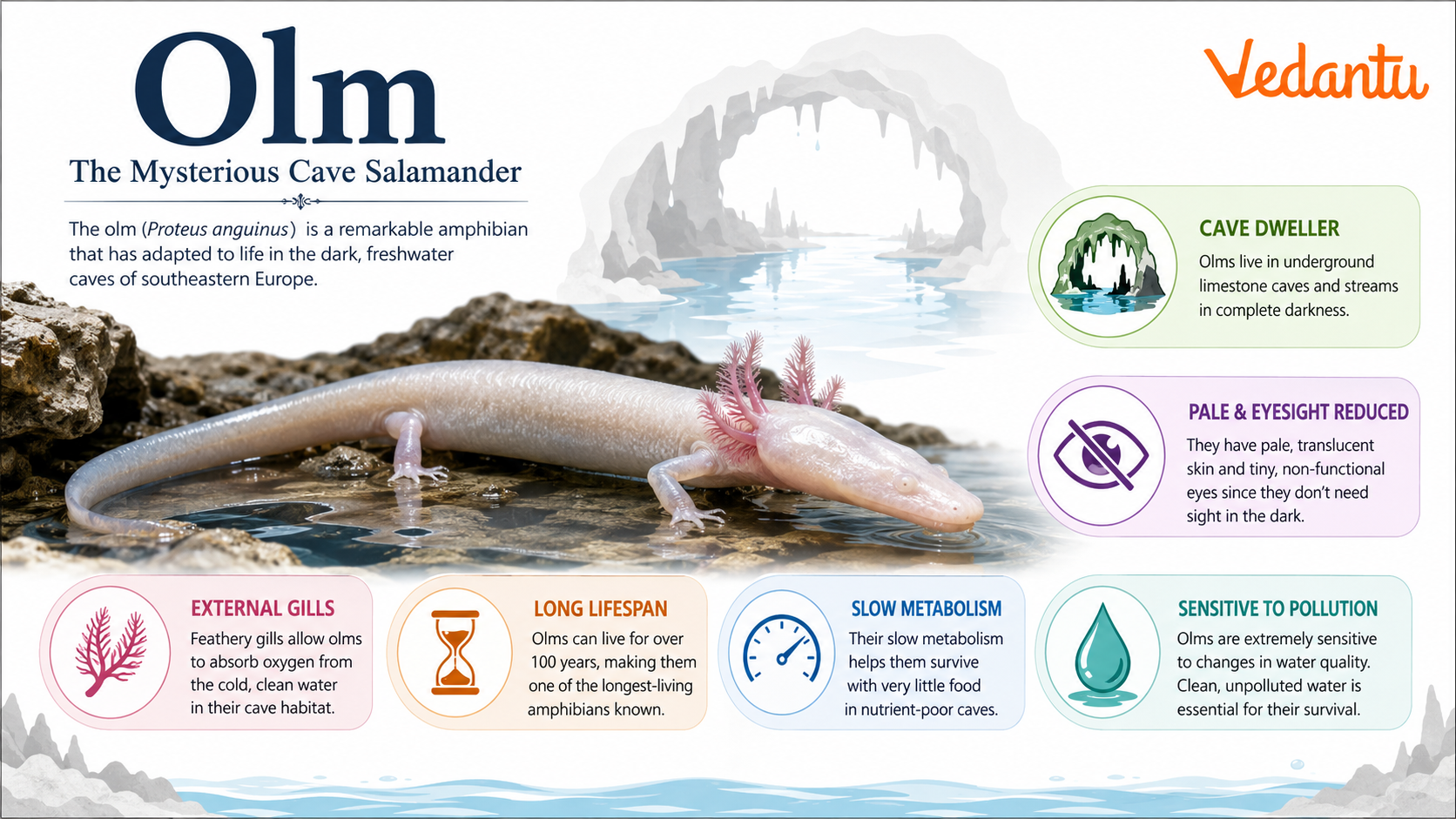
Quick Facts About Olm
| Feature | Details |
|---|---|
| Common Name | Olm |
| Scientific Name | Proteus anguinus |
| Animal Group | Amphibian (Salamander) |
| Size | 20–30 cm long |
| Lifespan | Up to 70–100 years |
| Habitat | Underground caves and freshwater streams |
| Diet | Small insects, worms, snails |
| Conservation Status | Vulnerable |
Appearance and Physical Characteristics
- Long, thin, snake-like body.
- Pale pink or white skin because it lacks pigment.
- Tiny, undeveloped eyes hidden under the skin.
- External feathery gills for breathing underwater.
- Small legs with three toes in front and two at the back.
Olm Habitat and Distribution
- Lives in underground caves of Europe.
- Found mainly in Slovenia, Croatia, Bosnia, and nearby regions.
- Stays in cold, dark freshwater streams inside caves.
- Rarely comes to the surface.
The Olm habitat is completely dark and quiet. It has adapted to survive in places where sunlight never reaches. Clean underground water is very important for its survival.
Olm Diet and Feeding Habits
Behaviour and Lifestyle
- Spends almost its entire life underwater.
- Moves slowly and calmly in cave waters.
- Highly sensitive to sound and water vibrations.
- Mostly solitary (lives alone).
Even though it is blind, the Olm has excellent senses of smell and hearing. These strong senses help it survive in total darkness.
Olm Life Cycle
- Egg Stage: The female lays eggs attached to rocks in water.
- Larva Stage: Young Olms hatch with gills and already live in water.
- Adult Stage: They grow slowly and remain aquatic for life.
- Lifespan: They can live up to 70–100 years, which is very long for an amphibian.
What Makes the Olm Special?
Importance and Role in Nature
- Helps control small insect and worm populations.
- Indicates clean and healthy underground water.
- Important for studying evolution and adaptation.
- Shows how animals survive in extreme environments.
Amazing Olm Facts
Interesting Facts About Olm
- Olms do not need sunlight to survive.
- Their metabolism is very slow.
- They grow very slowly compared to other amphibians.
- They are protected by law in many countries.
Fun Facts for Kids
- The Olm cannot see, but it “feels” its way around.
- It lives in caves like a real-life cave monster!
- It can live longer than many humans.
- It looks like a tiny underwater dragon.
- It spends almost all its time hiding in rocks.
FAQs on Olm – The Mysterious Blind Salamander of Caves
1. What is an Olm?
The Olm is a rare cave-dwelling amphibian that lives in underground waters.
- Scientific name: Proteus anguinus
- Also called the “human fish” because of its pale skin
- Belongs to the salamander family
- Lives in dark caves in Europe
- Known for its long body and tiny legs
2. Where does the Olm live?
The Olm habitat is underground freshwater caves in Southern Europe.
- Found in the Dinaric Alps region
- Lives in caves in Slovenia, Croatia, Bosnia and Herzegovina
- Prefers dark, cold, and clean underground rivers and lakes
- Spends its entire life in total darkness
3. Why is the Olm called the “human fish”?
The Olm is called the human fish because its skin looks similar to human skin.
- It has pale pink or white skin
- Its skin lacks dark pigment due to cave life
- It rarely sees sunlight
- The nickname comes from local European folklore
4. What does an Olm eat?
The Olm diet includes small animals found in cave waters.
- Eats insects and insect larvae
- Feeds on tiny crustaceans and snails
- Can survive without food for several years
- Uses its strong sense of smell and hearing to find prey
5. How long can an Olm live?
The Olm lifespan is extremely long compared to most amphibians.
- Can live up to 70–100 years
- One of the longest-living amphibians in the world
- Grows slowly and matures late
- Has a very slow metabolism
6. Is the Olm blind?
Yes, the Olm is mostly blind because it lives in complete darkness.
- Its eyes are underdeveloped and covered by skin
- Relies on strong senses of smell, hearing, and touch
- Can detect tiny vibrations in water
- Perfectly adapted to cave ecosystems
7. How does the Olm breathe underwater?
The Olm breathes using external gills and lungs.
- Has feathery red external gills
- Can also breathe with simple lungs
- Absorbs oxygen through its skin
- Adapted for life in low-oxygen cave waters
8. Why is the Olm important to the ecosystem?
The Olm plays an important role in maintaining healthy cave ecosystems.
- Controls populations of small aquatic animals
- Indicates clean and unpolluted freshwater systems
- Helps scientists study evolution and adaptation
- Represents biodiversity in underground habitats
9. Is the Olm endangered?
Yes, the Olm is considered a vulnerable and protected species.
- Threatened by water pollution
- Affected by habitat destruction
- Protected by European wildlife laws
- Conservation efforts focus on protecting cave waters
10. How is the Olm adapted to cave life?
The Olm has special adaptations that help it survive in dark caves.
- Has pale skin with little pigment
- Developed strong non-visual senses
- Has a slow metabolism to save energy
- Can survive long periods without food
- Shows extreme cave adaptation known as troglomorphism
