



Where Do Piranhas Live, What Do They Eat, and Are They Dangerous?
Piranhas are famous freshwater fish known for their sharp teeth and powerful jaws. Often shown as dangerous in movies, these fish are actually fascinating creatures with unique behaviour and important roles in nature. Found mainly in South American rivers, the Piranha is quick, alert, and highly adapted to life in water. Let’s explore interesting Piranha facts, habitat, diet, characteristics, life cycle, and why these fish are more than just scary predators.
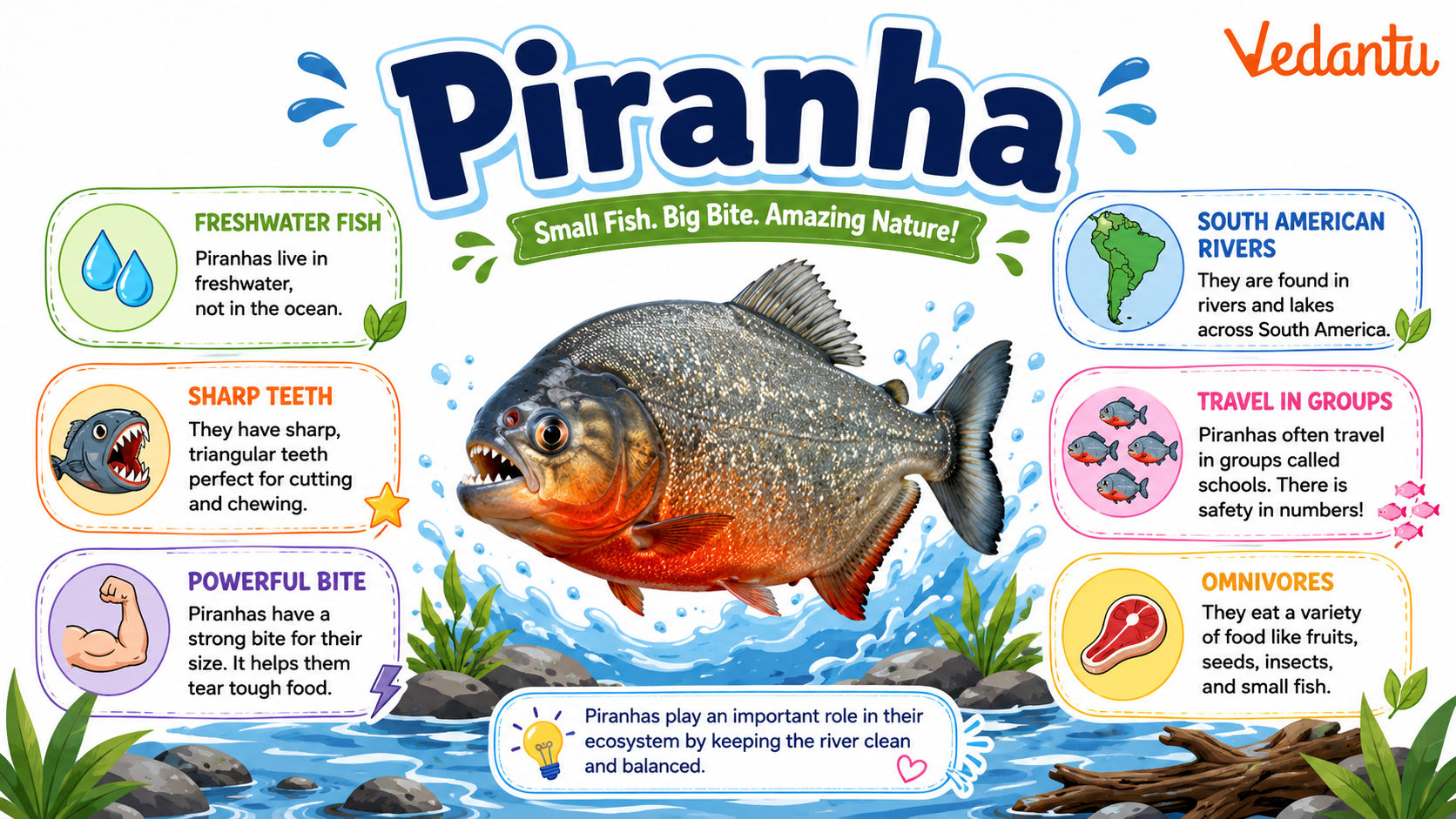
Quick Facts About Piranha
| Feature | Details |
|---|---|
| Common Name | Piranha |
| Scientific Group | Serrasalmidae family |
| Animal Group | Fish |
| Size | 15–35 cm (varies by species) |
| Weight | Up to 3.5 kg |
| Lifespan | 8–10 years (in the wild) |
| Habitat | Rivers, lakes, and flooded forests |
| Diet | Omnivore (meat, fish, insects, plants) |
| Found In | Amazon Basin and South America |
Appearance and Physical Characteristics
- Strong, deep body with a slightly rounded shape.
- Sharp, triangular teeth that fit perfectly together like scissors.
- Powerful jaws designed for quick bites.
- Silver body with red, orange, or yellow shades on the belly (in some species).
- Large eyes for better underwater vision.
Piranha Habitat and Distribution
- Mainly found in South America.
- Common in the Amazon River Basin.
- Live in freshwater rivers, lakes, streams, and flooded forests.
- Prefer warm tropical climates.
- Often stay in groups called shoals for safety.
Piranha Diet and Feeding Habits
The Piranha diet is more diverse than many people think. Although they are known for eating meat, they are actually omnivores.
Behaviour and Lifestyle
- Usually live in groups for protection.
- More active during the day.
- Can become aggressive if food is scarce.
- Use strong jaws for defence and hunting.
- Communicate through body movements and low sounds.
Piranha Life Cycle
- Egg Stage: Female lays eggs in shallow water nests.
- Hatching: Eggs hatch into tiny fish called fry.
- Juvenile Stage: Young piranhas grow quickly and stay in groups.
- Adult Stage: Fully grown fish reproduce and live up to 10 years.
What Makes Piranha Special?
Importance and Role in Nature
- Help maintain balance in aquatic ecosystems.
- Control fish populations.
- Act as natural scavengers by eating dead animals.
- Important part of the Amazon food chain.
Amazing Piranha Facts
Interesting Facts About Piranha
- They rarely attack humans unless threatened.
- During dry seasons, they may become more aggressive due to limited food.
- They use smell and movement to locate prey.
- Some species mainly eat fruits and seeds.
Fun Facts for Kids
FAQs on Piranha: Fascinating Facts About This Amazon Predator
1. What is a piranha?
Piranha is a type of freshwater fish known for its sharp teeth and strong jaws. These fish live mainly in South American rivers and are often linked to the Amazon River.
- Belong to the Serrasalmidae family
- Famous for razor-sharp triangular teeth
- Usually small to medium in size
- Related to pacus and silver dollars
- Often searched as: “Are piranhas dangerous?” or “Where do piranhas live?”
2. Where do piranhas live?
Piranhas live in freshwater rivers and lakes of South America, especially in warm tropical areas.
- Found in the Amazon Basin
- Live in Orinoco River and Paraguay River
- Prefer slow-moving streams and flooded forests
- Thrive in warm, freshwater habitats
- Common query: “What habitat do piranhas live in?”
3. Are piranhas dangerous to humans?
Piranhas are not usually dangerous to humans, and attacks are very rare.
- Most species are shy and avoid people
- Bites may happen if food is scarce
- They are more active during the dry season
- Hollywood movies often exaggerate their behavior
- Related searches: “Do piranhas attack humans?”
4. What do piranhas eat?
Piranhas are omnivores, which means they eat both plants and animals.
- Feed on fish, insects, and crustaceans
- Eat fruits and seeds that fall into rivers
- Some species scavenge dead animals
- Known for group feeding behavior
- Also searched as: “What is a piranha’s diet?”
5. How sharp are piranha teeth?
Piranha teeth are extremely sharp and perfectly aligned for cutting.
- Triangular and razor-edged shape
- Fit together like scissors
- Continuously replaced if broken
- Designed for slicing meat quickly
- Common query: “Why do piranhas have sharp teeth?”
6. How big do piranhas grow?
Most piranhas grow between 6 to 10 inches long, depending on the species.
- Some can reach up to 14 inches
- Weigh around 2–4 pounds
- Red-bellied piranha is one of the largest species
- Size depends on habitat and food supply
- People also ask: “What is the average size of a piranha?”
7. How many types of piranhas are there?
There are around 30 to 60 species of piranhas, depending on scientific classification.
- Most famous: Red-bellied piranha
- Other types include Black piranha
- Species vary in size and behavior
- Not all species are aggressive
- Also searched as: “Different types of piranhas”
8. Why do piranhas swim in groups?
Piranhas swim in groups mainly for protection, not for hunting.
- Groups are called shoals
- Protects them from predators like caimans and birds
- Helps them find food more easily
- Reduces individual risk
- Common question: “Do piranhas hunt in packs?”
9. What are the natural predators of piranhas?
Piranhas have several natural predators in the wild.
- Caimans (a type of crocodile)
- Large fish like river dolphins
- Herons and other water birds
- Humans who fish them for food
- Related query: “What eats piranhas?”
10. Can piranhas be kept as pets?
Piranhas can be kept as pets in some places, but they require special care.
- Need a large freshwater aquarium
- Require a protein-rich diet
- May be illegal in certain countries or states
- Best kept by experienced fish owners
- Often searched as: “Are piranhas legal pets?”
