



Where Do Red Deer Live? Habitat, Diet, Behavior & Life Cycle Explained
The Red Deer is one of the largest and most impressive deer species in the world. Known for its grand antlers and loud roaring calls, it lives in forests, grasslands, and mountains across Europe, Asia, and parts of North Africa. Red Deer facts are fascinating for students because these animals show strength, social behavior, and amazing seasonal changes. Let us explore the Red Deer habitat, diet, characteristics, life cycle, and importance in nature.
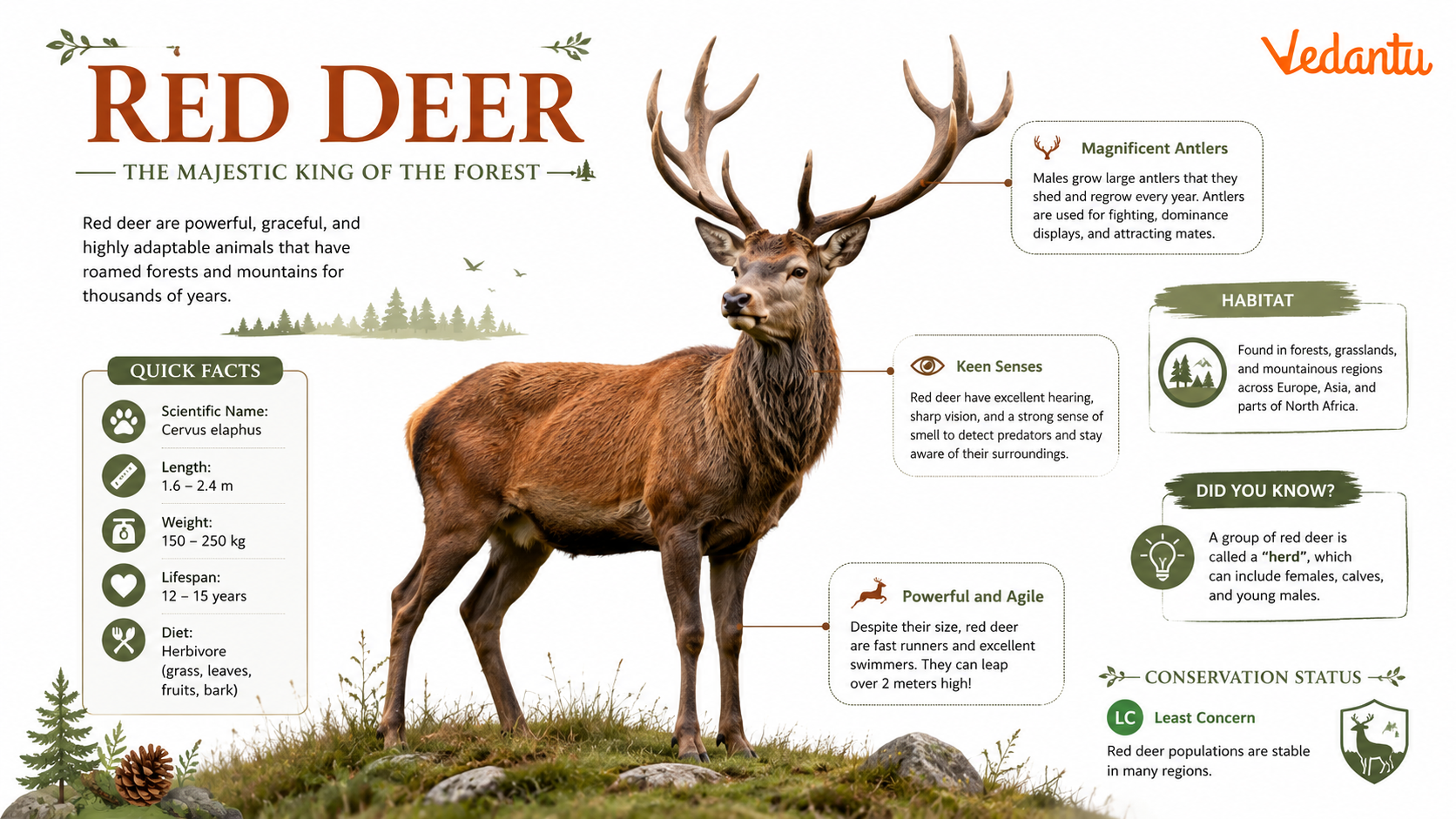
Quick Facts About Red Deer
| Feature | Details |
|---|---|
| Common Name | Red Deer |
| Scientific Name | Cervus elaphus |
| Animal Group | Mammal |
| Size | Up to 1.2 m tall at shoulder |
| Weight | 120–250 kg (males heavier) |
| Lifespan | 10–15 years in the wild |
| Diet | Herbivore (grass, leaves, shoots) |
| Habitat | Forests, grasslands, hills |
| Young One | Calf |
Appearance and Physical Characteristics
- Large, strong body with long legs.
- Reddish-brown coat in summer; thicker and greyer in winter.
- Short tail and lighter-colored rump patch.
- Males (stags) grow large branched antlers.
- Females (hinds) do not have antlers.
Red Deer Habitat and Distribution
- Found in Europe, parts of Asia, and North Africa.
- Prefer woodlands, forests, grasslands, and mountainous regions.
- Adapt well to cold climates.
- Often move between forest cover and open fields for feeding.
Red Deer Diet and Feeding Habits
Diet Type: Herbivore
- Grass
- Leaves
- Tree bark
- Shoots and shrubs
- Fruits and nuts (seasonally)
Red Deer usually graze in open fields during early morning or evening. They chew food slowly and have a four-chambered stomach to digest tough plant material.
Behaviour and Lifestyle
Females and calves live in groups called herds.
During mating season, males fight to control a group of females.
Mostly active at dawn and dusk.
Males make loud roaring calls during breeding season.
Red Deer Life Cycle
- Mating Season (Autumn): Males roar and compete for females.
- Pregnancy: Lasts about 8 months.
- Birth: Usually one calf is born in late spring.
- Calf Stage: Spotted coat helps it hide from predators.
- Adult Stage: Males grow antlers at around 1 year of age.
What Makes Red Deer Special?
Sound or Call
The male Red Deer produces a deep, loud roar called “bellowing” during the mating season. This call warns other males and attracts females. It can be heard from long distances in forests and valleys.
Importance and Role in Nature
Amazing Red Deer Facts
- Red Deer are among the largest deer species in the world.
- Antlers can grow up to 1 meter long.
- Only males grow antlers.
- They can run up to 40–50 km per hour.
- They are excellent swimmers.
- Their antlers are made of bone.
Fun Facts for Kids
FAQs on Red Deer: Fascinating Facts About Europe’s Largest Deer
1. What is a Red Deer?
A Red Deer is one of the largest species of deer found in Europe, Asia, and parts of North Africa.
- Scientific name: Cervus elaphus
- Belongs to the mammal family
- Known for its reddish-brown coat
- Males are called stags, females are hinds
- Related to elk and wapiti (People also search for)
2. Where do Red Deer live?
Red Deer live in forests, grasslands, and mountains across Europe and Asia.
- Found in United Kingdom, Spain, Germany, and Central Asia
- Prefer woodlands, open plains, and highlands
- Adapt well to cold and mild climates
- Similar habitats to moose and caribou (People also ask)
3. What do Red Deer eat?
Red Deer are herbivores that eat plants, grass, and leaves.
- Main diet includes grass, shrubs, and tree bark
- Also eat berries and acorns
- Chew cud like other ruminant animals
- Similar diet to white-tailed deer (People also search for)
4. How big can a Red Deer grow?
Red Deer are large animals that can grow up to 4 feet tall at the shoulder.
- Adult males weigh up to 240 kg (530 lbs)
- Females are smaller than males
- Stags have large branching antlers
- One of the largest deer species in the world
5. Why do Red Deer have antlers?
Male Red Deer grow antlers mainly to fight and attract mates.
- Only stags grow antlers
- Used during the rutting season (mating season)
- Antlers fall off and regrow every year
- Bigger antlers often mean stronger males
6. What is the Red Deer rut?
The Red Deer rut is the mating season when males compete for females.
- Happens in autumn
- Stags roar loudly to attract hinds
- Males may fight using their antlers
- A famous wildlife event in places like Scotland
7. Are Red Deer endangered?
Red Deer are not endangered and are listed as a species of Least Concern.
- Protected in many national parks
- Population is stable in Europe
- Threats include habitat loss and hunting
- Conservation helps maintain healthy ecosystems
8. How long do Red Deer live?
Red Deer usually live between 10 and 15 years in the wild.
- Can live longer in protected areas
- Face predators like wolves and bears
- Human activity affects lifespan
- Life expectancy similar to other wild deer species
9. What are baby Red Deer called?
Baby Red Deer are called calves.
- Born in late spring or early summer
- Have spotted coats for camouflage
- Stay close to their mother (hind)
- Can stand and walk shortly after birth
10. What is the difference between Red Deer and Elk?
Red Deer and Elk are closely related but differ in size and location.
- Elk (Wapiti) are usually larger
- Elk mainly live in North America
- Red Deer are common in Europe and Asia
- Both belong to the species group Cervus elaphus
