



What Is a Tunicate? Habitat, Diet, Life Cycle, and Fun Facts
Tunicates are soft, marine animals that live in oceans around the world. At first glance, they may look like simple jelly-like blobs attached to rocks. But here’s the surprising part — tunicates are closely related to vertebrates, including humans! They are also called sea squirts because they squirt out water when touched. Learning about Tunicate facts, habitat, diet, characteristics, and life cycle helps us understand how complex life evolved in the sea.
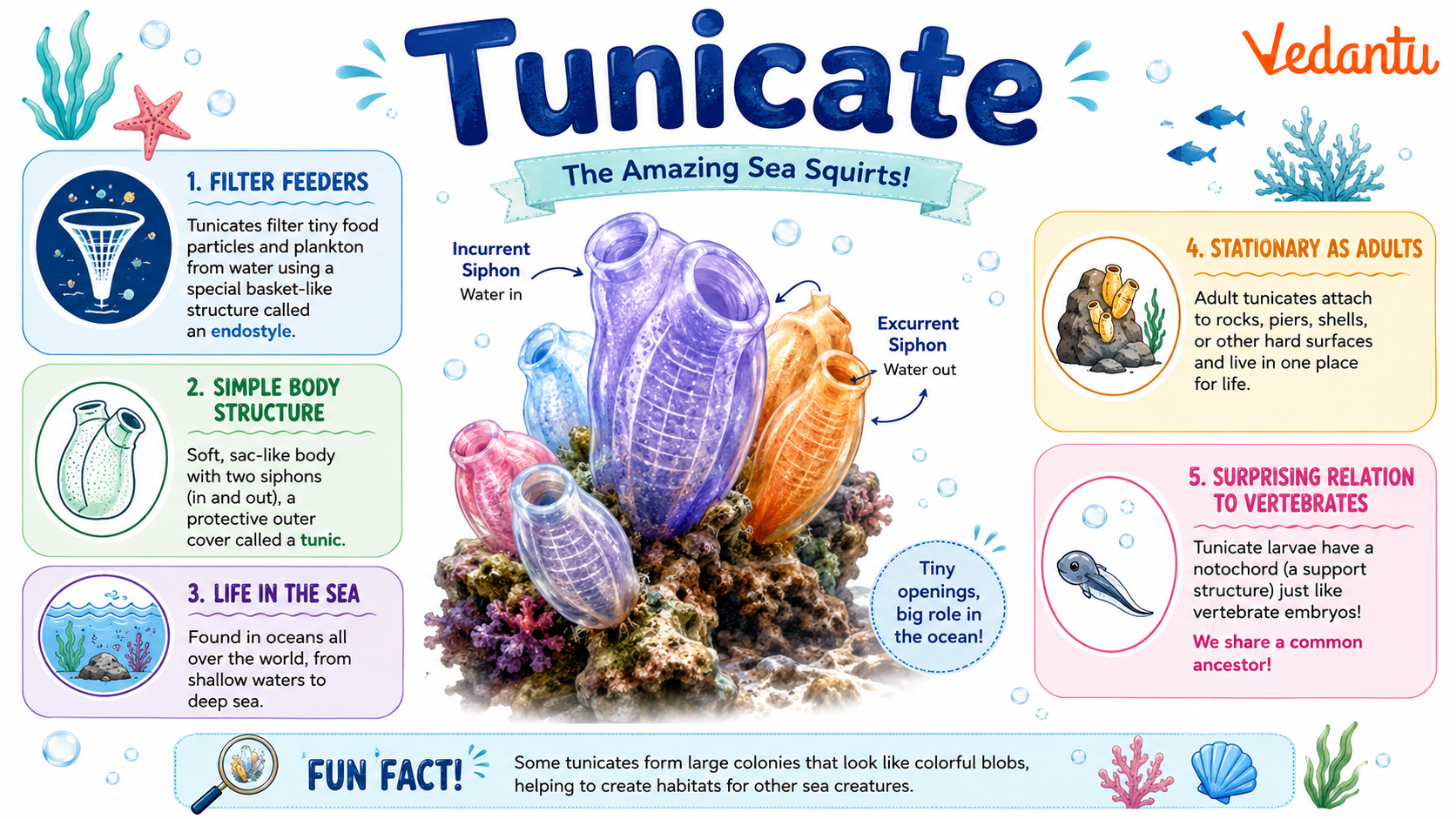
Quick Facts About Tunicate
| Feature | Details |
|---|---|
| Common Name | Tunicate / Sea Squirt |
| Scientific Group | Subphylum Tunicata (Urochordata) |
| Animal Group | Marine Invertebrate (Chordate relative) |
| Size | Few millimetres to 30 cm (some colonial forms larger) |
| Habitat | Oceans worldwide, attached to rocks, docks, ships |
| Diet | Plankton and tiny organic particles |
| Movement | Mostly stationary (sessile) as adults |
| Special Feature | Has a notochord in larval stage |
Appearance and Physical Characteristics
- Soft, sac-like body covered by a protective outer layer called a tunic.
- The tunic is made of a cellulose-like material (rare in animals!).
- Usually transparent, jelly-like, or rubbery.
- Have two openings (siphons) at the top.
- Colours may include white, yellow, orange, pink, or transparent.
- Incurrent siphon – water enters.
- Excurrent siphon – water exits.
- Large pharynx with gill slits for filter feeding.
Tunicate Habitat and Distribution
- Found in oceans all over the world.
- Live in shallow coastal waters and deep seas.
- Attach to rocks, coral reefs, shells, docks, and ship hulls.
- Some species float freely in open water.
- Prefer saltwater environments.
Tunicate habitat ranges from tropical seas to cold polar waters. They play an important role in marine ecosystems by cleaning water through filter feeding.
Diet and Feeding Habits
Tunicates are filter feeders.
Plankton, bacteria, and tiny organic particles.
Water enters through one siphon, food is trapped in mucus, and clean water exits.
Serve as food for fish, crabs, sea stars, and snails.
Behaviour and Lifestyle
- Most adult tunicates are sessile (fixed in one place).
- Some species form colonies attached together.
- When disturbed, they squirt water out — giving them the name “sea squirt.”
- Larval stage is free-swimming and active.
- Adults are simple in structure but efficient at filtering water.
Tunicate Life Cycle
- Egg Stage: Eggs are released into the water.
- Larva Stage: Tadpole-like larva swims freely and has a notochord.
- Attachment: Larva attaches to a surface.
- Metamorphosis: Body transforms; tail and notochord disappear.
- Adult Stage: Becomes a stationary, filter-feeding tunicate.
The Tunicate life cycle shows a fascinating transformation from a mobile larva to a simple, stationary adult.
Types and Diversity
Sea squirts that live attached to surfaces.
Free-floating tunicates that drift in open water.
Keep their tadpole shape even as adults.
Many individuals connected in one large colony.
Importance and Role in Nature
Amazing Tunicate Facts
- Their outer tunic contains a cellulose-like substance.
- They are among the closest living invertebrate relatives of vertebrates.
- Some salps form long chains that glow in the ocean.
- They can filter large amounts of water daily.
- Colonial tunicates may look like colourful underwater carpets.
- They can reproduce both sexually and asexually.
- Some species are invasive and grow quickly on ships.
Fun Facts for Kids
FAQs on Tunicate (Sea Squirt): A Simple Guide to This Unique Marine Animal
1. What is a tunicate?
A tunicate is a small marine animal that lives in the ocean and belongs to the group Urochordata (also called sea squirts).
- Tunicates are simple chordates, related to vertebrates like fish and humans.
- They have a soft body covered by a protective layer called a tunic.
- Most adult tunicates stay attached to rocks, ships, or coral reefs.
- They filter tiny food particles from seawater.
2. Where do tunicates live?
Tunicates live in oceans around the world, from shallow shores to deep sea habitats.
- Found in saltwater environments only.
- Attach to rocks, docks, coral reefs, and ship hulls.
- Some species float freely in open water (like salps).
- Live in both warm tropical seas and cold polar oceans.
3. What do tunicates eat?
Tunicates are filter feeders that eat tiny particles from seawater.
- They consume plankton, bacteria, and microscopic algae.
- Water enters through an inhalant siphon.
- Food is trapped in mucus inside the body.
- Clean water exits through an exhalant siphon.
4. Why are tunicates called sea squirts?
Tunicates are called sea squirts because they squirt water when touched.
- They draw water in to filter food.
- When disturbed, they forcefully push water out.
- This squirting action protects them from predators.
- The name is commonly used for attached adult tunicates.
5. Are tunicates related to humans?
Yes, tunicates are distant relatives of humans because they are chordates.
- Young tunicates have a notochord, like human embryos.
- They share basic features with vertebrates.
- Scientists study tunicates to learn about evolution.
- They help explain how backbone animals evolved.
6. How do tunicates reproduce?
Tunicates reproduce both sexually and asexually depending on the species.
- Many release eggs and sperm into the water.
- Some are hermaphrodites (have both male and female organs).
- Some reproduce by budding, forming colonies.
- Larvae swim freely before attaching to a surface.
7. What is the life cycle of a tunicate?
The tunicate life cycle has a swimming larva stage and a stationary adult stage.
- Egg hatches into a tadpole-like larva.
- Larva has a notochord and tail for swimming.
- It attaches to a surface.
- The body changes into a barrel-shaped adult.
8. Are tunicates harmful or helpful?
Tunicates can be both helpful and harmful depending on the situation.
- Helpful because they filter and clean seawater.
- Provide food for some marine animals.
- Some invasive tunicates damage fisheries and boats.
- Can compete with native marine species.
9. What are the main types of tunicates?
There are three main types of tunicates found in marine biology.
- Ascidiaceans – sea squirts that attach to surfaces.
- Thaliaceans – free-floating tunicates like salps.
- Larvaceans – tiny swimming tunicates that keep their larval shape.
10. What does a tunicate look like?
A tunicate usually looks like a soft, round, or tube-shaped sea animal attached to rocks.
- Covered by a tough outer layer called a tunic.
- Has two openings called siphons.
- Comes in many colors like orange, purple, yellow, or clear.
- Some look like small jelly blobs.
