



What Makes the Umbrellabird Unique? Habitat, Diet, and Interesting Facts
The Umbrellabird is one of the most unusual birds found in tropical rainforests. Famous for the large umbrella-like crest on its head and a long feathered throat pouch, this bird looks like it belongs in a fantasy movie! Found mainly in Central and South America, the Umbrellabird is shy, rare, and full of fascinating features. Let’s explore amazing Umbrellabird facts, its habitat, diet, characteristics, and why it is so important to rainforest ecosystems.
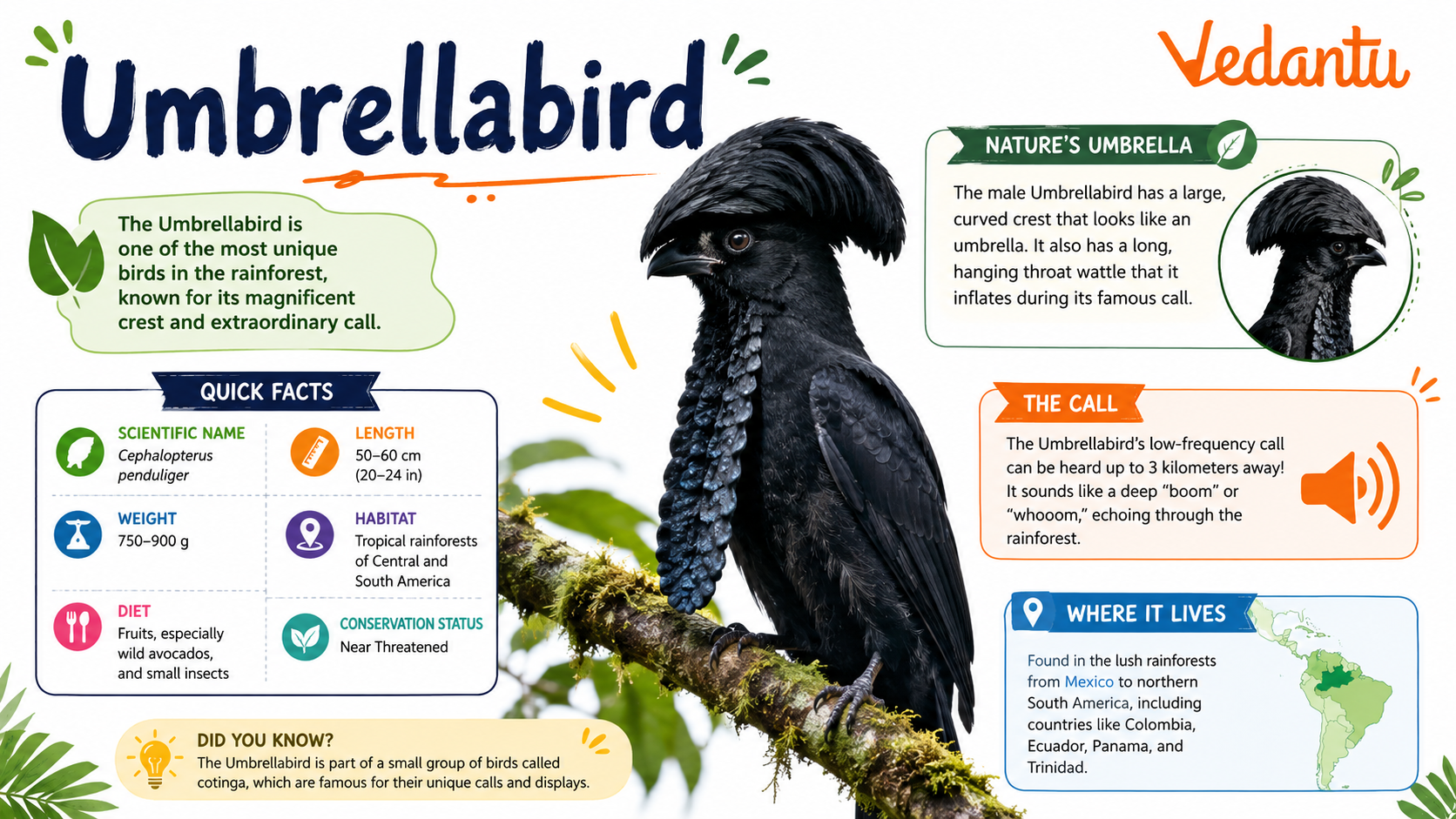
Quick Facts About Umbrellabird
| Feature | Details |
|---|---|
| Common Name | Umbrellabird |
| Scientific Genus | Cephalopterus |
| Animal Group | Bird |
| Size | About 35–50 cm long |
| Weight | Up to 550 grams (males heavier) |
| Habitat | Tropical rainforests |
| Diet | Mainly fruits, also insects and small animals |
| Lifespan | Around 12–16 years (estimated) |
| Conservation Status | Vulnerable (habitat loss) |
Appearance and Physical Characteristics
- Large, crow-like bird with glossy black feathers.
- Huge umbrella-shaped crest covering the head.
- Long feathered throat pouch called a wattle (mainly in males).
- Strong black beak and sharp claws.
- Males are larger and more decorated than females.
Habitat and Distribution
The Umbrellabird habitat is mainly dense tropical rainforests.
- Found in Central and South America.
- Countries include Costa Rica, Panama, Colombia, and Ecuador.
- Lives high in tall rainforest trees.
- Prefers humid, warm climates.
Diet and Feeding Habits
The Umbrellabird diet makes it an important part of the rainforest ecosystem.
- Mainly frugivore (fruit-eater).
- Eats berries, large rainforest fruits, and seeds.
- Also consumes insects and small vertebrates.
- Swallows fruits whole and spreads seeds through droppings.
Behaviour and Lifestyle
- Mostly solitary except during breeding season.
- Shy and difficult to spot in the wild.
- Spends most of its time high in trees.
- Males gather in special areas called leks to attract females.
Sound or Call
- Males produce a deep, booming sound.
- The sound can travel long distances through the forest.
- Used to attract females during mating season.
Flight Adaptations
- Strong wings for short, powerful flights.
- Broad wings help in gliding between trees.
- Light but muscular body for forest movement.
- Tail helps in balance while landing on branches.
Life Cycle and Reproduction
- Mating Display: Males show off crest and throat pouch while calling loudly.
- Nest Building: Female builds a simple nest in tall trees.
- Egg Laying: Usually lays 1 egg.
- Parental Care: Female alone takes care of the chick.
- Growth: Chick grows feathers and learns to fly within weeks.
What Makes the Umbrellabird Special?
The umbrella-shaped crest is one of the most dramatic features among birds.
The long wattle amplifies its deep booming call.
Males gather and compete in display areas to impress females.
Plays a key role in spreading rainforest plant seeds.
Importance and Role in Nature
Helps forests grow by spreading seeds across large areas.
Acts as both seed-eater and occasional predator of insects.
Its presence shows a healthy rainforest ecosystem.
Birdwatchers travel to see this rare and unique bird.
Amazing Umbrellabird Facts
- There are three main species of Umbrellabirds.
- Males are much more decorated than females.
- The crest is made of long, hair-like feathers.
- Its booming sound can be heard from far away.
- It is one of the largest passerine (perching) birds.
- It prefers untouched, old-growth forests.
- Habitat loss is its biggest threat.
Interesting Facts About Umbrellabird
Fun Facts for Kids
- It looks like it is wearing a feathery hat!
- Only the male has the long hanging throat pouch.
- It loves big tropical fruits.
- It makes a deep “boom” sound instead of a chirp.
- It lives high up in tall rainforest trees.
FAQs on Umbrellabird: The Rainforest Bird with a Giant Umbrella Crest
1. What is an Umbrellabird?
The Umbrellabird is a rare tropical bird known for its umbrella-shaped crest and throat pouch.
- It belongs to the Cotingidae family.
- It lives in the rainforests of Central and South America.
- Male umbrellabirds have a large black feather crest that looks like an umbrella.
- They are famous for their deep, booming calls.
2. Why is it called an Umbrellabird?
The Umbrellabird gets its name from the umbrella-like feathers on its head.
- The male has a large curved crest that covers its beak.
- This crest looks like an open umbrella.
- It also has a long throat wattle that hangs down like a ribbon.
3. Where do Umbrellabirds live?
Umbrellabirds live in warm, wet tropical rainforests of Central and South America.
- They are found in countries like Costa Rica, Panama, Colombia, and Ecuador.
- They prefer cloud forests and lowland rainforests.
- They stay high in the forest canopy.
4. What do Umbrellabirds eat?
Umbrellabirds mostly eat fruit but sometimes eat small animals.
- Their main diet includes berries and tropical fruits.
- They may also eat insects, frogs, and small lizards.
- They help spread seeds in the rainforest.
5. How big is an Umbrellabird?
The Umbrellabird is one of the largest songbirds in its region.
- It can grow up to 20 inches (50 cm) long.
- Males are usually bigger than females.
- They have strong bodies and large wings.
6. What sound does an Umbrellabird make?
Umbrellabirds make a deep, booming sound that can be heard from far away.
- The call sounds like a loud "boom".
- Males use this sound to attract females.
- The sound can travel long distances in the rainforest.
7. Are Umbrellabirds endangered?
Yes, some species of Umbrellabirds are considered endangered or vulnerable.
- Their rainforest homes are being cut down due to deforestation.
- Habitat loss makes it harder for them to find food.
- Conservation programs are working to protect them.
8. How many types of Umbrellabirds are there?
There are three main species of Umbrellabirds.
- Long-wattled Umbrellabird
- Bare-necked Umbrellabird
- Amazonian Umbrellabird
9. How do Umbrellabirds reproduce?
Umbrellabirds reproduce by laying eggs after a courtship display.
- Males perform display dances and make booming sounds.
- Females build the nest in trees.
- The female usually lays one egg at a time.
10. Why are Umbrellabirds important to the rainforest?
Umbrellabirds are important because they help keep the rainforest healthy.
- They spread seeds by eating fruit.
- This helps new trees grow.
- They are part of the biodiversity of tropical ecosystems.
