



Why Did the Woolly Rhinoceros Go Extinct? Habitat, Diet, and Key Facts
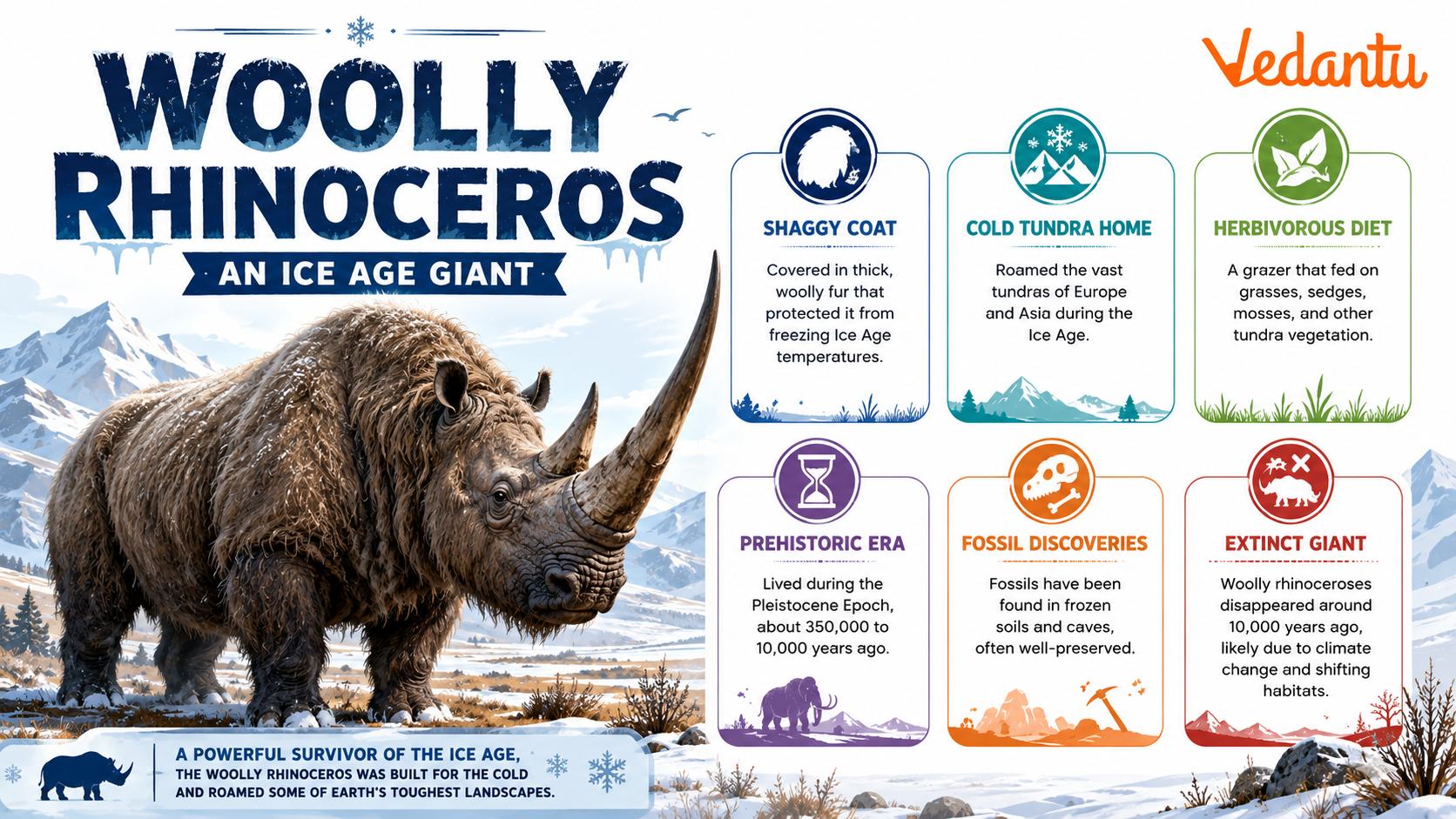
Quick Facts and Statistics
| Feature | Details |
|---|---|
| Common Name | Woolly Rhinoceros |
| Scientific Name | Coelodonta antiquitatis |
| Animal Group | Mammal |
| Time Period | Ice Age (Pleistocene Epoch) |
| Length | About 3–4 metres |
| Weight | Up to 2–3 tonnes |
| Diet | Herbivore (grass and plants) |
| Habitat | Cold grasslands and tundra |
| Conservation Status | Extinct |
Appearance and Physical Characteristics
- Thick, long, shaggy brown fur to protect from extreme cold.
- A large hump of fat on its shoulders for energy storage.
- Two horns on its nose – the front horn could grow up to 1 metre long.
- Short, strong legs to walk on snowy ground.
- Small ears to reduce heat loss.
Habitat and Distribution
- Lived in cold, dry grasslands called the “Mammoth Steppe.”
- Found in Europe, northern Asia, and parts of Siberia.
- Preferred open plains rather than forests.
- Adapted to snowy and icy environments.
Diet and Feeding Habits
- Grasses
- Sedges
- Small shrubs
- Low-growing plants
Behaviour and Lifestyle
Life Cycle and Reproduction
- Female gave birth to one baby after a long pregnancy.
- The baby stayed close to its mother for protection.
- It drank mother’s milk before slowly eating grass.
- Grew into a strong adult over several years.
What Made the Woolly Rhinoceros Special?
Importance and Role in Nature
- Helped maintain grasslands by grazing.
- Was part of the food chain with large predators.
- Its fossils help scientists understand climate change.
- Teaches us about extinction and environmental balance.
Amazing Facts About Woolly Rhinoceros
Fun Facts for Kids
- It looked like a giant hairy rhino!
- Its horn could be longer than a school ruler.
- It lived during the same time as early humans.
- It survived in freezing temperatures.
- We know about it from fossils and cave art.
FAQs on Woolly Rhinoceros: The Ice Age Giant Explained
1. What was the Woolly Rhinoceros?
The Woolly Rhinoceros was a large, hairy prehistoric mammal that lived during the Ice Age.
- Scientific name: Coelodonta antiquitatis
- Lived during the Pleistocene Epoch
- Covered in thick fur to survive freezing temperatures
- Had two large horns made of keratin
- Shared its habitat with the Woolly Mammoth and early humans
2. When did the Woolly Rhinoceros live?
The Woolly Rhinoceros lived during the last Ice Age and became extinct around 10,000 years ago.
- Time period: Pleistocene Epoch
- Lived from about 2.6 million years ago
- Went extinct near the end of the last Ice Age
- Coexisted with early Stone Age humans
3. Why did the Woolly Rhinoceros go extinct?
The Woolly Rhinoceros likely went extinct due to climate change and human hunting.
- Warming temperatures melted the Ice Age tundra
- Loss of cold, grassy habitats
- Hunted by early humans
- Environmental changes reduced food supply
4. What did the Woolly Rhinoceros eat?
The Woolly Rhinoceros was a plant-eater that fed mainly on grasses and shrubs.
- Diet: Herbivore
- Ate grasses, leaves, and small bushes
- Used its wide lips to graze
- Lived in cold steppe and tundra environments
5. How big was the Woolly Rhinoceros?
The Woolly Rhinoceros was a massive Ice Age animal, similar in size to modern rhinos.
- Length: About 10–12 feet (3–3.8 meters)
- Height: Around 6 feet (1.8 meters)
- Weight: Up to 2–3 tons
- Had a large front horn up to 3 feet long
6. Where did the Woolly Rhinoceros live?
The Woolly Rhinoceros lived in cold regions of Europe and northern Asia.
- Found in Siberia, Russia, and Europe
- Preferred dry, cold grasslands
- Adapted to snowy and icy climates
- Shared land with mammoths and cave lions
7. What did the Woolly Rhinoceros look like?
The Woolly Rhinoceros had thick fur, a hump, and two large horns.
- Covered in long, shaggy brown hair
- Small ears to reduce heat loss
- Large front horn for defense and digging snow
- Fat layer under skin for insulation
8. Did humans and Woolly Rhinoceroses live at the same time?
Yes, early humans lived alongside the Woolly Rhinoceros during the Ice Age.
- Hunted by Stone Age humans
- Appears in ancient cave paintings
- Used for meat, hide, and possibly tools
- Evidence found in European caves
9. How is the Woolly Rhinoceros different from modern rhinos?
The Woolly Rhinoceros was specially adapted for cold weather, unlike modern rhinos.
- Had thick fur and fat layers
- Lived in freezing Ice Age environments
- Modern rhinos live in warm regions like Africa and Asia
- Both had horns made of keratin
10. How do scientists know about the Woolly Rhinoceros?
Scientists study fossils and frozen remains to learn about the Woolly Rhinoceros.
- Fossil bones discovered in permafrost
- Well-preserved frozen bodies in Siberia
- Ancient cave art drawings
- Study of teeth and horns for diet clues
