




What Are Aquatic Animals Definition Types and Key Adaptations
Aquatic animals are fascinating life forms that live in water environments like oceans, rivers, lakes, and ponds. These organisms have evolved unique adaptations to survive and thrive in aquatic habitats. Studying aquatic animals helps us understand biodiversity, food webs, and key processes that impact life on Earth. This page explores their structure, types, adaptations, and ecological significance.
Aquatic Animals: Types, Structure & Adaptations
What are Aquatic Animals?
Aquatic animals are organisms that spend most or all of their lives in water. They depend on water for nutrition, respiration, and reproduction, and cannot survive on land. These animals are incredibly diverse and can be found in both freshwater and marine habitats. Adaptations to different salinity levels, temperatures, and water depths enable them to flourish in their aquatic habitats.
Key Features of Aquatic Animals
Aquatic animals share common features that help them survive in watery environments. These adaptations make movement, breathing, and feeding in water possible. Understanding these features is crucial for learning about their physiology and ecological roles.
- Streamlined bodies enable easy and efficient movement through water.
- Many fish and other species use gills to extract oxygen from water, while some aquatic mammals have lungs.
- Fins, flippers or webbed limbs assist in swimming and navigation.
- Body coverings like scales, mucous, or blubber provide protection and help regulate temperature.
- Salt and water balance are maintained through processes such as osmoregulation.
- Special senses (like a lateral line in fish) allow them to detect changes in water movement or pressure.
These features are essential for aquatic habitat animals to survive and compete for resources. For an in-depth exploration of animal adaptations, see Adaptations in Animals on Vedantu.
Types of Aquatic Animals
Aquatic animals can be grouped in several ways based on their movement, position in the water, or habitat type. Here’s a simple classification:
| Group | Description | Examples |
|---|---|---|
| Plankton | Tiny or microscopic organisms that drift with water currents | Krill, phytoplankton, zooplankton |
| Nekton | Active swimmers that can move freely against currents | Fish (shark, tuna), dolphins, turtles, squid |
| Benthos | Organisms living on or near the seabed | Crabs, lobsters, starfish, oysters |
This classification helps understand the structure of aquatic ecosystems and the roles species play within food webs. For more on ecosystem dynamics, explore Ecosystems.
Major Aquatic Habitats
Aquatic animals inhabit two main types of water bodies:
- Freshwater Habitats: Rivers, lakes, ponds, streams. Animals here must deal with low salinity and may include fish like catfish, amphibians, and aquatic insects.
- Marine (Saltwater) Habitats: Oceans and seas with high salt content. They support vast numbers of aquatic animals such as sharks, whales, sea turtles, and crustaceans.
The types of animals found in each habitat vary based on salinity, temperature, and depth. Read more about the difference between aquatic and terrestrial ecosystems.
10 Examples of Aquatic Animals
Here’s a simple aquatic animals list covering different types, important for students learning about biodiversity and classification.
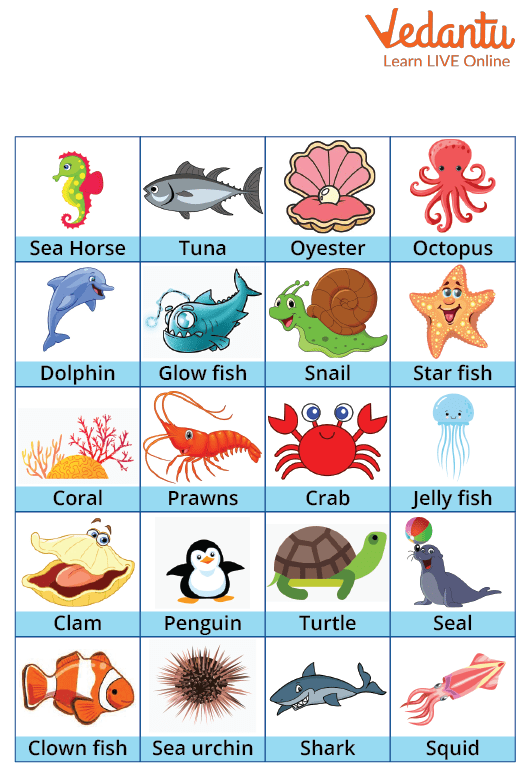
- Shark
- Dolphin
- Whale
- Starfish
- Octopus
- Crab
- Shrimp
- Catfish
- Sea Turtle
- Jellyfish
When learning about aquatic animals name or searching for “10 aquatic animals name,” these examples cover key categories. Looking for more? Check out Interesting Facts About Animals on Vedantu.
Adaptations in Aquatic Animals for Survival
Adaptations are features that enable aquatic animals to survive underwater. These changes are shaped by the demands of their environment, helping them access food, avoid predators, and reproduce efficiently.
- Gills for breathing: Fish aquatic animals use gills to extract dissolved oxygen.
- Streamlined shapes: Minimise water resistance, making swimming energy-efficient.
- Blubber: Marine mammals like whales have fat layers for warmth and buoyancy.
- Camouflage: Some fishes and octopuses can blend into surroundings to evade predators.
- Salt regulation: Saltwater and freshwater animals differ in maintaining salt-water balance. For more, explore Osmoregulation.
These adaptations are vital not just for survival in aquatic environments but also influence ecology, fisheries, and aquaculture.
Aquatic Animals vs. Terrestrial Animals
Aquatic and terrestrial animals have evolved distinct adaptations for their unique environments. Here’s a simple table:
| Feature | Aquatic Animals | Terrestrial Animals |
|---|---|---|
| Respiration | Gills (fish), skin (amphibians), or lungs (mammals) | Lungs, tracheae, or skin |
| Locomotion | Fins, flippers, webbed feet | Legs, wings |
| Body Shape | Streamlined, adapted for swimming | Varied shapes for walking or flying |
| Osmoregulation | Adjust to water/salt balance | Minimise water loss |
See also: Differences in Traits.
List of 5 Aquatic Animals with Quick Facts
Here are 5 aquatic animals with unique features that highlight their diversity:
- Blue Whale: Largest animal on Earth. Its tongue can weigh as much as an elephant.
- Parrotfish: Contributes to sand formation by excreting ground-up coral.
- Seahorse: Males give birth—rare in the animal kingdom.
- Crab: Taste sensors located on their feet.
- Jellyfish: Has no heart, brain, or bones yet can move and catch prey.
Interested in animal diversity? Read about Vertebrates and Invertebrates on Vedantu.
Role of Aquatic Animals in the Ecosystem
Aquatic animals hold critical positions in food webs and nutrient cycles. They are:
- Predators & Prey: Regulate populations, preventing overgrowth of any single species.
- Scavengers & Decomposers: Clean the environment by breaking down dead matter.
- Filter Feeders: Improve water quality by filtering out particles and excess nutrients.
- Habitat Builders: Coral reefs and oyster beds create natural shelters for many aquatic species.
For more on nutrient cycling and environmental impacts, explore Climate Change and Its Effects.
Interesting Facts about Aquatic Animals
- Dolphins sleep with only one-half of their brain at a time to stay alert for predators.
- Angelfish pair with a single mate for life—if one dies, the other never breeds again.
- Some shrimp act as “cleaners,” removing parasites from fish and protecting coral reefs.
Learning about aquatic fauna reveals successful survival strategies and can inspire innovations in technology and medicine.
Uses and Applications of Aquatic Animals
Aquatic animals support humans in many ways:
- Food Source: Fish and shellfish provide protein for billions of people.
- Medicine: Marine invertebrates are studied for new drugs and antibiotics.
- Agriculture: Aquatic animals are used in aquaculture to increase food production.
- Environmental monitoring: Some species indicate water quality and ecosystem health.
For more about the role of aquatic species in human diets, explore Food Science and Nutrients and Human Health.
Page Summary
Aquatic animals are diverse organisms living in water, equipped with specialised adaptations to thrive in aquatic habitats. They play vital roles in food webs, nutrient cycles, and human society, offering food, medicine, and ecological balance. Exploring their biology deepens our understanding of life’s evolution and ecosystem health, making this field essential for future research and environmental conservation.


FAQs on Aquatic Animals and Their Habitat Adaptations
1. What are aquatic animals?
Aquatic animals are animals that live primarily in water environments such as oceans, rivers, lakes, and ponds. They are specially adapted to survive in freshwater or marine ecosystems.
- They may breathe using gills (like fish) or lungs (like whales and dolphins).
- They have body adaptations such as fins, flippers, or streamlined shapes for swimming.
- Examples include fish, jellyfish, crabs, dolphins, and octopuses.
2. What are the main types of aquatic animals?
The main types of aquatic animals are classified based on habitat and biological group. They can be grouped as follows:
- Freshwater animals – live in rivers and lakes (e.g., carp, frogs).
- Marine animals – live in oceans and seas (e.g., sharks, whales).
- Vertebrates – animals with a backbone (e.g., fish, marine mammals).
- Invertebrates – animals without a backbone (e.g., starfish, jellyfish, crustaceans).
3. How do aquatic animals breathe?
Aquatic animals breathe using specialized respiratory organs adapted to extract oxygen from water or air. The main methods include:
- Gills – absorb dissolved oxygen from water (common in fish and many invertebrates).
- Lungs – used by aquatic mammals like whales and dolphins; they must surface to breathe air.
- Skin respiration – amphibians like frogs can absorb oxygen through moist skin.
4. What adaptations help aquatic animals survive in water?
Aquatic animals survive in water due to structural and physiological adaptations that support movement, breathing, and protection. Key adaptations include:
- Streamlined body shape to reduce water resistance.
- Fins or flippers for swimming and balance.
- Gills or lungs for respiration.
- Blubber in marine mammals for insulation.
- Swim bladder in many fish for buoyancy control.
5. What is the difference between freshwater and marine animals?
The main difference between freshwater and marine animals is the type of water habitat and their osmoregulation mechanisms. Key differences include:
- Freshwater animals live in low-salt environments and prevent excess water from entering their bodies.
- Marine animals live in high-salt environments and prevent water loss from their bodies.
- They have different adaptations for maintaining salt balance and internal homeostasis.
6. Are whales and dolphins fish?
Whales and dolphins are not fish; they are marine mammals. They share key mammalian characteristics:
- Breathe air using lungs.
- Give birth to live young.
- Feed their young with milk from mammary glands.
- Are warm-blooded (endothermic).
7. What is the role of aquatic animals in the ecosystem?
Aquatic animals play a crucial role in maintaining aquatic ecosystem balance and food webs. Their roles include:
- Acting as producers, consumers, or predators in food chains.
- Recycling nutrients through feeding and decomposition.
- Supporting biodiversity in marine and freshwater habitats.
- Providing food resources for humans and other animals.
8. What are some examples of aquatic invertebrates?
Aquatic invertebrates are water-dwelling animals that lack a vertebral column. Common examples include:
- Jellyfish (phylum Cnidaria)
- Starfish (phylum Echinodermata)
- Octopus and squid (phylum Mollusca)
- Crabs and shrimp (phylum Arthropoda)
9. How do fish maintain buoyancy in water?
Most bony fish maintain buoyancy using a gas-filled organ called the swim bladder. This organ works by:
- Adjusting gas volume to control floating or sinking.
- Reducing energy needed to stay at a certain depth.
10. Why are aquatic animals important to humans?
Aquatic animals are important to humans for food, economy, medicine, and ecological services. Their importance includes:
- Providing seafood such as fish and shellfish.
- Supporting livelihoods through fisheries and aquaculture.
- Contributing to medical research and pharmaceutical development.
- Maintaining healthy marine and freshwater ecosystems that regulate climate and oxygen production.



