




What Is Cell Transport Definition Process And Types
Cell transport is the process through which substances move in and out of cells. It ensures that nutrients enter cells and wastes are removed, maintaining balance within the cell. Below, we discuss the types of cell transport, how transport across cell membrane takes place, why it is essential for cells, and how it supports overall organism health. We will also examine cell transport function in plants, explore the cell transport mechanism in detail, and learn about the transport function of key cell structures.
Why is Cell Transport Important?
Cell transport helps maintain the right balance of nutrients, ions, and water inside a cell. This balance supports cellular activities like metabolism, growth, and reproduction. Without efficient transport across cell membrane, cells cannot function properly, leading to imbalances that may affect the entire organism. Thus, it answers the question, “What is the function of the transport system in a cell?”—it helps to maintain stable conditions essential for survival.
What are the 7 Functions of the Cell Membrane?
A cell membrane not only allows substances to enter or exit but also performs several other vital roles:
Protection – Acts as a barrier shielding the cell’s internal components.
Selective Permeability – Chooses which substances can pass through.
Communication – Receives signals from the environment or other cells.
Recognition – Helps identify cells as self or foreign.
Adhesion – Assists in binding cells to each other or surfaces.
Structure – Maintains cell shape.
Transport Regulation – Monitors the movement of substances, ensuring a balanced internal environment.
Types of Cell Transport
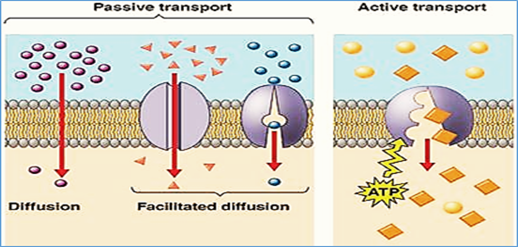
Broadly, there are two main types of cell transport mechanisms: passive transport and active transport. Within these, there are specific processes that govern the movement of substances.
1. Passive Transport
Passive transport does not require cellular energy (ATP). Instead, molecules move down their concentration gradient (from areas of high concentration to areas of low concentration). The main forms are:
Simple Diffusion: Small molecules like oxygen and carbon dioxide pass directly through the membrane.
Facilitated Diffusion: Specific proteins (permeases) in the membrane help larger or polar molecules cross.
Osmosis: Movement of water molecules from a region of higher water concentration to a lower one through a semipermeable membrane.
To see a simple overview, you could create a transport across cell membrane flow chart showing these steps: molecules on one side of the membrane → pass through membrane proteins (or phospholipid bilayer) → reach equilibrium inside the cell.
2. Active Transport
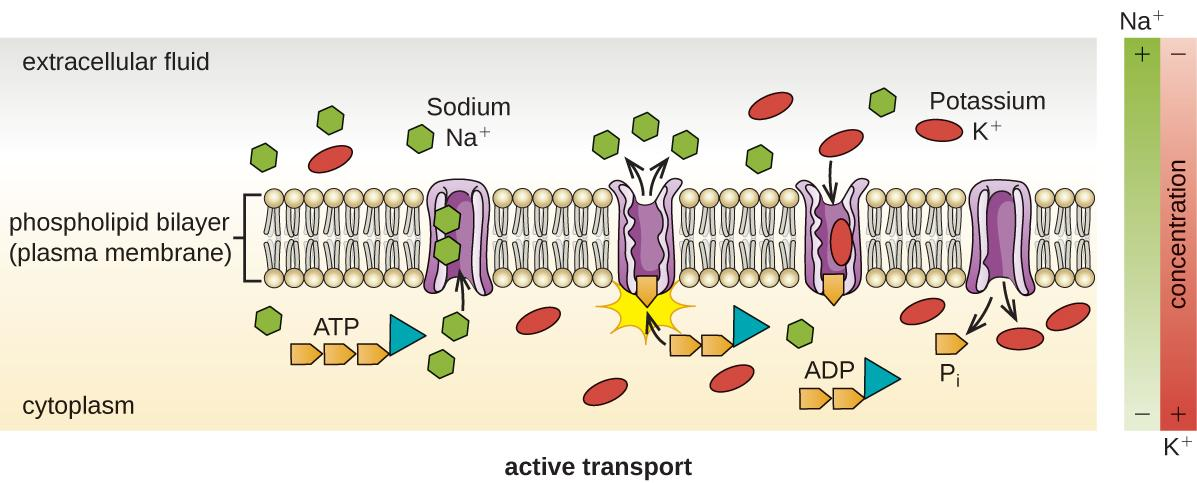
Active transport uses cellular energy (ATP) to move molecules or ions against their concentration gradient (from lower to higher concentration). This process often involves specialised proteins known as pumps.
Key Variations Include:
Primary Active Transport: Energy is derived directly from ATP. An example is the sodium-potassium pump in animal cells.
Secondary Active Transport (Coupled Transport): One ion moves down its gradient to provide the energy for another ion or molecule to move up its gradient. This can be antiport (opposite directions) or symport (same direction).
These mechanisms explain “What is the transport function?”—they work together to regulate and maintain the internal balance of essential substances in cells.
Cell Transport Function in Plants
Plants rely heavily on cell transport to absorb nutrients and water from the soil and distribute them to various parts of the plant:
Root Hair Cells: They use active transport to absorb mineral ions from the soil, even when concentrations in the soil are lower than inside the roots.
Xylem and Phloem: Movement of water (through xylem) and sugars (through phloem) depends on concentration gradients and osmotic pressures.
Transfer Cells: What are the functions of transfer cells? These specialised cells have numerous infoldings in their cell membranes, increasing surface area to facilitate rapid transport of solutes (e.g. in sugar transport during phloem loading).
Role of Organelles in Cell Transport
Although the cell membrane is the major player, other organelles contribute to cell transport function in cell membrane:
Endoplasmic Reticulum: Often considered the cell’s internal transport system, it helps in synthesising and transporting proteins (rough ER) and lipids (smooth ER).
Golgi Apparatus: Packages and modifies proteins and lipids, sending them to their destinations via vesicles.
These systems collectively answer “What is the function of the transport system in a cell?” by showing how substances move to the right place at the right time to maintain efficient cell activity.
Quick Quiz (With Answers)
1. Question: Which type of transport requires ATP?
Answer: Active transport.
2. Question: What drives molecules in passive transport?
Answer: Concentration gradient (moving from high to low concentration).
3. Question: Name an organelle involved in internal transport within the cell.
Answer: The endoplasmic reticulum.
4. Question: How do transfer cells support plant transport?
Answer: By increasing membrane surface area to speed up the movement of solutes.


FAQs on Cell Transport And Its Types In Biology
1. What is cell transport?
Cell transport is the movement of substances across the cell membrane to maintain cellular balance and function. It allows cells to take in nutrients, remove wastes, and regulate internal conditions. Cell transport occurs through two main mechanisms:
- Passive transport – does not require energy
- Active transport – requires cellular energy (ATP)
These processes are essential for maintaining homeostasis in living cells.
2. What are the main types of cell transport?
The main types of cell transport are passive transport and active transport. These are classified based on energy use and direction of movement.
- Passive transport: Moves substances from high to low concentration without energy (e.g., diffusion, osmosis, facilitated diffusion).
- Active transport: Moves substances against the concentration gradient using ATP (e.g., sodium-potassium pump, endocytosis).
Both types regulate the movement of ions, water, and molecules across the cell membrane.
3. What is passive transport in cells?
Passive transport is the movement of substances across a cell membrane without using cellular energy. It occurs along the concentration gradient, from high to low concentration.
- Simple diffusion – movement of small nonpolar molecules (e.g., oxygen)
- Osmosis – diffusion of water across a semipermeable membrane
- Facilitated diffusion – movement through transport proteins
Passive transport helps cells maintain equilibrium efficiently.
4. What is active transport and how does it work?
Active transport is the movement of substances across the cell membrane against their concentration gradient using ATP. It requires specific membrane proteins called transport pumps.
- ATP provides energy for protein shape change
- Substances move from low to high concentration
- Example: sodium-potassium pump
Active transport is essential for nerve impulses, muscle contraction, and maintaining ion balance.
5. What is the difference between passive and active transport?
The main difference between passive and active transport is that passive transport does not require energy, while active transport requires ATP. They also differ in movement direction.
- Passive transport: High to low concentration, no energy
- Active transport: Low to high concentration, energy required
- Passive uses diffusion; active uses membrane pumps
Both processes occur across the plasma membrane to regulate cellular function.
6. What is diffusion in cell transport?
Diffusion is the movement of molecules from an area of high concentration to an area of low concentration until equilibrium is reached. It is a type of passive transport.
- Does not require ATP
- Occurs due to random molecular motion
- Example: Oxygen entering cells from the bloodstream
Diffusion allows small, nonpolar molecules to cross the cell membrane easily.
7. What is osmosis and why is it important?
Osmosis is the diffusion of water across a selectively permeable membrane from high water concentration to low water concentration. It is a special type of passive transport.
- Maintains cell volume and pressure
- Prevents cell shrinkage or bursting
- Essential in plant cells for turgor pressure
Osmosis is critical for maintaining water balance in cells and organisms.
8. What is facilitated diffusion?
Facilitated diffusion is a type of passive transport where molecules move across the membrane through specific transport proteins. It does not require energy.
- Uses channel or carrier proteins
- Moves substances from high to low concentration
- Example: Glucose entering cells via carrier proteins
It helps large or polar molecules cross the hydrophobic lipid bilayer.
9. What are endocytosis and exocytosis?
Endocytosis and exocytosis are forms of bulk transport that move large materials into or out of the cell using vesicles. They are types of active transport.
- Endocytosis: Cell membrane engulfs material to bring it inside
- Exocytosis: Vesicles fuse with membrane to release material outside
- Require ATP for vesicle formation and movement
These processes are important for nutrient intake, secretion, and immune defense.
10. Why is cell transport important for living organisms?
Cell transport is important because it maintains homeostasis by controlling the movement of substances in and out of cells. Without it, cells cannot survive.
- Allows nutrient uptake (glucose, ions)
- Removes metabolic wastes
- Maintains water and ion balance
- Supports nerve and muscle function
Efficient cell transport ensures proper functioning of tissues, organs, and entire organisms.



