



In this article, we are going to study the dicot embryo and its structure of the dicot embryo. We will also learn about the development of the dicot embryo and the comparison between monocot and dicot embryos. After reading this article, readers can tell:
What is an embryo?
Comparison between monocot and dicot embryo
Development of embryo

Structure and Parts of a Dicot Embryo with Diagram and Functions
The dicot embryo is a crucial stage in the life cycle of dicotyledonous plants, setting the groundwork for seedling development. Understanding the structure and evolution of dicot embryos helps students grasp vital plant biology concepts. This topic explores the definition, development stages, and key features of dicot embryos with relatable examples and detailed explanations designed for CBSE class 12 and competitive exams.
Dicot Embryo Definition and Explanation
Dicot embryo refers to the young, multicellular organism present inside seeds of dicotyledonous plants. It forms after the fertilization of a male and female gamete in flowering plants and is characterized by having two cotyledons or seed leaves. These cotyledons often serve as food storage, supporting the early growth of the plant after seed germination.
- Dicot embryo definition: The developing plant inside a dicot seed, identified by two cotyledons and an embryonic axis.
- Seen in most flowering plants, especially broad-leaved species like beans, pea, and oak.
- Embryonic leaves (cotyledons) store nutrients used during the germination process.
Dicot embryos are distinct from monocot embryos, which have just one cotyledon. The differences begin to appear as the embryo develops, impacting seedling structure and classification. For more on classification, see Classification of Plants.
Structure of Dicot Embryo
A well-developed dicot embryo contains several specialized parts that help the seedling establish itself after germination. Understanding their arrangement helps clarify the functions and the process of plant growth.
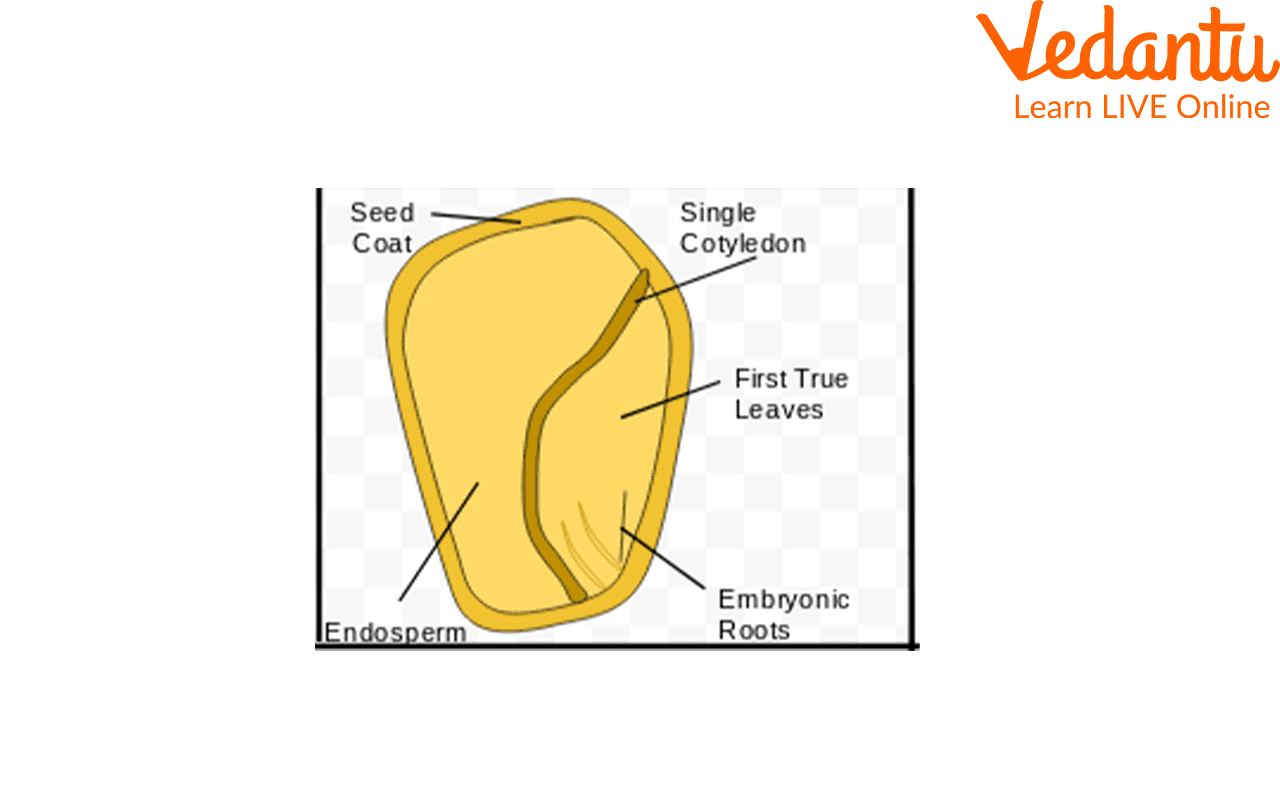
- Cotyledons: Two fleshy, food-storing seed leaves. They often make up the major mass of the embryo and supply energy during germination.
- Embryonal Axis: The central stalk connecting the cotyledons, from which future plant organs grow.
- Plumule: The embryonic shoot; it forms the stem and leaves of the new plant.
- Radicle: The embryonic root; develops into the main root system.
- Hypocotyl: The region below the cotyledons but above the root; forms part of the stem and root transition zone.
- Epicotyl: The region above the cotyledons, which gives rise to leaves and the upper stem.
In mature dicot seeds, the cotyledons often dominate and act as energy reserves. The external covering of the seed, composed of the testa and tegmen, protects the embryo. The Parts of a Seed page further explores seed structure.
Development of Dicot Embryo (Embryogenesis)
The formation of a dicot embryo from a fertilized zygote is called embryogenesis. This process consists of highly organized cell divisions and tissue patterning, which establish the plant's basic body plan. The development of the dicot embryo typically occurs in several stages:
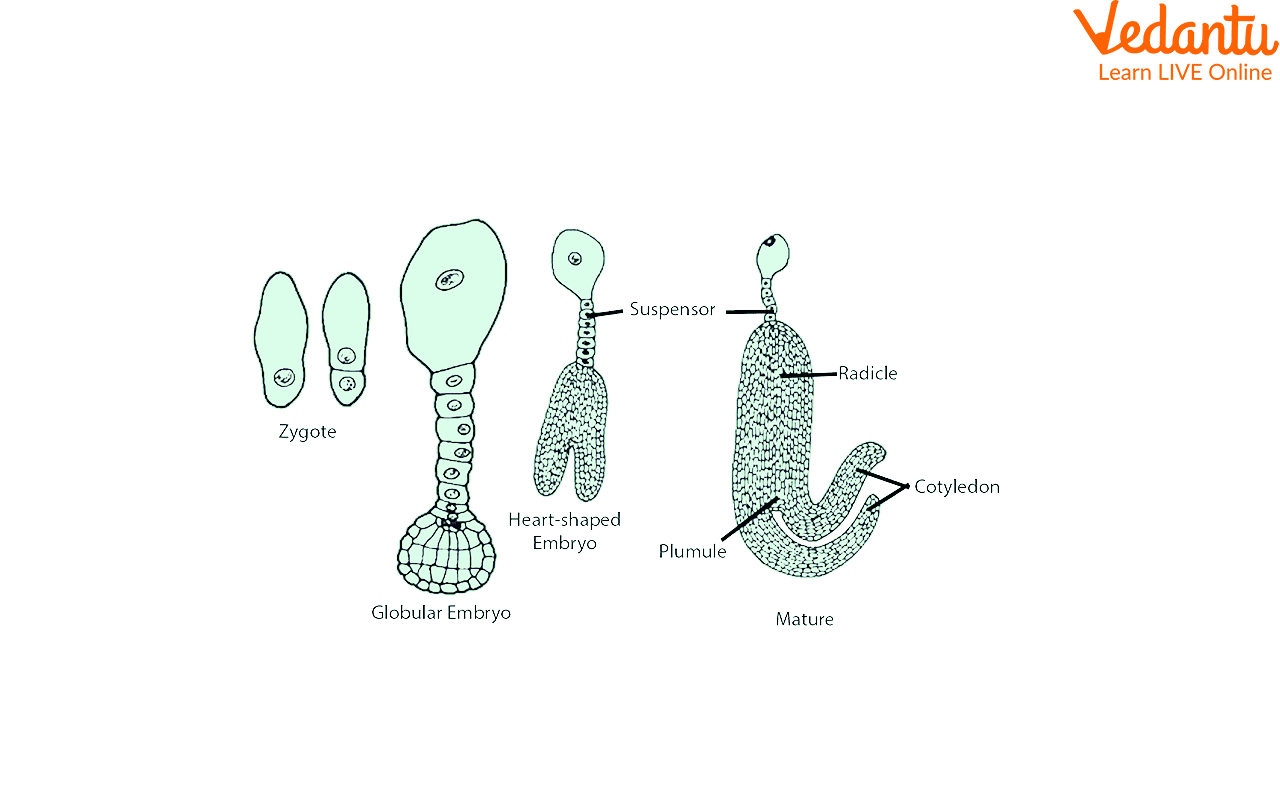
- Proembryo Stage: The zygote divides to form two cells—apical (forms embryo) and basal (forms suspensor).
- Globular Stage: Subsequent cell divisions produce a spherical mass called the globular embryo. The essential tissue layers begin to form.
- Heart-shaped Stage: The sides of the embryo enlarge, and early cotyledons appear, resulting in a heart-like shape. Bilateral symmetry sets in.
- Torpedo Stage: The embryo elongates as the cotyledons and main axis grow longer.
- Maturation Stage: The embryo loses water, becomes dormant, and the seed prepares for dispersal.
During embryogenesis, the suspensor pushes the developing embryo into nourishing endosperm tissue. As the seed matures, the endosperm is often absorbed by the cotyledons, especially in dicots, leaving little or no endosperm at germination. Learn more about Reproduction in Plants to understand fertilization and seed development.
Examples of Dicot Embryos
Dicot embryos are found in numerous plants that are important in agriculture, food security, and the environment. Some classic dicot embryo examples include:
- Peanut (Arachis hypogaea)
- Pea (Pisum sativum)
- Almond (Prunus dulcis)
- Cashew (Anacardium occidentale)
- Tomato (Solanum lycopersicum)
- Oak (Quercus)
These species exhibit the typical two-cotyledon structure in their seeds, which is essential for the early nourishment of the seedling. The dicot embryo is thus foundational to staple crops and key ecological species worldwide. Check Bean Plant and Pea Plant for practical insights.
Key Differences: Dicot Embryo vs Monocot Embryo
One of the most fundamental classifications in angiosperms is the distinction between monocots and dicots. The main differences between their embryos are summarized below.
| Feature | Dicot Embryo | Monocot Embryo |
|---|---|---|
| Number of Cotyledons | Two cotyledons | One cotyledon (scutellum) |
| Cotyledon Appearance | Usually thick, not leaf-like | Thin, often resembles a leaf |
| Plumule Position | Distal (at top of axis) | Lateral (to one side) |
| Protective Sheaths | Absent | Present (coleoptile & coleorhiza) |
The dicot embryo sets the pattern for branching root and shoot systems. Monocots, on the other hand, develop differently, impacting their leaf, flower, and seed characteristics. This classification is also useful in plant identification and crop management. For a deeper understanding, explore monocot and dicot stem differences and seed structures.
Importance and Key Features of Dicot Embryos
Dicot embryos play a central role in agriculture and natural ecosystems. Their unique development and structure determine the vigor of germinating seeds and ultimately the success of crops and wild plants.
- Seed reserves in cotyledons support the plant during early growth, essential for crops like beans and peanuts.
- Diversity of forms contributes to plant adaptation and evolution.
- Used illustratively in biology textbooks and classroom experiments for plant development.
- Vital for understanding plant breeding, biotechnology, and sustainable farming.
The study of dicot embryos also reveals evolutionary relationships among angiosperms, supporting research in life science, crop improvement, and environmental sustainability. They are also referenced in biotechnology and pharmaceutical research. More about the role of plant parts and nutrients in growth can be found on this resource.
Dicot Embryo: Questions and Applications
To apply knowledge about the dicot embryo, try answering these sample questions and exploring real-world scenarios:
- Which part of the dicot embryo gives rise to the root system?
- How do dicot embryos support early seedling development?
- Give two examples of crop plants with a dicot embryo.
- What happens to the endosperm in most mature dicot seeds?
Such questions appear in CBSE class 12 and entrance exams like NEET, where understanding dicot embryo concepts enhances biology scores. For more practice, check Parts of a Seed and seed embryonic development resources.
Interesting Facts About Dicot Embryos
Dicot embryos are connected with many fun and fascinating plant facts:
- Peanuts, beans, and sunflowers all start life as dicot embryos.
- The double coconut has the world’s largest seed—with a huge dicot embryo inside!
- Tomatoes and peas are common kitchen examples to observe dicot germination at home.
- Most trees in parks and forests (e.g., oak, maple) sprout from dicot seeds.
Experiments using dicot seeds are easy classroom activities, making the dicot embryo a foundational topic for both basic and advanced plant biology learning.
Page Summary
The dicot embryo is at the heart of angiosperm development, enabling plants to reproduce, adapt, and thrive across ecosystems. By mastering dicot embryo structure, development, and differences from monocots, students build a strong foundation in plant science for academic success and real-world application, especially in agriculture and environmental studies. For further learning, explore more biology concepts with Vedantu.


FAQs on Dicot Embryo in Flowering Plants
1. What is a dicot embryo?
A dicot embryo is the early developmental stage of a dicotyledonous plant seed that contains two cotyledons. It develops from the fertilized egg (zygote) inside the ovule and later forms the young plant. The typical parts of a dicot embryo include:
- Two cotyledons (seed leaves)
- Plumule (embryonic shoot)
- Radicle (embryonic root)
- Hypocotyl (region below cotyledons)
2. What are the parts of a dicot embryo?
The main parts of a dicot embryo are two cotyledons, plumule, radicle, and hypocotyl. These parts are organized as follows:
- Cotyledons – Two fleshy seed leaves that store or absorb nutrients
- Plumule – The embryonic shoot that develops into the stem and leaves
- Radicle – The embryonic root that forms the primary root
- Hypocotyl – The portion between radicle and cotyledons
3. How many cotyledons are present in a dicot embryo?
A dicot embryo has two cotyledons. The term “dicot” itself means “two seed leaves.” These cotyledons:
- Store or absorb nutrients from the endosperm
- Provide nourishment to the developing embryo
- May emerge above the soil during germination (e.g., in beans)
4. What is the function of cotyledons in a dicot embryo?
The cotyledons in a dicot embryo primarily function as food storage and nutrient supply organs. Their roles include:
- Storing food materials like starch and proteins (in non-endospermic seeds)
- Absorbing nutrients from the endosperm (in some seeds)
- Providing nourishment to the embryo during germination
5. What is the difference between a dicot embryo and a monocot embryo?
The main difference between a dicot embryo and a monocot embryo is the number of cotyledons. Key differences include:
- Dicot embryo: Two cotyledons; example – bean
- Monocot embryo: One cotyledon (called scutellum); example – maize
- Dicots often have non-endospermic seeds, while monocots are usually endospermic
- Monocot embryos have protective sheaths like coleoptile and coleorhiza, which are absent in dicots
6. How does a dicot embryo develop?
A dicot embryo develops from a zygote through a series of mitotic divisions inside the ovule. The stages include:
- Formation of zygote after fertilization
- Division into a proembryo
- Formation of globular, heart-shaped, and torpedo stages
- Differentiation into cotyledons, plumule, radicle, and hypocotyl
7. What is the role of the radicle in a dicot embryo?
The radicle is the embryonic root of a dicot embryo that develops into the primary root after germination. Its functions include:
- Growing downward into the soil
- Anchoring the seedling
- Absorbing water and minerals
8. What is the plumule in a dicot embryo?
The plumule is the embryonic shoot of a dicot embryo that develops into the stem and leaves. It is located above the cotyledons and consists of:
- The shoot apex
- Young leaf primordia
9. What is the hypocotyl in a dicot embryo?
The hypocotyl is the part of a dicot embryo located between the cotyledons and the radicle. It plays an important role in germination by:
- Elongating to push the cotyledons above the soil (in epigeal germination)
- Connecting the root and shoot regions
10. Can you give an example of a dicot embryo?
A common example of a dicot embryo is found in the bean seed (Phaseolus). In this example:
- The seed contains two large, fleshy cotyledons
- The embryo occupies most of the seed space
- The endosperm is usually absent at maturity (non-endospermic seed)
In this article, we are going to study the dicot embryo and its structure of the dicot embryo. We will also learn about the development of the dicot embryo and the comparison between monocot and dicot embryos. After reading this article, readers can tell:
What is an embryo?
Comparison between monocot and dicot embryo
Development of embryo



