




Comparison of monohybrid and dihybrid cross with examples and ratios
When Gregor Johann Mendel first conducted his classical experiments on pea plants, he laid the foundation for how we understand genetics today. Two fundamental types of genetic crosses he performed are the monohybrid cross and the dihybrid cross. In simple terms, a monohybrid cross focuses on one trait at a time, whereas a dihybrid cross considers two traits simultaneously. Below, we will explore what is monohybrid and dihybrid cross with an example, highlight their distinguishing features, and address the difference between monohybrid and dihybrid cross in detail.
What are Monohybrid and Dihybrid Crosses?
Before delving into the monohybrid and dihybrid cross-difference, let us establish their definitions clearly:
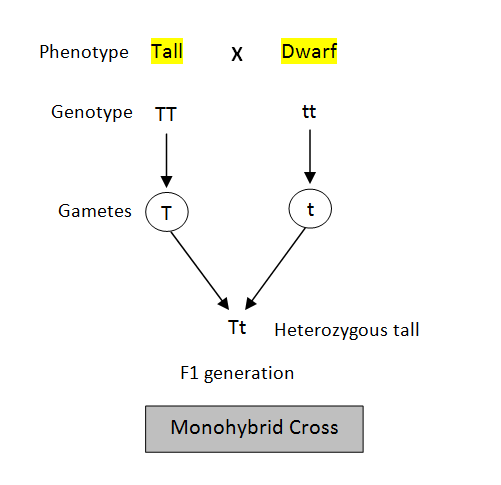
Monohybrid Cross: A monohybrid cross is a breeding experiment between organisms that differ in only one trait. For example, crossing a pea plant with dominant tall height (TT) and another pea plant with recessive dwarf height (tt) is a monohybrid cross. Here, you are studying how one pair of contrasting alleles (T vs t) is passed down through generations.
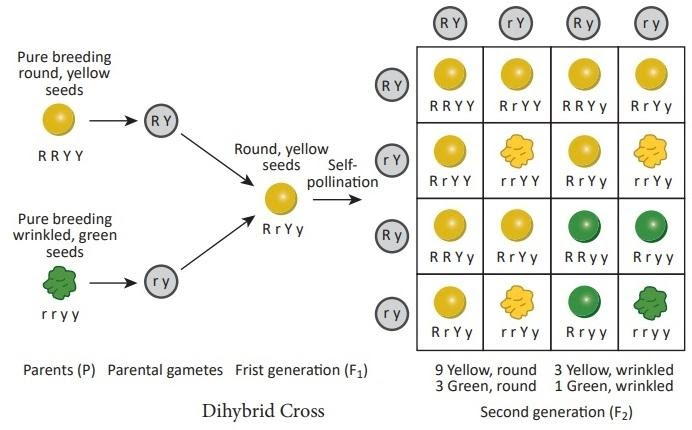
Dihybrid Cross: A dihybrid cross studies the inheritance pattern of two different traits simultaneously. For instance, crossing pea plants that differ in both seed shape (round vs wrinkled) and seed colour (yellow vs green) constitute a dihybrid cross. This allows us to observe how two pairs of contrasting alleles are inherited together.
Understanding these concepts is crucial because they directly relate to Mendel's laws of inheritance, including the Law of Segregation and the Law of Independent Assortment.
Key Features and Ratios
A core part of understanding the difference between monohybrid and dihybrid cross is looking at the genotypic and phenotypic ratios obtained from these genetic experiments.
Monohybrid Cross Ratios
Phenotypic Ratio: 3:1
In the classic example of tall (dominant) vs dwarf (recessive) pea plants, three offspring show the dominant tall trait for every dwarf offspring.Genotypic Ratio: 1:2:1
If you denote the dominant allele as T and the recessive as t, the ratio of TT:Tt:tt is 1:2:1.Test Cross Ratio: 1:1
When you perform a test cross (crossing a plant with a homozygous recessive individual), the ratio of the dominant phenotype to the recessive phenotype is 1:1 if the original plant is heterozygous.
Dihybrid Cross Ratios
Phenotypic Ratio: 9:3:3:1
If you consider seed shape (round - R, wrinkled - r) and seed colour (yellow - Y, green - y) in pea plants, you get four types of offspring in the ratio of 9:3:3:1. Nine show both dominant traits (round, yellow), three shows one dominant and one recessive trait (round, green), another three show the other dominant and recessive trait (wrinkled, yellow), and one shows both recessive traits (wrinkled, green).Genotypic Ratio: 1:2:1:2:4:2:1:2:1
Though less commonly memorised than the phenotypic ratio, this comprehensive genotypic breakdown represents each possible combination of R/r and Y/y alleles.Test Cross Ratio: 1:1:1:1
A dihybrid test cross with a double recessive individual (rryy) will produce offspring in equal proportions of the four possible phenotypes.
Difference Between Monohybrid and Dihybrid Cross
Here is a concise look at the monohybrid and dihybrid cross-difference in tabular form:
What is Monohybrid and Dihybrid Cross With an Example?
To solidify your understanding of monohybrid and dihybrid cross, let us explore classical pea plant examples:
Monohybrid Cross Example
Parental Generation (P): Tall plant (TT) × Dwarf plant (tt)
F1 Generation (All Tt): All plants appear tall (T is dominant)
F2 Generation: When F1 plants are self-fertilised, they produce a ratio of 3 tall:1 dwarf.
Dihybrid Cross Example
Parental Generation (P): Round-yellow (RRYY) × Wrinkled-green (rryy)
F1 Generation (All RrYy): All seeds are round-yellow (dominant traits)
F2 Generation: On selfing the F1, seeds appear in the ratio of 9 round-yellow : 3 round-green : 3 wrinkled-yellow: 1 wrinkled-green.
These examples illustrate what is monohybrid and dihybrid cross with an example in the simplest possible way, demonstrating how different traits are inherited.
Quick Quiz
Test your understanding of monohybrid and dihybrid cross:
1. In a monohybrid cross involving pea plants (T = tall, t = dwarf), the F1 offspring are:
A. All tall
B. All dwarf
C. Half tall, half-dwarf
D. 3 tall:1 dwarf
2. Which of the following best represents the phenotypic ratio in a dihybrid cross?
A. 9:3:3:1
B. 3:1
C. 1:2:1
D. 1:1
(Answers: 1–A, 2–A)
Why are These Crosses Important?
Learning the difference between monohybrid and dihybrid cross is crucial for anyone studying genetics because it forms the basis for understanding more complex inheritance patterns. These crosses are often extended to study polygenic inheritance, linked genes, and even genetic disorders in humans.
If you would like a deeper dive into these foundational concepts, explore our dedicated resource on Mendel’s laws of inheritance and how they apply to modern genetics.


FAQs on Difference Between Monohybrid and Dihybrid Cross in Genetics
1. What is the difference between monohybrid and dihybrid cross?
The main difference between a monohybrid cross and a dihybrid cross is that a monohybrid cross studies one trait, while a dihybrid cross studies two traits at the same time.
- Monohybrid cross: Involves a single pair of contrasting traits (e.g., tall vs dwarf plants).
- Dihybrid cross: Involves two pairs of contrasting traits (e.g., seed shape and seed color).
- Monohybrid crosses typically show a 3:1 phenotypic ratio in F2 generation.
- Dihybrid crosses typically show a 9:3:3:1 phenotypic ratio in F2 generation.
2. What is a monohybrid cross in genetics?
A monohybrid cross is a genetic cross that studies the inheritance of one specific trait controlled by a single gene.
- It involves two parents differing in one pair of contrasting traits.
- Example: Crossing Tt × Tt for plant height.
- It demonstrates Mendel’s Law of Segregation.
- The F2 generation usually shows a 3:1 phenotypic ratio.
3. What is a dihybrid cross in biology?
A dihybrid cross is a genetic cross that studies the inheritance of two different traits simultaneously.
- It involves two genes, each with two alleles.
- Example: RrYy × RrYy for seed shape and seed color in pea plants.
- It demonstrates Mendel’s Law of Independent Assortment.
- The F2 generation typically shows a 9:3:3:1 phenotypic ratio.
4. What is the phenotypic ratio of monohybrid and dihybrid crosses?
The phenotypic ratio in a monohybrid cross is usually 3:1, while in a dihybrid cross it is typically 9:3:3:1 in the F2 generation.
- Monohybrid cross: 3 dominant : 1 recessive.
- Dihybrid cross: 9 both dominant : 3 first dominant second recessive : 3 first recessive second dominant : 1 both recessive.
- These ratios apply when genes follow Mendelian inheritance and assort independently.
5. How many traits are studied in a monohybrid and dihybrid cross?
A monohybrid cross studies one trait, whereas a dihybrid cross studies two traits at the same time.
- Monohybrid cross: One gene, two alleles.
- Dihybrid cross: Two genes, four alleles in total.
- The complexity increases in dihybrid crosses due to more possible gamete combinations.
6. How does a Punnett square differ in monohybrid and dihybrid crosses?
A Punnett square for a monohybrid cross is typically 2×2, while for a dihybrid cross it is usually 4×4.
- Monohybrid cross: 4 possible genotype combinations.
- Dihybrid cross: 16 possible genotype combinations.
- Dihybrid Punnett squares are larger because each parent produces four types of gametes.
7. What law of Mendel is shown in monohybrid and dihybrid crosses?
A monohybrid cross demonstrates the Law of Segregation, while a dihybrid cross demonstrates the Law of Independent Assortment.
- Law of Segregation: Alleles separate during gamete formation.
- Law of Independent Assortment: Genes for different traits assort independently during gamete formation (if unlinked).
- Both laws were discovered by Gregor Mendel using pea plants.
8. Can you give an example of a monohybrid and a dihybrid cross?
An example of a monohybrid cross is plant height inheritance, while a dihybrid cross example is seed shape and seed color inheritance in pea plants.
- Monohybrid example: TT (tall) × tt (dwarf).
- Dihybrid example: RRYY (round, yellow) × rryy (wrinkled, green).
- These experiments were performed by Mendel in pea plants.
9. Why is a dihybrid cross more complex than a monohybrid cross?
A dihybrid cross is more complex because it involves two genes and produces more gamete combinations than a monohybrid cross.
- Monohybrid cross: 2 types of gametes per parent.
- Dihybrid cross: 4 types of gametes per parent.
- This increases the number of genotype and phenotype combinations in offspring.
10. What are the similarities between monohybrid and dihybrid crosses?
Both monohybrid and dihybrid crosses are Mendelian genetic crosses used to study inheritance patterns.
- Both follow basic principles of Mendelian genetics.
- Both involve dominant and recessive alleles.
- Both use Punnett squares to predict offspring genotypes and phenotypes.
- Both help explain how traits are passed from parents to offspring.



