




Structure and Function of Nephron with Labeled Diagram
The nephron is the essential structural and functional unit of the kidney, playing a crucial role in filtering blood and forming urine. Every human kidney contains around a million nephrons, working tirelessly to maintain fluid balance, remove waste, and regulate essential substances. Understanding the nephron helps us appreciate how the body controls water, salts, and toxins, supporting overall health and homeostasis.
What is Nephron?
Nephrons are microscopic tubular structures within the kidney that filter blood and produce urine. Each nephron operates independently, performing vital processes that remove unwanted substances and maintain stability in the body's internal environment. If you’ve ever wondered how the kidney “cleans” your blood, the answer lies in the amazing function of each nephron.
Nephron Structure
The structure of a nephron is divided into several major parts, each with a unique function. Let's explore the main regions that make up the nephron structure and see how they work together for efficient filtration.
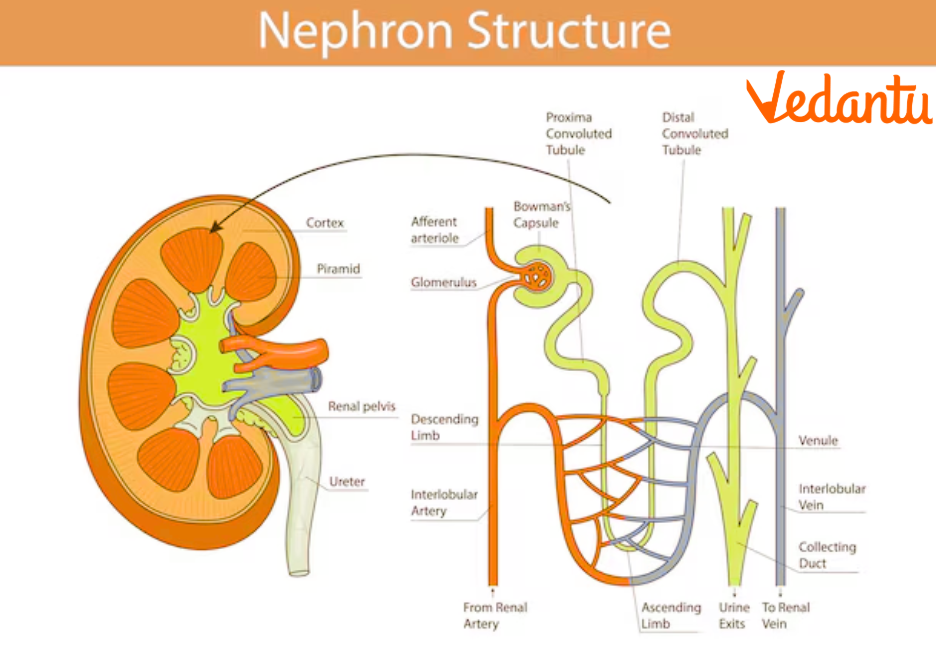
Parts of a Nephron
- Bowman’s Capsule: A cup-shaped structure that surrounds the glomerulus and collects the filtrate from blood.
- Glomerulus: A cluster of tiny capillaries where blood filtration begins. Learn more about the glomerulus.
- Proximal Convoluted Tubule (PCT): Reabsorbs water, glucose, and salts back into the blood.
- Loop of Henle: Extends into the kidney medulla; helps in concentrating urine by reabsorbing water and salts.
- Distal Convoluted Tubule (DCT): Regulates sodium, potassium, and pH; further adjusts urine composition.
- Collecting Duct: Collects urine from multiple nephrons, delivering it to the renal pelvis for excretion.
This arrangement ensures efficient filtration, reabsorption, and secretion. Understanding the structure of nephron (nephron diagram class 10, labelled nephron diagram) provides insight into how kidneys function in our daily lives.
Nephron Diagram (Simple & Class 10)
A labelled diagram of nephron is essential for visualizing how each part works. Students often draw a simple diagram of nephron with the glomerulus, tubules, and collecting ducts clearly marked. Practice nephron drawing regularly for exams.
Types of Nephron
There are two main types of nephrons in the human kidney. Each type has unique features and functional roles that contribute to the kidneys’ ability to process vast amounts of blood every day.
- Cortical Nephron: Found mostly in the outer cortex, these nephrons have shorter loops of Henle and are involved in filtration and reabsorption.
- Juxtamedullary Nephron: Located near the boundary of the cortex and medulla, with long loops of Henle; crucial for producing concentrated urine.
The difference between these nephron types highlights their specialized roles in water conservation and salt regulation, essential for survival when water is scarce.
Structure of Nephron: Detailed Explanation
Let’s describe the structure and functioning of nephron step by step. This is especially important for students in class 10 who are expected to explain the structure of nephron for their board exams.
- Blood enters the nephron through the glomerulus, where filtration occurs in the Bowman’s capsule.
- PCT reabsorbs useful solutes and water, returning them to the bloodstream.
- Loop of Henle creates a concentration gradient in the kidney medulla, crucial for water reabsorption.
- DCT further regulates ions and pH, using hormones like aldosterone for balance.
- Collecting Duct fine-tunes water content in urine, influenced by antidiuretic hormone (ADH).
Each region of the nephron structure is specialized for functions like reabsorption, secretion, or urine concentration, making the nephron far more than just a simple filter!
Function of Nephron
What is the function of nephron? Primarily, nephrons maintain the body’s internal environment. They remove waste, regulate blood pressure, and control the volume and concentration of body fluids. Let’s break down the key functions of nephron for class 10 and advanced learners:
- Filtration: Removes waste and excess substances from the blood.
- Reabsorption: Returns useful molecules and water to the bloodstream.
- Secretion: Transfers additional waste products from blood into the nephron tubule.
- Urine Formation: Produces urine, which collects in the collecting duct and drains from the kidney.
- Homeostasis: Maintains balance of salt, water, and pH in the body.
The function of nephron ensures toxic substances do not accumulate and that the body retains essential nutrients and water—a process vital to our health.
Nephron in Kidney: Real-World Importance
Nephrons in kidneys are vital for human health. A failure in nephron function can lead to kidney disorders, affecting the body’s balance. Medicine, agriculture, and even environmental studies relate to nephron efficiency and kidney health. Measurement of substances like urea or proteins in urine can indicate nephron health—a key aspect of diagnosing diseases. Refer to related topics like the human excretory system, dialysis, and kidney disorders for more information.
Differences: Alveoli vs Nephron
| Feature | Alveoli | Nephron |
|---|---|---|
| Organ | Lungs | Kidney |
| Main Function | Gas exchange (Oxygen/CO₂) | Filtration and urine formation |
| Structure | Air sacs | Tubular unit |
While both are specialized structures, alveoli exchange gases, and nephrons manage fluid and waste through urine formation.
Quick Recap: Structure and Function of Nephron
To describe the structure and function of nephron quickly: the nephron includes the glomerulus, tubules, and collecting duct. It filters blood, reabsorbs useful substances, secretes waste, and creates urine. Without the nephron's function, our bodies could not maintain chemical and fluid balance or excrete toxins effectively.
Explore More with Vedantu
Understanding the nephron not only prepares you for exams but also explains essential physiological processes. For deeper insights into biological topics, check out resources on biomolecules, animal adaptations, and genetics. Vedantu provides easy, student-friendly notes, diagrams, and expert guidance to help you master challenging concepts.
The nephron is the cornerstone of kidney function and body fluid regulation. Knowing its structure and roles helps us comprehend health, disease, and the science behind urine formation. By mastering nephron concepts, you build a solid foundation in human physiology and prepare yourself for advanced biology topics and real-life applications.


FAQs on Nephron Anatomy and Role in Urine Formation
1. What is a nephron?
A nephron is the structural and functional unit of the kidney responsible for filtering blood and forming urine. Each human kidney contains about 1–1.5 million nephrons. A nephron performs three main processes:
- Glomerular filtration – filters blood plasma
- Tubular reabsorption – reabsorbs useful substances
- Tubular secretion – removes additional wastes
2. What is the structure of a nephron?
The structure of a nephron consists of a renal corpuscle and a renal tubule. It has two main parts:
- Renal corpuscle – includes the glomerulus and Bowman’s capsule
- Renal tubule – includes the proximal convoluted tubule (PCT), Loop of Henle, distal convoluted tubule (DCT), and collecting duct
3. What is the function of the nephron?
The main function of the nephron is to filter blood and produce urine. It performs several vital roles:
- Removes nitrogenous wastes like urea and creatinine
- Regulates water and electrolyte balance
- Maintains blood pH through acid–base regulation
- Helps control blood pressure via the renin-angiotensin system
4. How does a nephron form urine step by step?
A nephron forms urine through three main steps: filtration, reabsorption, and secretion. The process occurs as follows:
- Glomerular filtration – Blood is filtered in the glomerulus into Bowman’s capsule.
- Tubular reabsorption – Glucose, amino acids, water, and ions are reabsorbed mainly in the PCT.
- Tubular secretion – Additional wastes and excess ions are secreted into the DCT.
5. What is the difference between cortical and juxtamedullary nephrons?
The main difference between cortical and juxtamedullary nephrons is the length of the Loop of Henle and their role in urine concentration. Key differences include:
- Cortical nephrons – Short Loop of Henle; mainly involved in filtration; located mostly in the cortex.
- Juxtamedullary nephrons – Long Loop of Henle; extend deep into the medulla; essential for concentrating urine.
6. Where is the nephron located in the kidney?
A nephron is located partly in the renal cortex and partly in the renal medulla. Its distribution includes:
- Glomerulus, PCT, and DCT – Located in the cortex
- Loop of Henle – Extends into the medulla
- Collecting duct – Passes through the medulla
7. What happens in the glomerulus of a nephron?
The glomerulus is the site of blood filtration in the nephron. In this structure:
- High blood pressure forces plasma into Bowman’s capsule
- Small molecules like water, glucose, salts, and urea pass through
- Large molecules such as proteins and blood cells remain in the blood
8. What is the role of the Loop of Henle?
The Loop of Henle creates a concentration gradient in the kidney medulla to concentrate urine. It has two limbs with different functions:
- Descending limb – Permeable to water; water moves out by osmosis
- Ascending limb – Impermeable to water; actively transports sodium and chloride ions out
9. How many nephrons are there in each kidney?
Each human kidney contains approximately 1 to 1.5 million nephrons. The total number varies among individuals and decreases slightly with age. Since nephrons do not regenerate significantly, damage to them can reduce kidney function over time.
10. Why is the nephron important for homeostasis?
The nephron is essential for homeostasis because it regulates the internal environment of the body. It maintains balance by:
- Controlling water levels and osmotic pressure
- Regulating electrolytes like sodium and potassium
- Maintaining blood pH
- Removing metabolic wastes



