




What is the difference between saturated and unsaturated fats in structure and function
Fats are one of the three main macronutrients, alongside carbohydrates and proteins. They play an important role in our body by providing energy, supporting hormone production, and helping the absorption of certain vitamins. However, not all fats are the same. Some fats can increase the risk of heart-related issues if consumed in excess, while others can help maintain good health when included in a balanced diet.
In this article, we will discuss saturated and unsaturated fatty acids and explore the differences for easier understanding.
Introduction
Saturated fatty acids have single bonds between carbon atoms. Foods that contain high levels of saturated fat generally stay solid at room temperature. Common sources include red meat, butter, cheese, and certain oils such as coconut oil. Although our bodies need some saturated fat, a high intake of these fats over time can contribute to increased levels of low-density lipoprotein (LDL), also called “bad” cholesterol.
Unsaturated fatty acids have at least one double bond between carbon atoms. They are usually liquid at room temperature and are often considered healthier when compared to saturated fats. These fats can increase high-density lipoprotein (HDL), commonly referred to as “good” cholesterol. Foods rich in unsaturated fats include nuts, seeds, avocados, and oils such as sunflower oil and olive oil. While unsaturated fats are healthier options, it is still crucial to maintain moderate consumption as part of a balanced diet.
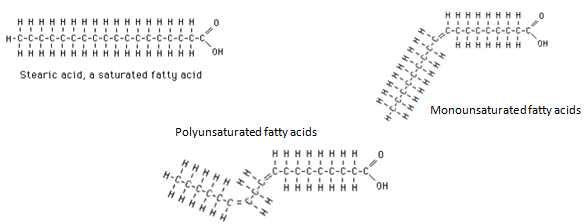
Saturated and Unsaturated Fatty Acids Examples
Examples of Saturated Fatty Acids are butter, ghee, cheese, full-fat dairy products, fatty cuts of meat, coconut oil, and palm oil.
Examples of Unsaturated Fatty Acids are olive oil, peanut oil, avocados, nuts (walnuts, almonds), seeds (flax, chia), and oily fish (salmon, mackerel).
Difference Between Saturated and Unsaturated Fatty Acids in Tabular Form
Which Is Better: Saturated Fat or Unsaturated Fat?
When comparing which is better saturated fat or unsaturated fat, health experts generally suggest prioritising unsaturated fats over saturated fats. Unsaturated fats provide several benefits, such as promoting healthy cholesterol levels and supporting cardiovascular well-being. That said, our body does need a certain amount of saturated fat. So, the focus should be on balance and quality of sources rather than eliminating saturated fats.
Moderation: Limit saturated fat intake to around 10% or less of your total daily calories.
Variety: Choose a variety of unsaturated fat sources (e.g., nuts, seeds, avocados, oily fish) to gain different essential fatty acids.
Overall Dietary Pattern: A balanced diet with fruits, vegetables, whole grains, and lean protein, along with moderate fat intake,e is key to good health.
Quick Quiz (With Answers)
Test your understanding with these short multiple-choice questions:
Which of the following fats typically remain solid at room temperature?
A. Saturated fats
B. Unsaturated fats
C. Both
Answer: A. Saturated fats
Which type of fatty acid can help raise HDL (“good” cholesterol) levels?
A. Saturated fatty acids
B. Unsaturated fatty acids
C. Trans fats
Answer: B. Unsaturated fatty acids
Which of the following is an example of a saturated fat source?
A. Olive oil
B. Sunflower oil
C. Butter
Answer: C. Butter
What is the recommended maximum daily intake of saturated fat as a percentage of total calories?
A. Less than 10%
B. Less than 20%
C. Less than 5%
Answer: A. Less than 10%
Related Topics
Learn more about important biology concepts by exploring


FAQs on Saturated vs Unsaturated Fats Key Differences and Health Impact
1. What is the difference between saturated and unsaturated fats?
The main difference between saturated fats and unsaturated fats is that saturated fats have no double bonds between carbon atoms, while unsaturated fats have one or more double bonds in their fatty acid chains.
- Saturated fats: All carbon atoms are single-bonded; usually solid at room temperature (e.g., butter).
- Unsaturated fats: Contain one or more C=C double bonds; usually liquid at room temperature (e.g., olive oil).
- The presence of double bonds changes the shape and packing of the fat molecules.
2. What are saturated fats?
Saturated fats are fats composed of fatty acids that contain only single bonds between carbon atoms and are fully saturated with hydrogen atoms.
- They have straight hydrocarbon chains.
- They pack tightly together, making them solid at room temperature.
- Common sources include animal fats like butter, cheese, and fatty meat.
3. What are unsaturated fats?
Unsaturated fats are fats that contain one or more double bonds in their fatty acid chains, which makes them less tightly packed and usually liquid at room temperature.
- They include monounsaturated fats (one double bond).
- They include polyunsaturated fats (two or more double bonds).
- Common sources include plant oils, nuts, seeds, and fish.
4. Why are unsaturated fats considered healthier than saturated fats?
Unsaturated fats are considered healthier because they help reduce harmful LDL cholesterol levels and support heart health.
- Monounsaturated fats can improve blood cholesterol balance.
- Polyunsaturated fats, such as omega-3 fatty acids, reduce inflammation.
- They are associated with a lower risk of cardiovascular disease.
5. What is the chemical structure of saturated and unsaturated fats?
The chemical structure of saturated fats contains only single carbon–carbon bonds, while unsaturated fats contain one or more carbon–carbon double bonds.
- Both are made of glycerol and three fatty acids, forming a triglyceride.
- In saturated fats, fatty acid chains are straight.
- In unsaturated fats, double bonds cause bends or kinks in the chain.
6. What are examples of saturated and unsaturated fats?
Examples of saturated fats include butter and lard, while examples of unsaturated fats include olive oil and sunflower oil.
- Saturated fats: Butter, cheese, red meat, coconut oil.
- Monounsaturated fats: Olive oil, avocados, peanuts.
- Polyunsaturated fats: Sunflower oil, flaxseed oil, fatty fish like salmon.
7. How do saturated and unsaturated fats affect cholesterol levels?
Saturated fats tend to raise LDL (low-density lipoprotein) cholesterol, while unsaturated fats can lower LDL and sometimes raise HDL (high-density lipoprotein) cholesterol.
- High LDL levels are linked to plaque buildup in arteries.
- HDL helps remove excess cholesterol from the bloodstream.
- Replacing saturated fats with unsaturated fats improves lipid profile.
8. What are monounsaturated and polyunsaturated fats?
Monounsaturated fats have one double bond in their fatty acid chain, while polyunsaturated fats have two or more double bonds.
- Monounsaturated fats (MUFA): One C=C bond; found in olive oil and avocados.
- Polyunsaturated fats (PUFA): Multiple C=C bonds; include omega-3 and omega-6 fatty acids.
- Both types are forms of unsaturated fats.
9. Why are saturated fats solid and unsaturated fats liquid at room temperature?
Saturated fats are solid at room temperature because their straight fatty acid chains pack tightly, whereas unsaturated fats are liquid because double bonds create bends that prevent tight packing.
- Saturated fatty acids: Straight chains, strong intermolecular forces.
- Unsaturated fatty acids: Kinked chains due to double bonds.
- Tighter packing results in a higher melting point.
10. Are trans fats the same as unsaturated fats?
Trans fats are a type of unsaturated fat with at least one double bond in the trans configuration, but they behave more like saturated fats in the body.
- They contain a trans double bond instead of the natural cis form.
- They are often produced by partial hydrogenation of vegetable oils.
- They increase LDL and decrease HDL cholesterol.



