




What Are the Key Differences Between Spermatogenesis and Oogenesis Process and Stages
The process of gamete formation is essential to human reproduction and genetic continuity. Two vital processes—spermatogenesis and oogenesis—are responsible for producing the male (sperm) and female (ovum) gametes, respectively. Understanding how these processes differ is crucial for students, educators, and parents alike in the study of reproductive biology.
Write Four Differences Between Spermatogenesis and Oogenesis
Spermatogenesis and oogenesis each play unique roles in forming male and female gametes. While both are types of gametogenesis, they differ in location, process, timing, and outcomes. Below is a simple tabular comparison outlining four fundamental differences between the two processes, as referenced in leading educational resources.
| Point of Difference | Spermatogenesis | Oogenesis |
|---|---|---|
| 1. Site of Occurrence | Takes place in the testes of males. | Occurs in the ovaries of females. |
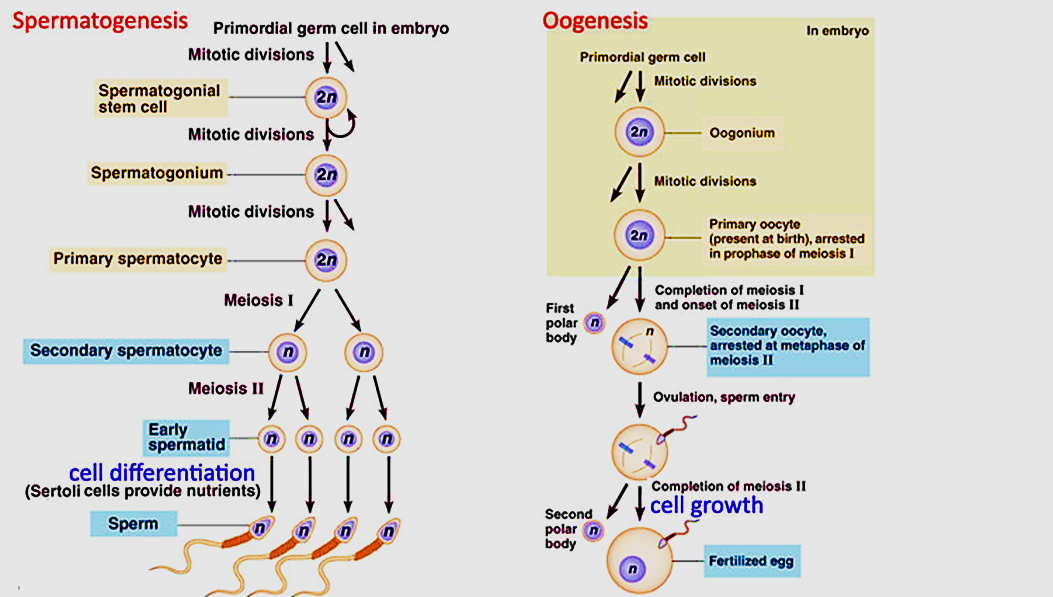
| 2. Number of Gametes Produced | From each primary spermatocyte, four functional sperm cells are formed. | From each primary oocyte, only one functional ovum is produced, along with polar bodies. |
| 3. Timing and Continuity | A continuous process starting at puberty, continuing throughout life. | A discontinuous process that begins before birth, pauses, and completes only after fertilisation. |
| 4. Division of Cytoplasm | Cytokinesis is equal — resulting in four similar sized sperm cells. | Cytokinesis is unequal — resulting in one large ovum and smaller polar bodies. |
Explanation with Examples
Spermatogenesis ensures that millions of motile sperm are produced continuously in males, maintaining fertility throughout the reproductive years. For example, in a healthy male, spermatogenesis generates several million sperm every day, all of which are capable of fertilizing an ovum.
Oogenesis, in contrast, produces one mature ovum per menstrual cycle. The process starts before the birth of a female, with primary oocytes getting arrested until puberty. Upon ovulation, usually only one ovum completes the process and is available for fertilisation—thus, far fewer ova are produced compared to sperm.
Step-by-Step Breakdown of Each Process
Spermatogenesis:
- Occurs in the seminiferous tubules of the testes.
- Begins with spermatogonia (male germ cells) multiplying by mitosis.
- Primary spermatocytes undergo meiosis, leading to four haploid spermatids per cycle.
- Spermatids differentiate into mature, motile sperm.
Oogenesis:
- Occurs in the ovary, starting before a female is born.
- Oogonia divide mitotically and form primary oocytes, which arrest in meiosis until puberty.
- After puberty, each menstrual cycle, usually one oocyte resumes meiosis and forms a secondary oocyte and polar body.
- Meiosis completes only upon fertilisation, yielding a single ovum and additional polar bodies.
Key Definitions and Biological Significance
Spermatogenesis is the formation process of sperm cells in the male reproductive system. It ensures continuous availability of male gametes for fertilisation.
Oogenesis is the formation process of ova in the female reproductive system, essential for providing the cytoplasm and nutrients the early embryo needs. The formation of only one large ovum ensures that the resulting zygote has sufficient resources for early development.
Further Vedantu Resources
Practice Questions
- List four differences between spermatogenesis and oogenesis.
- Why does oogenesis produce only one ovum, while spermatogenesis produces four sperm?
- Explain the significance of unequal cytokinesis in oogenesis.
- Draw the process of oogenesis and label each stage.
Understanding these differences in gamete formation helps clarify many concepts in reproductive biology and is foundational knowledge for advanced studies and exams.


FAQs on Differences Between Spermatogenesis and Oogenesis in Human Reproduction
1. What is the difference between spermatogenesis and oogenesis?
The main difference between spermatogenesis and oogenesis is that spermatogenesis produces four functional sperm cells, while oogenesis produces one functional ovum and three polar bodies.
- Spermatogenesis occurs in the testes and results in four small, motile spermatozoa.
- Oogenesis occurs in the ovaries and produces one large, non-motile ovum and three polar bodies.
- Spermatogenesis is continuous after puberty, whereas oogenesis begins before birth and proceeds cyclically after puberty.
2. What is spermatogenesis?
Spermatogenesis is the process by which male germ cells develop into mature sperm cells in the testes.
- It occurs in the seminiferous tubules of the testes.
- It starts at puberty and continues throughout life.
- A spermatogonium undergoes mitosis and meiosis to form four haploid spermatozoa.
3. What is oogenesis?
Oogenesis is the process by which female germ cells develop into a mature ovum in the ovaries.
- It begins during fetal development with the formation of primary oocytes.
- Meiosis pauses at prophase I until puberty.
- Each primary oocyte produces one functional ovum and three polar bodies after meiosis.
4. Where do spermatogenesis and oogenesis occur?
Spermatogenesis occurs in the seminiferous tubules of the testes, while oogenesis occurs in the ovarian follicles of the ovaries.
- In males, developing sperm cells are supported by Sertoli cells inside the seminiferous tubules.
- In females, developing oocytes are surrounded by follicular cells within ovarian follicles.
5. How many gametes are produced in spermatogenesis and oogenesis?
Spermatogenesis produces four functional sperm cells, whereas oogenesis produces one functional ovum from each primary germ cell.
- One primary spermatocyte → four haploid spermatozoa.
- One primary oocyte → one haploid ovum + three polar bodies.
6. Why does oogenesis produce polar bodies but spermatogenesis does not?
Oogenesis produces polar bodies because the cytoplasm divides unequally to concentrate nutrients in one large ovum.
- During female meiosis, most cytoplasm is retained in one cell.
- The smaller cells formed are called polar bodies and usually degenerate.
- In spermatogenesis, cytoplasm divides equally, producing four functional sperm cells.
7. When do spermatogenesis and oogenesis begin?
Spermatogenesis begins at puberty, while oogenesis begins before birth during fetal development.
- In males, spermatogonia become active at puberty.
- In females, primary oocytes are formed before birth and remain arrested in prophase I until puberty.
- Oogenesis resumes cyclically after puberty during each menstrual cycle.
8. How long does spermatogenesis and oogenesis take?
Spermatogenesis takes about 64–74 days in humans, whereas oogenesis can take years due to meiotic arrest.
- Spermatogenesis is a continuous process completed in a few months.
- Oogenesis starts before birth and may remain paused until fertilization.
- The second meiotic division in oogenesis completes only after fertilization.
9. What are the similarities between spermatogenesis and oogenesis?
Both spermatogenesis and oogenesis are processes of gametogenesis that produce haploid gametes through meiosis.
- Both occur in the gonads (testes and ovaries).
- Both involve mitosis followed by meiosis I and meiosis II.
- Both result in genetically unique haploid cells.
10. Why is spermatogenesis continuous but oogenesis cyclic?
Spermatogenesis is continuous to ensure a constant supply of sperm, while oogenesis is cyclic because it is regulated by the menstrual cycle and hormonal changes.
- Male reproduction requires millions of sperm daily for successful fertilization.
- Female reproduction typically releases one ovum per cycle.
- Hormones like FSH and LH regulate both processes differently in males and females.



