




What Is Excretion in Plants Definition Process Types and Examples
Excretion in plants is a crucial process by which living plants remove waste products formed during their metabolic activities. This natural waste elimination is vital for plant health and balance within their cellular systems. Understanding how plants excrete waste not only helps us in biology class, but also reveals important links to agriculture, biotechnology, and environmental science.
Excretion in Plants: Definition and Overview
Excretion in plants refers to the process of removing or managing unnecessary and toxic metabolic waste substances produced during various plant activities, such as respiration and photosynthesis. Unlike animals, plants do not possess specialized excretory organs. Instead, they apply several simple yet efficient mechanisms to maintain homeostasis and avoid accumulation of harmful byproducts.
Why is Excretion Important in Plants?
The importance of excretion in plants lies in maintaining internal chemical balance, supporting healthy growth, and preventing cellular damage. By efficiently removing or neutralizing waste, plants avoid toxic buildup that could otherwise disrupt essential life functions. In an ecological context, plant excretion contributes substances like oxygen to the environment, thereby supporting life on Earth.
How Do Plants Excrete Waste?
Plants handle excretory products through multiple methods, depending on the type and nature of the waste. Their processes are passive and spread throughout different plant parts. This section explains the major mechanisms plants use for excretion.
- Transpiration: Excess water, along with certain minerals, is excreted through small openings in leaves called stomata. This process also helps cool the plant.
- Diffusion: Gaseous wastes like oxygen (from photosynthesis) and carbon dioxide (from respiration) diffuse out through stomata and lenticels (tiny pores on stems).
- Storage in Parts to be Shed: Plants often store solid wastes such as tannins, resins, and oils in leaves, bark, or old xylem. These parts are later shed, permanently removing the waste.
- Conversion to Harmless Compounds: Some waste products are converted into non-toxic or even useful secondary metabolites, such as essential oils and natural gums.
- Guttation: Under certain conditions, plants excrete excess water as droplets from leaf edges, a process known as guttation.
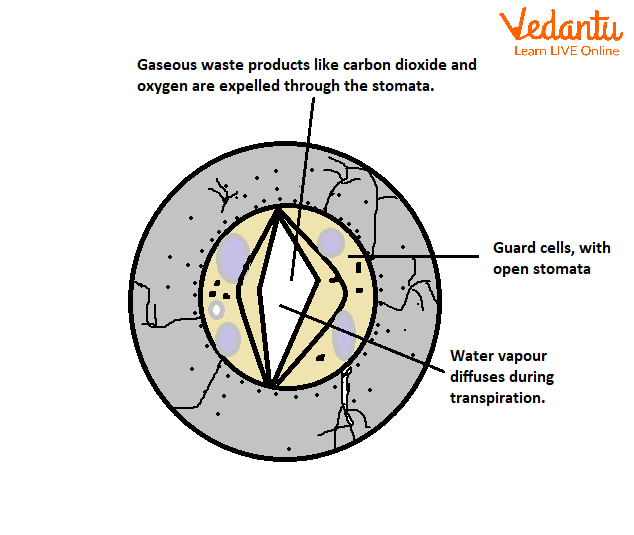
For more about water movement in plants, explore transpiration and related mechanisms.
Major Excretory Products of Plants and Their Uses
Excretory products in plants vary based on their metabolism and physiological activities. Many of these substances even have economic or ecological significance for humans and animals.
- Oxygen: Released as a byproduct during photosynthesis, essential for animal and human life.
- Tannins: Stored in leaves and bark; used in the leather industry and as natural astringents.
- Resins: Collected in older stems and branches; serve as the raw material for varnishes and glazing agents.
- Gums: Formed in stems and bark; used as natural adhesives and in food/textile industries.
- Essential Oils: Stored mainly in leaves; valuable in medicine, aromatherapy, and perfumes.
- Latex: Stored in specific vessel systems; used to produce natural rubber.
Some plant wastes support organic farming. For example, shed bark and fallen leaves decompose to make manure, naturally enriching soils (manure).
Detailed Look: How Do Leaves Help in Excretion?
Leaves are the principal sites of water and gaseous exchange in the plant. Let's see how they play a key role in excretion:
- Stomata: Tiny adjustable pores located on the leaf surface. Oxygen exits after photosynthesis, and carbon dioxide exits after respiration.
- Transpiration: Excess water evaporates from stomata, maintaining water balance and pulling minerals upward from roots.
- Storage and Shedding: Toxic wastes accumulate in leaves and are removed from the plant when leaves fall during abscission.
- Guttation: In certain conditions, specialized leaf tip cells (hydathodes) release water droplets, expelling mineral-rich solutions.
Leaves therefore function as both a 'waste outlet' and a storage unit for substances that might be harmful if retained.
Key Features and Interesting Facts about Excretion in Plants
- No specialized excretory organs: Plants use their natural structures for excretion without any dedicated system.
- Dual benefits: Many excretory products, such as oxygen, benefit the environment and other living beings.
- Recycling: Certain waste gases, like carbon dioxide from respiration, are reused in photosynthesis.
- Protective function: Some excreted substances deter herbivores or pathogens, protecting the plant.
- Slow metabolism: Plants produce less toxic waste than animals, so simpler processes suffice.
Plants' efficient and eco-friendly excretion mechanisms ensure their survival across diverse habitats, from grasslands to dense forests. For more on plant adaptations, visit adaptations in plants.
Difference Between Plant and Animal Excretion
| Feature | Plant Excretion | Animal Excretion |
|---|---|---|
| Excretory System | No specialized organs; uses leaves, stem, etc. | Specialized organs (e.g., kidneys, liver, skin) |
| Types of Wastes | Oxygen, CO2, water, secondary metabolites | CO2, urea, uric acid, sweat, etc. |
| Removal Method | Diffusion, transpiration, shedding, storage | Filtration, secretion, active transport |
| Metabolic Rate | Slower | Faster |
| Reuse of Wastes | Often reused (e.g., CO2 in photosynthesis) | Rarely reused |
This table highlights the primary distinctions between excretion in plants and animals, emphasizing plants' less complex yet highly effective waste management strategies. To dive deeper, see how human excretory systems compare.
Real-World Applications and Environmental Impact
Understanding excretion in plants is vital for agriculture, environmental conservation, and biotechnology. Many plant wastes, such as essential oils and latex, are widely used in medicine, industry, and art. Moreover, by excreting oxygen, plants are essential allies in combating air pollution and supporting all aerobic life.
Organic composting leverages leaf and bark waste to enrich soils and support sustainable farming. For more about eco-environmental topics, see effects of climate changes or learn how plants help manage air and water quality.
Quick Excretion in Plants Notes for Exams
- Plants lack specialized excretory organs.
- Primary excretion methods: diffusion, transpiration, guttation, storage and shedding.
- Main excretory products: oxygen, carbon dioxide, water, tannins, gums, resins, latex.
- Waste is often stored in leaves or bark, which are later shed.
- Several waste products are useful to humans (e.g., oxygen, essential oils, rubber).
Excretion in Plants: Class 12 Diagram and Explanation
When studying excretion in plants for class 12, including a well-labelled diagram greatly aids understanding. Practice drawing and labelling stomata, lenticels, hydathodes, leaves, and points of gaseous exchange for clear answers in excretion in plants MCQs or short notes questions. To see more plant anatomy diagrams, check important biology diagrams.
Practice Questions on Excretion in Plants
- Define excretion in plants and state its importance.
- List three excretory products of plants useful for humans.
- Explain the role of stomata in plant excretion with a diagram.
- How does excretion in plants differ from excretion in animals?
- Describe how leaves participate in the excretion process.
For more practice and to learn about the difference between acquired and inherited traits, or to explore how plant excretion ties into broader life processes, Vedantu offers comprehensive study support and resources for every biology student.
Excretion in plants illustrates nature’s elegant balance between life, waste management, and resource recycling. From simple diffusion to the production of economically valuable byproducts, plant excretion reveals both practical and ecological lessons. Understanding these processes equips students for exams and helps appreciate the vital role of plants in environmental stability and human well-being.


FAQs on Excretion in Plants and How Plants Remove Wastes
1. What is excretion in plants?
Excretion in plants is the process of removing metabolic waste products produced during life processes. Unlike animals, plants do not have specialized excretory organs; instead, they eliminate wastes through:
- Stomata (release of gases like oxygen and carbon dioxide)
- Lenticels (gaseous exchange in woody stems)
- Roots (excretion of some substances into the soil)
- Storage in leaves, bark, or vacuoles that are later shed
2. What are the main waste products in plants?
The main waste products in plants include gases, excess water, and secondary metabolites formed during metabolism. Common plant wastes are:
- Oxygen (by-product of photosynthesis)
- Carbon dioxide (from respiration)
- Water vapor (lost during transpiration)
- Resins, gums, latex, and tannins
- Excess salts and organic acids
3. How do plants remove waste gases?
Plants remove waste gases mainly through diffusion via stomata and lenticels. The process occurs as follows:
- Stomata on leaves allow oxygen and carbon dioxide to diffuse out
- Lenticels in woody stems enable gaseous exchange
- Diffusion occurs along a concentration gradient
4. Do plants have excretory organs like animals?
No, plants do not have specialized excretory organs like kidneys in animals. Instead, plants manage waste by:
- Simple diffusion of gases
- Storage of wastes in vacuoles
- Depositing wastes in leaves or bark that later fall off
- Secreting substances like gums and resins
5. What is the role of stomata in excretion in plants?
Stomata play a key role in excretion by allowing the removal of gaseous wastes and excess water vapor. Their functions include:
- Releasing oxygen produced during photosynthesis
- Removing carbon dioxide from respiration
- Facilitating transpiration (loss of water vapor)
6. How do plants store waste products?
Plants store waste products in specific tissues or cellular compartments to prevent toxicity. Storage methods include:
- Accumulation in vacuoles inside cells
- Storage in old leaves, bark, and heartwood
- Deposition as crystals like calcium oxalate
7. What is transpiration and how is it related to excretion?
Transpiration is the loss of excess water in the form of water vapor from aerial parts of plants, mainly through stomata. It is related to excretion because:
- It removes excess water absorbed by roots
- It helps eliminate small amounts of dissolved wastes
- It maintains internal water balance
8. What are some examples of excretory products in plants?
Examples of excretory products in plants include secondary metabolites and metabolic by-products. Common examples are:
- Latex in rubber plants
- Resin in pine trees
- Gums and tannins
- Crystals of calcium oxalate
9. How do roots help in excretion in plants?
Roots help in excretion by releasing certain waste substances into the surrounding soil. This occurs through:
- Excretion of excess salts
- Release of organic acids and other metabolic wastes
- Diffusion into the soil solution
10. Why is excretion important in plants?
Excretion is important in plants because it prevents the accumulation of toxic metabolic wastes and maintains internal balance. Its importance includes:
- Removal of harmful by-products of photosynthesis and respiration
- Regulation of water balance through transpiration
- Maintenance of cellular health and proper metabolism



