




What Is the Process of Feeding and Digestion in Amoeba with Diagram and Functions
Feeding and Digestion in Amoeba is a fascinating biological process seen in this simple unicellular organism. Understanding how Amoeba captures, digests, absorbs, and utilizes food helps explain not only cell biology but also basic life functions. This topic is important for students and forms a major part of class 12 Biology, as well as for those interested in nutrition and cellular mechanisms.
Feeding and Digestion in Amoeba: Definition & Overview
Feeding and digestion in Amoeba refers to the way this unicellular organism obtains food from its surroundings and processes it to release nutrients. Amoeba shows holozoic nutrition—taking in solid food, digesting it, absorbing nutrients, and ejecting waste. Its flexible and ever-changing shape, caused by its simple cell membrane and cytoplasm, helps it efficiently capture food and carry out intracellular digestion.
How Does Amoeba Obtain and Digest Its Food?
Amoeba mainly feeds on small organisms found in water, such as bacteria and algae. It detects food by movement or chemical signals and reaches towards it by extending finger-like projections known as pseudopodia. The core steps of feeding and digestion in amoeba definition are explained through a sequential process called phagocytosis. This ability places Amoeba among excellent examples of unicellular adaptation.
Modes of Nutrition in Amoeba
Amoeba exhibits heterotrophic nutrition, relying on other organisms for food, unlike plants which are autotrophic. The main mode is holozoic nutrition, which includes:
- Phagocytosis: Engulfing solid particles by flow of cytoplasm.
- Pinocytosis: Absorbing tiny liquid droplets by invagination of the cell membrane.
For a broader understanding, you can read about difference between autotrophs and heterotrophs and nutrition in living organisms.
Process of Nutrition in Amoeba
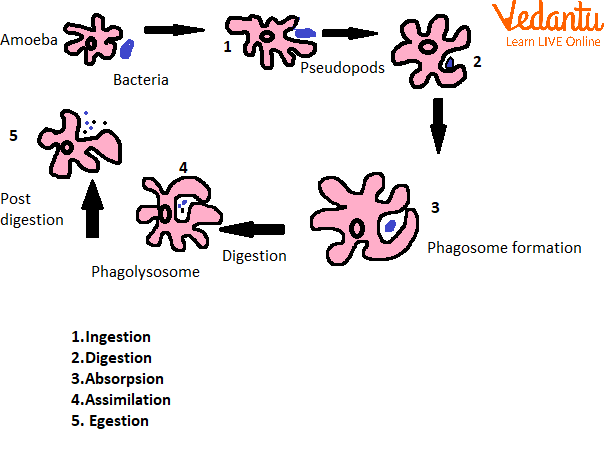
The feeding and digestion in amoeba diagram explains five key steps, ensuring the cell meets its daily energy needs. It acts as a model to understand digestion in other organisms too.
- Ingestion: Amoeba forms pseudopodia to surround and engulf the food particle, creating a food vacuole.
- Digestion: The food vacuole fuses with lysosomes; digestive enzymes break down food into simpler substances.
- Absorption: Digested nutrients pass from the vacuole into the cytoplasm by diffusion.
- Assimilation: The absorbed nutrients are used for growth, repair, and energy within the cell.
- Egestion: Undigested waste is expelled out by bringing the food vacuole to the cell membrane, which opens to release waste outside.
These steps are important not only for feeding and digestion in amoeba class 12 topics but are also used as basis in teeth and digestion and other multicellular organism studies.
The Role of Pseudopodia in Amoeba Feeding
Pseudopodia are temporary, finger-shaped projections of the cytoplasm. They are the most important structures for both movement and food capture in Amoeba. When sensing food, the amoeba’s membrane flows outward to form pseudopodia around the target. This process, called “phagocytosis,” encloses solid food particles in a food vacuole. Their flexibility is crucial for survival and efficient feeding in constantly changing environments.
Intracellular Digestion: What Happens Inside the Amoeba?
Digestion in amoeba takes place inside the cell. Once a food vacuole forms, enzymes from lysosomes break down the captured food. This process occurs in each vacuole, ensuring the cytoplasm is not harmed by digestive enzymes. Absorbed nutrients are distributed through diffusion. Intracellular digestion is a key difference compared to humans and other multicellular animals, where digestion is extracellular.
Key Features and Adaptations of Amoeba
- No fixed body shape: Amoeba appears like a jelly-like blob, allowing it to move and feed flexibly.
- Single-celled: All life processes—including feeding, digestion, and reproduction—occur within one cell.
- Food vacuole: Acts as a temporary ‘stomach’ for digestion, unlike the digestive tracts in higher animals.
- Engulfs solid and liquid food: Via pseudopodia (for solids) and pinocytosis (for liquids).
- Contractile vacuole: Maintains osmoregulation, preventing the cell from bursting. For more, visit osmoregulation.
Feeding and Digestion in Amoeba: Real-World Relevance
Understanding amoeba’s nutrition has practical applications. For instance, the human immune system uses a similar process called phagocytosis to destroy bacteria. Medical science has found that the concept of food vacuoles inspired innovations in food science and microbiology. Studying amoeba feeding also helps diagnose diseases like amoebic dysentery that affect humans.
Feeding and Digestion in Amoeba: Examples and Short Notes
- **Capturing bacteria**: When amoeba meets a bacterium, it forms pseudopodia around it and engulfs it.
- **Absorbing nutrients**: Amoeba absorbs digested sugar, proteins, and fats directly into its cytoplasm for growth.
- **Ejecting waste**: The cell moves undigested waste to the membrane and expels it easily—this keeps the cell clean and healthy.
These instances in feeding and digestion in amoeba examples give insight into how unicellular life solves challenges we see at larger scales in complex animals and humans.
Interesting Facts about Amoeba
- Flexibility: Amoeba can change shape to escape predators or move toward food.
- Multipurpose organelles: All life functions—movement, digestion, even reproduction—occur in one cell.
- Medical link: Some amoeba species cause diseases; studying their feeding helps in medicine.
Comparison: Digestion in Amoeba vs. Human Beings
| Aspect | Amoeba | Humans |
|---|---|---|
| Type of Digestion | Intracellular (inside food vacuoles) | Extracellular (in digestive tract) |
| Specialized Organs | No, all in one cell | Yes, multiple organs |
| Food Capture | Pseudopodia, endocytosis | Mouth, teeth, hands |
| Waste Removal | Direct through cell membrane | Via anus after digestion |
This table summarizes the main differences between feeding and digestion in amoeba and in complex animals like humans. Each method suits the organism’s structure and lifestyle.
Feeding and Digestion in Amoeba: MCQs for Practice
- Which organelle performs digestion in Amoeba? (A) Food vacuole (B) Nucleus (C) Mitochondria (D) Ribosome
- What is the process called when Amoeba engulfs solid food? (A) Diffusion (B) Phagocytosis (C) Pinocytosis (D) Active transport
- How does Amoeba expel undigested food? (A) Through cilia (B) By exocytosis at the cell membrane (C) Using the nucleus (D) Flagella
You can find more feeding and digestion in amoeba questions in Vedantu’s Biology MCQ section.
Feeding and Digestion in Amoeba: Diagram
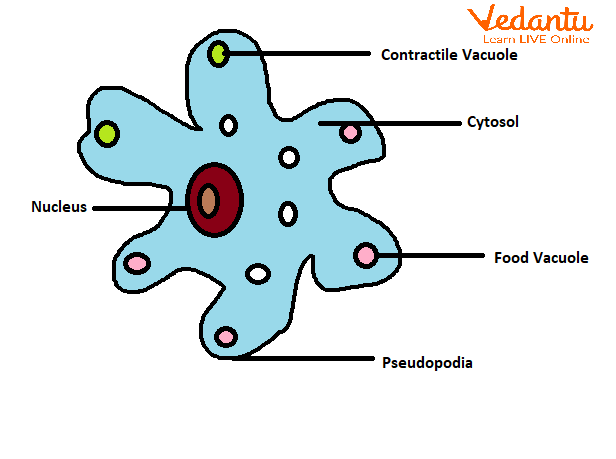
A well-labelled feeding and digestion in amoeba diagram shows pseudopodia, nucleus, contractile vacuole, food vacuole, and cytoplasm. It’s a valuable tool for study and exam preparation. For more visual learning, explore Amoeba diagrams and other biology diagrams at Vedantu.
Further Reading and Related Biology Topics
To expand your knowledge on feeding and digestion, check out these related concepts:
- Cell Theory and Unicellular Life
- Teeth and Digestion in Animals
- Animal Adaptations
- Life Processes in Biology
- Nutrient Functions for Growth and Health
Feeding and digestion in Amoeba is a well-studied, classic model for understanding nutrition and cell biology. This page described its definition, main steps, special features, and real-world applications. Use these insights for your next exam, project, or to appreciate life’s complexity—even in the tiniest cells.


FAQs on Feeding and Digestion in Amoeba Explained Step by Step
1. What is feeding in Amoeba?
Feeding in Amoeba is the process by which it captures, engulfs, and digests food particles through phagocytosis. Amoeba is a unicellular organism that feeds on microscopic organisms like bacteria and algae. The process involves:
- Extending pseudopodia to surround the food
- Engulfing the food to form a food vacuole
- Digesting the food with enzymes inside the vacuole
2. How does digestion take place in Amoeba?
Digestion in Amoeba takes place inside a food vacuole with the help of digestive enzymes. After food is engulfed:
- The food is enclosed in a vacuole
- Digestive enzymes are secreted into the vacuole
- Complex food substances are broken down into simpler soluble substances
3. What are pseudopodia in Amoeba and what is their function?
Pseudopodia are temporary finger-like projections of cytoplasm that help Amoeba in movement and feeding. The term pseudopodia means “false feet.” Their main functions are:
- Engulfing food particles during phagocytosis
- Helping in locomotion by changing the cell’s shape
4. What is holozoic nutrition in Amoeba?
Holozoic nutrition in Amoeba is a mode of nutrition in which solid food is ingested, digested, absorbed, and egested. In this process:
- Food is ingested using pseudopodia
- Digestion occurs inside a food vacuole
- Nutrients are absorbed into the cytoplasm
- Undigested waste is expelled out
5. What is a food vacuole in Amoeba?
A food vacuole in Amoeba is a membrane-bound sac that contains the engulfed food for digestion. It is formed when pseudopodia surround and enclose a food particle. Inside the food vacuole:
- Digestive enzymes break down food
- Nutrients diffuse into the cytoplasm
- Waste material remains until egestion
6. How is food absorbed and assimilated in Amoeba?
Absorption in Amoeba occurs when digested nutrients diffuse from the food vacuole into the cytoplasm. After digestion:
- Simple soluble substances pass into the cytoplasm
- The nutrients are used for energy, growth, and repair
7. How does egestion occur in Amoeba?
Egestion in Amoeba occurs when undigested food is expelled through the cell membrane. After digestion and absorption:
- The food vacuole moves toward the surface of the cell
- The vacuole fuses with the cell membrane
- Waste material is thrown out of the body
8. Is digestion in Amoeba intracellular or extracellular?
Digestion in Amoeba is intracellular because it occurs inside the cell within a food vacuole. Unlike humans, Amoeba does not have specialized digestive organs. Instead:
- Food is enclosed in a food vacuole
- Digestive enzymes act within the vacuole
9. What are the steps of feeding and digestion in Amoeba?
The steps of feeding and digestion in Amoeba include ingestion, digestion, absorption, assimilation, and egestion. These steps occur as follows:
- Ingestion – Food is engulfed by pseudopodia
- Digestion – Enzymes break down food inside the food vacuole
- Absorption – Nutrients diffuse into the cytoplasm
- Assimilation – Nutrients are utilized for energy and growth
- Egestion – Undigested matter is expelled
10. How is feeding in Amoeba different from feeding in humans?
Feeding in Amoeba differs from feeding in humans because Amoeba performs intracellular digestion while humans perform extracellular digestion. The key differences are:
- Amoeba uses pseudopodia to engulf food, while humans use a mouth
- Digestion in Amoeba occurs inside a food vacuole, while in humans it occurs in the digestive tract
- Amoeba is unicellular, whereas humans are multicellular with specialized organs



