




What Is Fertilization in Plants and How Does Double Fertilization Occur
Fertilisation in plants is the joining (fusion) of male and female gametes to form a diploid zygote. This process is a crucial part of sexual reproduction and usually occurs after pollination has successfully transferred pollen grains from the anther (male part) to the stigma (female part). In flowering plants (angiosperms), fertilisation was first discovered by Ralph B. Strasburger in 1884.
Fertilisation Process in Plants
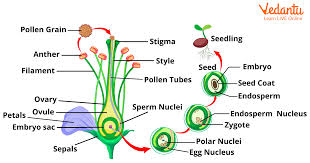
Pollination: In many flowering species, pollination in plants is carried out by animals such as honeybees, birds, bats, and butterflies. Wind and water can also serve as natural pollinating agents. Once the pollen grain lands on the stigma, it starts to germinate.
Pollen Tube Formation: After germination, the pollen grain develops a pollen tube, which grows through the style to reach the ovary.
Entry into the Ovule: The pollen tube enters the ovule through a small opening called the micropyle. Upon reaching the embryo sac, the pollen tube bursts, allowing the male nucleus to be released.
Fusion of Gametes: One male gamete fuses with the egg (female gamete), forming the diploid zygote. This zygote later divides and develops into an embryo.
Seed Formation: After fertilisation, the ovule matures into a seed, which protects the growing embryo. Eventually, seed dispersal happens through various agents like wind, water, or animals, ensuring that plants can colonise new habitats.
Types of Fertilisation
Depending on how the pollen tube enters the ovule, fertilisation can be divided into three types:
Porogamy:
The most common type in angiosperms.
The pollen tube enters the ovule directly through the micropyle.
Chalazogamy:
Observed in plants belonging to the genus Casuarina.
The pollen tube enters the ovule through the chalaza (the region opposite the micropyle).
Mesogamy:
Commonly seen in certain Cucurbit plants (such as pumpkins, ridge gourds, and bitter gourds).
The pollen tube enters the ovule through its middle region or through the integuments.
Double Fertilisation
Double fertilisation is unique to angiosperms. In this mechanism:
One male gamete fuses with the egg cell to form the zygote.
The other male gamete unites with two polar nuclei in the embryo sac to form the triploid endosperm.
The endosperm provides essential nutrients to the developing embryo, making double fertilisation highly efficient for plant growth and reproduction.
Significance of Fertilisation
Genetic Variation: Since fertilisation involves the fusion of male and female gametes, it introduces genetic diversity in the offspring.
Seed and Fruit Formation: Successful fertilisation leads to the formation of seeds and often the development of fruit around the seed.
Continuation of the Species: By producing new seeds that undergo seed dispersal, plants can spread to different regions and maintain their populations over generations.
Efficient Nutrient Use: Double fertilisation ensures that endosperm (the food source) is only created after the egg is fertilised, preventing wastage of resources.
Quick Quiz (With Answers)
Question: Which scientist discovered fertilisation in flowering plants in 1884?
Answer: Ralph B. Strasburger
Question: In double fertilisation, which cell fuses with the two polar nuclei?
Answer: The second male gamete (sperm cell)
Question: What is the role of endosperm in seed development?
Answer: It provides essential nutrients to the developing embryo.
Related Topics


FAQs on Fertilization in Plants Explained Clearly
1. What is fertilization in plants?
Fertilization in plants is the process by which the male gamete fuses with the female gamete to form a zygote. In flowering plants, this occurs inside the ovule after pollination. The zygote later develops into an embryo, which becomes the new plant. Fertilization ensures genetic variation and continuation of the plant life cycle.
2. How does fertilization occur in flowering plants?
Fertilization in flowering plants occurs through a series of steps involving pollination and fusion of gametes inside the ovule.
- Pollination: Transfer of pollen from anther to stigma.
- Pollen germination: Pollen tube grows through the style toward the ovule.
- Pollen tube entry: It enters the ovule through the micropyle.
- Fusion of gametes: Male gamete fuses with the egg cell to form a zygote.
3. What is double fertilization in plants?
Double fertilization is a unique process in angiosperms where two fusion events occur inside the ovule. One male gamete fuses with the egg cell to form a zygote (syngamy), while the other fuses with two polar nuclei to form the endosperm (triple fusion). The endosperm provides nutrition to the developing embryo, making double fertilization a defining feature of flowering plants.
4. What is the difference between pollination and fertilization in plants?
Pollination is the transfer of pollen, whereas fertilization is the fusion of male and female gametes.
- Pollination: Occurs on the stigma; involves movement of pollen grains.
- Fertilization: Occurs inside the ovule; involves fusion of gametes.
- Pollination happens before fertilization.
- Fertilization results in zygote formation.
5. Where does fertilization take place in plants?
Fertilization in flowering plants takes place inside the ovule, which is located in the ovary of the flower. After pollination, the pollen tube carries male gametes to the embryo sac within the ovule. The actual fusion of gametes occurs inside the embryo sac, leading to zygote and endosperm formation.
6. What happens after fertilization in plants?
After fertilization, the zygote develops into an embryo and the ovule transforms into a seed.
- Zygote → develops into embryo.
- Endosperm → provides nourishment.
- Ovule → becomes seed.
- Ovary → develops into fruit.
7. What is the role of the pollen tube in fertilization?
The pollen tube transports male gametes from the pollen grain to the ovule for fertilization. After landing on the stigma, the pollen grain germinates and forms a pollen tube that grows through the style. It enters the ovule via the micropyle and releases two male gametes into the embryo sac, enabling double fertilization.
8. Why is fertilization important in plants?
Fertilization is important because it leads to the formation of seeds and ensures genetic variation. It:
- Produces a zygote that develops into a new plant.
- Forms endosperm for embryo nourishment.
- Initiates seed and fruit formation.
- Maintains species continuity through sexual reproduction.
9. What are the types of fertilization in plants?
The main types of fertilization in plants are single fertilization and double fertilization.
- Single fertilization: One male gamete fuses with one female gamete (common in non-flowering plants).
- Double fertilization: Two fusion events occur (unique to angiosperms).
10. Can you give an example of fertilization in a flowering plant?
An example of fertilization in a flowering plant is seen in pea (Pisum sativum). After pollination, the pollen tube grows into the ovule and releases two male gametes. One fuses with the egg cell to form a zygote, and the other fuses with polar nuclei to form endosperm. The ovule develops into a seed, and the ovary becomes a pod (fruit).



