




What Is Health Definition Dimensions and Determinants in Biology
You might be knowing that health does not only mean the absence of disease, it is a state of overall well-being. Being in good health refers to not just the absence of illness or disability but also the whole physical, mental, and social well-being. Every human being, regardless of ethnicity, religion, political beliefs, economic situation, or social standing, has the fundamental right to the enjoyment of the highest degree of health that is reasonably practicable.
Health
Definition of Health
A healthy idea emphasises both physical capabilities and social and personal resources. This indicates that health is a resource to support a person's role in a larger society rather than being a goal in and of itself. The means to live a complete life with meaning and purpose are provided by a healthy lifestyle.
Health Education
Through education-driven voluntary behaviour change initiatives, health education promotes health and prevents disease, disability, and early death. It draws on the fields of biology, the environment, psychology, physical science, and medicine.
‘Health’ According to the WHO
WHO health criteria from 1948 define Health as - A condition of full bodily, mental, and social well-being that goes beyond simply being free from illness or infirmity.
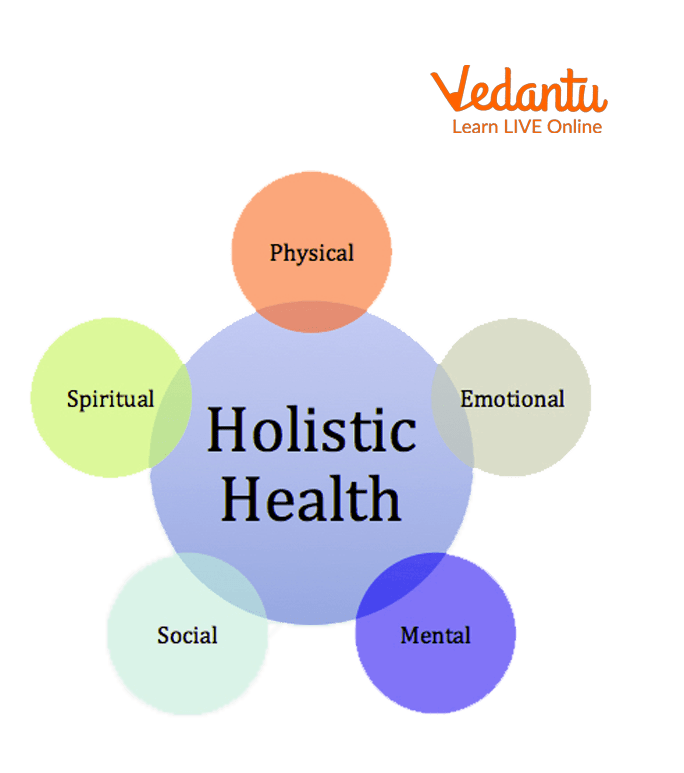
Holistic Health Approach
What is Health-Giving?
Healthy givers encourage others to seek expert care for their physical or mental health as opposed to creating adjustments that make it easier for them to put it off. By trying to regulate or supervise their transformation, they don't try to fix people with complex issues who don't want to be fixed.
Aim of Health Education
Health education is crucial because it raises the nation's health standards. Additionally, it aids in illness prevention and increases people's awareness of their health situations. Most notably, it emphasises both physical and mental health in addition to others.
Interesting Facts
Your mouth contains more bacteria than there are humans on the planet.
Sleeping burns more calories than watching television.
The average lifespan of a right-handed person is nine years longer than a left-handed person.
In the morning compared to the evening, you are around 1 cm taller.
Important Questions
1. How can we improve health?
Ans: Health can be improved by exercise, maintaining personal and environmental hygiene, and eating healthy and fresh food.
2. What is a healthy lifestyle?
Ans: A healthy lifestyle is defined as a way of living that reduces the risk of being seriously ill or dying early or due to any disease.
3. What are the benefits of a healthy lifestyle?
Ans: The healthy lifestyle protects us from serious health problems like diabetes or obesity.
Practice Questions
How does lifestyle affect health?
Why is health important in life?
What are the different types of health?
Define health in Biology.
Conclusion
Living a productive life is intimately correlated with being in excellent health. The numerous organs in the body work together to function. The health of the organs is crucial for their optimal operation. Having excellent health is significant since it refers to the state of being physically, mentally, and socially healthy.


FAQs on Health in Biology Meaning Dimensions and Importance
1. What is health in biology?
Health in biology is the state of complete physical, mental, and social well-being, not merely the absence of disease. In biological terms, health reflects proper functioning of body systems and maintenance of homeostasis.
- Balanced internal environment (temperature, pH, glucose levels)
- Efficient functioning of organs and organ systems
- Ability to adapt to environmental changes and stress
- Freedom from chronic infections and disorders
2. What is the difference between health and disease?
The difference between health and disease is that health represents normal body functioning, while disease is a condition that disrupts normal physiological processes.
- Health: Stable homeostasis and proper organ function
- Disease: Structural or functional abnormalities in cells, tissues, or organs
- Health: Efficient immune response and metabolism
- Disease: Caused by pathogens, genetic defects, lifestyle, or environmental factors
3. What are the main types of diseases?
The main types of diseases are infectious and non-communicable diseases. These categories are based on cause and transmission.
- Infectious diseases: Caused by pathogens like bacteria, viruses, fungi, or parasites (e.g., tuberculosis, influenza)
- Non-communicable diseases: Not spread person-to-person; include genetic, lifestyle, and deficiency diseases (e.g., diabetes, cancer)
- Deficiency diseases: Caused by lack of nutrients (e.g., scurvy due to vitamin C deficiency)
4. How does the immune system protect the body?
The immune system protects the body by identifying and destroying harmful pathogens such as bacteria and viruses. It works through two main defense mechanisms:
- Innate immunity: First-line defense including skin, mucous membranes, and phagocytic cells
- Adaptive immunity: Specific response involving B cells, T cells, and antibody production
- Formation of immunological memory for faster response upon re-infection
5. What is homeostasis and why is it important for health?
Homeostasis is the biological process by which the body maintains a stable internal environment despite external changes. It is essential for health because cells function properly only within specific limits.
- Regulation of body temperature (around 37°C in humans)
- Control of blood glucose levels by insulin and glucagon
- Maintenance of pH balance in blood
6. What are the components of a balanced diet for good health?
A balanced diet contains all essential nutrients in appropriate proportions to support growth, energy, and body repair. The key components include:
- Carbohydrates – main energy source
- Proteins – growth and tissue repair
- Lipids (fats) – energy storage and insulation
- Vitamins and minerals – regulate metabolic processes
- Water – solvent and transport medium
- Dietary fiber – aids digestion
7. How do pathogens cause disease in humans?
Pathogens cause disease by invading body tissues, multiplying, and damaging cells directly or through toxin production. The infection process generally involves:
- Entry into the body (through air, food, water, or wounds)
- Attachment and multiplication inside host tissues
- Release of toxins or destruction of host cells
- Triggering of inflammatory and immune responses
8. What is the role of exercise in maintaining good health?
Exercise maintains good health by improving cardiovascular efficiency, muscle strength, and metabolic balance. Regular physical activity leads to:
- Stronger heart muscles and improved blood circulation
- Better regulation of blood glucose and body weight
- Enhanced lung capacity and oxygen delivery
- Improved mental health through endorphin release
9. What is vaccination and how does it prevent disease?
Vaccination is the administration of a weakened or inactivated pathogen to stimulate the immune system and provide protection against specific diseases. It works by:
- Triggering production of antibodies
- Activating memory B cells and memory T cells
- Creating long-term immunity without causing severe illness
10. What are lifestyle factors that affect health?
Lifestyle factors affect health by influencing physiological processes, immune function, and disease risk. Major factors include:
- Diet – nutrient intake affects metabolism and immunity
- Physical activity – impacts cardiovascular and muscular health
- Sleep – essential for hormonal balance and tissue repair
- Stress management – chronic stress weakens immune response
- Avoidance of tobacco and alcohol abuse – reduces risk of cancer and organ damage



