




What is the Human Genome Project and its goals methods and applications
The Human Genome Project is considered one of the greatest scientific achievements in the field of biology. By sequencing the entire human genome, scientists unlocked the genetic code of our species, revealing essential details about genes, heredity, and disease. In this article, we’ll explore the journey, scientific foundations, process, and impacts of the Human Genome Project in a simple, student-friendly way.
What is the Human Genome Project?
The Human Genome Project (HGP) was a massive international research effort launched to map and sequence all the genes present in human DNA. The aim was to produce a comprehensive reference of the entire human genome, helping researchers understand gene function, inheritance, and the genetic basis of health and disease. This breakthrough created a foundation for innovations in genetics, medicine, agriculture, and many areas of science. The knowledge gained has benefited topics such as inherited and acquired traits, biotechnology, and disease diagnosis.
Science Behind the Human Genome Project
Understanding the Human Genome Project requires knowledge of classical, molecular, and human genetics. Classical genetics began with Gregor Mendel's experiments, which revealed basic inheritance laws. Later, scientists discovered that DNA and RNA are the carriers of genetic instructions. Each DNA molecule contains genes made up of sequences of nucleotides (adenine, thymine, guanine, and cytosine). These sequences serve as blueprints for all bodily proteins and processes.
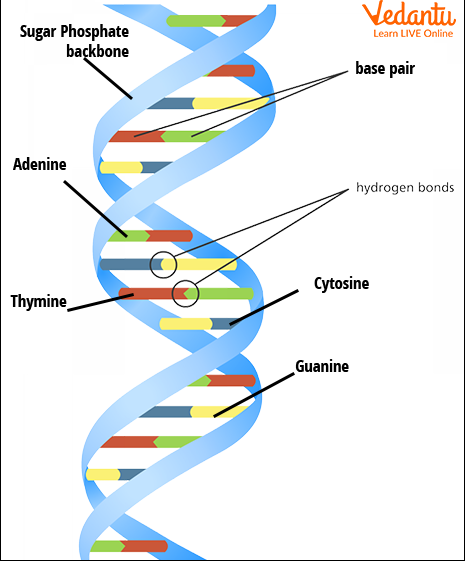
With discoveries such as Mendel’s laws, DNA structure, and gene regulation, researchers recognized the value in mapping the human genome. The Human Genome Project combined traditional genetics with molecular biology, computers, and advanced laboratory techniques to sequence the genome efficiently.
Timeline of the Human Genome Project
The Human Genome Project was a global collaboration involving scientists from the United States, United Kingdom, Japan, China, France, and other countries. It started in 1990 under the guidance of Francis Collins, with support from organizations like the National Institutes of Health and the U.S. Department of Energy. Over time, private companies also joined the race to sequence the genome, accelerating the pace of discovery and leading to technological advancements.
Key Milestones in the HGP
- 1990: Project officially begins, with a projected length of 15 years.
- 1998: Private company Celera Genomics enters and boosts competition.
- June 2000: First draft of the human genome sequence is completed.
- 2003: Human Genome Project is declared complete, two years ahead of schedule, coinciding with the 50th anniversary of DNA structure discovery.
Technological advances, such as automated sequencing and computational analysis, allowed researchers to read billions of DNA bases quickly and accurately.
Steps Used in the Human Genome Project
The process of sequencing the human genome followed several systematic steps. Specialized instruments and software handled massive amounts of DNA data. Here’s how the project worked:
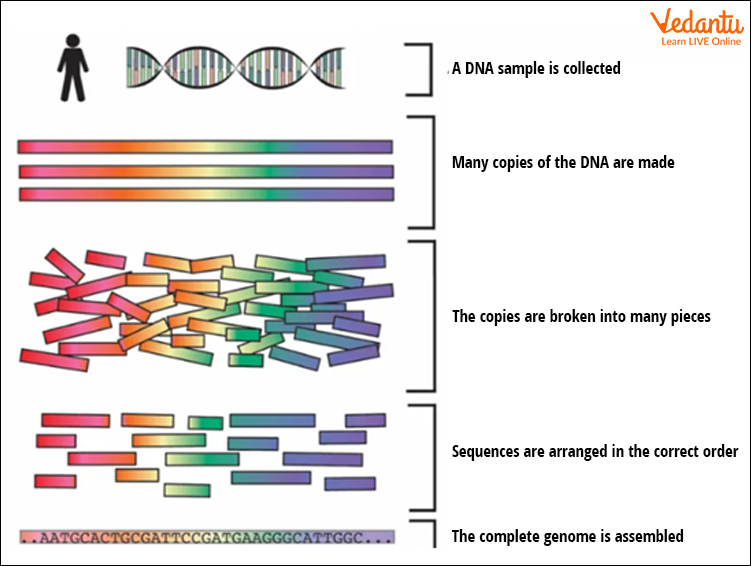
- DNA Extraction: Collecting DNA samples from volunteers.
- Fragmentation: Breaking DNA into manageable pieces for sequencing.
- Sequencing: Determining the order of bases (A, T, G, C) in each fragment.
- Assembly: Using computers to piece together overlapping sequences into a complete genome.
- Annotation: Identifying genes, coding regions, and non-coding regions.
- Analysis and Sharing: Making the data publicly available for further research and medical use.
This organized approach ensured every step, from extraction to sharing, was accurate, reliable, and transparent, setting standards followed in modern genetic research.
Outcomes and Significance of the Human Genome Project
The Human Genome Project revolutionized our understanding of the genetic basis of human biology. It showed that humans have around 20,000 to 25,000 genes. Much of the genome consists of non-coding DNA, with complex roles in gene regulation. The outcomes go far beyond science labs and have impacted many fields, including:
- Medicine: Improved diagnosis and treatment of genetic disorders.
- Pharmacogenomics: Tailoring medicines to individual genetic profiles.
- Agriculture: Enhanced breeding programs and genetically modified crops.
- Environmental studies: Understanding the effects of genetic diversity on adaptation (see climate effects).
- Evolution and inheritance: Better knowledge of how traits pass from one generation to the next (difference between acquired and inherited traits).
The HGP has also inspired new research in fields like genetic engineering, endocrinology, and nutrition. For example, deeper insights into genes related to hormones and metabolic processes help guide studies in endocrinology, food science, and human physiology.

Future Directions and Real-World Applications
The completion of the Human Genome Project opened doors to many new possibilities. Personalized medicine, gene therapy, early detection of inherited diseases, and understanding the genetics of diseases like cancer are all growing fields. The techniques pioneered during HGP are used in research about biomolecules, life science, and disease control. It also enables us to study adaptations, environmental challenges, and human evolution in more detail.
By following HGP’s legacy, Vedantu aims to deliver clear, accessible explanations for biology topics—making scientific advances understandable for every student.
Page Summary: The Human Genome Project was a landmark scientific effort that mapped the entire human genetic code. It revolutionized medicine, genetic research, and our understanding of hereditary diseases. Its outcomes influence health, evolution, agriculture, and environmental studies, with everyday relevance and ongoing innovations that continue to benefit both society and the scientific community.


FAQs on Human Genome Project Overview and Key Insights
1. What is the Human Genome Project?
The Human Genome Project (HGP) was an international scientific research initiative that mapped and sequenced the entire human genome. It was carried out from 1990 to 2003 to determine the complete DNA sequence of humans and identify all human genes.
- Sequenced approximately 3 billion base pairs of DNA.
- Identified about 20,000–21,000 protein-coding genes.
- Provided a reference genome for biomedical research.
2. What was the main goal of the Human Genome Project?
The main goal of the Human Genome Project was to determine the complete DNA sequence of the human genome and identify all its genes. Specifically, it aimed to:
- Map the location of every gene on the 23 pairs of chromosomes.
- Sequence all human DNA base pairs.
- Store the data in publicly accessible databases.
- Develop new tools for genetic analysis and bioinformatics.
3. When was the Human Genome Project completed?
The Human Genome Project was officially completed in April 2003. The project began in 1990 and took about 13 years to finish.
- A working draft was announced in 2000.
- The final reference sequence was released in 2003.
- The completion coincided with the 50th anniversary of the discovery of the DNA double helix.
4. How does the Human Genome Project help in medicine?
The Human Genome Project helps medicine by identifying genes linked to diseases and enabling personalized treatment. Its contributions include:
- Discovery of genes associated with genetic disorders like cystic fibrosis and sickle cell anemia.
- Advancement of personalized medicine based on genetic profiles.
- Improved diagnostic tests and targeted drug development.
- Better understanding of cancer genomics.
5. How many genes are in the human genome?
The human genome contains approximately 20,000 to 21,000 protein-coding genes. These genes are distributed across 23 pairs of chromosomes.
- Only about 1–2% of the genome codes for proteins.
- The remaining DNA includes regulatory sequences, introns, and non-coding regions.
- Gene expression varies by cell type and developmental stage.
6. What is the difference between genome and gene?
A gene is a specific segment of DNA that codes for a functional product, while a genome is the complete set of genetic material in an organism. In simple terms:
- A gene is a small functional unit of heredity.
- The genome includes all genes plus non-coding DNA.
- Humans have one genome made up of about 3 billion DNA base pairs.
7. What technologies were used in the Human Genome Project?
The Human Genome Project used automated DNA sequencing and computational analysis to decode the genome. Key technologies included:
- Sanger sequencing for determining DNA sequences.
- Polymerase Chain Reaction (PCR) for amplifying DNA.
- Genetic and physical mapping techniques.
- Bioinformatics tools for data storage and analysis.
8. Why is the Human Genome Project important?
The Human Genome Project is important because it provides the foundational blueprint of human genetic information. Its significance includes:
- Understanding the molecular basis of diseases.
- Advancing biotechnology and genetic engineering.
- Improving forensic science and ancestry studies.
- Enabling research in evolutionary biology and population genetics.
9. What is a genome map in the Human Genome Project?
A genome map is a representation that shows the locations of genes and markers on chromosomes. In the Human Genome Project, two main types were used:
- Genetic maps showing relative positions based on recombination frequencies.
- Physical maps showing actual distances in base pairs.
10. Did the Human Genome Project sequence one person's DNA?
The Human Genome Project did not sequence just one person’s DNA but created a composite reference genome from multiple donors. Key points include:
- DNA samples were taken from several anonymous individuals.
- The final sequence represents a reference genome, not a single individual.
- This reference is used for comparison in genetic and medical research.



