




What is Planaria structure reproduction and regeneration explained
The phylum Platyhelminthes is a major phylum of the kingdom Animalia. It constitutes flatworms that are segmented and bilaterally symmetrical. There are several parasitic varieties of flatworms, some of which are quite harmful to human populations. Planaria is among the many examples of flatworms in Platyhelminthes. Planarians have been studied extensively over the last century for their regenerative properties and more recently as a model for stem cell biology.
What is Planaria?
Planaria are flatworms belonging to the phylum Platyhelminthes that have incredible regeneration ability, earning them the nickname "immortal under the knife." Freshwater, marine, and terrestrial habitats all have a diverse range of organisms. The majority of planarians live in freshwater and can be found in huge groups; some species are marine, while others are terrestrial. Some species are parasitic, meaning they feed on other living creatures’ bodies.
Scientific Classification and Diagram of Planaria
Planaria Classification
Kingdom: Animalia
Phylum: Platyhelminthes
Class: Rhabditophora
Clade: Adiaphanida
Order: Tricladida
Family: Planariidae
Genus: Planaria
Planaria Diagram
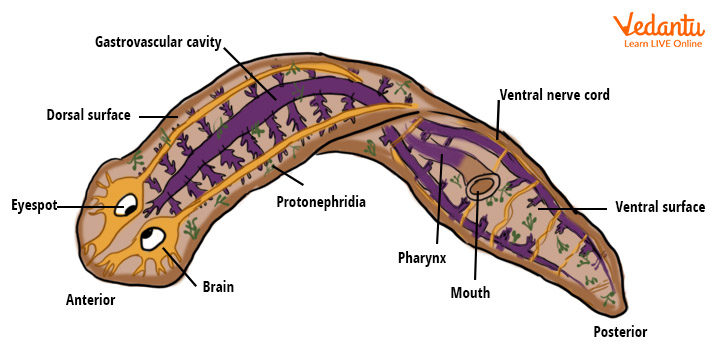
Structure of Planaria
Anatomy of Planaria
When extended, the body is soft, leaf-shaped, and ciliated. Two eyes and tentacles can be found on the spade-shaped head. The tail is angular. The mouth is located on the ventral (lower) side of the animal, frequently more than halfway to the tail. There is no body cavity or coelom. The pharynx, which may extend from the mouth, leads to a normally blind gut. The length ranges from 3 to 15 mm (0.1 to 0.6 inches), with some reaching more than 30 cm (approximately 1 foot) in length. Species from the tropics are frequently brilliantly coloured. Dugesia is a black, grey, or brown genus found in North America.
Planarians swim in an undulating pattern or move along the ground like slugs. The majority of them are carnivorous night feeders. Protozoans, small snails, and worms are among their favourite foods. All are simultaneous hermaphrodites, meaning they have both male and female reproductive organs in the same person. Early in the autumn, the reproductive organs begin to mature. In the spring, cocoons holding fertilised eggs are laid. In most species, fully developed young emerge and develop without metamorphosis (radical change). However, in a few marine species, free-living, ciliated larvae are discharged. In some species, the organism in the cocoon divides into two halves, each of which grows into a complete individual. Buds form at the end of others of the genus Microstomum and can stay attached to the parent for a long time; chains of three or four buds have been seen. Planarians are frequently employed in experiments to explore the process of regeneration because of their exceptional capacity to restore missing portions.
The Nervous System of Planaria
Flatworms were the first invertebrates to acquire a central nervous system with a brain, as well as bilateral symmetry.
A brain, longitudinal nerve cords, and peripheral nerve plexuses (interlacing networks of peripheral nerves) make up the neurological system of a free-living flatworm-like Planaria.
The brain, which is placed in the front of the animal, is made up of two cephalic ganglia that are connected by a commissure.
Longitudinal nerve cords, usually three to five pairs, extend posteriorly from the brain; transverse commissures connect them, and smaller, lateral nerves emerge from the cords.
The peripheral nerve plexuses are formed by the lateral nerves. The submuscular nerve plexus, which consists of sensory cells, ganglion cells, and their processes, is located beneath the subepidermal musculature in loose tissue (mesenchyme). Above the muscle layer, another subepidermal plexus is found at the bases of epithelial cells.
Planaria nervous system has a plethora of sensory receptors.
The nerve plexuses include single sensory cells that are extensively dispersed throughout the organism.
Ciliated pits and grooves, auricles, the frontal organ, statocyst, and eyeballs are among the sensory organs present.
Chemical receptors, or chemoreceptors, are found in the ciliated pits and grooves, allowing the animal to detect food. The statocyst is in charge of balance and reflexes like rising to the water's surface or sinking.
How does Planaria reproduce?
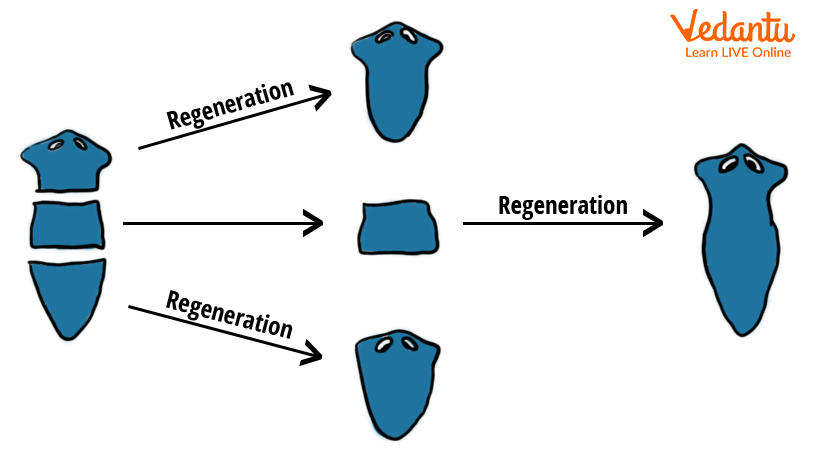
Regeneration in Planaria
Planaria have both male and female sex organs, making them hermaphroditic. The ovaries are found near the eyespots in a rostral direction. Of course, this is not the same as the human ovaries, which are located in the lower abdominal cavity! A single egg cell is produced by the ovaries of planarians. Testes and seminal ducts, which together make and carry sperm, are positioned laterally along the sides of the body. A penis is also present in planarian worms, which are contained in a genital chamber. Nutrients are delivered to eggs via specialised yolk glands.
Sexual Reproduction: Planarian worms have both testes and ovaries, as well as the ability to generate both sperm and eggs. Sexual reproduction, on the other hand, occurs when one flatworm transports sperm to the seminal receptacle of the recipient flatworm via the penile duct. In the seminal receptacle, the recipient's egg is fertilized and transmitted outside the body into the planarian worm's liquid environment. A thin mucous filament is usually used to bind the egg to a surface in the liquid.
Asexual Reproduction: Planaria have the power to create new persons from the components of their bodies. This is referred to as regeneration. Planaria's body can be cut or broken into several pieces, each of which grows into a whole organism. Regeneration varies from reproduction in that regeneration can occur from any part of the organism, such as a lizard's damaged tail. Reproduction, on the other hand, is the process through which a new organism is created from specialised cells known as gametes. Furthermore, regeneration does not always result in the emergence of a new person, whereas reproduction always results in the emergence of new individuals from the parent organism.
Conclusion
In many regions of the world, planaria are widespread. In freshwater ponds and rivers, planaria typically dwell beneath rocks or aquatic plants. Salinity is the home of several marine animals. In humid environments, several terrestrial species can be found on or in the soil, under logs, and on plants. Polluted water is intolerable to planaria. They are frequently researched as bio-indicators in an aquatic habitat as a result.
The most striking feature of planaria is its ability to regenerate itself when cut with a knife.


FAQs on Planaria in Biology Structure Function and Regeneration
1. What is Planaria?
Planaria is a free-living flatworm belonging to the phylum Platyhelminthes that is well known for its remarkable ability to regenerate lost body parts. It is commonly found in freshwater habitats such as ponds and streams.
- It has a soft, elongated, and dorsoventrally flattened body.
- It shows bilateral symmetry and is triploblastic.
- It is a non-parasitic flatworm, unlike tapeworms and flukes.
2. Where are Planaria found?
Planaria are primarily found in freshwater habitats such as ponds, lakes, and slow-moving streams. They prefer clean, well-oxygenated water environments.
- Commonly seen under stones, leaves, or debris in water.
- Some species live in moist soil.
- A few species are marine, but most are freshwater forms.
3. What are the main features of Planaria?
The main features of Planaria include a flat body, bilateral symmetry, and strong regenerative ability. These characteristics make it a typical example of a free-living flatworm.
- Triploblastic body organization with three germ layers.
- Acoelomate (no body cavity).
- Cephalization with a distinct head region and eyespots.
- Incomplete digestive system with a single opening.
- Presence of protonephridia with flame cells for excretion.
4. How does Planaria regenerate its body?
Planaria regenerates its body through the action of specialized stem cells called neoblasts that divide and differentiate into missing tissues. Even a small fragment can regrow into a complete organism.
- Neoblasts migrate to the injured site.
- They form a regeneration bud called a blastema.
- Cells differentiate into required organs and tissues.
5. What type of symmetry does Planaria have?
Planaria exhibits bilateral symmetry, meaning its body can be divided into two equal halves along a single longitudinal plane. This type of symmetry is associated with directional movement.
- Distinct right and left sides.
- Well-developed head region due to cephalization.
- Adapted for active locomotion.
6. How does Planaria move?
Planaria moves by gliding smoothly using ciliated epithelial cells and muscular contractions. It secretes mucus to aid in locomotion.
- Cilia beat against a layer of mucus.
- Circular and longitudinal muscles help in crawling.
- Movement is slow and controlled.
7. What does Planaria eat and how does it digest food?
Planaria feeds on small invertebrates and organic matter, digesting food in an incomplete digestive system with a single opening. The same opening acts as both mouth and anus.
- It extends a muscular pharynx to suck in food.
- Food enters a branched gastrovascular cavity.
- Digestion is partly extracellular and partly intracellular.
8. How does excretion occur in Planaria?
Excretion in Planaria occurs through a network of protonephridia that contain specialized cells called flame cells. These structures help remove metabolic wastes and maintain water balance.
- Flame cells have cilia that create a current.
- Waste fluids are filtered from body tissues.
- Excretory pores release waste outside the body.
9. Is Planaria hermaphrodite?
Yes, Planaria is a hermaphrodite, meaning each individual possesses both male and female reproductive organs. However, it usually reproduces sexually through cross-fertilization.
- Produces both sperm and eggs.
- Fertilization is internal.
- Zygotes develop inside protective cocoons.
10. Why is Planaria important in biological research?
Planaria is important in biological research because of its exceptional regenerative capacity and abundance of stem cells. It serves as a key model organism in developmental and regenerative biology.
- Used to study stem cells and tissue regeneration.
- Helps understand body pattern formation.
- Provides insights into wound healing mechanisms.



