




What Are Prokaryotic and Eukaryotic Cells Definition Structure Functions and Comparison
Cells are the basic building blocks of life, from the simplest bacteria to complex plants and animals. At the microscopic level, life can be divided into two major types: prokaryotic cells and eukaryotic cells. These two types differ in structure, size, and function, and understanding these differences is crucial for studying biology.
But did you know that the first cells on Earth, the prokaryotic cells, appeared around 3.5 billion years ago? It is from these tiny organisms that all other life evolved!
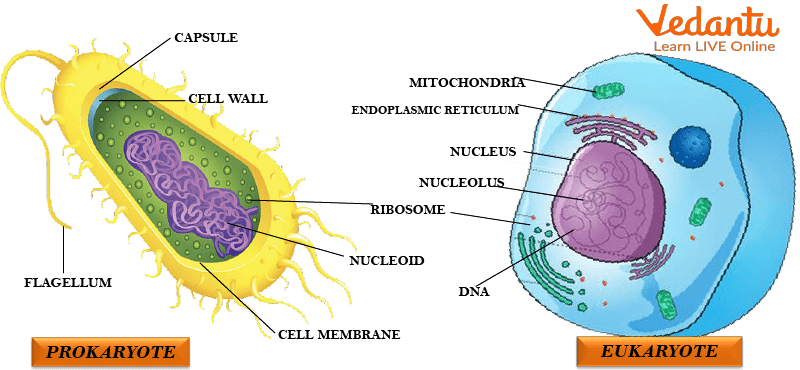
What are Prokaryotic Cells?
Prokaryotic cells are the simplest and smallest type of cells, usually measuring between 0.2 μm – 2.0 μm in diameter. These cells do not have a membrane-bound nucleus. Instead, their genetic material is located in a region called the nucleoid. Prokaryotic cells are typically unicellular organisms, such as bacteria and archaea.
Key characteristics of prokaryotic cells include:
No membrane-bound organelles (e.g., mitochondria, Golgi bodies).
A protective cell wall made of complex chemicals.
Smaller ribosomes compared to eukaryotic cells.
DNA is in a circular form.
Reproduction occurs through binary fission.
What are Eukaryotic Cells?
Eukaryotic cells are more complex and larger than prokaryotic cells, measuring between 10 μm – 100 μm in diameter. These cells contain a defined nucleus, which houses the cell's DNA. Eukaryotic cells are found in both unicellular organisms (like yeast) and multicellular organisms (like plants and animals).
Key characteristics of eukaryotic cells include:
A well-defined nucleus is surrounded by a nuclear membrane.
Presence of membrane-bound organelles like mitochondria, chloroplasts, and the endoplasmic reticulum.
Linear DNA is stored within the nucleus.
Larger ribosomes compared to prokaryotic cells.
Reproduction through mitosis (in multicellular organisms) and sometimes meiosis (for sexual reproduction).
Key Differences Between Prokaryotic and Eukaryotic Cells Table
Real-World Applications of Prokaryotic and Eukaryotic Cells
Understanding the differences between prokaryotic and eukaryotic cells is not only fundamental to biology but also to various real-world applications. For example, genetic engineering uses bacteria (prokaryotic cells) to produce insulin. Stem cell research involves eukaryotic cells and holds the potential for groundbreaking medical treatments. In agriculture, understanding plant cells' structure helps in improving crop resistance and yield.
Interactive Quiz: Test Your Knowledge on Prokaryotic and Eukaryotic Cells!
1. Which of the following is a characteristic of prokaryotic cells?
a) Membrane-bound nucleus
b) Circular DNA
c) Larger ribosomes
d) Complex organelles
2. Which type of cell is responsible for producing energy through mitochondria?
a) Prokaryotic cell
b) Eukaryotic cell
c) Both prokaryotic and eukaryotic cells
d) None of the above
Check Your Answers Below!
b) Circular DNA
b) Eukaryotic cell


FAQs on Prokaryotic and Eukaryotic Cells Structure and Key Differences
1. What is the difference between prokaryotic and eukaryotic cells?
The main difference between prokaryotic cells and eukaryotic cells is that prokaryotes lack a true nucleus and membrane-bound organelles, while eukaryotes have both.
- Prokaryotic cells: No true nucleus (DNA in a nucleoid region), no membrane-bound organelles, usually smaller and simpler (e.g., bacteria).
- Eukaryotic cells: DNA enclosed in a nucleus, contain membrane-bound organelles like mitochondria and endoplasmic reticulum, generally larger and more complex (e.g., plant and animal cells).
2. What are prokaryotic cells?
Prokaryotic cells are simple, single-celled organisms that lack a true nucleus and membrane-bound organelles.
- Genetic material is located in a nucleoid region.
- Usually contain a single circular DNA molecule.
- Examples include organisms from the domains Bacteria and Archaea.
- Often have a cell wall, ribosomes, and sometimes flagella for movement.
3. What are eukaryotic cells?
Eukaryotic cells are complex cells that contain a true nucleus and membrane-bound organelles.
- The nucleus stores genetic material in the form of linear chromosomes.
- Contain organelles such as mitochondria, Golgi apparatus, and endoplasmic reticulum.
- Found in organisms belonging to Protista, Fungi, Plantae, and Animalia.
4. Do prokaryotic cells have a nucleus?
No, prokaryotic cells do not have a true nucleus enclosed by a nuclear membrane.
- Their DNA is located in a region called the nucleoid.
- The genetic material is not surrounded by a nuclear envelope.
- This is a key feature distinguishing them from eukaryotic cells.
5. What organelles are found in eukaryotic cells?
Eukaryotic cells contain several membrane-bound organelles that perform specialized functions.
- Nucleus – stores and protects DNA.
- Mitochondria – site of cellular respiration and ATP production.
- Endoplasmic reticulum – protein and lipid synthesis.
- Golgi apparatus – modifies and packages proteins.
- Lysosomes – intracellular digestion (mainly in animal cells).
- Chloroplasts – photosynthesis in plant cells.
6. How do prokaryotic and eukaryotic cells reproduce?
Prokaryotic cells reproduce mainly by binary fission, while eukaryotic cells reproduce by mitosis and meiosis.
- Binary fission: DNA replicates, and the cell divides into two identical cells.
- Mitosis: Produces two genetically identical daughter cells for growth and repair.
- Meiosis: Produces gametes with half the chromosome number for sexual reproduction.
7. What are examples of prokaryotic and eukaryotic cells?
Examples of prokaryotic cells include bacteria, while examples of eukaryotic cells include plant and animal cells.
- Prokaryotic example: Escherichia coli (E. coli), a bacterium.
- Eukaryotic examples: Human skin cells, plant leaf cells, yeast cells.
8. Are plant and animal cells prokaryotic or eukaryotic?
Plant and animal cells are eukaryotic cells because they contain a true nucleus and membrane-bound organelles.
- Both have a nucleus, mitochondria, and endoplasmic reticulum.
- Plant cells also have a cell wall, chloroplasts, and a large central vacuole.
- Animal cells lack a cell wall and chloroplasts but contain lysosomes.
9. What is the size difference between prokaryotic and eukaryotic cells?
Prokaryotic cells are generally smaller (1–5 µm) than eukaryotic cells (10–100 µm).
- Prokaryotes: Smaller size allows rapid nutrient exchange and fast reproduction.
- Eukaryotes: Larger size supports compartmentalization and specialized organelles.
10. Why are eukaryotic cells considered more complex than prokaryotic cells?
Eukaryotic cells are considered more complex because they contain a true nucleus and specialized membrane-bound organelles.
- DNA is organized into multiple linear chromosomes.
- Presence of organelles like mitochondria and Golgi apparatus allows division of labor.
- Support multicellularity and cell specialization.



