




What Are Resources on Earth Definition Types and Conservation Strategies
Earth is unique among the planets in our solar system because it offers everything we need to survive, such as water, air, and food. But what are the resources of Earth? They include a wide range of elements like minerals, fossil fuels, forests, and sources of energy that help us live comfortably. They can be broadly divided into those obtained directly from nature (like water and sunlight) and those that require human intervention (like refined petroleum products).
In simple terms, resources on Earth support life in every possible way. Our existence depends on how wisely we use these resources so that future generations can also benefit from them.
What are Natural Resources?
Natural resources are substances and materials that exist in nature without human effort. Examples include water, sunlight, wind, soil, plants, and animals. These resources form the basis of life on Earth because they help fulfil our fundamental needs – for instance, soil helps grow food, and water is vital for drinking and irrigation.
Types of Natural Resources
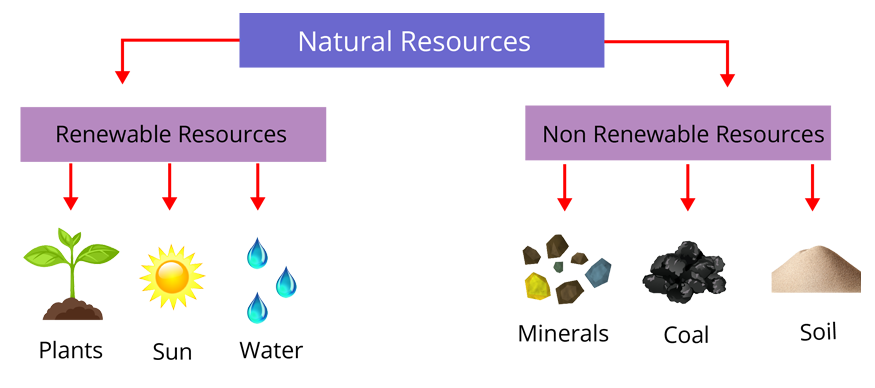
Have you ever wondered what are the 4 types of natural resources? While we often classify them into just two categories—renewable and non-renewable—some experts group them into four broader types:
Actual Resources: Those that are surveyed, quantified, and currently in use (e.g., active coal mines or operating oil wells).
Potential Resources: Those that exist but are not yet fully used or explored (e.g., tidal energy in certain coastal areas).
Renewable Resources: Resources that can be replenished relatively quickly by natural processes.
Non-renewable Resources: Resources available in limited quantities that cannot be replaced easily once they are exhausted.
Renewable Resources
These are resources that nature can restore or replenish over time. Examples include sunlight, wind, fresh water (through the water cycle), and biomass (like wood from forests). Because they can be regenerated, they are considered more sustainable for long-term use.
Non-renewable Resources
These resources either take millions of years to form or exist in fixed amounts. Fossil fuels (coal, petroleum, and natural gas) and minerals (iron, gold, and diamonds) fall into this category. Once used, it is extremely difficult or impossible to replace them within a human lifespan.
What are 20 Natural Resources?
Water
Air
Sunlight
Wind
Soil
Coal
Petroleum (Crude Oil)
Natural Gas
Forests (Timber)
Wildlife (Fauna)
Agricultural Crops
Marine Life (Fish)
Salt
Iron Ore
Copper Ore
Gold
Silver
Sand
Clay
Geothermal Energy
All these examples are found naturally on our planet, though some require human effort to make them usable.
What are the 10 Important Natural Resources?
Freshwater (Drinking and Irrigation)
Clean Air (Respiration and Health)
Soil (Agriculture and Habitat)
Forests (Timber, Habitat, Oxygen Production)
Fossil Fuels (Energy Production)
Sunlight (Solar Energy)
Wind (Wind Energy)
Minerals (Construction and Manufacturing)
Marine Resources (Food and Trade Routes)
Biodiversity (Genetic Variety and Ecosystem Balance)
Each of these resources plays a pivotal role in supporting life and various economic activities worldwide.
Importance of Natural Resources
Natural resources are crucial for several reasons:
Sustaining Life: They supply essential elements like oxygen (through plants), water, and nutrients for plants and animals.
Economic Development: Many industries—such as construction, agriculture, and manufacturing—depend on raw materials derived from natural resources.
Energy Generation: Resources like coal, petroleum, natural gas, sunlight, and wind are used to produce energy.
Environmental Balance: Forests and other ecosystems maintain oxygen and carbon dioxide levels, support biodiversity, and regulate climate.
Future Security: Wise use of resources ensures that future generations can also meet their own needs.
Depletion of Resources on Earth
Sadly, human activities are leading to the rapid depletion of Earth’s resources. The major causes include:
Overpopulation: With more people, there is a higher demand for food, water, energy, and land.
Over-exploitation: Excessive harvesting of resources like fisheries, forests, and minerals depletes them quickly.
Deforestation: Clearing forests for agriculture and urban development disrupts ecosystems.
Loss of Biodiversity: Pollution and habitat loss lead to the extinction of various species.
Industrialisation: The rapid growth of industries consumes large amounts of fossil fuels and minerals.
Pollution: Land, water, and air pollution make resources unusable.
Erosion: Loss of fertile soil reduces agricultural productivity.
Tips to Conserve Resources
Use Renewable Energy: Switch to solar, wind, or hydro energy whenever possible.
Recycle and Reuse: Decrease the need to extract new raw materials by recycling paper, metals, and plastics.
Responsible Consumption: Limit waste, especially food and water.
Reforestation: Plant trees to combat deforestation and maintain ecological balance.
Sustainable Farming: Adopt eco-friendly agricultural methods to keep the soil fertile.
Public Awareness: Educate others about natural resources examples and why conservation matters.
Also refer:
These topics will further deepen your understanding of resource management and ecological balance.


FAQs on Resources on Earth and Their Importance in Life Support Systems
1. What are resources on Earth in biology?
Resources on Earth are natural materials and energy sources that living organisms use for survival, growth, and reproduction. In biology, these resources support life processes in ecosystems.
- Biotic resources: Living resources such as plants, animals, and microorganisms.
- Abiotic resources: Non-living resources such as water, air, soil, and sunlight.
- They are essential for processes like photosynthesis, respiration, and nutrient cycling.
2. What are the main types of natural resources on Earth?
The main types of natural resources on Earth are renewable and non-renewable resources. These categories are based on how quickly nature can replenish them.
- Renewable resources: Replaced naturally in a short time (e.g., sunlight, wind, forests).
- Non-renewable resources: Formed over millions of years and cannot be quickly replaced (e.g., coal, petroleum, natural gas).
- Both types are vital for ecosystems and human survival.
3. Why are resources on Earth important for living organisms?
Resources on Earth are important because they provide the energy, nutrients, and materials needed for life processes. Without these resources, organisms cannot survive.
- Water is required for metabolic reactions.
- Oxygen supports cellular respiration.
- Soil nutrients help plants grow.
- Sunlight drives photosynthesis in plants.
4. What is the difference between renewable and non-renewable resources?
The difference between renewable and non-renewable resources is that renewable resources can be naturally replenished, while non-renewable resources cannot be replaced quickly. This distinction affects sustainability.
- Renewable resources: Solar energy, wind, water, biomass.
- Non-renewable resources: Fossil fuels and certain minerals.
- Overuse of non-renewable resources leads to depletion and environmental damage.
5. How do natural resources support ecosystems?
Natural resources support ecosystems by providing the energy flow and nutrient cycling required for ecological balance. They maintain interactions among organisms and their environment.
- Sunlight enables producers to make food.
- Water and minerals support plant growth.
- Decomposers recycle nutrients back into the soil.
6. What are biotic and abiotic resources?
Biotic resources are derived from living organisms, while abiotic resources come from non-living components of the environment. Both are essential parts of ecosystems.
- Biotic resources: Forests, wildlife, fisheries.
- Abiotic resources: Air, water, minerals, sunlight.
- The interaction between biotic and abiotic factors determines ecosystem health.
7. How does sunlight act as a resource on Earth?
Sunlight acts as a resource by serving as the primary source of energy for photosynthesis. It powers almost all life on Earth either directly or indirectly.
- Plants convert solar energy into chemical energy through photosynthesis.
- Herbivores obtain energy by eating plants.
- Carnivores receive energy by consuming other animals.
8. What role does water play as a natural resource?
Water plays a crucial role as it is essential for metabolism, transport, and temperature regulation in living organisms. It is one of the most important abiotic resources.
- Acts as a solvent for biochemical reactions.
- Transports nutrients and wastes in blood and plant sap.
- Regulates body temperature through sweating and transpiration.
9. What are some examples of non-renewable resources on Earth?
Examples of non-renewable resources include coal, petroleum, natural gas, and metallic minerals. These resources take millions of years to form.
- Coal and petroleum are fossil fuels formed from ancient organic matter.
- Natural gas is used for energy production.
- Excessive use can lead to environmental problems like pollution and climate change.
10. Why is conservation of natural resources important?
Conservation of natural resources is important to ensure sustainable use and protect ecosystems for future generations. It helps maintain biodiversity and ecological balance.
- Prevents depletion of non-renewable resources.
- Protects habitats and biodiversity.
- Reduces pollution and environmental degradation.



