




What Are Sepals Definition Structure Function and Types
The vegetative part of a flower constitutes the sepals and petals. The flowering plant's sepals are linked straight to the top of the stem. They are available in a variety of sizes and shapes. Sepals vary in length and thickness, with some being long and thin and others being short and thick. Some sepals are individually shaped, while others are fused to form a cup around the flower's petals.
The perianth is made up of the calyx and corolla together. Petaloid refers to a perianth that isn't green. It's called sepaloid if it's green in colour.
What are Sepals?
Sepals are modified leaves that make up a flower's outer whorl. They are usually green, although they can be any hue. They envelop the rest of the flower in the bud stage. Depending on the species, flowers have varying number of sepals. However, in some species, they can be missing or prominent and petal-like. Due to the presence of chlorophyll, sepals are capable of photosynthesis. They safeguard the flower's bud.
Functions of Sepals
The sepals’ functions in a flower are as follows:
By encapsulating the developing buds in the bud condition, it protects them.
Since the sepals of a flower are green, they can also generate food.
They also safeguard the flower buds.
Some of the sepals that have petaloid attract insects.
Fruit dissemination is aided by some sepals.
Calyx
The calyx of the flower refers to all of the sepals together. The epicalyx, or the second layer of sepals, is visible in the hibiscus. Coloured petal-like or petaloid petals of a flower adorn the flame of the forest blooms. When the flower blooms, the sepals may stay on or fall off. Calyx has two patterns that are visible.
Plants with joined sepals form a cup-like shape in a gamosepalous flower.
Sepals are separated into polysepalous animals.
Corolla
The next whorl toward the apex is the corolla flower part, which is made up of units called petals, which are often thin, delicate, and colourful to attract pollinating creatures. To attract pollinators, the corolla may be fragrant, coloured, or flashy. The inner layers of a flower's critical layers should be protected. One layer or whorl, two layers or double whorl (Poppy), or a spiral (Water lily). The following two patterns can be seen in the corolla:
Petals join together to form a tube in gamopetalous flowers. For example, Ipomea and Nerium.
Petals are free in polypetalous flowers. Rose and mustard are two examples.
Aestivation in Flowers
The arrangement of petals and sepals in flower buds before blooming is known as aestivation in plants. It is all about the other whorl members. Aestivation is frequently mistaken for vernation, which is the process of arranging new leaves and scales in a leaf bud. Perianth refers to the petals and sepals as a whole. The aestivation of plants is the arranging of perianth inside a flower bud before it blooms. Aestivation is an important element of taxonomy since the aestivation of flowers from various species differs. The following are the five types of aestivation:
Valvate
Twisted
Imbricate
Vexillary
Quincuncial
Fabaceae Family
Here are the characteristics of the Fabaceae family:
Herbs, shrubs, vines, and plants that climb by twining or tendrils belong to this family.
Root nodules contain nitrogen-fixing bacteria (rhizobium), and non-protein amino acids are frequently discovered.
The leaves are generally pinnatus and spirally organized, with well-developed pulvinas and separate leaflets.
Sleep motions are generally seen in the leaf axis and leaflets.
The stipules that are present are sometimes big or have spines.
Flowers are normally bisexual, with cup-shaped hypanthium petals that are regular or irregular.
Sepals are normally five in number, free or connate when a tube with valvate or bilabiate lobes is present.
Irregular petals are adaxially small and lie within the laterals in and outside the laterals in III (resupinate sometimes).
It's imbricate or basally connate, regular, and valvate.
Androecium has one to ten stamens, which are concealed by the perianth and have long-exerted and sometimes showy filaments that are separate or connate.
Pollen grains are tricolporate, tricolpate, or triporate if connate is monodelphous or diadelphous.
The one-carpel gynoecium is unique, elongated, and has a short gynophore.
With parietal (marginal) placentation, the ovary is superior.
Campylotropous ovules are anatropous.
The majority of fruits are legumes.
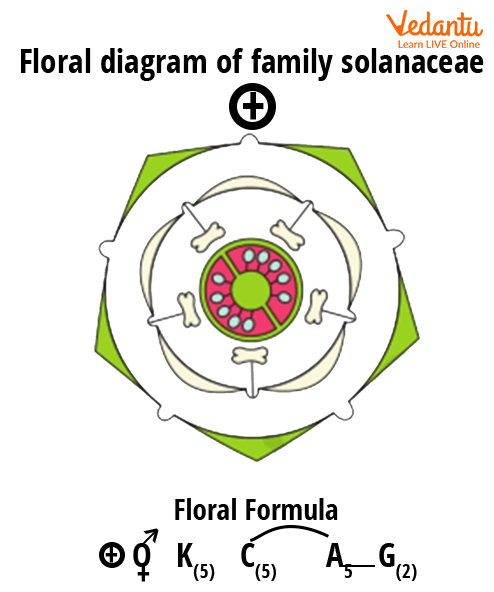
Fabaceae Floral Diagram
Conclusion
The distinguishing feature of angiosperms is the flower, which is a component of the shoot system. It is the reproductive structure of the plant. They are frequently brightly coloured to attract pollinating insects. Sepals and petals comprise the vegetative part of a plant which helps in the protection of the flower bud.
In botanical terminology, aestivation refers to the arrangement of sepals and petals in flower buds around other members of the whorl. Vernation, which is the arrangement of scales and new leaves in a leaf bud before it opens, is frequently confused with it. A perianth is a combination of sepals and petals. Bud pollination is the term used to describe the process of pollination that takes place when the flower is in bud condition.


FAQs on Sepals in Flower Structure Functions and Types
1. What are sepals in a flower?
Sepals are the outermost leaf-like structures of a flower that protect the developing bud before it opens. They collectively form the calyx and are usually green and photosynthetic.
- Located at the base of the flower
- Protect the flower in the bud stage
- Often resemble small leaves
2. What is the function of sepals?
The main function of sepals is to protect the developing flower bud from damage and desiccation. Additional roles include:
- Supporting the petals when the flower opens
- Reducing water loss due to their green, leaf-like structure
- Sometimes performing photosynthesis
3. Where are sepals located in a flower?
Sepals are located at the base of the flower, forming the outermost whorl. They are attached to the receptacle and surround the inner floral parts.
- Outermost floral whorl
- Below the petals
- Protecting the inner reproductive structures
4. What is the difference between sepals and petals?
The main difference between sepals and petals is that sepals protect the bud, while petals attract pollinators. Key differences include:
- Sepals: Usually green, form the calyx, protective function
- Petals: Often brightly colored, form the corolla, attract pollinators
- Sepals are typically tougher and leaf-like compared to soft petals
5. What is the calyx in botany?
The calyx is the collective term for all the sepals of a flower. It forms the outermost floral whorl and encloses the flower bud.
- Composed entirely of sepals
- Usually green and protective
- May persist even after fertilization in some plants
6. Are sepals always green?
Sepals are usually green, but they are not always green in all plants. While most sepals contain chlorophyll, in some species they are brightly colored and resemble petals.
- Green in many plants like mustard
- Colored in plants like lily
- May help attract pollinators if petal-like
7. What are fused and free sepals?
Fused sepals are joined together, while free sepals remain separate from each other. This characteristic helps in flower classification.
- Gamosepalous: Sepals fused together (e.g., hibiscus)
- Polysepalous: Sepals free and separate (e.g., mustard)
8. How many sepals does a flower usually have?
The number of sepals in a flower varies by species but commonly ranges from three to five. The number often corresponds to the flower’s symmetry and classification.
- Dicots commonly have 4 or 5 sepals
- Monocots commonly have 3 sepals
- Some flowers may have many sepals
9. Do sepals perform photosynthesis?
Yes, sepals can perform photosynthesis if they contain chlorophyll. Because many sepals are green and leaf-like, they are capable of producing food.
- Contain chloroplasts in green sepals
- Contribute small amounts of glucose
- Support the developing flower bud
10. What happens to sepals after fertilization?
After fertilization, sepals may either fall off or remain attached to the fruit, depending on the plant species. In many plants, the calyx withers and drops.
- May dry and fall off after pollination
- May persist and protect the developing fruit (e.g., tomato)
- Sometimes enlarge along with the fruit



