



How Do You Calculate the Time Period in SHM?
The time period of SHM is a fundamental concept in class 11 physics, especially important for JEE aspirants seeking to master oscillatory motion. It refers to the time required for an object undergoing simple harmonic motion to complete one full cycle, returning to its original state. Accurately determining and applying the time period of SHM allows for quick problem-solving in questions involving springs, pendulums, and various oscillating systems.
Meaning and Physical Significance of Time Period of SHM
In SHM, the time period denotes how quickly the oscillatory system repeats its motion. Whether it is a vibrating mass-spring system or a simple pendulum, each has a distinct time period defined by the nature and properties of that system. This property is key to predicting the system’s future behavior and resonates through exam-level questions.
Mathematical Formula and Units: The SHM Time Period
The standard time period of SHM formula is given by:
\(T = \frac{2\pi}{\omega}\), where \(T\) is the time period and \(\omega\) (omega) is the angular frequency. This formula is universally valid across systems following simple harmonic motion, including those discussed under class 11 physics curriculum. The SI unit for the time period is seconds (s), while angular frequency is measured in radians per second (rad/s).
| Quantity | SI Unit |
|---|---|
| Time Period (T) | Seconds (s) |
| Frequency (f) | Hertz (Hz) |
| Angular Frequency (ω) | Radians per second (rad/s) |
Derivation: SHM Time Period for Spring and Pendulum Systems
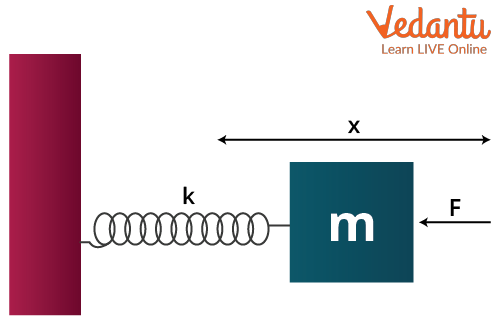
For a linear spring-mass setup, the restoring force is described by Hooke’s law as \(F = -kx\). Applying Newton’s second law gives \(m\ddot{x} = -kx\). Rearranged, this becomes \(\ddot{x} + \frac{k}{m}x = 0\), matching the form of SHM where \(\omega^2 = \frac{k}{m}\). Therefore, the angular frequency is \(\omega = \sqrt{\frac{k}{m}}\).
The time period of the spring-mass system becomes \(T = 2\pi \sqrt{\frac{m}{k}}\). This result is critical in exams and aligns perfectly with concepts explained on the Spring Mass System page.
In the case of a simple pendulum, for small angles, the time period is \(T = 2\pi \sqrt{\frac{L}{g}}\), where \(L\) is the length and \(g\) is acceleration due to gravity.
SHM Spring System Diagram - SHM time period derivation frequently aids in visualizing this derivation process for practical questions.
Variables Affecting the Time Period of SHM
The time period of SHM depends upon specific system parameters, never the amplitude under ideal conditions. For springs, the time period only depends on the mass and the spring constant. For pendulums, it’s the length and the value of gravity. The strict dependence for each system is frequently tested in class 11, competitive, and entrance exams.
- Mass of the oscillating body
- Spring constant (for spring-based SHM)
- Length of pendulum (for pendulum-based SHM)
- Acceleration due to gravity
- External field strengths (electric/magnetic)
- Distribution of mass—moment of inertia in rotational SHM
Understanding Time Period in Electric Field and Through Earth’s Tunnel
Unique systems such as a charged particle oscillating in a uniform electric field or a particle traversing a tunnel through Earth also follow SHM under ideal assumptions. In both these scenarios, the formula changes to fit the system, but the proportional relationship of time period to root of a physical ratio remains. In an electric field, the time period of SHM depends on the mass, charge, and field strength; in the tunnel through Earth, it hinges on Earth’s radius and gravity variation.
How Time Period Relates to Frequency and Angular Frequency
The three quantities—time period, frequency, and angular frequency—are deeply interconnected. Remember, time period and frequency are reciprocals, and angular frequency is always \(2\pi\) times the frequency. This relationship ensures smooth switching between formulas in SHM exam problems.
| Physical Quantity | Formula |
|---|---|
| Time Period (T) | \(T = \frac{2\pi}{\omega}\) |
| Frequency (f) | \(f = \frac{1}{T}\) |
| Angular Frequency (ω) | \(ω = 2\pi f\) |
Expressions for Time Period: Acceleration and Moment of Inertia
In advanced rotational SHM or physical pendulums, the time period of SHM in terms of moment of inertia is \(T = 2\pi \sqrt{\frac{I}{mgd}}\), where \(I\) is the moment of inertia, \(m\) mass, \(g\) gravity, and \(d\) the distance from the axis. In systems like torsional pendulums, the formula becomes \(T = 2\pi \sqrt{\frac{I}{C}}\) with \(C\) as the torsional constant. Similarly, SHM’s acceleration-based formulas often appear in exam contexts.
Graphical Representation: Recognizing Time Period from SHM Graphs
Exam questions may include a displacement-time graph of SHM. The time period can be directly measured as the horizontal distance between two peaks or troughs. Knowing this allows for rapid graph-based analysis, especially in JEE or NEET settings.
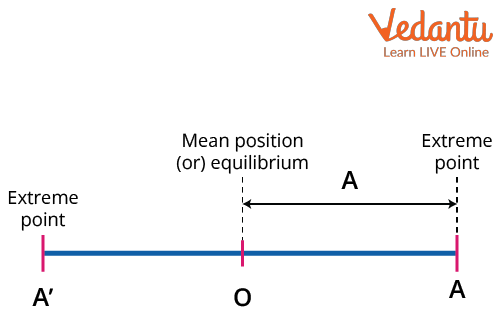
SHM Diagram illustrates time period of SHM, showcasing the oscillatory nature and periodic repetition clearly for exam visualization.
Common Errors and Special Situations in Time Period Calculations
Mistakes in calculating the time period of SHM commonly include unit errors, confusing frequency with period, or forgetting the effect (or lack thereof) of amplitude. For a simple pendulum at large amplitudes, the formula’s validity declines, and amplitude does slightly influence time period, but in most JEE and class 11 problems, amplitude is irrelevant.
- Mixing up frequency (Hz) and time period (s)
- Applying formula outside its valid range
- Ignoring physical constraints (e.g., large angle for pendulum)
- Assuming amplitude affects time period of ideal SHM
- Neglecting unit consistency
Useful SHM Resources and Insights at Vedantu
A deep understanding of the time period of SHM simplifies a wide range of topics, from waves to rotational dynamics. For more on oscillatory physics, visit the Oscillations And Waves section, or compare the Time Period Of Simple Pendulum with other cases. Vedantu’s resources continually support students’ exam preparation for JEE and advanced physics.


FAQs on Understanding the Time Period of Simple Harmonic Motion
1. What is the time period of simple harmonic motion (SHM)?
The time period of a simple harmonic motion (SHM) is the duration required for a particle to complete one full oscillation.
- It is denoted by T.
- Mathematically, T = 2π/ω, where ω is the angular frequency.
- The time period is independent of the amplitude for linear SHM.
2. What is the formula for the time period of a mass-spring system in SHM?
For a mass-spring system undergoing SHM, the time period depends on the mass and the spring constant.
- The formula is T = 2π√(m/k), where:
- m = mass of the body
- k = spring constant
- The time period increases with mass and decreases with a stiffer spring.
3. How does the time period of a simple pendulum depend on its length?
The time period (T) of a simple pendulum depends on the length of the pendulum and acceleration due to gravity.
- The formula is T = 2π√(l/g), where:
- l = length of pendulum
- g = acceleration due to gravity
- As length (l) increases, the time period increases.
- The time period does not depend on the mass or the amplitude (for small angles).
4. What factors affect the time period of SHM?
The time period of SHM is influenced by several factors depending on the system.
- For a spring-mass system: mass (m) and spring constant (k)
- For a pendulum: length (l) and gravity (g)
- The time period is independent of amplitude (in ideal SHM) and mass (in pendulums).
5. Why is the time period independent of amplitude in SHM?
In ideal simple harmonic motion, the time period does not depend on the amplitude.
- The restoring force remains proportional to displacement (Hooke’s Law).
- For small amplitudes, the assumption holds true in mass-spring systems and pendulums.
- Large amplitudes can introduce non-linearity, but in standard CBSE problems, time period is amplitude-independent.
6. What is the relationship between time period and frequency in SHM?
The time period (T) and frequency (f) in SHM are inversely related.
- T = 1/f
- f = 1/T
- Frequency is the number of oscillations per second.
- Time period is the time taken for one oscillation.
7. If the length of a pendulum is quadrupled, what happens to its time period?
When the length of a pendulum becomes four times greater, the time period doubles.
- Time period equation: T = 2π√(l/g)
- Replace l with 4l: T' = 2π√(4l/g) = 2π×2√(l/g) = 2T
8. How do you calculate the time period of a body undergoing SHM given its angular frequency?
The time period (T) of SHM is calculated from angular frequency (ω) using the formula:
- T = 2π/ω
- ω (angular frequency) is measured in radians per second.
9. What is the dimensional formula of the time period?
The dimensional formula of the time period (T) is [T]1.
- It shows time period has the dimension of time only.
- Unit: second (s)
10. What do you mean by the natural frequency and how is it related to the time period?
Natural frequency is the frequency at which a system oscillates in the absence of external force.
- Natural frequency (f) = 1 / Time period (T)
- It is determined by the system's properties (mass, stiffness, etc.).
- A system oscillates at its natural frequency when set into SHM.
11. What is the SI unit of the time period?
The SI unit of time period is the second (s).
- All oscillatory motions, including SHM, use seconds to express time period.
- Examples: A second, millisecond (ms), microsecond (μs), etc.
