




With which part the mRNA should be bound to initiate the translation?
A. The smaller ribosomal sub-unit
B. The larger ribosomal sub-unit
C. The whole ribosome
D. No such specificity exists.
Answer
 Verified
275.7k+ views
Hint: mRNA (messenger ribonucleic acid) is a variety of the RNA (Ribonucleic acid) which is required in the living being for the formation of protein.
Complete step by step answer:
RNA termed ribonucleic acid is a nucleic acid that is present in the living thing cells that has some similarity with the DNA (Deoxy-ribonucleic acid). RNA is a single-stranded backbone-like structure having alternating phosphate groups and sugar ribose whereas in the DNA, the alternating deoxy-ribose group is found in repetitions. The bases attached to the sugar in nucleic acid- are Adenine(A), Uracil(U), Cytosine(C), and Guanine(G).
The different types of RNA present in the living being are rRNA, tRNA, and mRNA.
rRNA: Ribosomal RNA is used to synthesise organelle known as ribosomes which are exported to the cytoplasm to help translate the information. The rRNA molecules are synthesised in an organelle of the nucleus of a cell called the nucleolus.
tRNA: Transfer ribonucleic acid is a type of molecule required to decode the mRNA in protein. Its specific function is to synthesise a protein from an mRNA molecule.
mRNA: Messenger RNA, a blueprint of the protein which helps synthesise that protein. The transcription process creates mRNA where an enzyme, RNA polymerase, gets converted into primary transcript mRNA or pre-mRNA.
Proteins are synthesised by the ribosome which is present in the nucleolus. The ribosome consists of about 80 different proteins with structural RNA. When the protein is not in an active or inactive state, it consists of the 2 sub-unit in which one is larger and the other is a small sub-unit.
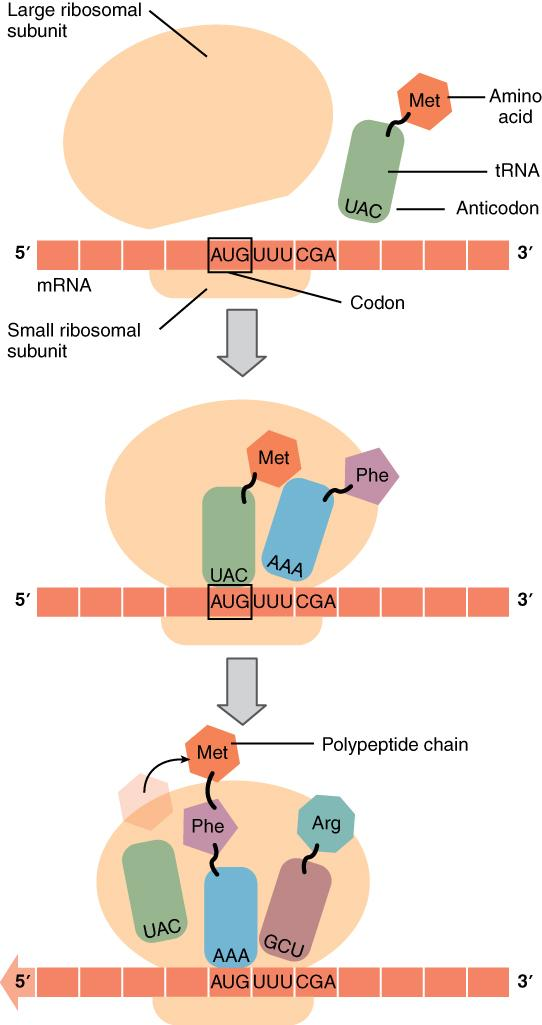
Image: Diagrammatic representation of process of Translation
Therefore, correct option to this question is A
Note: RRNA (Ribonucleic acid) is quite similar to DNA (Deoxyribonucleic acid), the difference is the positioning of the groups. DNA consists of the blueprint called gene and the RNA converts that blueprint into protein.
Complete step by step answer:
RNA termed ribonucleic acid is a nucleic acid that is present in the living thing cells that has some similarity with the DNA (Deoxy-ribonucleic acid). RNA is a single-stranded backbone-like structure having alternating phosphate groups and sugar ribose whereas in the DNA, the alternating deoxy-ribose group is found in repetitions. The bases attached to the sugar in nucleic acid- are Adenine(A), Uracil(U), Cytosine(C), and Guanine(G).
The different types of RNA present in the living being are rRNA, tRNA, and mRNA.
rRNA: Ribosomal RNA is used to synthesise organelle known as ribosomes which are exported to the cytoplasm to help translate the information. The rRNA molecules are synthesised in an organelle of the nucleus of a cell called the nucleolus.
tRNA: Transfer ribonucleic acid is a type of molecule required to decode the mRNA in protein. Its specific function is to synthesise a protein from an mRNA molecule.
mRNA: Messenger RNA, a blueprint of the protein which helps synthesise that protein. The transcription process creates mRNA where an enzyme, RNA polymerase, gets converted into primary transcript mRNA or pre-mRNA.
Proteins are synthesised by the ribosome which is present in the nucleolus. The ribosome consists of about 80 different proteins with structural RNA. When the protein is not in an active or inactive state, it consists of the 2 sub-unit in which one is larger and the other is a small sub-unit.
Image: Diagrammatic representation of process of Translation
Therefore, correct option to this question is A
Note: RRNA (Ribonucleic acid) is quite similar to DNA (Deoxyribonucleic acid), the difference is the positioning of the groups. DNA consists of the blueprint called gene and the RNA converts that blueprint into protein.
Recently Updated Pages
With which part the mRNA should be bound to initiate class 12 biology JEE_Main

Which one of the following is an example of a biofertiliser class 12 biology JEE_Main
Which of the following protein destroys the antigen class 12 biology JEE_Main
The type of pollination observed in Zostera and Vallisneria class 12 biology CBSE
A straight line goes through the points pq and rs -class-11-mathematics-JEE_Main
Which of the following scientists discovered the Pasteurization class 11 biology JEE_Main
Trending doubts
JEE Main Marks vs Percentile 2026: Predict Your Score Easily
JEE Main Cutoff 2026: Category-wise Qualifying Percentile
JEE Main 2026: Exam Dates, Session 2 Updates, City Slip, Admit Card & Latest News
JEE Main Marks vs Rank 2026: Expected Rank for 300 to 0 Marks
NIT Cutoff 2026: Tier-Wise Opening and Closing Ranks for B.Tech. Admission
JoSAA 2026 Mock Seat Allotment Round 2 OUT JUNE 10: Check Choice Filling Deadline and Counselling Dates
Other Pages
NCERT Solutions For Class 12 Biology Chapter 1 Sexual Reproduction In Flowering Plants - 2026-27
NCERT Solutions For Class 12 Biology Chapter 2 Human Reproduction - 2026-27
NCERT Solutions For Class 12 Biology Chapter 4 Principles Of Inheritance And Variation - 2026-27
NCERT Solutions For Class 12 Biology Chapter 3 Reproductive Health - 2026-27
NCERT Solutions For Class 12 Biology Chapter 13 Biodiversity And Conservation - 2025-26
NCERT Solutions For Class 12 Biology Chapter 5 Molecular Basis Of Inheritance - 2026-27