



Class 7 SST Part 2 Chapter 3 Empires and Kingdoms: 6th to 10th Centuries Questions and Answers – FREE PDF Download
The Big Questions (Page 61)
Question 1. What major changes characterised this period?
Answer: This period was marked by the emergence of several regional kingdoms following the decline of the Gupta Empire. Dynasties such as the Palas, Gurjara-Pratiharas, Rashtrakutas, Chalukyas, Pallavas, and Cholas became powerful and extended their territories.
Local administrative systems became more organised, while land grants helped increase agricultural production. Trade relations with different parts of Asia and Africa also expanded. Significant progress was made in literature, mathematics, astronomy, art, and temple architecture, making this an important phase of political and cultural development.
Question 2. How did the political, cultural, and religious developments shape India during this period?
Answer:
Political developments during this period resulted in the establishment of powerful regional kingdoms, including the Palas, Pratiharas, Rashtrakutas, Chalukyas, and Cholas.
These rulers created effective administrative systems, expanded their territories through warfare, and strengthened local governance through village assemblies and land grants.
In the cultural field, kings supported education, literature, art, and architecture. Centres of learning such as Nalanda and Vikramashila attracted scholars from different regions.
Literary works such as Harshacharita and Rajatarangini provided valuable information about rulers and historical events. Magnificent temples and monuments at places such as Ellora and Mamallapuram reflected the artistic achievements of the period.
Religious diversity also flourished. Hinduism, Buddhism, and Jainism received support from different rulers.
Temples, monasteries, and religious institutions became important centres of worship, education, philosophy, and cultural exchange. Together, these developments enriched India’s political structure, economy, and cultural identity.
Question 3. What was the impact of foreign invasions and interactions on Indian society and polity during this period?
Answer: Foreign invasions and contacts created both political difficulties and opportunities for cultural interaction. The Huns' invasion weakened the Gupta Empire and contributed to the division of northern India into smaller kingdoms. Over time, however, many Hunas became part of Indian society by adopting local customs, languages, and traditions.
The Arab conquest of Sindh under Muhammad bin Qasim in 711 CE introduced new political and administrative influences. At the same time, India’s trade connections with Iran, China, Southeast Asia, and other regions became stronger. These contacts encouraged the movement of goods, knowledge, religious ideas, and cultural practices, contributing to the development of towns, trade, learning, and society.
Let’s Explore
Question 1. Do you recall where the capital of the earlier Maurya and Gupta empires was located?
How do you think this shift may have shaped the sub-continent’s politics in the years to come? (Page 64)
Answer: Yes. The capital of both the Maurya and Gupta empires was Pataliputra, located near present-day Patna in Bihar. The decline of a single powerful political centre, such as Pataliputra, encouraged the growth of several regional kingdoms.
Instead of being ruled by a single central empire, various rulers began competing for territory and political influence. They formed alliances, fought wars, and developed their own systems of local administration. As a result, regional cultures, political identities, and administrative traditions became stronger and continued to influence Indian politics for many centuries.
Question 2. If you know the Devanagari script, with the help of your teacher, try to identify some of the letters in Harșha’s signature (see Fig. below). (Page 64)

Answer: With the guidance of the teacher, some letters and symbols that may be recognised in Harsha’s signature are:
ह, म, र, ज, स, श्री, त।
Question 3. Looking at the map (below), can you identify a few mountain passes or desert areas that Xuanzang had to cross while travelling between China and India?
Can you also identify a few important Buddhist centres of learning that Xuanzang visited in India? Do you know
something of their significance? (Page 66)
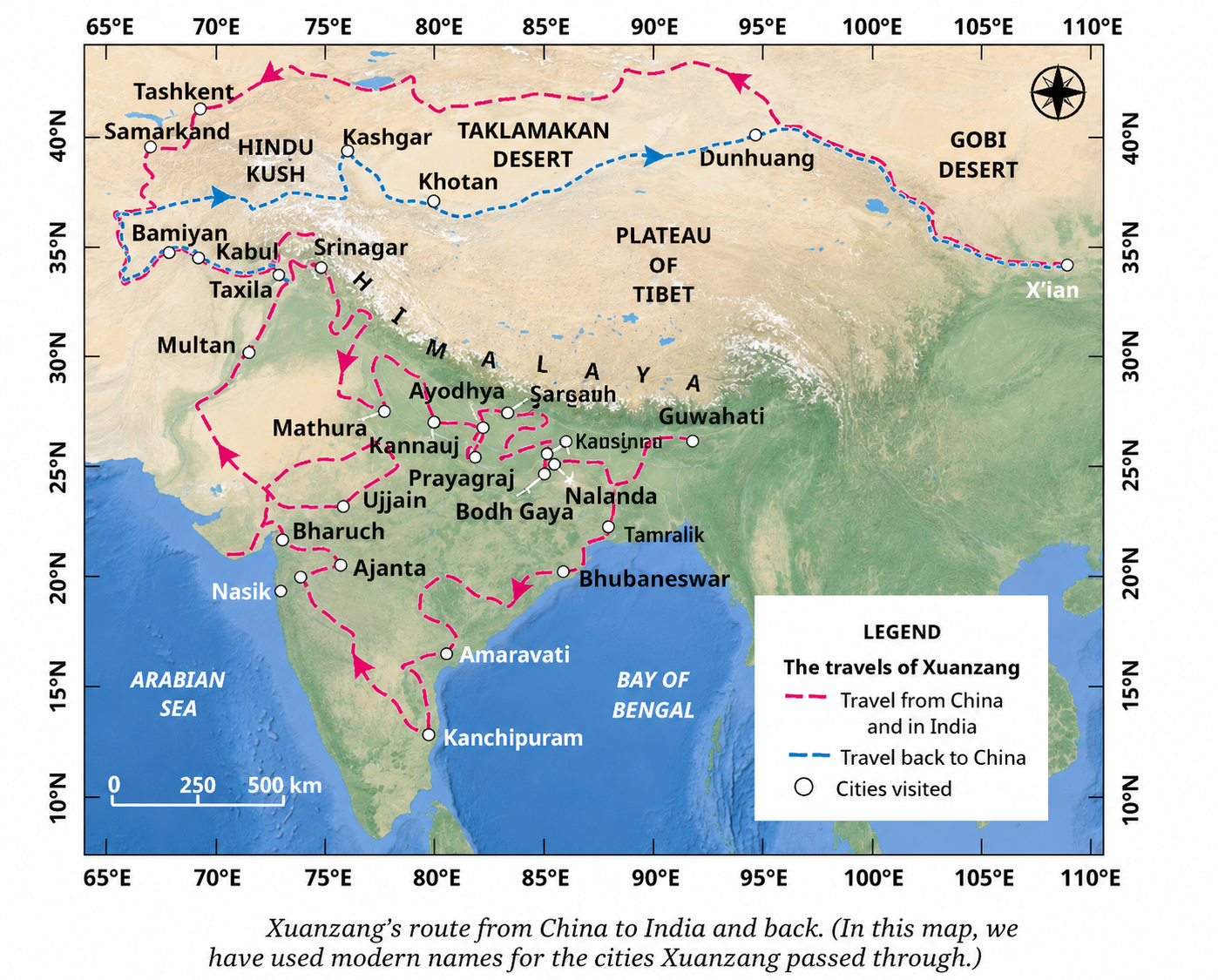
Answer: According to the map, Xuanzang, also known as Hiuen Tsang, travelled through several dangerous deserts and mountainous regions on his journey from China to India. Some of them are given below.
Desert Regions
Gobi Desert: Located in northern China and Mongolia, the Gobi Desert has a severe climate with freezing nights, hot days, and frequent sandstorms.
Taklamakan Desert: Located in Central Asia, this desert was one of the most difficult parts of the Silk Route. Xuanzang travelled through oasis settlements such as Khotan while crossing this region.
Mountain Ranges/Pass Areas
Tibetan Plateau: Often called the “Roof of the World,” this region has high altitudes, thin air, and extremely cold weather, which made travel very challenging.
Himalayas: Xuanzang had to cross parts of the Himalayan region, where snow-covered mountains, landslides, cold temperatures, and narrow passes created serious difficulties.
Hindu Kush Mountains: These steep, rugged mountains near present-day Afghanistan contained important routes connecting Central Asia to the Indian subcontinent.
Xuanzang was a well-known Chinese Buddhist monk who travelled across India during the 7th century CE. He recorded his observations about Indian society, religion, education, and geography in his work, Great Tang Records on the Western Regions.
Some important centres and their significance that he visited were:
Nalanda → A renowned international centre of Buddhist education where scholars studied religion, philosophy, medicine, grammar, and other subjects.
Lumbini → The birthplace of Gautama Buddha and an important Buddhist pilgrimage centre.
Ajanta → A famous group of Buddhist caves known for monasteries, sculptures, paintings, and religious learning.
Bodh Gaya → The place where Gautama Buddha attained enlightenment, making it one of the most sacred Buddhist sites.
Taxila → An ancient centre of education where students studied subjects such as medicine, philosophy, warfare, grammar, and politics.
Question 4. Why was Kannauj so attractive to those powerful dynasties?
Observe its location on the map given below and discuss in class. (Page 68)
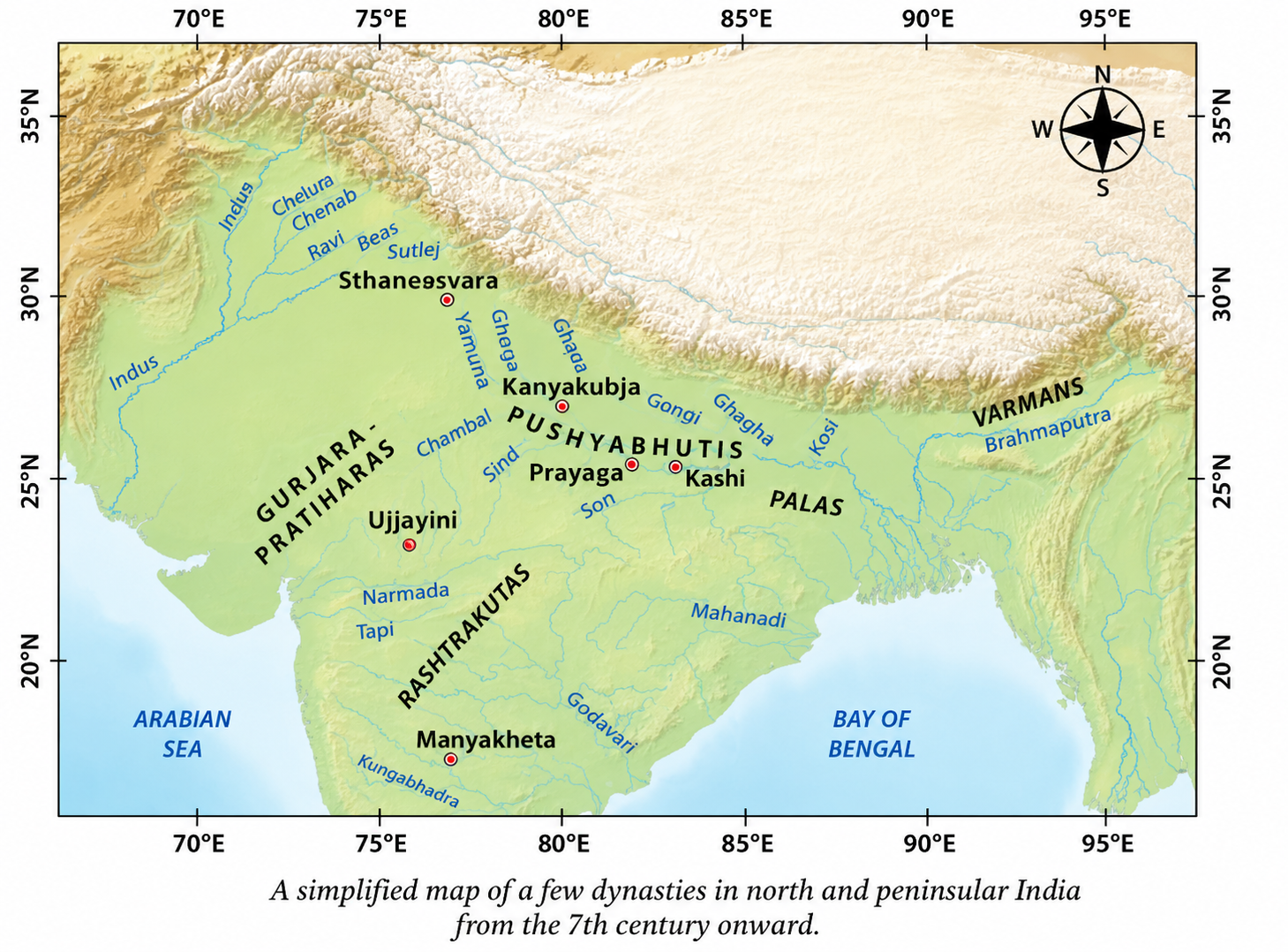
Answer: Kannauj attracted powerful dynasties because of its important geographical, economic, and political position in northern India. The main reasons were:
(a) Located in the fertile Ganga-Yamuna Doab: The surrounding land was highly fertile and produced large quantities of crops. Controlling Kannauj provided access to agricultural wealth, revenue, and a large population.
(b) Command of important river routes: Kannauj was situated close to the Ganga River, which was an important route for transport and trade. It allowed rulers to move soldiers, goods, and people more easily.
(c) A central point in North Indian politics: Its central location enabled rulers to influence different parts of northern India and expand their kingdoms towards the east, west, and south.
(d) A great cultural and commercial centre: Kannauj was a prosperous city visited by traders, scholars, and religious groups. Controlling such an important city increased a ruler's wealth, authority, and prestige.
Question 5. Form groups in your class to discuss the following questions, then compare the groups’ answers.(Page74)
(a) What qualities does Kalhana think a historian should have?
Answer: According to Kalhana, a historian must be honest, impartial, and committed to presenting the truth. A historian should depend on trustworthy evidence rather than imagination, personal opinions, or exaggerated praise of rulers. Kalhana studied earlier writings, inscriptions, temple records, and land grants to identify mistakes and arrange events correctly. He also believed that history should offer moral lessons by showing that fair rulers earn respect, while unjust rulers eventually face negative consequences.
(b) What do these lines reveal about his method of gathering information? In what ways does it resemble or differ from the way history is currently written?
Answer: These lines indicate that Kalhana drew on various sources, including earlier books, inscriptions, temple records, royal documents, and accounts of kings. He compared these sources carefully to identify inaccuracies and develop a more reliable account of the past.
His approach is similar to modern historical writing because present-day historians also examine evidence, compare different sources, and verify information before reaching conclusions.
However, Kalhana sometimes included legends, moral observations, and personal judgements about rulers. Modern historians usually place greater emphasis on objective analysis, factual evidence, and the avoidance of personal opinions.
(c) Kalhana also writes, “That nobleminded poet is alone worthy of praise whose words, like that of a judge, remain free from love or hatred in relating the facts of the past.” What does he mean by ‘free from love or hatred’? How would meeting this condition make a historian more reliable?
Answer: The expression “free from love or hatred” means that a historian should remain impartial while describing people and events from the past. A historian should neither favour a ruler because of admiration nor criticise someone because of personal dislike.
Following this principle allows historians to describe both achievements and failures honestly. It prevents them from exaggerating certain events, hiding uncomfortable facts, or presenting a one-sided account. Therefore, a historian who remains unbiased is considered more dependable because the information is based on evidence rather than personal emotions.
Question 6. Shankaracharya taught that brahman is the ultimate reality or the pure consciousness, and that the world as we perceive it is maya, or illusion. He established four mathas (monasteries and centres of learning) at Badrinath, Puri, Dwarka, and Sringeri. Mark the location of these cities on a map; why do you think he chose four different corners of India rather than more central locations? (Page 75)
Answer: Shankaracharya founded four mathas at Badrinath in the north, Puri in the east, Dwarka in the west, and Sringeri in the south. By establishing these centres in four different corners of India, he could spread his teachings across a much wider area.
To promote spiritual unity: The four mathas helped connect people from different regions through the common teachings of Advaita philosophy.
To make learning accessible, establishing centres across the country made religious and philosophical education more readily available to people in distant regions.
To represent India’s unity: The four institutions symbolised that people from all parts of the subcontinent could share a common spiritual and cultural tradition.
To reduce regional isolation, these centres encouraged communication between different regions and helped religious ideas spread beyond local boundaries.
To encourage pilgrimage and cultural exchange: People travelling to these mathas interacted with other communities, exchanged ideas, and strengthened cultural connections across India.
Question 7. Note this panel’s highly dynamic three-dimensional composition, expressing Durga’s confident assault on the demon.
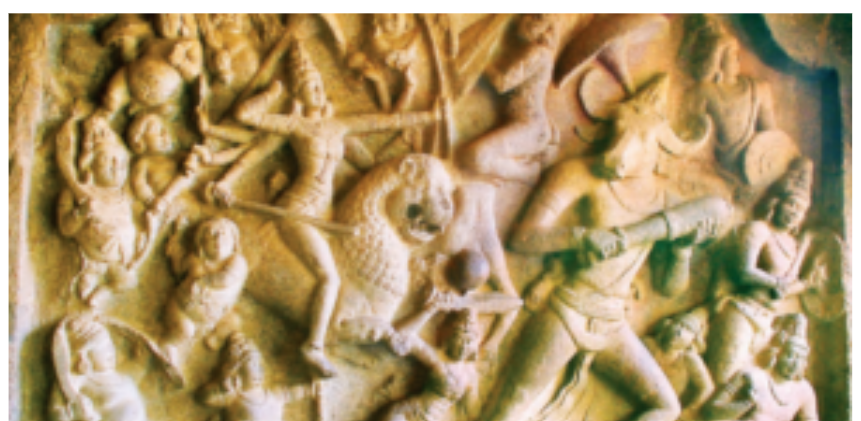
(a) Can you identify some of Durga’s many weapons? And her vahana?(Page 79)
Answer: The panel shows Goddess Durga carrying several weapons in her multiple hands. These include a trident or trishul, a sword, a bow and arrow, a mace, and a spear. According to tradition, these weapons were given to her by different gods to help her defeat the buffalo demon Mahishasura. Her vahana, or vehicle, is the lion. The lion represents bravery, strength, confidence, and fearlessness.
(b) What are the main differences between her attendants and the demon’s attendants? (Page 79)
Answer: Durga’s attendants appear disciplined, confident, and prepared for battle. Their firm positions and alert expressions show that they trust Durga and are ready to support her. In comparison, the demon’s attendants seem frightened, disorganised, and uncertain. Their expressions and movements suggest panic and an awareness that they are being defeated. This contrast emphasises the strength and order on Durga’s side and the fear and confusion among the demons’ forces.
(c) What does the demon’s slanted posture and general attitude indicate? (Page 79)
Answer: The demon’s slanting posture suggests that he has lost his balance and is being overpowered by Durga. His body appears to bend or fall backwards, indicating fear, weakness, and a loss of control. The posture also symbolises the approaching defeat of evil by divine power and righteousness.
Question 8. What details do you observe in these coins? (Page 90)
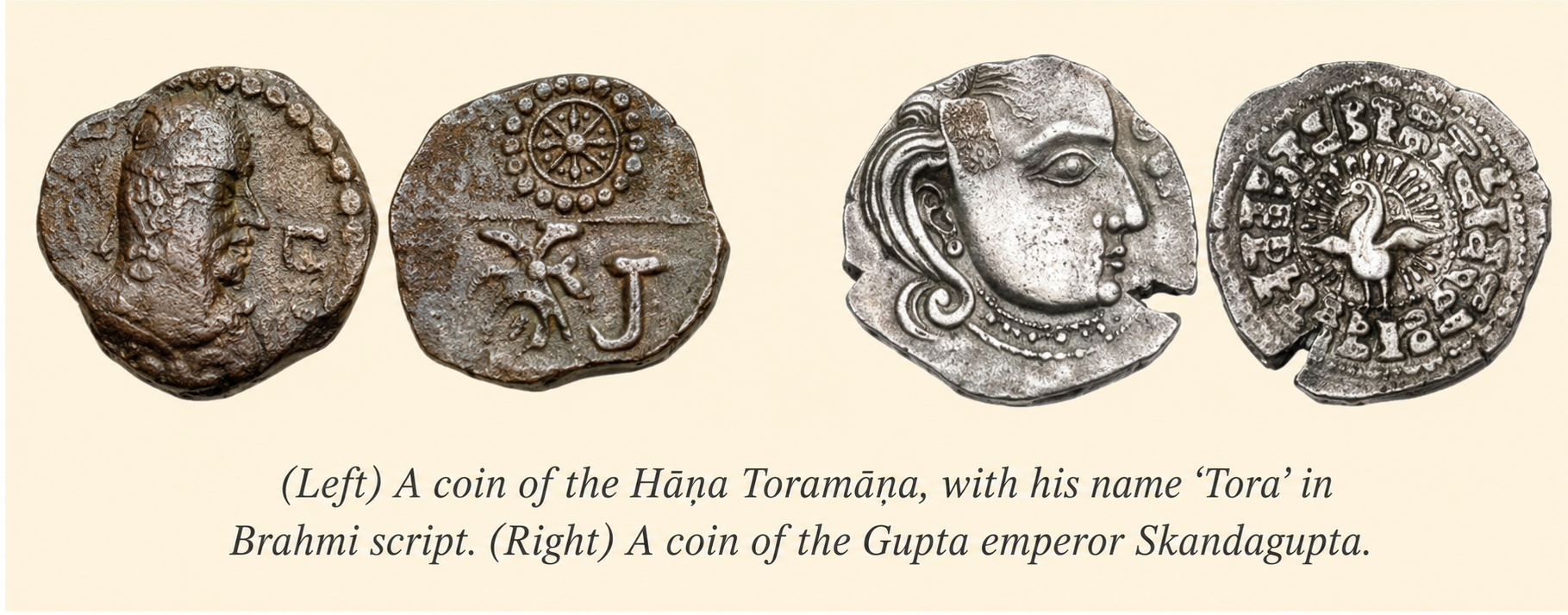
Answer: The coins contain several noticeable features. One side of each coin displays the side profile of a ruler’s face. The reverse side contains different symbols, patterns, or decorative designs, including a wheel-like symbol. Toramana’s coin also carries the shortened form of his name, “Tora,” written in the Brahmi script. These details help historians identify the rulers and understand the scripts, artistic styles, and symbols used during that period.
Question 9. Why do the coins of Toramana and Skandagupta appear so similar? (Page 90)
Answer: The coins appear similar because the Huna rulers followed the coin-making style established by the Guptas. They adopted similar shapes, designs, portraits, and symbols to present themselves as powerful and legitimate rulers. By issuing coins resembling Gupta coins, Toramana sought to gain acceptance and establish himself as a rightful Indian king.
Question 10. What conclusions can you draw? (Page 90)
Answer: The coins indicate that rulers used coin designs to display their authority and political status. Foreign rulers, such as the Hunas adopted familiar Indian symbols and artistic styles to gain the trust and support of the local population. With these coins, they sought to present themselves as accepted rulers rather than as foreign outsiders.
Question 11. The Chachnama records that when King Dahar was killed, his widowed queen put up a brave resistance, and when the situation became hopeless, she immolated herself along with other ladies. Another queen ordered her treasure to be distributed among the brave soldiers and inspired them to stand against the invaders.
(a) What does this suggest about the way the indigenous people responded to invasions? (Page 91)
Answer: It suggests that the indigenous people strongly resisted foreign invasions instead of surrendering without a fight. Even after their king was killed, they continued to defend their kingdom with courage and determination.
(b) Why do you think the queen chose to give away her treasure? (Page 91)
Answer: The queen distributed her treasure to honour and encourage the soldiers who were defending the kingdom. The wealth could also be used to obtain weapons, food, and other resources required by the army. Her action motivated the soldiers to continue resisting the invaders.
(c) What does this reveal about the role of women in warfare? (Page 91)
Answer: This incident shows that women played important, active roles in war. They provided leadership, encouraged soldiers, organised resistance, and made great sacrifices to protect their kingdom. Women were not merely observers but courageous participants in times of conflict.
Think About It
Question 1. Does the above ceremony remind you of a similar event discussed in Part 1 of this textbook? (Page 67)
Answer: Yes, the ceremony resembles the Ashvamedha Yajna, or horse sacrifice, discussed in Part 1 of the textbook. Both were grand royal ceremonies linked to religion, political power, prestige, and a ruler's authority.
Question 2. Al-Masudi, a 10th-century Arab historian and traveller from Baghdad, gave high praise to a Rashtrakuta ruler: “His troops and elephants are innumerable. … There is none among the rulers of Sindh and Hind who in his territory respects the Muslims [as he does]. In his kingdom, Islam is honoured and protected. And, for them, mosques and congregational mosques, which are always full, have been built for offering prayers five times.” What does this tell us about the Rashtrakutas? (Page 72)
Answer: The passage provides several important details about the Rashtrakutas:
They possessed a powerful army: Al-Masudi’s description of their countless troops and elephants indicates that the Rashtrakutas maintained a large and well-organised military force.
They controlled a prosperous kingdom: Maintaining such a large army required considerable wealth, an efficient administration, productive lands, and access to important trade routes.
They respected religious diversity: The Rashtrakuta ruler allowed Muslim communities to practise their religion freely and protected their places of worship.
They encouraged peaceful coexistence: The construction and protection of mosques indicate that different religious communities were permitted to live and worship within the kingdom.
Overall, the passage presents the Rashtrakutas as militarily powerful, economically prosperous, and tolerant towards different religious groups.
Question 3. How does a professional group transform into a jati? (Page 85)
Answer: A professional group gradually transforms into a jati when people engaged in the same occupation begin to consider themselves a distinct social community. Over time, they may develop shared customs, establish their own social rules, marry within the group, and pass down their occupation from one generation to the next. As these practices become permanent, the occupational group develops into a recognised jati.
Question 4. Sulaiman, a 9th-century Arab merchant and traveller, makes this comment on a Gurjara-Pratihara ruler: “This king maintains numerous forces, and no other Indian prince has so fine a cavalry. He is unfriendly to the Arabs … there is no greater foe of the Muhammadan faith than he. … He has riches, and his camels and horses are numerous. … There is no country in India safer from robbers.” Why do you think the author calls the ruler a ‘foe to the Muslim faith’? (Page 92)
Answer: Sulaiman describes the ruler as a “foe to the Muslim faith” because the Gurjara-Pratihara ruler strongly opposed the political and military expansion of the Arabs into his territory.
The ruler maintained a large army and a highly skilled cavalry, which enabled him to prevent Arab forces from extending their control further into India. From Sulaiman’s point of view, this resistance made the ruler an enemy of the Arabs and their political interests. The statement mainly reflects the political conflict between the Gurjara-Pratiharas and the Arab powers of that period.
Question 5. The table lists common everyday words, highlighting their similar pronunciation across the three languages. By comparing these sounds, you can identify words that are closely related or share common roots in all three languages. With the help of your teacher, use this observation to complete the table. (Page 93)
Answer:
Don’t Miss Out
Question 1. During this period, inscriptions began using both Sanskrit and regional languages simultaneously. In land grants, the ruler and his dynastic history were often praised in Sanskrit, while the operative details of the grant were recorded in the local language. Why do you think such inscriptions were written in two languages? (Page 81)
Answer: These inscriptions were written in Sanskrit and a regional language because each language served a different purpose.
(a) To express royal prestige and cultural importance: Sanskrit was widely used in royal courts, religious texts, poetry, and scholarly works. The ruler’s achievements and family history were therefore written in Sanskrit to make the inscription appear formal, prestigious, and connected with established traditions.
(b) To communicate practical information clearly: Details such as the boundaries of the granted land, taxes, the name of the recipient, and the responsibilities connected with the grant were written in the local language. This allowed village officials, residents, temple authorities, and recipients to understand and follow the instructions correctly.
Using two languages allowed the inscription to honour the ruler while also making its practical details understandable to the local population.
Question 1. If you lived in Kannauj during the struggle between the Palas, the Pratiharas and the Rashtrakutas, how would it change your daily life and your estimate of the rulers? Write a letter on this to your friend living in Kanchipuram.
Answer:
Kannauj
Date: 25.10.2026
Dear friend,
I hope you and your family are doing well in Kanchipuram. Life in Kannauj has become extremely uncertain due to the ongoing struggle among the Palas, Pratiharas, and Rashtrakutas. Different armies repeatedly attempt to capture the city, and people never know when another battle may begin.
Soldiers and horses frequently pass through the streets. Traders are sometimes forced to close their shops, while farmers and travellers fear being attacked on the roads. The markets are less active, and many families remain worried about their safety and property.
Kannauj remains a wealthy and beautiful city, but constant warfare has disrupted normal life. Earlier, I believed that rulers existed to protect their people and maintain peace. Now, it appears that many of them are more interested in territory, prestige, and power than in the welfare of ordinary citizens.
I wish the rulers would end their conflicts and work towards peace and stability. A strong ruler should protect the population, encourage trade, and improve people’s lives rather than repeatedly expose them to warfare.
I hope conditions in Kanchipuram are more peaceful. Please write back and tell me about life in your city.
Your friend
Question 2. Emperors and kings during this period controlled only core regions and governed other regions through subordinate vassals. What would be the advantages and the challenges of such a system?
Answer: Advantages of such a system were:
The emperor did not need to administer every region personally.
Local rulers were familiar with the customs, languages, resources, and needs of their areas.
Administrative and military responsibilities could be shared between the emperor and the vassals.
The emperor could expand the kingdom without creating a completely new administration in every conquered region.
Challenges of such a system were:
Powerful vassals could become independent and rebel against the emperor.
Some subordinate rulers might refuse to obey orders, provide soldiers, or pay the required taxes.
The loyalty of vassals could change whenever the central ruler became weak.
Communication with distant territories was slow, which could delay decisions and create administrative problems.
Question 3. In what ways were the invasions of the Hunas and the Arabs different in their aims, methods, and impact on the Indian subcontinent? Prepare a write-up, discuss and present it in the class.
Answer: The invasions of the Hunas and the Arabs differed in their objectives, methods, and long-term effects on the Indian subcontinent.
The Hunas entered India mainly during the 5th and 6th centuries CE. Their primary aim was to capture territory, obtain wealth, and establish political control. They relied heavily on fast-moving cavalry and carried out destructive military attacks. Their invasions weakened the Gupta Empire, damaged several settlements, and contributed to political instability. However, their rule did not last long, and many Huna groups were gradually absorbed into Indian society.
Arab forces entered Sindh during the early 8th century CE under Muhammad bin Qasim. Their campaign combined military conquest with political administration. After gaining control of Sindh, they established an administrative system, formed arrangements with some local groups, and maintained connections with the wider Islamic world.
The Huna invasions mainly caused political disruption and contributed to the decline of the Gupta Empire. Arab rule had a more lasting influence in Sindh through administration, trade, cultural contact, and the gradual spread of Islam. Therefore, while both groups sought political control, their methods and long-term effects were different.
Question 4. Imagine you are a common citizen watching the Prayaga assembly. How would you react to Harsha giving away most of his wealth?
Answer: As a common citizen watching the Prayaga assembly, I would be deeply impressed by Harsha’s generosity. Seeing a powerful ruler distribute most of his wealth among religious people, scholars, and those in need would make me respect him.
I would consider him a kind and noble king who valued generosity more than personal riches. At the same time, I might also wonder whether enough wealth had been kept aside to manage the kingdom, maintain the army, and support the people during emergencies.
Question 5. Forming groups, let each group choose one Alvar and one Nayanar and prepare a biography poster or booklet. Include their life stories and a sample poem or two (in translation).
Answer: We have selected Andal, an Alvar saint, and Appar, also known as Tirunavukkarasar, a Nayanar saint.
(a) Andal – Alvar Saint
Andal was the only woman among the twelve Alvars. She is believed to have lived in Srivilliputhur in present-day Tamil Nadu. According to tradition, Vishnuchittar, also known as Periyalvar, found her as a baby near a tulsi plant and raised her as his daughter.
From an early age, Andal developed a deep devotion towards Lord Vishnu. She composed devotional poems expressing her love for him and her desire for spiritual union with the deity.
A well-known story tells of Andal secretly wearing the flower garlands prepared for the temple deity before they were offered. When her father discovered this, he was upset. However, Lord Vishnu is believed to have expressed his preference for the garlands worn by Andal. This story became a symbol of her pure devotion.
Tradition holds that Andal later became spiritually united with Lord Ranganatha at the temple in Srirangam.
A Poem Inspired by Andal’s Devotional Message – English Translation:
“Let us rise together in the early light,
Sing the many names of the divine Lord,
And pray for peace, kindness, and prosperity.
To reach every living being.”
Empires and Kingdoms: 6th to 10th Centuries Class 7 Questions and Answers Social Science Part 2 Chapter 3
(b) Appar – Nayanar Saint
Appar, also called Tirunavukkarasar, was one of the most respected Shaiva Nayanars. He lived during the 7th century CE and was born in Tiruvamur in present-day Tamil Nadu. His childhood name was Marulneekkiyar.
During his youth, he became a follower of Jainism. Later, after suffering from a serious illness, he prayed to Lord Shiva and is believed to have recovered. Following this experience, he returned to Shaivism and devoted his life to worshipping Shiva.
Appar travelled on foot to numerous Shiva temples and sang devotional hymns. He also cleaned temple grounds and performed physical service, demonstrating humility and dedication. His hymns later became part of the important Tamil Shaiva collection known as the Tevaram.
A Poem Inspired by Appar’s Devotional Message – English Translation:
“O Lord who lives within the sacred shrine,
You ease the suffering of those who remember you.
May your grace remain beside us
And guide us through every difficulty.”
Question 6. You will notice that our maps show only ancient names for the kingdoms capitals and main cities. Using a pencil, mark the modern names next to their original names. Refer to the current map of India and try to locate those cities on it.
Answer: Students can write the modern names beside the ancient names on the map and identify their present-day locations.
Ancient Names → Modern Names
Pataliputra → Patna, Bihar
Kanyakubja → Kannauj, Uttar Pradesh
Sthanesivara → Thanesar, Haryana, near Kurukshetra
Kanchi → Kanchipuram, Tamil Nadu
Vatapi → Badami, Karnataka
Manyakheta → Malkhed, Karnataka
Madurai → Madurai, Tamil Nadu
Sri Lanka → Sri Lanka, an island country situated to the south of India
Nalanda → Nalanda, Bihar
Vikramashila → Near Bhagalpur, Bihar
Somapura Mahavihara → Paharpur, Bangladesh
Parihasapura → Near Srinagar, Jammu and Kashmir
Kanchipuram, the Pallava capital → Kanchipuram, Tamil Nadu
Tanjavur, the Chola capital → Thanjavur, Tamil Nadu
Kaveri delta region → Tamil Nadu
Some of these places may not be marked on the chapter map. However, they are important sites associated with rulers and dynasties, including Harsha, the Palas, the Gurjara-Pratiharas, the Rashtrakutas, the Pallavas, and the Cholas.
Question 7. Match the ruler or the dynasty with the city.
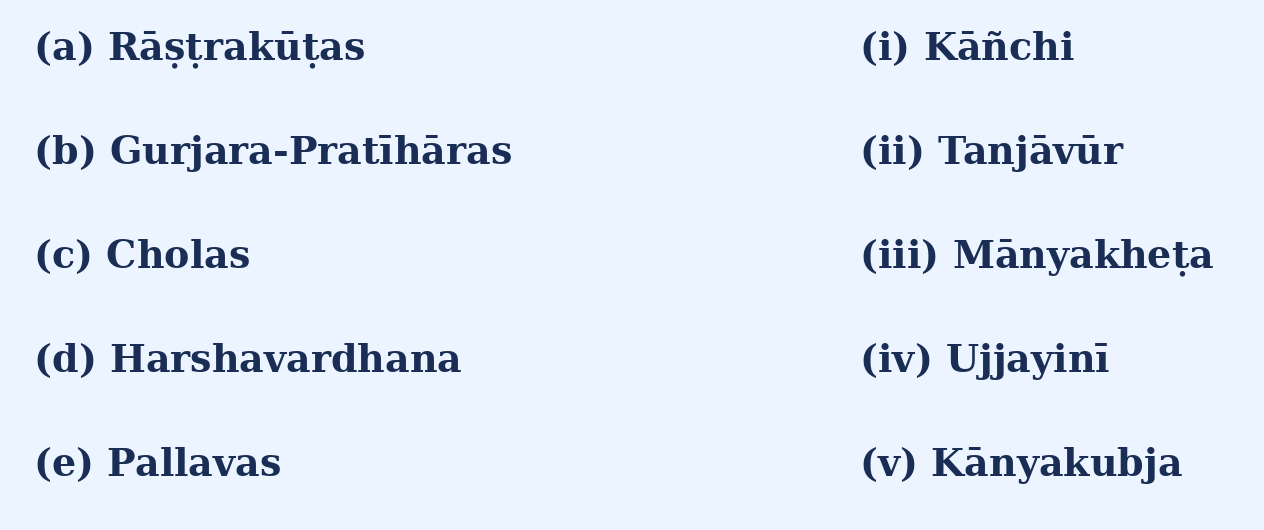
Answer:
(a) Rastrakutas → (iii) Manyakheta
(b) Gurjara-Pratiharas → (iv) Ujjayini
(c) Cholas → (ii) Tanjavur
(d) Harshavardhana → (v) Kanyakubja
(e) Pallavas → (i) Kanchi
Key Rulers and Dynasties in Class 7 SST Part 2 Chapter 3
CBSE Class 7 Social Science Part 2 Chapter 2 Empires and Kingdoms: 6th to 10th Centuries Study Materials
Explore More NCERT Solutions for Class 7 Social Science Chapters
Related Study Material for Class 7 Social Science
FAQs on NCERT Solutions for Class 7 Social Science: Exploring Society India and Beyond Part 2 Chapter 3 Empires and Kingdoms: 6th to 10th Centuries 2026-27
1. Where can I download the Class 7 Social Science Chapter 3 Empires and Kingdoms NCERT Solutions PDF?
You can download the complete NCERT Solutions for Class 7 Social Science Part 2 Chapter 3 Empires and Kingdoms: 6th to 10th Centuries as a FREE PDF directly from this Vedantu page. The PDF includes answers to all the Big Questions, Let's Explore, Think About It, and Don't Miss Out activities, and can be saved for offline study.
2. Are these Chapter 3 solutions based on the latest CBSE 2026-27 syllabus?
Yes. All answers follow the latest "Exploring Society: India and Beyond" Part 2 textbook and the CBSE 2026-27 syllabus, so every question matches what students will see in their exams.
3. What major changes does Class 7 Chapter 3 Empires and Kingdoms describe?
After the Gupta Empire declined around 600 CE, India saw the rise of strong regional kingdoms such as the Palas, Gurjara-Pratiharas, Rashtrakutas, Chalukyas, Pallavas, and Cholas. Local administration grew stronger, land grants boosted farming, trade expanded across Asia and Africa, and major advances were made in art, temple architecture, mathematics, and astronomy.
4. What was the Tripartite Struggle in Class 7 SST Chapter 3?
The Tripartite Struggle was a long contest among three powerful dynasties — the Palas of Bengal, the Gurjara-Pratiharas of western India, and the Rashtrakutas of the Deccan — for control of the city of Kannauj. Despite repeated wars, no single dynasty was able to hold the city permanently.
5. Why was Kannauj so important to powerful dynasties?
Kannauj sat in the fertile Ganga-Yamuna Doab, controlled important river trade routes, held a central position in north Indian politics, and was a prosperous cultural and commercial centre. Controlling it gave a ruler wealth, strategic advantage, and prestige, which is why so many dynasties fought over it.
6. Who was Xuanzang, and why is he important in this chapter?
Xuanzang was a Chinese Buddhist pilgrim who travelled across India in the 7th century CE during Harsha's reign. He recorded detailed observations of Indian society, religion, and education in his work, the Great Tang Records on the Western Regions, and visited famous centres such as Nalanda, Bodh Gaya, and Taxila.
7. What was the impact of foreign invasions during this period?
The Huna invasions weakened the Gupta Empire and added to political instability, though many Hunas were later absorbed into Indian society. The Arab conquest of Sindh under Muhammad bin Qasim in 711 CE brought new administrative influences, while expanding trade links with Iran, China, and Southeast Asia encouraged the exchange of goods, ideas, and culture.
8. How do these solutions help in Class 7 SST exam preparation?
The solutions answer every textbook question in clear, structured language, explain the difficult source- and map-based activities, and come with a free downloadable PDF. This makes them well-suited for both regular homework and quick revision before exams.
