




Stepwise Answers for Harvest Hymn Poem Questions and Exercises
Harvest Hymn Question Answer – Let us do these activities before we read. (Page 173)
I. Work in pairs and share your responses with your classmates and teacher.
1. India celebrates many harvest festivals. When is the harvest festival celebrated in your region and how is it celebrated?
Answer:
2. A hymn refers to a song of praise.
(i) To whom do we offer a hymn?
(ii) When and where do we sing a hymn?
(iii) Why do we offer it?
Answer:
II. Some poets and authors use words that are no longer a part of common usage. Such words are called archaic words. Work in pairs. Read the sentences given below. Match the underlined archaic words in Column 1 with their meanings in Column 2.
Thou art my friend, and I trust thee. Thy kindness is great, and everything that is mine is thine.’
Answer:
III. Work in pairs. Read the paragraph and select the correct meaning for each underlined word from the options given below. Share your answers with your classmates and teacher.
Under the golden 1. radiance of the evening sun, the villagers gathered to pay 2. tribute to their 3. cherished elder, who had dedicated his life to their well-being. His wise 4. counsel had guided generations, steering them through challenges. Known for his 5. munificent spirit, he never hesitated to share his resources generously.
1. radiance : (i) glow (ii) brilliance
2. tribute : (i) respect (ii) gratitude
3. cherished : (i) preserved (ii) loved
4. counsel : .(i) advice (ii) decision
5. munificent : (i) rich (ii) generous
Answer:
1. (ii),
2. (i),
3. (ii),
4. (i),
5. (ii)
Harvest Hymn Class 8 Question Answer – Let us discuss (Pages 176-177)
I. Write the stanza number for the main idea of each stanza given below. Share your answers with your classmates and teacher.
Answer:
1. Stanza 1
2. Stanza 4
3. Stanza 4
4. Stanza 3
II. Fill in the blanks by choosing the appropriate words or phrases from within the brackets.
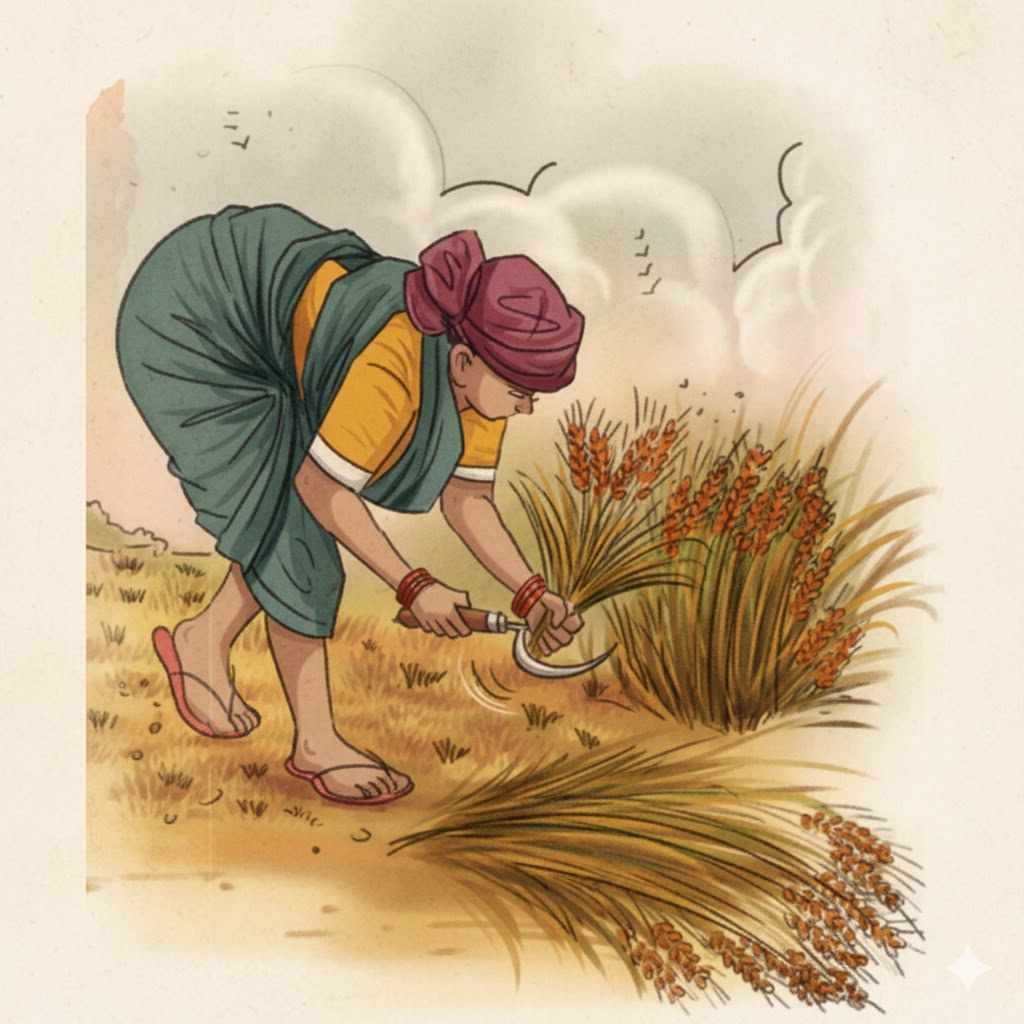
1. The setting of the poem is a rural landscape, possibly during a ____________ (harvest/religious) festival.
2. The tone of the poem is respectful and celebratory because it praises ____________ (the men and women / nature and the Lord) with deep respect and gratitude.
3. In the line Thou art our Hands and our Heart and our Home’, the letter ‘h’ is capitalised in ‘Hands’, ‘Heart’ and ‘Home’ because ____________ (it represents the hard work of farmers/ God resides in them)
Answer:
1. harvest
2. nature and the Lord
3. God resides in them.
III. Identify the poetic device used in the
Bright and munificent lord of the morn!
We bring thee our lives and our labours poetic device from
Answer:
Alliteration
IV. Match the lines from the poem in following lines from the poem. Column 1 with their expressions in Column 2. Choose the appropriate the box given below for tribute and write in Column 3.
Answer:
V. Certain words or phrases are repeated in the same line of the poem.
For example, The gold of our fields and the gold of our fruit;
Find more such repetitions from the poem. What is the poet’s purpose of using repetition in the poem?
Answer: We bring thee our songs and our garlands for tribute” and the repeated phrase “We praise thee…” express devotion through offerings and praise. The poet repeats these lines to create a musical rhythm, highlight the significance of gratitude, and show how the whole community comes together in worship and praise.
VI. The poem uses symbolism to convey deeper meanings. Match the symbols in Column 1 with the meanings they convey in Column 2.
Answer:
Class 8 English Harvest Hymn Question Answer – Let us think and reflect (Pages 178-179)
I. Read the given extracts and answer the questions that follow.
1. We bring thee our songs and our garlands for tribute,
The gold of our fields and the gold of our fruit;
O giver of mellowing radiance, we hail thee,
We praise thee, O Surya, with cymbal and flute.
(i) What does the act of bringing songs and garlands as tribute suggest about the people’s relationship with the divine?
A. They fear the gods and wish to calm them in any way possible.
B. They have a deep sense of reverence and gratitude towards the divine.
C. They are forced to perform rituals without understanding the divine.
D. They depend on the gods for their daily needs and activities.
Answer:
B. The act of bringing songs and garlands as tribute suggests that people have a deep sense of reverence and gratitude towards the divine.
(ii) Complete the following sentence suitably.
The word ‘gold’ in the phrases ‘the gold of our fields’ and ‘the gold of our fruit’ symbolises ____________
Answer:
richness and abundance of the harvest
(iii) How does the description ‘O giver of mellowing radiance’ help us understand Surya’s role in the harvest?
Answer:
It highlights Surya’s (Sun’s) role in ripening and nurturing the crops by providing gentle, life-giving light.
(iv) Fill in the blank by selecting the correct option from those given in the brackets.
The use of cymbal and flute signifies ____________ (joy and celebration/meditation and worship)
Answer:
joy and celebration
2. All Voices:
Lord of the Universe, Lord of our being, Father eternal, ineffable Om!
Thou art the Seed and the Scythe of our harvests,
Thou art our Hands and our Heart and our Home.

(i) In the phrase ‘Lord of our being,’ what I does the word ‘being’ most likely refer to?
A. Our physical body
B. Our entire existence
C. Our spiritual practices
D. Our earthly possessions
Answer:
B. Our entire existence
(ii) Identify whether the following statement is true or false.
The imagery of ‘the Seed and the Scythe’ symbolises the divine’s role as both the beginning (creation) and the end (harvest) of the agricultural cycle.
Answer:
True
(iii) Identify the phrases from the extract that mean the following:
A. The divine as a timeless, everlasting presence
B. Beyond human comprehension or description
Answer:
A. Father eternal
B. Ineffable Om
(iv) How do we know that these lines from the extract are spoken as a chorus?
Answer:
These lines are spoken by a group because the stanza begins with “All Voices,” showing that the whole community is joining together in a collective chorus of praise.
II. Answer the following questions.
1. Why do the farmers hail the God of rain?
Answer: The farmers praise the God of rain because their crops depend on rainfall to grow. They express gratitude to Varuna for providing the rain and dew that enrich and sustain their fields.
2. What is being referred to as “wealth of our valleys’? Why?
Answer: The phrase “wealth of our valleys” refers to the newly harvested crops, which stand for the rich produce of the valleys and symbolize prosperity and abundance.
3. State one reason why the women refer to the Earth as a ‘source of manifold gladness’.
Answer: The women call the Earth a “source of manifold gladness” because she gives them nourishment, shelter, and life itself. Mother Earth offers everything needed for happiness and well-being, which makes her a source of many joys.
4. Why does everyone in the poem offer their “labours for tribute’?
Answer: Everyone in the poem offers their “labours for tribute” to express gratitude to the divine for blessing their hard work with a fruitful harvest. By doing so, they dedicate their efforts, unity, and the joy of the harvest season to a higher cosmic power.
5. Why has the poet presented the poem as voices of men, women, and all voices?
Answer: The poet uses the voices of men, women, and “all voices” to show that the whole community—people of all genders—joins together in harmony and thankfulness to celebrate the harvest and honour nature and the divine.
6. How does the poet create the joyous atmosphere of rural India at harvesting time?
Answer: The poet brings to life the joyful spirit of rural India during harvest time by using rich imagery, references to musical instruments like cymbals, flutes, and drums, and expressions of praise and gratitude. Through these elements, the poem conveys the happiness, energy, and festive atmosphere of the season.
7. Why is the poem presented as a hymn?
Answer: The poem is written like a hymn because it expresses devotion and praise, offering spiritual gratitude to nature and the divine for the blessings of the harvest.
Harvest Hymn Class 8 Questions and Answers – Let us learn (Pages 179-181)
I. Match the pictures of the farming implements given in Column 1 with their use given in Column 2. Then, fill in the blanks in Column 3 to complete the name of the implement.
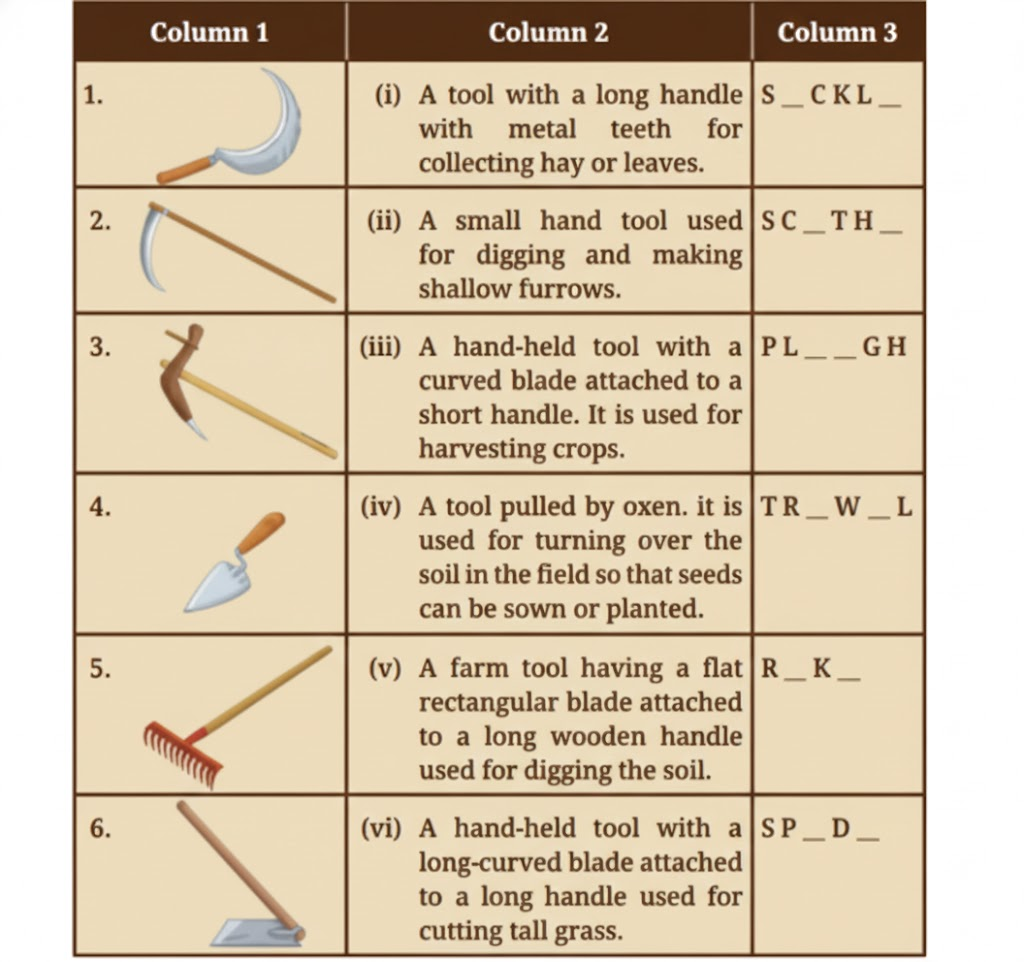
Answer:
1. (iii) SICKLE
2. (vi) SCYTHE
3. (iv) PLOUGH
4. (ii) TROWEL
5. (i) RAKE
6. (v) SPADE
II Choose the correct synonyms for the underlined words in the given sentences from the box below. Circle the words or phrases in the sentences that helped you to infer the meanings. One example has been done for you.
1. The king was benefient to the poor because
he took good care of them.
synonym: kind
2. He was munificent towards the needy and donated a lot for their health care,
synonym: ____________
Answer:
Generous
3. When he lost his job, all his friends gave him succour by supporting him with money.
synonym: ____________
Answer:
Help
4. When the sun’s rays came into the dark room, the whole room was full of radiance,
synonym: ____________
Answer:
Brightness
5. The little girl was speechless with ineffable joy when she got her birthday gift from her aunt.
synonym: ____________
Answer:
Indescribable
III. You have learnt about some archaic words. Some more archaic words are given below. Refer to a dictionary to find commonly used words which are similar in meaning.
1. morrow
2. hither
3. quoth
4. betwixt
5. yonder
Answer:
1. tomorrow
2. here
3. said
4. between
5. over there
Harvest Hymn Question Answer Class 8 – Let us listen (Pages 181-182)
I. Listen to the talk about paddy cultivation. As you listen, number the events in the correct order in which they happen.
(Refer to the NCERT Textbook Page No. 203 for transcript.)
Hello everyone!
Did you know that rice is actually a type of grass, and the part we eat is its seed? Let me tell you about the process of cultivating rice.
It all starts with preparing the land. First, the soil has to be ploughed. Rice is typically grown in fertile soil that holds a lot of water. The most important step in preparing the soil is to soak it with plenty of water. This step is called puddling. Once the nursery bed is prepared, the seeds can be planted. After that, we sow the seeds on the soil’s surface.
Paddy farmers have to ensure that their filds stay floded with water because irrigation is crucial. It takes around 4 to 5 weeks for the seeds to grow into seedlings. After this comes the most important step—transplanting. The seedlings that were prepared in the nursery bed are uprooted and then transplanted into the floded fild.
In around 120 days, the rice plants are fully grown. At this point, the crops are harvested by cutting them. Following this, the seeds are separated from the plant. This is called threshing. To reduce the moisture content even more, the separated grains are dried. This ensures that they can be stored or processed further. Through a process called milling, the rice is separated from the outer covering on it.
Finally, the rice reaches the market, and that’s where we get it to make all kinds of delicious foods. Whether it’s Appam, Pulao, Khichdi, or Daal Bhaat, rice is a big part of many meals.
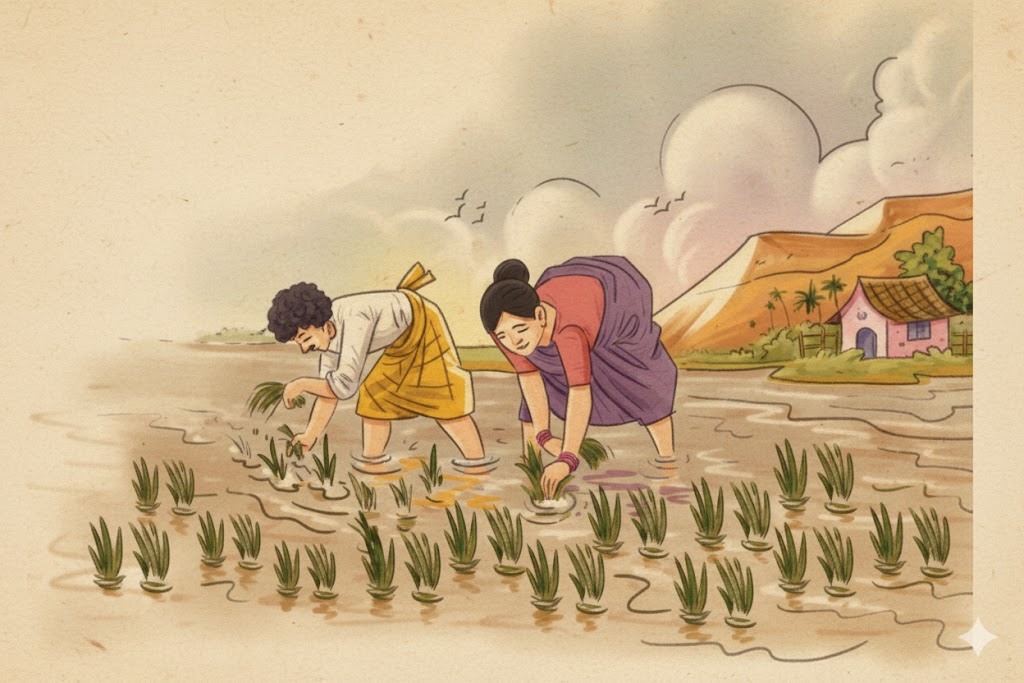
1. Transplanting of seedlings
2. Ploughing of soil
3. Threshing of grains
4. Puddling of land
5. Harvesting of paddy
6. Irrigating the field
7. Milling of rice
Answer:
1. Ploughing of soil
2. Puddling of land
3. Irrigating the field
4. Transplanting of seedlings
5. Harvesting of paddy
6. Threshing of grains
7. Milling of rice
II. Now, listen to the talk again. As you listen, choose the correct option to answer the questions that follow.
1. What is the main step in preparing the soil for cultivation of rice?
(i) Ploughing the s oil
(ii) Clearing the soil
(iii) Puddling the soil
Answer:
(iii) Puddling the soil
2. How long does it take for rice seeds to grow into seedlings before being transplanted?
(i) 2-3 weeks
(ii) 4-5 weeks
(iii) 6-7 weeks
Answer:
(ii) 4-5 weeks
3. Why is drying rice grains important after threshing?
(i) To get rice seeds for plantation
(ii) To separate the rice grains easily
(iii) To store the rice grains for longer
Answer:
(iii) To store the rice grains for longer
Class 8 English Chapter 11 Question Answer – Let us speak (Pages 182-183)
I . In English, some letters are not pronounced in certain words. For example, in words like ‘knife’, ‘knowledge’, and ‘know’, the fist letter ‘k’ is not pronounced. Let us look at a few more such examples.
In the words given below the letter ‘n’ is silent when it appears with ‘m’ at the end of the word.
hymn, column, autumn, solemn
Now, say these words aloud.
In the words given below the letter ‘b’ is silent when it appears with ‘m’.
womb, tomb, bomb, climb, comb
Now, say these words aloud.
Answer:
Do it yourself.
II. In our country, harvest is celebrated with the preparation of delicious dishes. Work in groups and make a presentation on any popular dish made during the harvest festival in your region. Use the prompts given in the box to make your presentation. Make sure that all the members share their views.
Include the following:
What is the dish called? Is it known by any other name in other parts of India?
What ingredients are used to make the dish?
How is the dish prepared?
How is the dish served?
What does the dish taste like?
What is the special ritual related to the preparation of this dish? .
Describe any special memory associated with the preparation of this dish.
Answer:
Good morning respected Principal, teachers, and friends!
Today, we — Asha, Ravi, and I — are here to share about a special dish prepared during our harvest festival, Pongal, also called Ven Pongal in Tamil Nadu. This dish is made using rice, moong dal, ghee, pepper, cumin, ginger, and cashews. The rice and dal are cooked together and then seasoned with spices fried in ghee. It is usually served hot with chutney or sambhar on banana leaves. Pongal tastes warm, savoury, and mildly spicy, with a rich and comforting aroma. It is also offered to the Sun God during the Pongal festival.
Every year, our grandmother prepares it early in the morning, and we enjoy it together as a family. For us, Pongal is not just a food item — it is a beautiful tradition that strengthens our bond.
Thank you very much for listening to our presentation!
NCERT Class 8 English Poorvi Chapter 11 Question Answer – Let us write (Page 80)
Creative slogans are used to spread a message to capture the reader’s attention. Some examples are given below:
Education is the Key, Unlock Your Destiny!
Protect the Environment Today for a Better Tomorrow
Learn, Grow, Succeed
Go Green by Keeping the Planet Clean
Your school wishes to express gratitude to the farmers who play an important role in providing us the food on our plates. Draft a creative slogan to be put up on the school notice board.
Remember to
focus on the main idea to be expressed
use simple language
be concise—express yourself in a few words
You may write the slogan on a chart paper and decorate it.
Answer:
No Farmers, No Food
Farmers Make Earth Smile
Class 8th English Chapter 11 Harvest Hymn Question Answer – Let us explore (Page 184)
I. Millets are a varied group of small-seeded grasses. They have more fire and minerals than other cereals. Millets have been a part of the Indian cuisine for years. They have been rediscovered worldwide as superfoods.
1. Read the information on Pearl Millet given below.
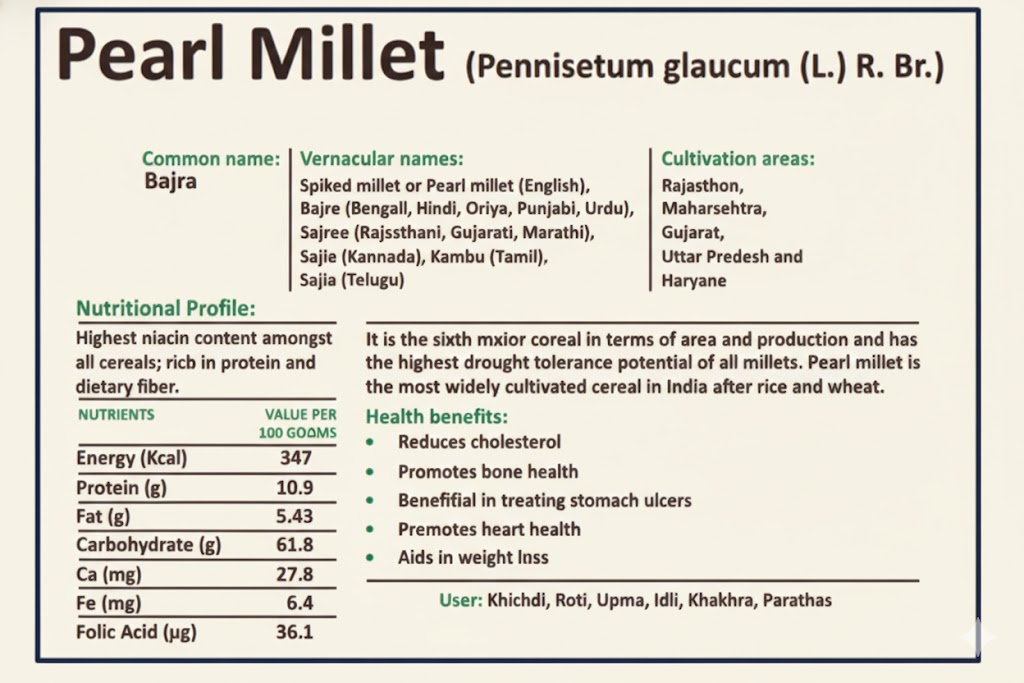
Use the link given below to know more about other kinds of millets.
https://eatrightindia.gov.in/millets2023/assets/documents/Millets%20-%20
Nutritious%20Cereal%20of%20India.pdf
2. Work in groups of four and do the following activities.
(i) Find out if millets are a part of your cuisine.
(ii) Find recipes with millets and compile them into a booklet.
(iii) Create a recipe of your choice.
Answer:
Do it yourself.
II. Songs related to harvest season form a part of our culture and heritage. Talk to the elders in your house and learn a song sung on a harvest festival. Share it with your classmates and teacher. Then, compile all the songs to create a songbook with the help of teacher.
Answer:
Do it yourself.
Key Concepts in NCERT Class 8 English Poorvi Chapter 11 - Harvest Hymn
The Harvest Hymn beautifully highlights the spirit of gratitude and unity in Indian culture. By studying the NCERT Solutions for Class 8 English Poorvi Chapter 11 (2025-26), students gain an in-depth understanding of poetic devices and symbolic meanings within the poem.
Regular practice of chapter-wise solutions improves your grasp on key terms like “personification” and “imagery.” Stay consistent with your revision and focus on connecting the chapter’s ideas to real-life experiences for better retention and exam performance.
For scoring high in CBSE English, review the main stanzas and poetic elements of the Harvest Hymn. Understanding symbolism alongside regular revision will help you answer both textual and creative questions confidently.
FAQs on NCERT Solutions For Class 8 English Chapter 11 Harvest Hymn - 2025-26
1. What are NCERT Solutions for Class 8 English Poorvi Chapter 11 Harvest Hymn?
NCERT Solutions for Class 8 English Poorvi Chapter 11 Harvest Hymn are stepwise, CBSE-aligned answers to every question from the chapter.
- They include detailed explanations, definitions, and model answers according to the CBSE 2025–26 syllabus.
- Students can use these solutions for quick revision and exam preparation.
- The solutions are designed for full marks and are available as a free PDF download.
2. How should answers be written to score full marks in Class 8 English Harvest Hymn?
To score full marks in Harvest Hymn, answers should be structured stepwise and include key points.
- Start with a brief introduction using important keywords from the question.
- Write answers in clear steps, using bullets or numbering for long/complex answers.
- Use definitions and refer to the summary or main theme if relevant.
- Present neat, error-free content as per the CBSE marking scheme.
- Underline important lines or terms if writing in exams.
3. Which topics or questions from Chapter 11 Harvest Hymn are most important for exams?
The most important topics from Chapter 11 Harvest Hymn usually include:
- Central idea or summary of the poem
- Explanation of key lines or stanzas
- Character traits or qualities highlighted in the chapter
- Definitions and meanings of difficult words
- Short notes on the poem’s theme or message
4. Are diagrams or definitions required in the answers for Class 8 English Poorvi Chapter 11?
Definitions are important in Class 8 English Poorvi Chapter 11, especially for explaining difficult words or poetic devices.
- Diagrams are generally not required for this literature chapter.
- Use exam-ready definitions for terms like 'harvest', 'hymn', or poetic devices mentioned.
- Presentation of answers should be neat and include required definitions for better marks.
5. How can I download the free PDF of NCERT Solutions for Chapter 11 Harvest Hymn?
You can download the free PDF of NCERT Solutions for Class 8 English Poorvi Chapter 11 Harvest Hymn from trusted educational platforms.
- Look for a single-click PDF download button or link on the solutions page.
- Ensure the PDF is for the correct chapter and academic year (2025–26).
- The PDF provides offline access and quick revision benefits.
6. What is the summary or main theme of Harvest Hymn in Class 8 English?
The poem Harvest Hymn centers on gratitude, hard work, and the blessings of nature in a farmer’s life.
- It reflects thankfulness towards nature and the divine for a bountiful harvest.
- Highlights the importance of teamwork, prayer, and hope in rural communities.
- Encourages students to appreciate agriculture and seasonal cycles.
- Useful as a summary point for question answers and long answer preparation.
7. Are NCERT Solutions for Class 8 English enough to prepare for school exams?
NCERT Solutions for Class 8 English are generally sufficient for exam preparation, as they cover the textbook questions as per the latest CBSE syllabus.
- They include model answers and stepwise formats.
- For higher marks, combine these solutions with revision notes, sample papers, and important questions.
- Verify with your school’s question pattern for complete prep.
8. How should I structure long answers for Harvest Hymn to match CBSE marking?
To structure long answers for CBSE marking:
- Begin with a topic sentence or introduction.
- Break the answer into numbered or bulleted points.
- Integrate main ideas, definitions, and examples.
- End with a concise conclusion or summary sentence.
- Use key CBSE-specific terminology and keep answers within word limits.
9. What are common mistakes students make while answering Class 8 English Poorvi Chapter 11 questions?
Common mistakes to avoid while answering Harvest Hymn include:
- Missing out on stepwise explanation and main points.
- Neglecting definitions or poem-specific keywords.
- Writing vague or off-topic answers.
- Ignoring marking scheme requirements.
- Poor presentation or grammatical errors.
Review the model NCERT solutions to avoid these errors.
10. Where can I find revision notes or quick summaries for Class 8 English Poorvi Chapter 11 Harvest Hymn?
You can find revision notes and quick summaries for Chapter 11 Harvest Hymn on leading educational websites and in the back of some NCERT solutions PDFs.
- Look for sources that include summary points, key definitions, and exam insights.
- These aids make last-minute preparation easier and improve recall for exams.
- Use flashcards and 1-day/3-day/7-day revision plans for best results.
