




Stepwise Solutions & Important Questions – Waiting For The Rain Class 8
Waiting for the Rain Question Answer – Let us do these activities before we read (Page 185)
I. Have you ever waited for the rains? Why?
Answer:
Yes, I have waited for the rains, especially during the hot summer months. After days of heat, the rain brings cool, refreshing air. It also helps the plants and trees grow healthy and strong.
II. How do you feel when it rains after a long time?
Answer: When it rains after a long gap, I feel joyful and refreshed. The scent of the first rain, the sound of falling raindrops, and the cool breeze all make me feel calm and happy.
III. Why do you think the farmers wait for the rains?
Answer: Farmers rely on rain to water their crops. If there is no rainfall, their fields dry up and they are unable to grow food. This is why rain is crucial for their livelihood and survival.
IV. Discuss in groups what happens when you wait for something or someone for a long period of time.
1. How do you spend the waiting period?
2. What do you think about?
3. How do you feel?
Share your answers with your classmates and teacher.
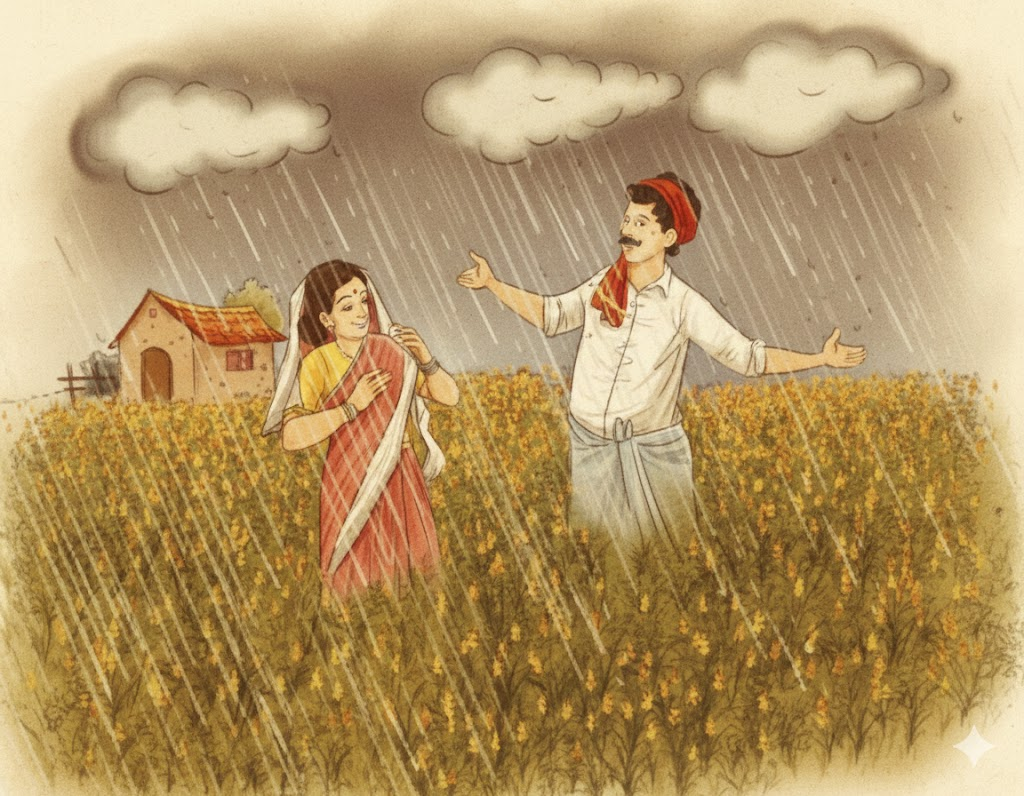
Answer:
I try to remain calm and keep myself busy with activities like reading, listening to music, or observing what’s happening around me while I wait.
I often think about when the person or thing will arrive and whether everything will turn out as planned.
Sometimes I feel restless or anxious, but I also feel hopeful and excited, depending on the situation.
Waiting for the Rain Class 8 Question Answer – Let us discuss (Page 188)
I. Complete the table given below. One example has been done for you. Share your answers with your classmates and teacher.
Answer:
II. Do you think the old woman would help Velu? If yes, why? If no, why not?
Answer: Yes, the old woman does help Velu—not by bringing rain, but by giving him a new perspective. She tells him that the land, like people, also needs rest. Her words give Velu comfort and help him understand things better during his difficult time.
III. Will Velu’s wait continue or will it rain?
Answer: Velu’s waiting doesn’t last much longer. By the end of the story, dark clouds appear and the first raindrops fall, showing that the rain has finally come, bringing Velu relief and happiness.
Class 8 English Waiting for the Rain Question Answer – Let us discuss (Page 191)
I. Complete the following statements given below with suitable reasons.
1. Velu asked the old woman to stop smiling because _________________.
2. Velu said that it was hard not being able to work since_________________.
3. Velu was confused when the old lady said that the land needed rest because _________________.
4. The old lady said that it was good for the land when it didn’t rain as _________________
5. Velu ran home laughing and happy because _________________.
Answer: There had been no rain, and he felt there was nothing to be happy about during such a tough period.
He had been working non-stop for six years and found it difficult to remain idle.
He had never imagined that the land also needed rest, just like people do.
It gave the land a chance to rest and recover after being cultivated for many years.
He felt the cool breeze and noticed the raindrops, realizing that the long-awaited rain had finally arrived.
Waiting for the Rain Class 8 Questions and Answers – Let us think and reflect (Pages 191-193)
I. Read the given extracts and answer the questions that follow.
1. “…Ican’t see how talking to astrologers will bring rain. ”
He decided to go to the weather office in the city and talk to someone. But the people at the weather office said they couldn’t really tell him when the sky would gather clouds and bring rain. “We are at a loss ourselves!” they exclaimed. “So many favourable conditions but still no rain. Very odd!”
(i) What does the first line of the extract tell us about Velu’s beliefs?
Answer:
It shows that Velu is sensible and thinks logically. He doesn’t believe in superstitions or depend on astrologers for answers.
(ii) Complete the following sentence with a suitable reason.
Velu is determined to seek information about the rain because ___________________. (he was at a loss of words/he wants to find a practical solution to the drought affcting his farm)
Answer: He wants to look for a realistic and workable solution to the drought that is affecting his farm.
(iii) Complete the table with reference to Velu’s weather offi visit.
| Expectation (What I think will happen) | Outcome (What actually happened) |
Answer:
(iv) Complete the following sentence with a suitable option.
The absence of rain despite favourable conditions, shows _________________.
A. lack of astrological knowledge
B. ineffectiveness of farmers like Velu
C. delay in understanding the weather
D. unpredictability of nature
Answer:
D. unpredictability of nature
2. “The soil, the land, the earth… shouldn’t someone let the land rest a bit?” the old woman said, softly, smiling.
“Rest? Let the land rest? I don’t understand, ” Velu looked at her, a little puzzled.
“Yes, my son, that is the difficulty. You don’t realise that the earth is old…”
(i) The old woman’s advice was accompanied with a soft tone and a smile. What does that tell us about her?
Answer: It shows that she is wise, gentle, and calm. She speaks with kindness, care, and understanding.
(ii) Fill in the blank with the correct option from those given below.
The old woman’s advice _________________
Velu, at that moment.
A. failed to impress
B. confused
C. scared
D. made sense to
Answer:
B. confused
(iii) State one thing about the old woman when she referred to Velu as ‘my son’, while offering advice.
Answer: It shows that the old woman was loving, motherly, and caring in the way she treated Velu.
(iv) Complete the following sentence with a suitable explanation.
The ‘difficulty’ that the old woman mentions is due to the fact that _________________
Answer: People like Velu do not realise that the earth also needs rest after being used continuously.
II. Answer the following questions.
1. How does the old woman convey Nature’s wisdom to Velu?
Answer: The old woman explains that the land needs time to recover, just as people need rest. She personifies the earth by saying it has worked for centuries and now needs a chance to breathe and regain its strength.
2. The writer says, The fields lay untended…’ Why couldn’t the farmers tend to their fields in the absence of rain?
Answer: Without rain, the soil turned dry, cracked, and hard. This made it impossible to plough the land, sow seeds, or grow crops. As a result, the farmers were unable to work in their fields.
3. Support the old woman’s perspective that the land needs rest just like people do.
Answer: Just as people become tired from working nonstop, the earth also gets exhausted after continuous cultivation. Leaving the land fallow allows it to regain nutrients and moisture, which leads to healthier crop growth later.
4. What can be inferred about Velu’s character based on his reaction to the drought?
Answer: Velu is dedicated, sincere, and emotionally attached to his land. He feels worried and restless when he is unable to work. His behaviour shows that he is responsible and practical, even though he is a little impatient at first.
5. What does the story suggest about the life of farmers and their relationship with nature?
Answer: The story shows that farmers live in harmony with nature’s rhythms, and their lives depend heavily on natural events like rainfall. It also highlights the need for farmers to understand and respect nature’s cycles, including periods of rest.
6. How might the rest and care of land contribute to a balanced and sustainable ecosystem?
Answer: Resting the land stops the soil from becoming exhausted, helps it retain moisture, and keeps it fertile. This practice supports healthy crop cycles and ensures long-term productivity, making farming more sustainable.
Waiting for the Rain Question Answer Class 8 – Let us learn (Pages 193-197)
I. Solve a crossword using picture and word clues. All clues are related to the words from the text that are connected to weather or agriculture.
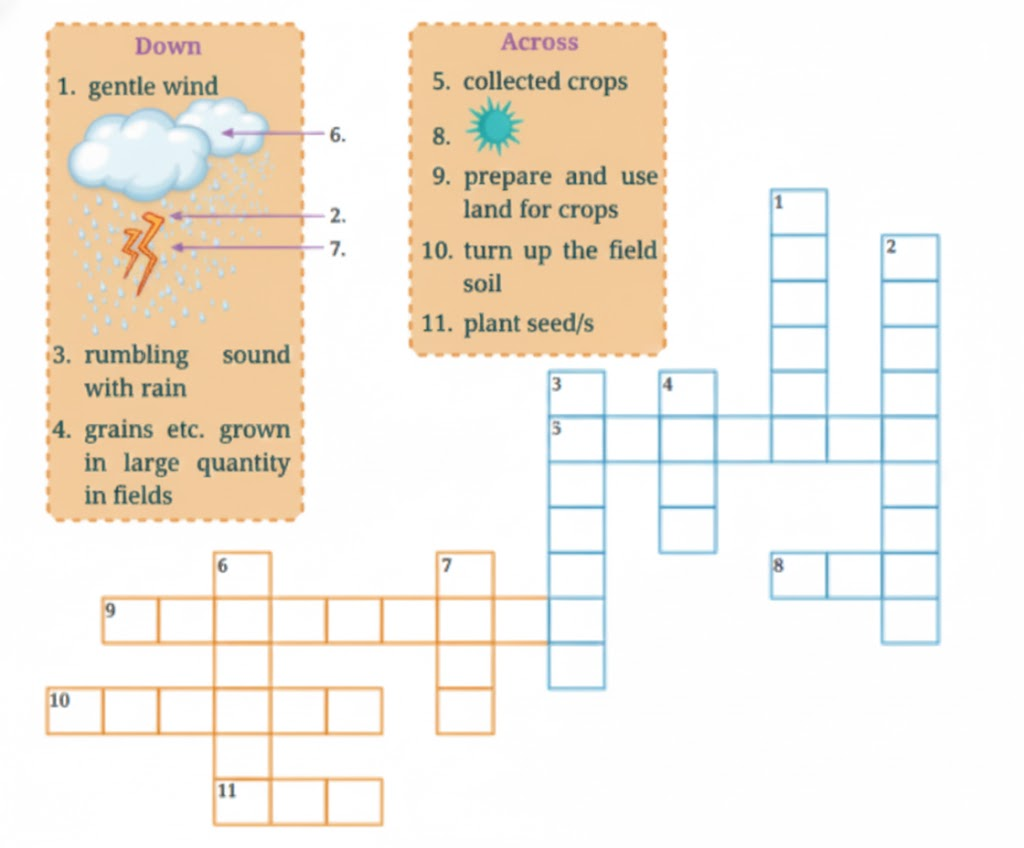
Answer:
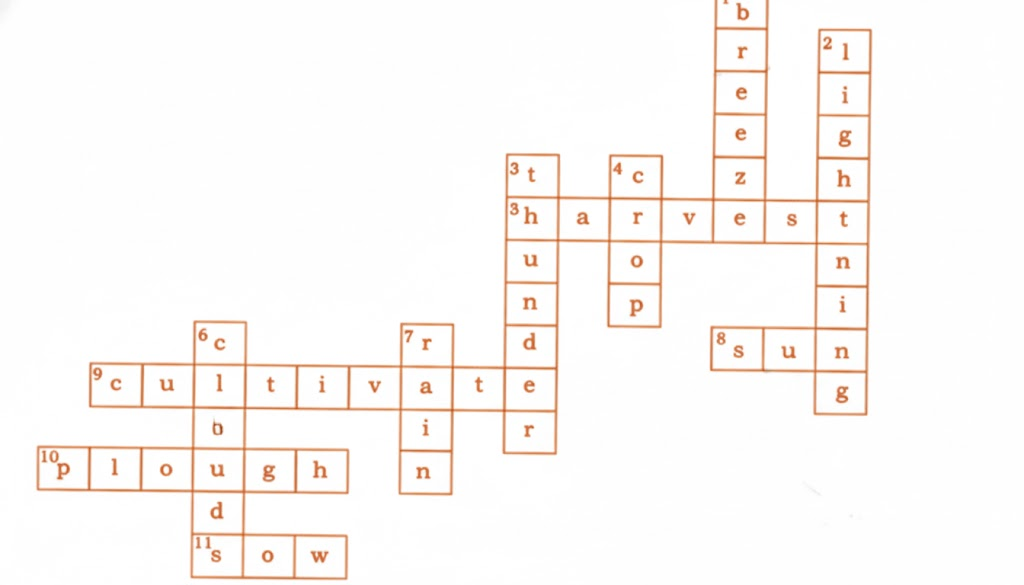
II. The text uses words like ‘piece,’ “weather,’ ‘son,’ and ‘rain’. These words are the same as other words that are spelt differently— peace, whether, sun, and reign.
Words that are pronounced the same as other words but differ in meaning or in spelling are called homophones.
Now, complete the paragraph by filling in the correct option of homophones given in the brackets.
The farmer looked at the sky and wondered 1. ________________ (weather/whether) the clouds would fially bring rain. He sat down on the ground, breaking a small 2. ________________ (piece/peace) of roti for his meal. The 3. ________________ (plain/plane) filds stretched endlessly before him, completely dry. He thought about how he could 4. ________________ (sell/cell) his last sack of grain to buy some essentials for his family. Without the rains, it didn’t 5.
________________ (seam/seem) possible to grow another crop this season. Despite his worries, he smiled, knowing that every farmer hopes for the next 6. ________________ (rain/reign) by nature to bring life back to the land.
Answer:
1. whether
2. piece
3. plain
4. sell
5. seem
6. rain
III. Choose the correct meanings from the given options for the underlined words or phrases in the following sentences.
1. Being annoyed, she muttered something which nobody heard.
(i) spoke in a low voice
(ii) spoke slowly
(iii) spoke angrily
Answer:
(i) spoke in a low voice
2. At the new work place, Riya felt forlorn for a week.
(i) upset and irritated
(ii) angry and bitter
(iii) sad and neglected
Answer:
(iii) sad and neglected
3. When all his friends had gone, he was at a loss because he did not know what to do. .
(i) confused
(ii) shocked
(iii) lonely
Answer:
(i) confused
4. When the little child saw her father, her eyes sparkled.
(i) glowed dimly
(ii) showed joy
(iii) opened wide
Answer:
(ii) showed joy
IV. Match each word (adjective) in Column 1 with a word (noun) that collocates in Column 2. Write the adjective-noun collocation in Column 3. One example has been done for you.
Answer:
V. Underline the verbs and identify the forms of tenses for the following sentences from the text.
1. Oh, it is hard not to be able to work…
2. …I am too old.
3. What are you smiling at, Amma?
4. But my son, that is what I am talking about.
5. The earth has worked for years, centuries…
6. I have worked hard and honestly.
Answer: Oh, it is difficult when I cannot work…
…I am already too old.
What are you smiling about, Amma?
But my son, that is exactly what I am saying.
The earth has been working for many years, even centuries…
I have put in honest and hard work.
The forms of tenses in the given statements are Simple Present Tense (1 and 2), Present Progressive Tense (3 and 4) Present Perfect Tense (5 and 6).
Now, fill in the blanks with the correct form of Simple Present, Present Progressive or Present Perfect tenses of the verbs given in brackets.
Ravi (i) __________ (be) a farmer who (ii) __________ (practise) crop rotation on his land. Each season, he (iii) __________ (plant) different crops to maintain the soil’s health. This year, he (iv) __________ (grow) legumes, which help restore the nutrients in the soil. Over the years, Ravi (v) __________ (learn) that planting the same crop repeatedly (vi) __________ (deplete) the soil, making it less fertile. By rotating crops, he (vii) __________ (keep) the land productive and fertile. He (viii) __________ (see) a noticeable improvement in his yields since adopting this method. Now, Ravi (ix) __________ (share) his knowledge with other farmers, explaining how crop rotation(x) __________ (benefit) both the soil and their harvests.
Answer:
(i) is
(ii) practices
(iii) plants
(iv) will grow
(v) has learnt
(vi) depletes
(vii) keeps
(viii) has seen
(ix) is sharing
(x) benefits
VI. Study the highlighted words in the following sentences from the text.
The rains came all these years without any such consultations.
So many favourable conditions, but still no rain.
Every day they hoped that the rains would come.
But this year turned out to be diffrent.
This is the fist season in fie, no, six years that I have not sown, nor ploughed.
We ought to talk to some astrologers.
I have only done what any hard-working farmer would do.
Velu looked at her, a little puzzled.
She takes care to give her children the rest they need…
Velu felt a cool breeze on his back.
The highlighted words or phrases that come before a noun but do not describe them are called determiners.
Let us learn the use of some common determiners.
Articles: a, an, the
These are used to introduce nouns.Demonstrative Determiners: this, that, these, those
These are used to point out specifi items.Possessive Determiners: my, our, your, his, her, its, their, one’s
These indicate ownership or relationship.Defiite Numeral Determiners: one, two, three, etc.
These specify exact quantities.Indefiite Numeral Determiners: some, any, no, all, much, many, few, less, several, little and few
‘Some’ is used in affiative sentences, while ‘any’ and ‘no’ are used in negative and interrogative sentences.
‘All’ refers to the entirety of a group.
‘Much’ and ‘many’ denote large quantities of uncountable and countable nouns, respectively.
‘Few’ indicates a small number, ‘less’ refers to a smaller quantity, and ‘several’ means more than two but not many.
‘Little’ means not much, ‘few’ means not many. Use ‘a little’ and ‘a few’ to convey a positive sense.Distributive Determiners: each, every, either, neither
‘Each’ refers to individual items or people, ‘every’ refers to all items or people collectively.
‘Either’ means one of two options and ‘neither’ means not one of the two options.
Now, fill in the blanks by choosing the correct determiner from those given in the brackets.
It was 1. ________ (a/an) rainy afternoon, and 2. ________ (a/the) sky was thick with dark clouds. Mala noticed a large puddle quickly forming in front of 3. ________ (her/their) house. Excited, she called for her brother to join her, knowing that both of them always loved playing in 4. ________ (a/the) rain. While jumping from 5. ________ (some/one) puddle to another, Mala spotted 6. ________ (few/a few) snails slowly creeping along the wet sidewalk and pointed them out to her brother. With 7. ________ (each/every) jump, the sound of both 8. ________ (her/their) squeals and laughter was heard through the soft patter of raindrops. Though they were fully drenched 9. ________ (either/neither) siblings minded it. It had been a perfect rainy day.
Answer:
1. a
2. the
3. her
4. the
5. one
6. a few
7. each
8. her
9. neither
Class 8 English Chapter 12 Question Answer – Let us listen (Page 197)
I. Listen to the weather forecast. As you listen, fill in the blanks with the exact word you listen to. (Refer to NCERT Textbook Page 204 for Transcript)
1. Delhi will mostly have a ___________ sky with light rain.
2. Moderate rain is likely to happen in ___________.
3. Kolkata is likely to have a maximum temperature of around
___________ °C.
4. There is a chance of a ___________ in Chennai.
5. Bengaluru will have a ___________ temperature of 29 °C.
6. Taking an ___________ is advisable because of the weather conditions.
Answer:
1. cloudy
2. Mumbai
3. 34
4. thunderstorm
5. maximum
6. umbrella
NCERT Class 8 English Poorvi Chapter 12 Question Answer – Let us speak (Page 198)
I. Here is a tongue twister about ‘weather’. Practice saying it as fast as you can.
Whether the weather be fine, or whether the weather be not, whether the weather be cold, or whether the weather be hot, well weather the weather, whatever the weather, whether we like it or not.
Answer:
Practise it yourself.
II. Rain has arrived after a long dry spell on the Earth. Imagine the Rain and the Earth have a conversation. Work in pairs and present the role-play.
You may use the hints in the table given below.
You may start the conversation in the following way.
Rain: Greetings, Earth! It’s been awhile since we’ve met. How have you been?
Earth: Hello Rain! I am so glad to see you.
To continue the conversation, use the hints given below.
Answer:
Rain: Hello, Earth! It’s been a long time since we last met. How have you been?
Earth: Welcome, Rain! I’m so happy to see you. I’ve been dry and exhausted. Everything on me — the trees, rivers, and crops — has been waiting for your return.
Rain: I’m sorry I took so long. My journey from the ocean to the sky and back to you is long and sometimes uncertain. But I’m here now!
Earth: Thank you for coming back. Your water gives life to my soil. With you here, crops will grow, rivers will fill, and forests will blossom again.
Rain: I promise to visit regularly and on time next year. I will keep bringing water to your plants and people.
Earth: You are always welcome, Rain. Let’s celebrate with the rivers, forests, and everyone who depends on you. You are truly a blessing.
Rain: I’m happy to help. I’ve missed being here as well.
Class 8th English Chapter 12 Waiting for the Rain Question Answer – Let us write (Page 199)
I. You have observed the difficulties faced by the people in your neighbourhood due to scarcity of water especially during the summer months. Write a letter to the Councillor of your Municipal ward, requesting her/him to set up a rain water harvesting unit. Provide suggestions to address the issue.
Remember to
use formal language
keep sentences short and to the point
state the purpose clearly and concisely
give relevant details
Format and Layout:
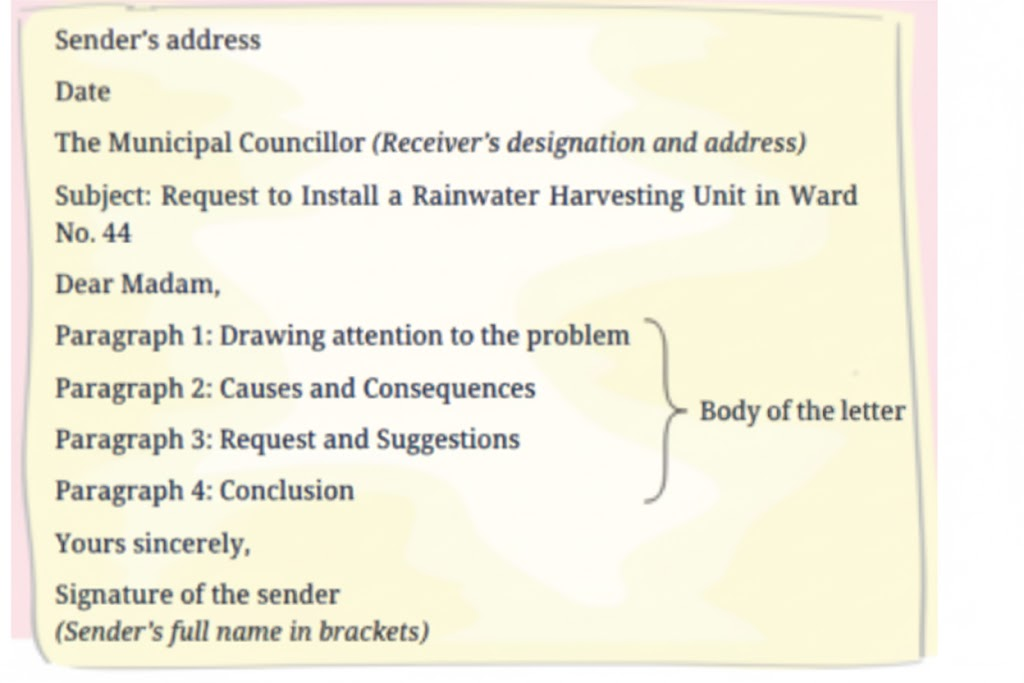
Answer:
123 Green Lane
Vikas Nagar
New Delhi – 110018
19 May 20XX
The Municipal Councillor
Ward No. 44
New Delhi Municipal Council (NDMC)
New Delhi – 110001
Subject: Request for Installation of a Rainwater Harvesting System in Ward No. 44
Dear Madam,
I am writing to bring your attention to the serious water shortage faced by the residents of our area, especially during the summer months.
This problem has worsened due to irregular rainfall, overuse of water, and inadequate storage facilities. Because of this, it has become difficult for us to meet basic needs such as drinking, cooking, and cleaning. Many families are forced to rely on water tankers, which are costly and often unreliable.
Therefore, I kindly request you to install a rainwater harvesting system in our locality. Such a system will help collect and store rainwater, reduce our dependence on groundwater, and ensure a more sustainable water supply. Public awareness drives and community participation can further support this initiative. Rooftop collection units, recharge pits, and community storage tanks can be effective starting measures.
We sincerely hope for your timely action and support in making our ward more water-efficient and environmentally friendly.
Yours sincerely,
Ravi Sharma
Waiting for the Rain Class 8 NCERT Solutions – Let us explore (Pages 199-200)
I. Rest is very important for us to function in a proper manner. Even the Earth needs rest. This is known as fallowing.
Read the facts given below related to fallowing:
A fallow year refers to leaving the land without sowing for one, or several vegetative cycles.
This is done to allow the land to recover its nutrients and retain moisture. It also helps to avoid spreading of diseases and controlling pests.
The sustainable land management method has been applied for centuries, wherein a field is divided into two halves—one is planted with crops while the other remains unplanted. Then, the process is reversed in the following year.
II. Find out from your Vocational Education teacher about Agriculture as a vocation and other related vocations, such as horticulture, etc.
Answer:
Student’s Question:
What are some vocations related to agriculture?
Expected Answer from the Teacher:
Apart from regular farming, several other vocations are connected to agriculture. These include:
Horticulture: Growing fruits, vegetables, flowers, and ornamental plants.
Dairy farming: Rearing cattle for milk and milk products.
Poultry farming: Rearing birds such as chickens and ducks for eggs or meat.
Sericulture: Producing silk by rearing silkworms.
Apiculture: Beekeeping for honey and other bee products.
Agri-business: Selling agricultural equipment, seeds, fertilizers, and related products.
Soil conservation: Working to protect, maintain, and improve soil quality.
Class 8 English Poorvi Chapter 12: Key Concepts and Exam Strategy
Learning about Waiting for the Rain in Class 8 English Poorvi helps students understand the struggles of farmers and the importance of rainfall. Focusing on NCERT solutions makes it easy to cover all critical topics and score well in school exams.
Practice all the chapter exercises and examples provided for Waiting for the Rain. Reviewing real situations in rural India builds awareness and boosts your confidence for writing answers in English examinations.
Consistent revision of Class 8 English Poorvi Chapter 12 NCERT Solutions will help you master the chapter and perform better in the 2026-27 academic year. Stay curious and keep practicing to secure excellent marks.
FAQs on NCERT Solutions For Class 8 English Chapter 12 Waiting For The Rain - 2026-27 Free PDF Download (Login Required)
1. What is included in NCERT Solutions for Class 8 English Poorvi Chapter 12 – Waiting For The Rain?
NCERT Solutions for Class 8 English Poorvi Chapter 12 – Waiting For The Rain include step-by-step solutions for all exercises in the chapter, tailored for the latest CBSE syllabus.
Key features:
- Complete answers to intext and back exercises
- Clear, exam-ready explanations for every question
- Important definitions, key points, and sample long answers
- User-friendly format with free PDF download
- Aligned with CBSE Class 8 English 2026–27 pattern for full marks
2. How to write stepwise NCERT answers to score full marks in Class 8 English Poorvi Chapter 12?
To score full marks in Class 8 English Poorvi Chapter 12 answers, present your solutions stepwise, following the CBSE marking scheme.
Tips:
- Begin with a direct answer to the question
- Support with relevant examples or references from the story
- Highlight key words and phrases used in the textbook
- Structure long answers in points or small paragraphs
- Incorporate definitions or maps/diagrams if needed (as per question)
3. Which questions are likely from this chapter in CBSE exams?
CBSE often selects questions from both intext and back exercise sections of Waiting For The Rain.
Common types include:
- Short answers based on character actions and events
- Long answer/Value-based questions on themes or lessons
- Word meanings, definitions, and usage
- Reference to context/extract-based questions
- Map or diagram labelling if relevant
4. Are diagrams or definitions mandatory in answers for Class 8 English Poorvi Chapter 12?
Diagrams or definitions are required only if the question specifically asks for them in Class 8 English Poorvi Chapter 12.
Follow these guidelines:
- Use definitions for important terms when asked
- Include diagrams/maps only if the exercise mentions them
- Always label diagrams neatly and use conventions
5. How do I structure long answers for better marks in English Chapter 12?
Structure long answers for maximum marks by organizing thoughts clearly and using evidence from the text.
Best practices:
- Start with an introduction sentence
- Present main points in order, using bullet points or short paragraphs
- Use examples or quotes from the chapter
- Conclude with a summary sentence
- Use relevant keywords and phrases from the story
6. Where can I download the NCERT Solutions PDF for Class 8 English Poorvi Chapter 12?
You can download the NCERT Solutions PDF for Class 8 English Poorvi Chapter 12: Waiting For The Rain for free from trusted educational websites.
Steps:
- Visit the relevant chapter page
- Look for the 'Free PDF Download' button/link
- Click to save for offline study
7. What are the key themes of Waiting For The Rain in Class 8 English?
Key themes of Waiting For The Rain include patience, hope, rural life, and the importance of rainfall for farmers.
Students should remember:
- How characters express their feelings and challenges
- Why rain matters for the community
- Lessons on resilience and optimism
8. Are NCERT Solutions enough for Class 8 English exams?
NCERT Solutions form the foundation for scoring well in Class 8 English exams.
Advantages:
- Fully aligned with CBSE/NCERT syllabus
- Includes all important chapter questions
- Focus on stepwise, exam-oriented answers
9. How to revise quickly for Class 8 English Chapter 12 – Waiting For The Rain?
Revise Class 8 English Chapter 12 efficiently using a structured plan and key notes.
Quick revision strategy:
- Read summary and key points of the chapter
- Practice all textbook exercises using NCERT solutions
- Make flash notes of important terms or character sketches
- Practice long answers and important definitions
- Attempt sample questions for self-assessment
10. How are marks awarded in CBSE exams for stepwise answers in Class 8 English Poorvi?
CBSE awards marks stepwise in Class 8 English Poorvi by checking for each point, definition, or step in your answer.
What to include:
- Main point – 1 mark
- Supporting example or explanation – 1 mark
- Conclusion or relevant takeaway – 1 mark
11. Do examiners award partial marks for correct steps even if the final answer is wrong?
Yes, CBSE examiners often give partial marks for correct steps or partial reasoning in answers, even if your final result has an error.
It's important to:
- Show each step of your answer clearly
- Use relevant textbook keywords and logic
- Attempt all steps to maximize your score
12. What are common mistakes students make in NCERT Solutions for Class 8 English Chapter 12?
Common mistakes in NCERT Solutions for Class 8 English Chapter 12 include missing key points, incomplete answers, or not following stepwise format.
To avoid these:
- Read the question carefully
- Write complete answers in steps
- Revise definitions and important terms
- Present answers neatly and clearly
