



What are Squamous Epithelial Cells and What Do They Do in the Body?
Squamous epithelial cells are thin, flat, scale-like cells that form a smooth protective covering over many body surfaces. They are one of the main shapes of epithelial cells and are specially adapted for areas where a thin barrier, smooth lining, easy diffusion, or frictionless movement is needed. These cells are broad and flat, with their width usually greater than their height, and they contain a small, centrally placed nucleus.
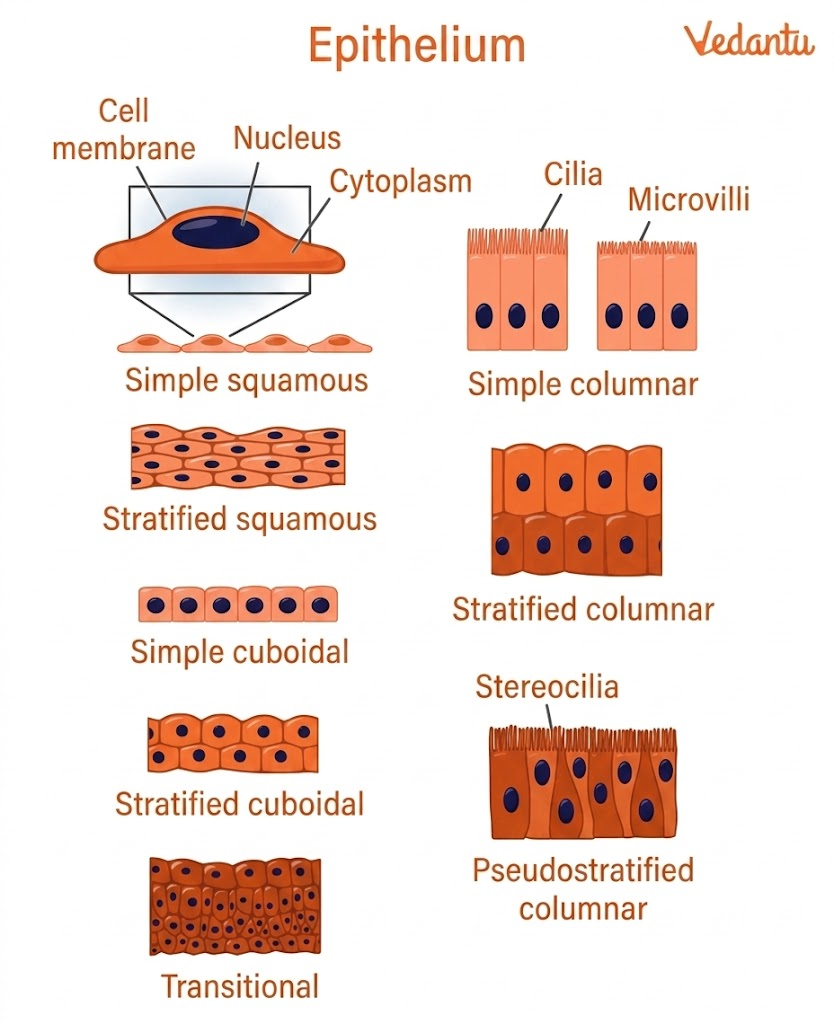
Types of Epithelial Cells
The three major types of epithelial cells are:
Squamous epithelial cells
Cuboidal epithelial cells
Columnar epithelial cells
Among these, squamous cells are the flattest and most delicate in appearance, making them highly suited to places where a very thin lining is needed.
What are Squamous Epithelial Cells?
Squamous epithelial cells are large, flattened cells filled with cytoplasm and containing a small, round or flattened nucleus near the centre. Their outline is often irregularly round or polygonal when viewed from above. The word “squamous” comes from their resemblance to fish scales.
Because of their flat shape, they create a low-friction surface and can form a very thin membrane. This makes them useful in areas such as:
air sacs of the lungs
blood vessels
body cavities
skin
mouth
vagina
They are especially important where substances must pass quickly and easily across a lining.
Structure of Squamous Epithelial Cells
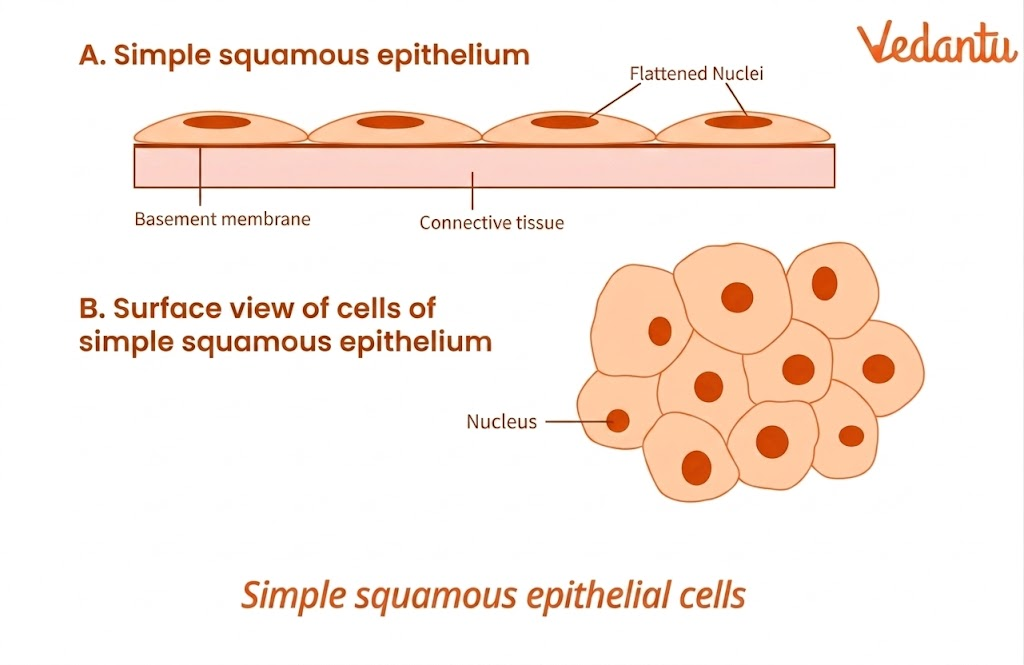
The structure of squamous epithelial cells is directly linked to their function.
flat and thin like plates
broader than tall
closely packed together
irregular or polygonal outline from top view
small, flattened, oval-shaped nucleus
very little intercellular space
These cells are arranged tightly, providing a smooth, continuous lining. Since they are thin, they allow rapid diffusion or filtration in places where exchange is needed. Since they are tightly packed, they also provide a protective covering.
Surface Characteristics
The close packing of these cells creates a smooth, low-friction surface over which fluids can move easily. This is important in blood vessels, capillaries, and certain body cavities.
Location of Squamous Epithelial Cells
The location of squamous epithelial cells varies depending on whether they form a simple or stratified epithelium.
Simple Squamous Epithelium Is Found In:
alveoli of the lungs
capillaries and blood vessels
Bowman’s capsule of the kidney
mesothelium lining body cavities
Pericardium
Stratified Squamous Epithelium Is Found In:
skin
mouth
vagina
parts of the oesophagus
other areas subjected to abrasion
This location-based distribution helps explain why some squamous tissues are primarily for exchange while others are primarily for protection.
Function of Squamous Epithelium
The function of squamous epithelium depends on whether it is simple or stratified and where it is found.
1. Protection
One important function of squamous epithelium is protection. It forms a covering that helps shield underlying tissues from foreign particles, mild trauma, and irritating substances. In multilayered stratified forms, the protective role becomes even stronger.
2. Diffusion
Simple squamous epithelium is thin enough to allow substances to pass across it rapidly. This is essential in:
oxygen exchange in the lungs
carbon dioxide exchange between tissues and blood
diffusion across capillary walls
3. Filtration
In places such as Bowman’s capsule of the kidney, squamous epithelium helps in filtration. Small molecules and fluid pass across this thin barrier during urine formation.
4. Secretion and Lubrication
Some squamous epithelial cells help provide smooth, frictionless surfaces, whereas the secretion of mesothelium lining body cavities contributes to a slippery surface that reduces friction between moving organs. Some epithelial surfaces also produce mucus, which acts as a lubricant.
5. Absorption and Transport
The role of these cells is also important in regions where absorption and transport occur. Across their surface, physiological processes like:
take place efficiently.
So, the function of squamous epithelium includes protection, diffusion, filtration, secretion, lubrication, and support for transport.
Simple Squamous Epithelium
Simple squamous epithelium consists of a single thin layer of flattened cells. Because it is only one cell thick, it is ideal for diffusion and exchange.
Functions of Simple Squamous Epithelium
gas exchange in the lungs
exchange of wastes and nutrients in blood capillaries
filtration in the kidneys
reducing friction in body cavities
Examples
alveoli of the lungs
capillary lining
Bowman’s capsule
mesothelium
pericardium
This type is mainly functional in physiology rather than heavy protection.
Stratified Squamous Epithelium
Stratified squamous epithelium consists of many layers of flattened cells arranged over a basement membrane. Its main role is protection, especially in areas exposed to friction and abrasion.
Functions of Stratified Squamous Epithelium
protection from rubbing and abrasion
protection from foreign particles
strengthening body surfaces under stress
Examples
skin
oral cavity
vagina
parts of the oesophagus
conjunctiva and some external genital areas in a non-keratinised form
This type is thicker and stronger than simple squamous epithelium.
Squamous Epithelial Cells in Urine
Squamous epithelial cells in urine are important because they can be seen during urinalysis examination. In most cases, they come from the lining of the lower urinary tract or surrounding external surfaces rather than the kidney itself.
When squamous epithelial cells appear in urine, they often suggest that the sample may contain cells shed from epithelial linings. Since squamous cells commonly line surfaces such as the urethral opening and nearby genital areas, they may appear in urine specimens during collection.
In basic biological interpretation, their presence may indicate:
normal shedding of epithelial cells
contamination of the urine sample from external surfaces
improper collection technique
In some settings, irritation or inflammation of the lower tract or the surrounding lining
Because squamous epithelial cells are flat surface-lining cells, they are not the main cells expected from deep kidney tubules. That is why their presence in a urine sample is often discussed in relation to sample collection and the ureteral tract lining rather than the distal renal tubule nephron function.
Squamous Epithelial Cells in Female Urine
The phrase sq" squamous epithelial cells in female urine is commonly searched because these cells are more likely to appear in urine samples collected from females due to the anatomical proximity of the urinary opening and the epithelial linings of the external genital tract.
In females, squamous epithelial cells may enter the urine sample from:
vaginal lining
external genital surfaces
lower urinary tract surface lining
Why Squamous Cells Matter in Body Function?
Squamous epithelial cells are a strong example of how cell shape determines function.
Why Does Their Shape Matter?
Because they are thin:
substances cross easily
gases diffuse rapidly
fluids filter efficiently
Because they are tightly packed:
surfaces remain protected
Friction is reduced
The barrier function is maintained
Because they can form either one layer or many layers:
Simple forms specialise in exchange
Stratified forms specialise in protection
This makes squamous epithelium one of the clearest illustrations of the structure-function relationship in biology.
Difference Between Simple and Stratified Squamous Epithelium
This distinction is important for NEET-level tissue questions.
FAQs on Squamous Epithelial Cells: Structure, Function, Location and Role in Urine
1. What does it mean if you have squamous epithelial cells?
If squamous epithelial cells are found in urine, it usually means the sample may have been contaminated. This often happens when cells from the skin or genital area mix with the urine during collection.
2. Should I worry about squamous cells in urine?
No, finding a small number of squamous epithelial cells in urine is normal. These cells naturally shed from the skin and lining of the urinary tract, especially near the urethra.
3. How many squamous epithelial cells are normal?
A normal urine sample usually contains 0–5 squamous epithelial cells per high-power field (HPF). A slightly higher count may still be acceptable, but very high numbers often suggest contamination.
4. What is a high range of epithelial cells in urine?
A high count is generally considered more than 5–15 cells per HPF. This may indicate infection, inflammation, or improper sample collection and should be evaluated further.
5. What causes abnormal squamous cells?
Abnormal squamous cells can be caused by infections such as HPV or yeast infections, inflammation, hormonal changes, or noncancerous growths, such as cysts or polyps.
6. When to worry about urinalysis results?
You should be concerned if there are high levels of white blood cells, epithelial cells, or other abnormal findings, as these may suggest infection, inflammation, or other medical conditions.
7. What is the best treatment for epithelial cells in urine?
Treatment depends on the underlying cause. If the cause is an infection, such as a UTI, doctors usually prescribe antibiotics or other appropriate medications to treat the condition.
8. What are the symptoms of high epithelial cells?
Common symptoms may include frequent urination, burning or pain during urination, and discomfort in the lower abdomen, especially if an infection is present.
9. What diseases affect epithelial cells?
Epithelial cells can be affected by conditions such as cancers, celiac disease, asthma, infections like HPV, and other disorders involving both body's linings.
10. What vitamin helps epithelial cells?
Vitamin A is important for maintaining healthy epithelial cells. It supports cell growth, repair, and the integrity of body linings.
11. What is a silly mistake students make regarding squamous epithelial cells’ location?
A common mistake is confusing the location of simple versus stratified squamous epithelium. Students sometimes incorrectly state that simple squamous epithelium lines the skin, but in reality, stratified squamous epithelium forms the skin’s outer layer, providing protection. Clear memorization of functional location prevents such errors.
