



Gigantopithecus Size, Diet, Habitat, and Why It Went Extinct
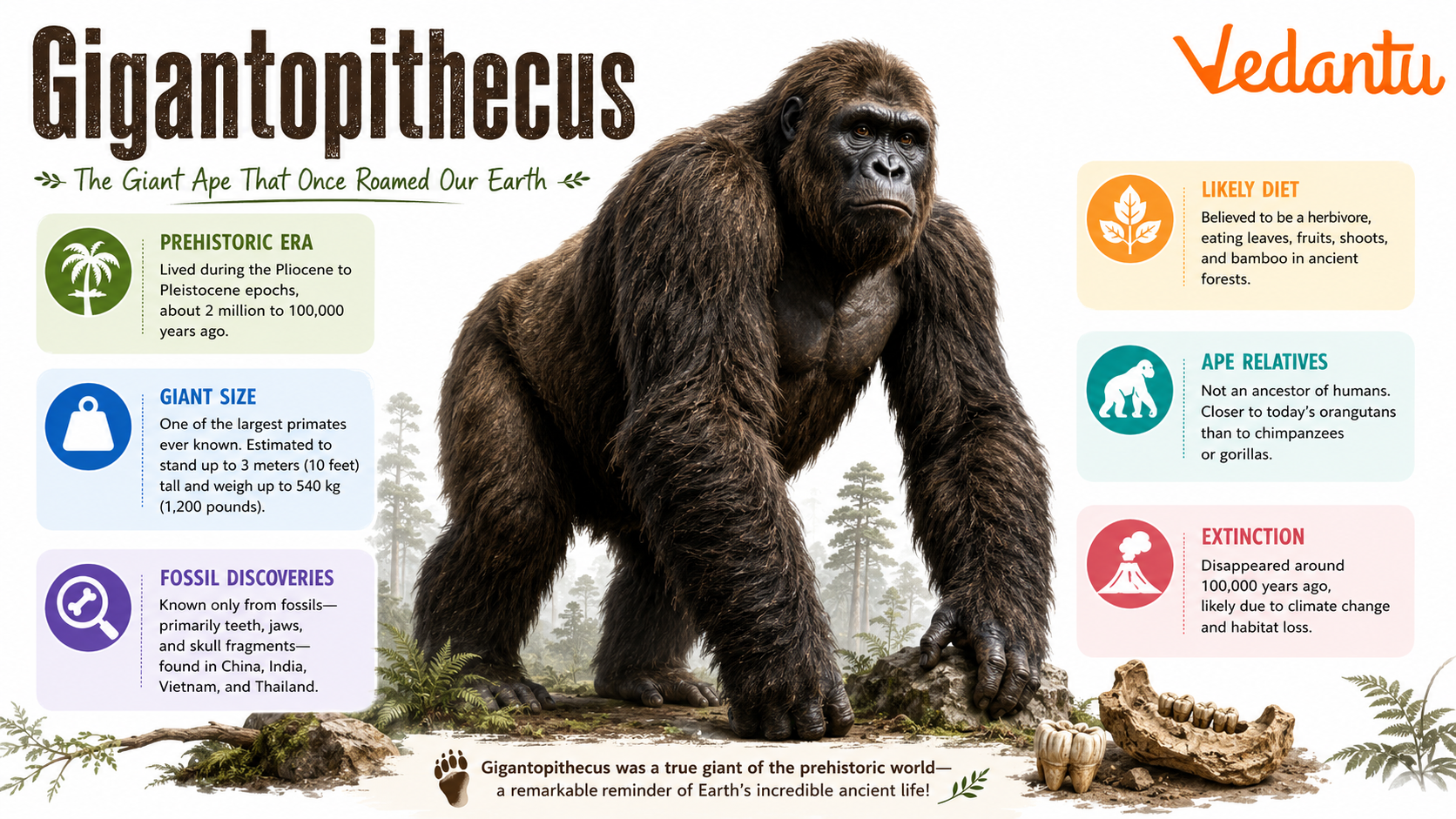
Quick Facts and Statistics
| Feature | Details |
|---|---|
| Common Name | Gigantopithecus |
| Scientific Name | Gigantopithecus blacki (most famous species) |
| Animal Group | Mammal (Primate) |
| Time Period | Pleistocene Epoch (about 2 million – 300,000 years ago) |
| Height | Up to 3 metres (about 10 feet) |
| Weight | Up to 250–300 kg |
| Habitat | Tropical and subtropical forests |
| Diet | Herbivore (mainly plants and bamboo) |
| Status | Extinct |
Appearance and Physical Characteristics
- Extremely large and strong body structure.
- Huge jaws and very thick teeth.
- Flat molars perfect for grinding tough plants.
- Probably covered with thick body hair like modern apes.
- Long arms suited for climbing and moving through forests.
Habitat and Distribution
- Lived mainly in southern China.
- Also found in parts of Vietnam and India.
- Preferred dense forests with plenty of plants.
- Likely stayed near areas with bamboo and fruit trees.
These forests provided food, shelter, and protection from predators. Climate changes during the Ice Age may have reduced forest areas, affecting its survival.
Diet and Feeding Habits
- Herbivore – ate plants only.
- Probably consumed bamboo, fruits, leaves, and roots.
- Strong jaws helped crush hard plant material.
- Large molars were perfect for grinding fibrous food.
Some studies suggest it relied heavily on bamboo, similar to giant pandas.
Its thick enamel teeth helped it chew tough, raw vegetation.
Behaviour and Lifestyle
- Likely lived alone or in small family groups.
- Moved slowly due to its large size.
- May have walked on all fours like modern great apes.
- Spent much time feeding to support its huge body.
Life Cycle and Reproduction
- Birth: Babies were probably born live, as mammals give birth to live young.
- Infant Stage: Young ones likely depended on their mother for milk and protection.
- Growth: Slow growth over many years, similar to orangutans and gorillas.
- Adult Stage: Became fully grown at a large size, possibly after several years.
Because it was a large primate, it may have had a slow reproduction rate, which could have made survival harder during environmental changes.
What Made Gigantopithecus Special?
No other ape in history has matched its massive size.
Its molars were much bigger than those of modern apes.
It ruled the ancient forests of Asia.
Scientists are still studying why it disappeared.
Importance and Role in Nature
- Provides clues about the evolution of great apes.
- Helps researchers study prehistoric ecosystems.
- Shows how climate change can affect large animals.
- Adds valuable knowledge about extinct mammals.
Amazing Gigantopithecus Facts
Interesting Facts About Gigantopithecus
- It was first identified in 1935 by a German paleontologist.
- Some people once linked it to the legend of Bigfoot.
- Its name means “giant ape” in Greek.
- Climate change may have reduced its food sources.
Fun Facts for Kids
FAQs on Gigantopithecus: Exploring the Largest Prehistoric Ape on Earth
1. What is Gigantopithecus?
Gigantopithecus was a giant prehistoric ape that lived millions of years ago and is considered the largest ape ever discovered.
- It lived during the Pleistocene Epoch.
- Its name means "giant ape" in Greek.
- Scientists study its fossil teeth and jawbones to learn about it.
- It is often compared to modern gorillas and orangutans.
2. How big was Gigantopithecus?
Gigantopithecus was the largest ape ever to live, much bigger than today’s gorillas.
- It may have stood up to 10 feet (3 meters) tall.
- It likely weighed around 600 pounds (270 kg) or more.
- Its massive size makes it a popular topic in prehistoric animal studies.
3. When did Gigantopithecus live?
Gigantopithecus lived between about 2 million and 300,000 years ago during the Ice Age period.
- It lived in the Pleistocene Epoch.
- It existed at the same time as early human ancestors.
- Climate changes during the Ice Age may have affected its survival.
4. Where did Gigantopithecus live?
Gigantopithecus lived in parts of Asia, especially in warm forest areas.
- Fossils were found in China, Vietnam, and India.
- It likely lived in dense forests and jungles.
- These habitats provided plenty of plants and bamboo to eat.
5. What did Gigantopithecus eat?
Gigantopithecus mainly ate plants, especially tough vegetation like bamboo.
- Its large teeth were perfect for crushing and grinding.
- It likely ate fruits, leaves, and stems.
- Scientists believe it was mostly herbivorous (plant-eating).
6. Why did Gigantopithecus go extinct?
Gigantopithecus likely went extinct because of climate change and food shortages.
- Cooling temperatures reduced forest habitats.
- Less forest meant less bamboo and plant food.
- Its large body size required a lot of food to survive.
7. Is Gigantopithecus related to humans?
Gigantopithecus was an ape, not a human ancestor, but it shared a distant common ancestor with humans.
- It belongs to the primate family.
- It is more closely related to orangutans than to humans.
- Humans and giant apes evolved from a shared ancient ancestor.
8. How do scientists know about Gigantopithecus?
Scientists know about Gigantopithecus from fossil discoveries, mainly teeth and jawbones.
- No complete skeleton has been found.
- Large molars and jaw fragments were discovered in caves.
- Researchers use fossils to estimate its size, diet, and habitat.
9. Was Gigantopithecus like King Kong?
Gigantopithecus may have inspired the idea of King Kong, but it was a real animal, not a movie monster.
- It was a real prehistoric ape.
- Unlike King Kong, it likely walked on all fours.
- It lived in Asian forests, not on a fantasy island.
10. What makes Gigantopithecus important in history?
Gigantopithecus is important because it helps scientists understand ape evolution and prehistoric life.
- It shows how large ancient primates could grow.
- It helps explain how climate change affects species.
- It adds knowledge about human evolution and Ice Age ecosystems.
