



Pliohippus Facts, Size, Diet, Habitat, and Evolution Explained
Pliohippus was an ancient horse that lived millions of years ago and played an important role in the evolution of modern horses. It was one of the first horse ancestors to develop a single strong hoof, just like the horses we see today. By studying Pliohippus fossils, scientists learn how horses changed over time in size, speed, and body structure. Let’s explore interesting Pliohippus facts, its habitat, diet, characteristics, and why it is important in prehistoric history.
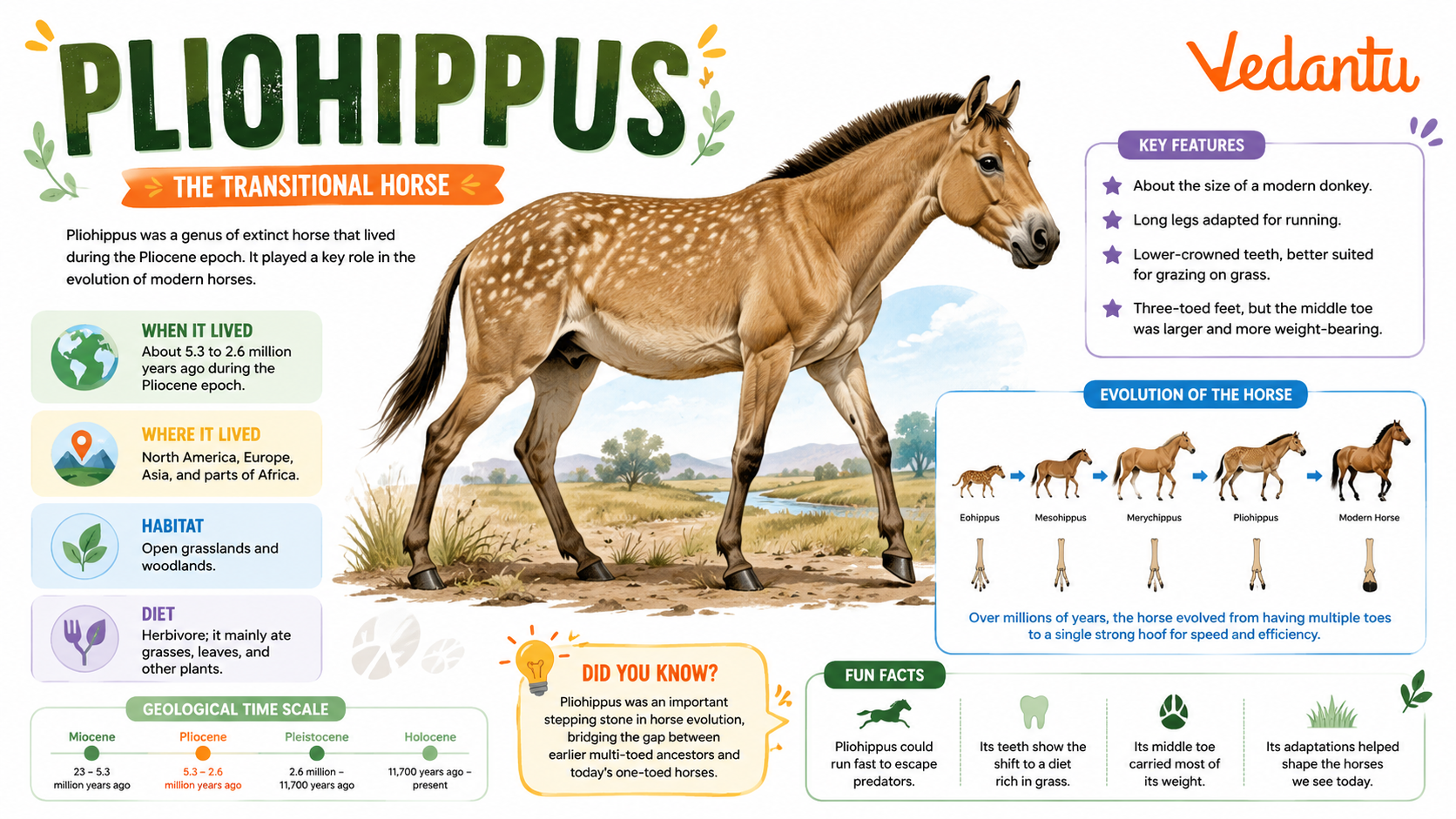
Quick Facts About Pliohippus
| Feature | Details |
|---|---|
| Common Name | Pliohippus |
| Meaning of Name | "More recent horse" |
| Animal Group | Mammal |
| Time Period | Late Miocene to Pliocene (about 24–2 million years ago) |
| Size | Around 1.2 meters tall (similar to a small pony) |
| Diet | Herbivore (grass eater) |
| Habitat | Open grasslands of North America |
| Special Feature | Single strong hoof on each foot |
| Status | Extinct |
Appearance and Physical Characteristics
- Looked similar to a modern horse but smaller in size.
- Had long legs built for running fast.
- Possessed a single main hoof on each foot.
- Shorter face compared to earlier horse ancestors.
- Strong teeth adapted for grazing on tough grasses.
Pliohippus Habitat and Distribution
- Lived mainly in North America.
- Preferred wide, open grasslands.
- Thrived in dry and semi-dry climates.
- Adapted to flat lands where running fast was important for survival.
Diet and Feeding Habits
- Herbivore – ate only plants.
- Main diet included grasses.
- Had high-crowned teeth to chew tough, dry grass.
- Likely grazed in herds for safety.
Behaviour and Lifestyle
- Likely lived in groups (herds) like modern horses.
- Active during the day.
- Relied on speed to escape predators.
- Communicated possibly through body movements and sounds.
Pliohippus Life Cycle and Reproduction
- Birth: Gave birth to live young, like modern mammals.
- Foal Stage: Baby Pliohippus (foal) could likely stand and walk shortly after birth.
- Growth: Young ones learned to graze and run with the herd.
- Adult Stage: Became strong runners with fully developed hooves.
Though exact details of the Pliohippus life cycle are based on fossil studies, scientists compare it with modern horses to understand its development.
What Made Pliohippus Special?
Importance in Evolution
Amazing Pliohippus Facts
- Pliohippus lived millions of years before humans appeared.
- Its name means “more recent horse.”
- It stood about the size of a small pony.
- It had better running ability than earlier horse ancestors.
- Its fossils have been found in several parts of North America.
- It is an important species studied in horse evolution research.
Interesting Facts About Pliohippus
Fun Facts for Kids
- Pliohippus was like a prehistoric pony!
- It ran across ancient grasslands millions of years ago.
- It helped scientists understand how modern horses evolved.
- It had strong teeth for chewing tough grass.
- It is known mainly from fossil discoveries.
FAQs on Pliohippus: The Prehistoric Horse That Shaped Modern Horses
1. What is Pliohippus?
Pliohippus was an ancient horse that lived millions of years ago and is considered an important step in horse evolution.
- It lived during the Miocene Epoch, about 24 to 12 million years ago.
- Its name means “more horse.”
- It is part of the horse family (Equidae).
- Many scientists once believed it was a direct ancestor of the modern horse.
2. When did Pliohippus live?
Pliohippus lived during the Miocene Epoch, long before humans existed.
- Time period: 24–12 million years ago.
- Era: Cenozoic Era, often called the “Age of Mammals.”
- It lived after earlier horses like Merychippus.
3. What did Pliohippus look like?
Pliohippus looked similar to a small modern horse but had some unique features.
- It stood about 3 feet (90 cm) tall at the shoulder.
- It had long legs built for running.
- It mostly had one main hoof on each foot.
- Its skull had a deep facial pit, which scientists still study.
4. Where did Pliohippus live?
Pliohippus lived in North America in open grassland habitats.
- Fossils have been found in the United States.
- It lived in wide plains and grasslands.
- These habitats helped it run fast to escape predators.
5. What did Pliohippus eat?
Pliohippus was a herbivore that ate mostly grass.
- It had strong, flat teeth for grinding plants.
- It likely ate grasses and small shrubs.
- Its diet was similar to that of a modern grazing horse.
6. Is Pliohippus the ancestor of modern horses?
Pliohippus was once thought to be the direct ancestor of modern horses, but scientists are still studying this idea.
- It belongs to the Equidae family.
- Some fossils suggest it may have been a side branch of horse evolution.
- Modern horses evolved from similar ancient horse species.
7. How was Pliohippus different from earlier horses?
Pliohippus was more advanced than earlier horses because it was better adapted for running.
- Earlier horses had three toes on each foot.
- Pliohippus mostly had one strong hoof.
- It had longer legs for faster movement across grasslands.
8. Why is Pliohippus important in horse evolution?
Pliohippus is important because it shows how horses evolved over time.
- It helps scientists understand the shift from forest animals to grassland runners.
- It shows the development of the single-hoof structure.
- It is a key fossil in studying horse evolution and prehistoric mammals.
9. How fast could Pliohippus run?
Pliohippus was likely a fast runner built for escaping predators.
- Its long legs helped it move quickly.
- The single hoof made running more efficient on hard ground.
- Speed was important in open Miocene grasslands.
10. What predators hunted Pliohippus?
Pliohippus was hunted by large prehistoric carnivores during the Miocene Epoch.
- Predators included ancient dogs (canids).
- It may have faced early saber-toothed cats.
- Its speed and herd behavior helped protect it from danger.
