



Why Did Smilodon Go Extinct? Ice Age History, Size, and Hunting Facts
Smilodon, often called the sabre-toothed tiger, was one of the most famous prehistoric predators. It lived during the Ice Age and is known for its long, curved canine teeth that looked like sharp swords. Although it looked like a tiger, Smilodon was not a true tiger. Studying Smilodon facts helps us understand ancient ecosystems, predator behaviour, and why some powerful animals became extinct.
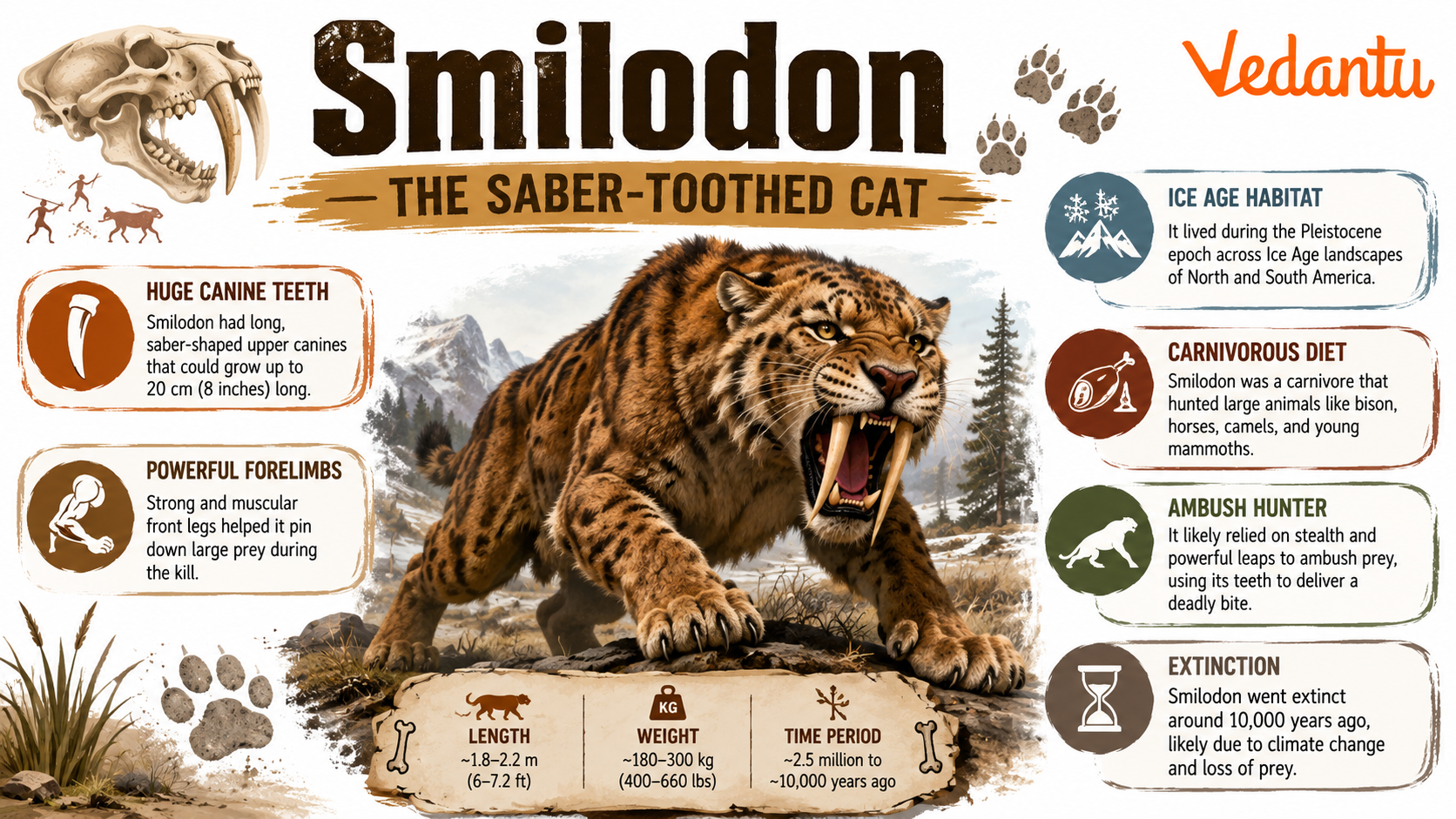
Quick Facts About Smilodon
| Feature | Details |
|---|---|
| Common Name | Smilodon (Sabre-Toothed Cat) |
| Scientific Name | Smilodon |
| Animal Group | Mammal |
| Time Period | Pleistocene Epoch (Ice Age) |
| Length | Up to 2.5 meters (including tail) |
| Weight | 160–300 kg |
| Diet | Carnivore |
| Habitat | Grasslands, forests, open plains |
| Extinction | Around 10,000 years ago |
Appearance and Physical Characteristics
- Strong, muscular body with a short tail.
- Very large, curved canine teeth up to 28 cm long.
- Powerful front legs used to hold prey down.
- Broad head and strong jaws.
- Likely had spotted or plain fur (exact colour unknown).
Smilodon Habitat and Distribution
The Smilodon habitat included a variety of environments across the Americas.
- Lived in North and South America.
- Preferred grasslands, open woodlands, and savannas.
- Shared its habitat with mammoths, giant sloths, and early humans.
- Fossils have been found in places like California’s La Brea Tar Pits.
Smilodon Diet and Feeding Habits
Smilodon diet was strictly carnivorous.
Bison, deer, young mammoths, and giant ground sloths.
Ambush predator that attacked suddenly instead of long chases.
Used strong forelimbs to pin prey and then delivered a deep bite with its long teeth.
Behaviour and Lifestyle
- Possibly lived in groups, similar to modern lions.
- Relied more on strength than speed.
- May have cared for injured members, based on fossil evidence.
- Active hunter in open landscapes.
Smilodon Life Cycle
- Birth: Gave birth to live young (like modern cats).
- Cubs: Cubs were dependent on their mother for protection and food.
- Growth: Young Smilodon learned hunting skills gradually.
- Adult Stage: Fully grown adults became powerful top predators.
- Lifespan: Estimated around 20–25 years.
What Made Smilodon Special?
Importance and Role in Nature
- Helped control populations of large herbivores.
- Maintained balance in Ice Age ecosystems.
- Its fossils help scientists study prehistoric life and climate change.
Amazing Smilodon Facts
Interesting Facts About Smilodon
- Its name means “knife tooth.”
- Smilodon likely could not run very fast.
- Some fossils show healed injuries, suggesting social care.
- It became extinct around the end of the last Ice Age.
Fun Facts for Kids
- Smilodon’s teeth were as long as a school ruler!
- It looked like a giant, super-strong cat.
- It hunted huge animals much bigger than itself.
- It lived during the Ice Age with mammoths.
- You can see its skeleton in many museums.
FAQs on Smilodon: Fascinating Facts About the Saber-Toothed Predator
1. What is a Smilodon?
The Smilodon was a large prehistoric cat famous for its long saber-like teeth.
- Also called the saber-toothed tiger (though it was not a true tiger)
- Lived during the Ice Age
- Belonged to the extinct genus Smilodon
- Was one of the most famous prehistoric predators
2. When did Smilodon live?
The Smilodon lived during the late Pleistocene Epoch, commonly known as the Ice Age.
- Existed about 2.5 million to 10,000 years ago
- Lived alongside woolly mammoths and giant ground sloths
- Became extinct at the end of the last Ice Age
3. Why is Smilodon called a saber-toothed tiger?
The Smilodon is called a saber-toothed tiger because of its long, curved canine teeth.
- Its teeth could grow up to 7 inches (18 cm) long
- The word "saber" means a curved sword
- It was not a true tiger but a different prehistoric cat species
4. What did Smilodon eat?
The Smilodon was a carnivore that hunted large Ice Age animals.
- Ate bison, deer, and young mammoths
- Used its powerful jaws and sharp fangs to kill prey
- Was a top Ice Age predator
5. How big was a Smilodon?
The Smilodon was about the size of a large lion but more heavily built.
- Weighed between 160 to 280 kg (350–620 pounds)
- Had a strong, muscular body
- Was shorter but stockier than modern big cats
6. Where did Smilodon live?
The Smilodon lived in North and South America during the Ice Age.
- Fossils found in the United States, especially at the La Brea Tar Pits
- Also lived in parts of South America
- Preferred grasslands, forests, and open plains
7. How did Smilodon hunt its prey?
The Smilodon hunted by ambushing its prey using strength rather than speed.
- Had strong front legs to grab animals
- Used long saber teeth to deliver a deep bite
- Likely hunted in areas with hiding spots like forests
8. Why did Smilodon become extinct?
The Smilodon became extinct due to climate change and possible human activity.
- The end of the Ice Age changed habitats
- Many large prey animals disappeared
- Early humans may have hunted them or competed for food
9. Is Smilodon the same as a tiger or lion?
The Smilodon was related to modern cats but was not a tiger or lion.
- Belonged to a different extinct group of saber-toothed cats
- Had longer canine teeth than any living big cat
- Looked similar to lions but had a stockier build
10. What are some interesting facts about Smilodon?
The Smilodon is one of the most fascinating Ice Age animals ever discovered.
- Its name means "knife tooth"
- Thousands of fossils were found in the La Brea Tar Pits
- It had a bite adapted for precision rather than crushing
- It is one of the most famous prehistoric mammals
