



Why Did the Thylacine Go Extinct? History, Habitat, and Surprising Facts
The Thylacine, also known as the Tasmanian Tiger, was one of the most fascinating extinct mammals in the world. With its dog-like body and tiger-like stripes, it looked like a mix of different animals. Once found in Australia and Tasmania, this unique predator disappeared in the 20th century. Today, Thylacine facts, habitat details, diet, and characteristics help scientists understand extinction and the importance of wildlife conservation.
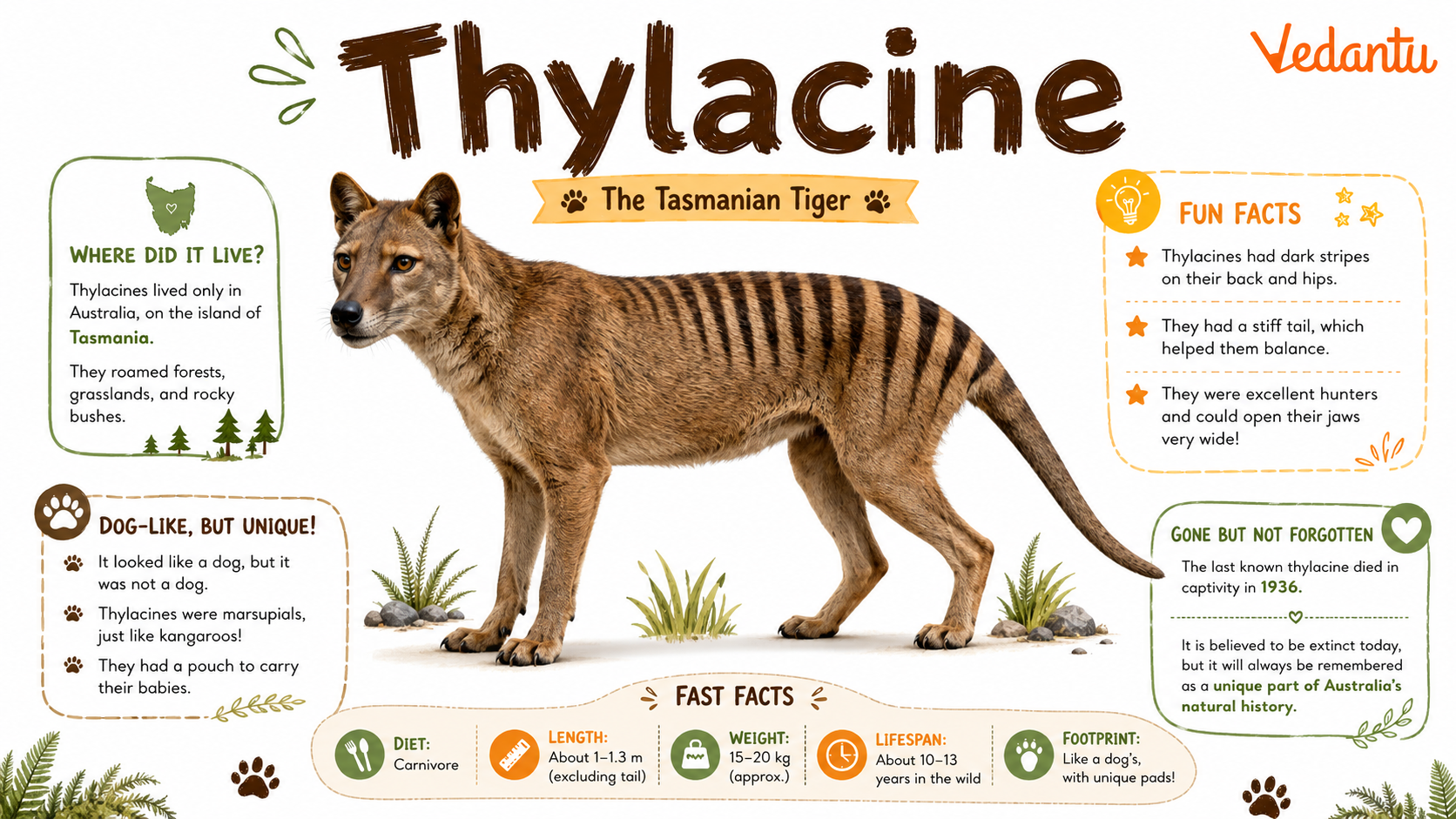
Quick Facts and Statistics
| Feature | Details |
|---|---|
| Common Name | Thylacine / Tasmanian Tiger |
| Scientific Name | Thylacinus cynocephalus |
| Animal Group | Marsupial (Mammal) |
| Length | Up to 1.8 meters (including tail) |
| Weight | 15–30 kg |
| Diet | Carnivore |
| Habitat | Forests, grasslands, and wetlands of Tasmania |
| Conservation Status | Extinct (last known individual died in 1936) |
Appearance and Physical Characteristics
- Dog-like body with a stiff tail.
- Yellowish-brown fur with 15–20 dark stripes on the back.
- Long snout and strong jaws.
- Large mouth that could open very wide.
- Both males and females had pouches (females carried babies).
Thylacine Habitat and Distribution
- Originally found across mainland Australia and New Guinea.
- Later survived only in Tasmania.
- Lived in forests, coastal scrublands, and open grasslands.
- Preferred quiet, less populated areas.
The Thylacine habitat shrank after humans arrived in Australia. Hunting and habitat loss played a big role in its extinction.
Diet and Feeding Habits
Behaviour and Lifestyle
- Mostly solitary but sometimes seen in pairs.
- Active during the night (nocturnal).
- Moved with a stiff-legged walk.
- Used scent markings to mark territory.
Thylacine Life Cycle
- Birth: Babies were born very small and undeveloped.
- Pouch Stage: They crawled into the mother’s pouch to grow safely.
- Juvenile Stage: Stayed with the mother until strong enough to hunt.
- Adult Stage: Became independent hunters.
The Thylacine life cycle was similar to other marsupials like kangaroos and koalas.
What Made the Thylacine Special?
Importance and Role in Nature
- Maintained balance in the food chain.
- Controlled populations of smaller animals.
- Helps scientists understand extinction.
- Symbol of wildlife conservation in Australia.
Amazing Thylacine Facts
Fun Facts for Kids
- The Thylacine looked like a mix of a dog and a tiger.
- It had stripes only on its back and tail.
- Both parents helped protect the babies.
- It was a marsupial, not a true tiger.
- It is one of Australia’s most famous extinct animals.
FAQs on Thylacine: The Extinct Tasmanian Tiger Explained
1. What is a Thylacine?
The Thylacine, also called the Tasmanian tiger, was a carnivorous marsupial that is now extinct.
- Scientific name: Thylacinus cynocephalus
- Native to Tasmania, Australia, and New Guinea
- Looked like a dog with tiger-like stripes
- Known as the largest modern marsupial predator
2. Why is the Thylacine called the Tasmanian tiger?
The Thylacine was called the Tasmanian tiger because of the dark stripes on its back.
- Had 13–21 dark stripes across its body
- Lived mostly in Tasmania
- Was not a real tiger but a marsupial
- Also called the Tasmanian wolf
3. When did the Thylacine go extinct?
The Thylacine officially went extinct in 1936.
- Last known Thylacine died at Hobart Zoo
- Died on September 7, 1936
- Now remembered on National Threatened Species Day in Australia
- Considered one of the most famous extinct animals
4. Why did the Thylacine become extinct?
The Thylacine became extinct mainly because of human activities.
- Hunted due to government bounty programs
- Loss of habitat from farming and settlement
- Competition with dogs
- Possible disease outbreaks
5. What did the Thylacine eat?
The Thylacine was a meat-eater that hunted small animals.
- Ate kangaroos and wallabies
- Hunted birds and small mammals
- Was a nocturnal predator
- Used strong jaws to catch prey
6. Where did the Thylacine live?
The Thylacine lived in forests and grasslands of Australia and nearby islands.
- Found in Tasmania
- Also lived in mainland Australia
- Early fossils found in New Guinea
- Preferred open woodland and coastal areas
7. Are Thylacines still alive today?
There is no scientific proof that Thylacines are still alive today.
- Declared extinct in the 20th century
- Occasional unconfirmed sightings reported
- No verified photos or physical evidence
- Considered a famous cryptid mystery
8. What did the Thylacine look like?
The Thylacine looked like a medium-sized dog with stripes and a stiff tail.
- Sand-colored fur with dark back stripes
- Long, stiff kangaroo-like tail
- Large jaws that could open very wide
- Pouch for babies, like other marsupials
9. How was the Thylacine different from a wolf or dog?
Although it looked like a wolf, the Thylacine was a marsupial, not a dog.
- Belonged to the marsupial family
- Had a pouch to carry babies
- Evolved separately from wolves
- Example of convergent evolution
10. Can scientists bring the Thylacine back?
Some scientists are studying ways to possibly revive the Thylacine using modern science.
- Research in de-extinction
- Studying preserved DNA
- Using gene-editing tools like CRISPR
- Still experimental and not yet successful
