




What Is a Hermaphrodite Definition Types and Biological Significance
An organism that produces both eggs and sperm is known as a hermaphrodite (cosexual). It can be sequential, in which case one sex is produced before the other, or simultaneously, in which case both eggs and sperm are produced at the same time (both sexes at the same time). An intersex or mixture of male and female genetics and/or phenotype organism is referred to as a hermaphrodite.
What is Hermaphrodite?
Hermaphrodites, the mythical Greek offspring of Hermes and Aphrodite, are from where the name "hermaphrodite" originates. Hermes is a symbol of strong, masculine identity. Aphrodite is a symbol of feminine beauty.
There are two sorts of hermaphrodites: true and false. A real hermaphrodite has a genetic deficiency (issues with the X or Y chromosome) in any combination of the following: XXX, XXY, X0, X+ Y. SYR loci are connected to the partial Y in true hermaphrodites with XX + part Y. (carries TDF which drives maleness). There are testicular and ovarian tissues in it (dysfunctional).
The chromosome structure of the fake hermaphrodite is usually XX or XY. It has a mutation in gene loci that code for enzymes involved in the manufacture of androgen or oestrogen (get less than normal levels). Because differentiating ducts/external genitalia are hormone-driven (have partials/incomplete characteristics), this causes issues.
Hermaphrodite Animals
The animals that have the characteristics to develop both male and female gametes in their body are known as hermaphrodite animals. These hermaphrodite animals have some features and organs that help to adapt to this condition.
Worms, bryozoans (moss creatures), trematodes (flukes), snails, slugs, and barnacles are examples of hermaphrodite animals examples. Hermaphrodites include animals mostly in the phylum Platyhelminthes, including liver fluke and blood fluke. All leeches are hermaphrodites, meaning they can be either protandrous or cosexual. Most sponges are hermaphrodites who go through phases of being one sex and then the other. Earthworms, flatworms, mollusks, and fish(rarely) are all examples of each member who can act as both a man and a woman.
A free martin is a fake hermaphrodite found only in cattle. When twins are born, one male and one female, and the placentas fuse together (can occur early or late).
Snails
Hermaphrodites make up the majority of snails. Apple snails and periwinkle snails are the only freshwaters and marine species that are exempt.
Snails, in addition to being hermaphroditic, are also early bloomers, reaching sexual maturity by the age of a year.
The Achatina fulica, or gigantic African land snail, is the world's largest snail species, capable of depositing up to 500 eggs at a time. They mate with partners most of the time as hermaphrodites, although they can also self-fertilise in rare cases.
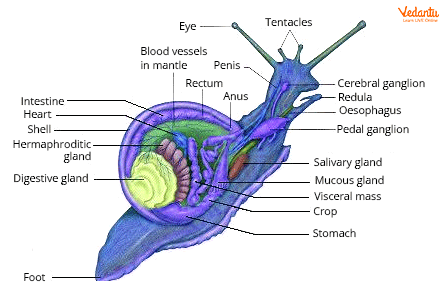
Image: A Hermaphrodite animal- Snail
Worms
Worms are another class of invertebrates that contribute to the spread of hermaphroditism.
Some worms can fertilise themselves, but most worms require a mate in order to breed.
Consider the mating behaviour of an earthworm. Earthworms connect together with their heads facing opposite ways during fertilisation and transmit sperm and eggs between them into a united cocoon.
When an earthworm emits a pheromone that signals it's ready to reproduce, it can happen above or below the soil. Caenorhabditis elegans is a free-living organism and both sex in a single body.
Frogs
Some frog species, such as the African tree frog (Xenopus laevis), are male in their juvenile stages before becoming female as adults.
Frogs' sex is fast changing due to commercial pesticides based on atrazine.
Banana Slugs
This mollusc tends to pair with a partner, but if one isn't available, it can self-fertilise.
For how they mate, being a hermaphrodite is a crucial trait of the banana slug. Banana slugs become caught together during the mating process, and because their male reproductive organs are so enormous, the organ is chewed off to separate the organs.
This causes no harm to the slug, and it can still mate with other slugs because it still has its female reproductive apparatus.
Fishes
Hamlet is a fish that does not reproduce like other fishes. It changes its sex after finding its mate.
If a mate is male then it changes itself to female and if a mate is female then changes to male and reproduces.
Starfish
The jellyfish are among the most well-known hermaphroditic animals on the planet.
They generally produce a male reproduction organ in their immature stages and then transition to a female reproductive organ as they mature.
Conclusion
The hermaphrodites are a type of sexual reproduction. It carries both genders and helps in self-fertilisation. Hermaphrodites that may mate with males or self-fertilise. This condition occurs in both plants and animals. They have no genetic variation. Slugs, worms, and plants exhibit hermaphroditic traits more frequently and pronouncedly than do people.
The above article provides all the information about examples of them in which this process occurs. The examples are helpful to identify the organism that has this type of characteristics.


FAQs on Hermaphrodite in Biology Meaning Types and Examples
1. What is a hermaphrodite in biology?
A hermaphrodite is an organism that possesses both male and female reproductive organs in the same individual. In biology, hermaphroditism allows a single organism to produce both male gametes (sperm) and female gametes (eggs).
- Common in many invertebrates such as earthworms and snails.
- Also found in many plants with bisexual flowers.
- Rare in vertebrates, but present in some fish species.
2. What are the different types of hermaphroditism?
The two main types of hermaphroditism are simultaneous hermaphroditism and sequential hermaphroditism. These types differ in how and when male and female functions occur.
- Simultaneous hermaphrodites: Have active male and female reproductive organs at the same time (e.g., earthworms).
- Sequential hermaphrodites: Change sex during their lifetime.
- Sequential types include protandry (male to female) and protogyny (female to male).
3. How does hermaphroditism work in earthworms?
In earthworms, hermaphroditism works through simultaneous presence of male and female reproductive organs with cross-fertilization between two individuals. Although each worm has testes and ovaries, self-fertilization is rare.
- Two worms align ventrally during mating.
- They exchange sperm.
- Fertilization occurs in a cocoon secreted by the clitellum.
4. What is sequential hermaphroditism?
Sequential hermaphroditism is a condition where an organism changes its sex during its lifetime. This adaptation is common in certain fish species.
- Protandry: Individual starts as male and later becomes female (e.g., clownfish).
- Protogyny: Individual starts as female and later becomes male (e.g., wrasses).
- Sex change is often triggered by social or environmental factors.
5. Can hermaphrodites self-fertilize?
Yes, some hermaphrodites can self-fertilize, but many prefer or require cross-fertilization for genetic diversity. Self-fertilization ensures reproduction when mates are unavailable.
- Common in some parasitic worms and plants.
- Reduces genetic variation compared to cross-fertilization.
- Cross-fertilization increases genetic recombination and adaptability.
6. Are hermaphrodites common in humans?
True hermaphroditism is extremely rare in humans and is medically referred to as ovotesticular disorder of sex development (DSD). In this condition, individuals may have both ovarian and testicular tissue.
- It is a rare genetic and developmental condition.
- Most cases involve variations in sex chromosome patterns or gene expression.
- It differs from typical male or female development.
7. What is the advantage of hermaphroditism?
The main advantage of hermaphroditism is increased reproductive success in environments where mates are scarce. It ensures that any two individuals can potentially reproduce.
- Maximizes mating opportunities.
- Beneficial in low population density habitats.
- Enhances survival in sessile or slow-moving organisms.
8. What is the difference between hermaphrodite and monoecious?
A hermaphrodite refers to an individual animal with both male and female reproductive organs, while monoecious describes plants that have both male and female flowers on the same plant. The terms are related but used in different biological contexts.
- Hermaphrodite: Commonly used for animals (e.g., earthworms).
- Monoecious: Used for plants (e.g., maize).
- Both involve presence of both sexes in one organism.
9. Which animals are examples of hermaphrodites?
Common examples of hermaphrodite animals include earthworms, snails, and some fish species. These organisms possess both male and female reproductive structures.
- Earthworms – simultaneous hermaphrodites.
- Snails – often capable of self-fertilization.
- Clownfish – sequential hermaphrodites (protandrous).
- Wrasses – protogynous fish.
10. How is hermaphroditism different from asexual reproduction?
Hermaphroditism is a form of sexual reproduction involving both male and female gametes, whereas asexual reproduction occurs without gamete fusion. The key difference lies in fertilization and genetic variation.
- Hermaphroditism involves meiosis and fertilization.
- Asexual reproduction involves mitotic division only.
- Sexual reproduction increases genetic diversity; asexual reproduction produces genetically identical offspring.



