




What is a Spore Definition Types and Reproductive Function
Spore formation is one of the most reproductive strategies used by a variety of organisms, ranging from fungi and bacteria to algae and plants. Spores are typically single-celled, haploid structures that can develop into new individuals when conditions become favourable. Here, we will explore what is spore, its production, structure and function, and various spore formation examples in diverse living organisms.
What are Spores?
In biology, spores can be defined as specialised reproductive cells formed as a result of either sexual or asexual reproduction. Unlike gametes, spores do not need to fuse with another cell to develop into a new organism. This means they can initiate growth independently, making them crucial for survival and dispersal in many species.
Spore Formation Short Definition
Spore formation refers to the biological process in which spores are produced by certain organisms. Formally known as sporogenesis, this process allows the organism to endure unfavourable conditions and propagate once the environment becomes suitable again.
Structure of Spore (Spore Structure and Function)
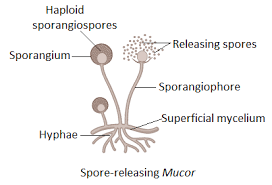
A typical spore is a tiny, usually microscopic, unicellular body. While spore structure can vary across different organisms, most spores include:
Protective Coat: A tough outer layer that shields the spore from harsh conditions such as extreme temperatures and radiation.
Cytoplasm and Organelles: Containing essential cellular machinery required to kick-start growth.
Genetic Material (Nucleus): Usually in a haploid state (n), carrying the hereditary information needed to form a new organism.
The spore structure and function together ensure that these cells can remain dormant for extended periods and later germinate into fully functioning organisms once conditions improve.
Spore Formation in Different Organisms
1. Fungi
Many fungi produce spores on specialised structures known as sporangia. For instance, in species like Aspergillus and Penicillium, the sporangium contains numerous minute haploid spores. When these spores are released and land in favourable conditions, they germinate into new fungal hyphae.
Spore Formation Examples in Fungi:
Aspergillus
Penicillium
Rhizopus (detailed below)
2. Bacteria
Certain bacteria form endospores, which are highly resistant structures produced during unfavourable conditions such as nutrient depletion or extreme environmental changes. These endospores are not considered “true” reproductive spores because their primary function is survival rather than reproduction.
Common Bacterial Endospore Examples:
Bacillus species
Clostridium species
For more details on bacterial sporulation, check out Endospores.
3. Plants
In many lower plants (e.g., liverworts, mosses, hornworts), what are spores in plants? They are asexual reproductive units formed in the diploid sporophyte stage. These haploid spores develop into a new generation known as the gametophyte, which eventually produces gametes.
This cycle, known as the alternation of generations, ensures genetic diversity and helps plants adapt to various environmental conditions.
Spore Formation in Rhizopus
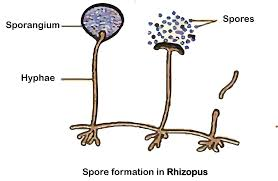
Spore formation in Rhizopus (a common bread mould) is a classic example often studied in schools. Rhizopus produces spores in round sporangia located at the tips of upright hyphae called sporangiophores.
Sporangiophore Formation: The fungus develops upright hyphae, each bearing a bulb-like structure (sporangium) at its tip.
Spore Production: Within each sporangium, several tiny, haploid spores form through asexual reproduction.
Spore Release: When the sporangium matures, it bursts, releasing spores into the environment.
Germination: If spores land in a favourable setting (optimal temperature, moisture, and nutrients), they germinate and grow into new fungal hyphae.
Spore Formation Diagram (Conceptual)
Hypha (mycelium)
|
| (upright growth)
v
Sporangiophore
|
| (knob-like swelling)
v
Sporangium
|
| (contains numerous spores)
v
Burst -> Spores Released -> Germination -> New Fungal Colony
This simple flowchart helps visualise how spores are formed and released in Rhizopus and other fungi.
Additional Insights
Spore Versus Gamete: Spores can develop directly into a new individual, whereas gametes (like sperm and egg) must fuse for fertilisation.
Importance of Spores: They help in dispersal, survival under harsh conditions, and colonising new environments.
Evolutionary Advantage: The ability to remain dormant for extended periods and later germinate ensures the continuity of the species.
Short Quiz (With Answers)
1. Question: Which structure in fungi typically produces spores?
Answer: The sporangium.
2. Question: Name one bacterial genus that forms endospores.
Answer: Bacillus (e.g., Bacillus subtilis).
3. Question: What is the main function of spores in plants?
Answer: To ensure asexual reproduction and facilitate alternation of generations.
4. Question: In spore formation in Rhizopus, what is the name of the structure that holds the spores before they are released?
Answer: The sporangium is located on a sporangiophore.
Conclusion
Spore formation is a vital process in what is spore in biology. It ensures the survival, dispersal, and reproduction of diverse organisms, from fungi and bacteria to algae and plants. By forming spores, these organisms can withstand unfavourable conditions and flourish when the environment becomes supportive.
Related Topics at Vedantu


FAQs on Spore in Biology Structure Formation and Role
1. What is a spore in biology?
A spore is a single-celled reproductive unit that can develop into a new organism without fertilization. Spores are produced by organisms such as fungi, algae, bacteria, and some plants for reproduction and survival.
- Usually microscopic and lightweight
- Can withstand harsh environmental conditions
- Germinate into a new individual under favorable conditions
2. What is the function of a spore?
The main function of a spore is reproduction and survival in unfavorable conditions. Spores help organisms spread and persist in changing environments.
- Enable asexual reproduction in fungi and some plants
- Allow dispersal by wind, water, or animals
- Resist heat, dryness, and chemicals in some species
3. How are spores formed?
Spores are formed either by mitosis or meiosis, depending on the organism and life cycle. The process varies among fungi, plants, and bacteria.
- Asexual spores form by mitosis (e.g., in fungi)
- Sexual spores form by meiosis (e.g., in ferns and mosses)
- Bacterial endospores form through a specialized survival process
4. What is the difference between spores and seeds?
The main difference between spores and seeds is that spores are single-celled and do not contain stored food, while seeds are multicellular and contain an embryo with food reserves.
- Spores are usually haploid
- Seeds contain a diploid embryo
- Seeds have protective coats and stored nutrients
5. What are the different types of spores?
Spores are classified into different types based on how they are formed and their function.
- Asexual spores (e.g., conidia, sporangiospores)
- Sexual spores (e.g., zygospores, ascospores, basidiospores)
- Endospores in bacteria for survival
6. What is an endospore in bacteria?
An endospore is a tough, dormant structure formed inside certain bacteria to survive extreme conditions. It is not a reproductive structure but a survival mechanism.
- Produced by bacteria like Bacillus and Clostridium
- Highly resistant to heat, radiation, and chemicals
- Germinates into a vegetative cell when conditions improve
7. How do spores germinate?
Spores germinate when environmental conditions become favorable, leading to the growth of a new organism. Germination typically involves:
- Absorption of water
- Activation of metabolic processes
- Cell division and development into a new individual
8. Why are spores important in the life cycle of plants?
Spores are important in the plant life cycle because they enable reproduction in non-seed plants like mosses and ferns. In these plants:
- Spores are produced by the sporophyte through meiosis
- Spores grow into a gametophyte
- This process forms part of alternation of generations
9. Where are spores found in fungi?
In fungi, spores are found in specialized reproductive structures called sporangia, asci, or basidia. Their location depends on the fungal group.
- Rhizopus produces spores in sporangia
- Ascomycetes produce ascospores in asci
- Basidiomycetes produce basidiospores on basidia
10. Are spores harmful to humans?
Some spores can be harmful to humans, especially fungal and bacterial spores that cause disease. While many spores are harmless, certain types pose health risks.
- Fungal spores may trigger allergies or respiratory issues
- Bacillus anthracis forms spores that cause anthrax
- Most environmental spores are non-pathogenic



