



 Watch Video




Class 10 Civics Chapter 2 Federalism Questions and Answers: FREE PDF Download
Class 10 Social Science Civics Chapter 2: Federalism explores how power is distributed in a federal system to accommodate linguistic, cultural, and regional diversities. The NCERT Solutions for Class 10 Federalism provide step-by-step answers to the chapter’s questions, helping students understand the key concepts of federalism, its features, and its importance in the Indian context. These Federalism Class 10 questions and answers guide students through the various facets of federalism, such as its structure, functioning, and how it is applied in India. By referring to these NCERT solutions, students will be able to develop better answer-writing skills and learn to address exam questions effectively, especially related to the division of power between central and state governments. Practicing these solutions will help in grasping complex concepts and preparing confidently for their CBSE exams.
 Table of Content
NCERT Solutions for Class 10 Social Science Democratic Politics Chapter 2 Federalism - 2026-27 Free PDF Download (Sign-In Required)


 ShareShare
Short Answers:
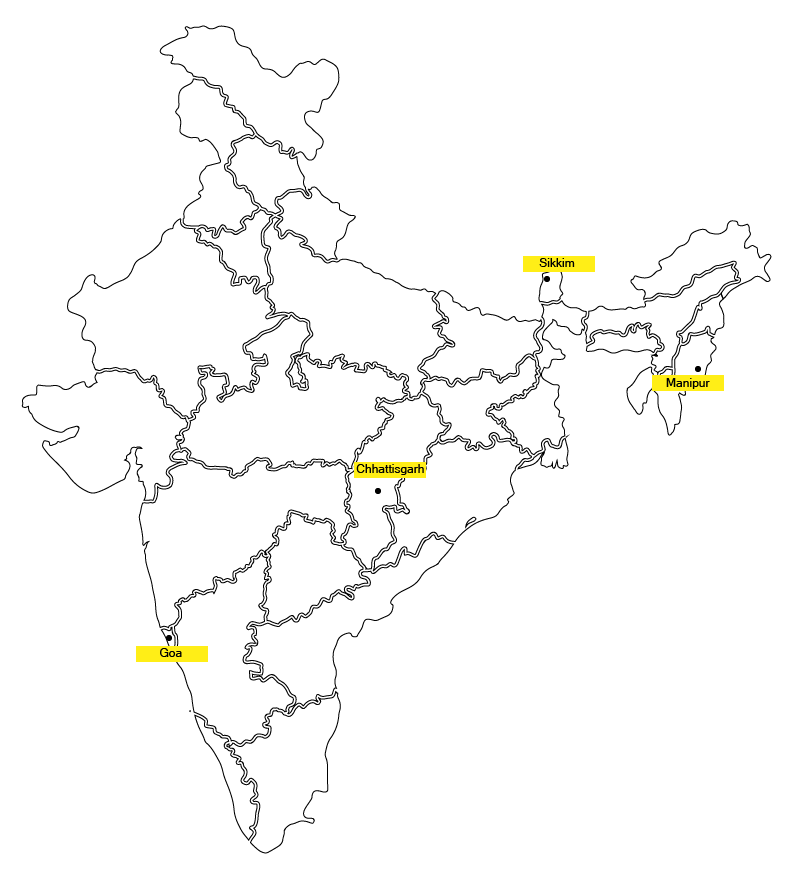
1. Locate the following States on a blank outline political map of India:
Manipur, Sikkim, Chhattisgarh and Goa
Ans:
2. Identify and shade three federal countries (other than India) on a blank outline political map of the world.
Ans:

3. Point out one feature in the practice of federalism in India that is similar to and one
feature that is different from that of Belgium.
Ans: Similarity: In both the countries, the central government shares its powers with the regional governments.
Difference: Along with the central and state government, Belgium also has a community government.
4. What is the main difference between a federal form of government and a unitary one?
Ans: In the Federal form of government, power is shared between the Central government and the other constituent units of the country. Like in India, the power is shared between the Central and the State governments.
The unitary form of government provides power to only one government. Like in Sri Lanka, all the power has been given to the national government.
5. State any two differences between the local government before and after the constitutional amendment in 1992.
Ans:
Local governments before 1992-
State controlled the elections and they were held irregularly.
No power or resources were given to local governments.
Local governments after 1992-
Elections are conducted regularly by an independent State Election Commission.
Some powers and revenue is shared with local government bodies by the State governments.
6. Fill in the blanks:
Since the United States is a ____________________ type of federation, all the constituent States have equal powers and States are _______________ vis-à-vis the federal government. But India is a _________________ type of federation and some States have more power than others. In India, the ___________________ government has more powers.
Ans:
Since the United States is a coming together type of federation, all the constituent States have equal powers and States are strong vis-à-vis the federal government. But India is a holding together type of federation and some States have more power than others. In India, the Central government has more powers.
7. Here are three reactions to the language policy followed in India. Give an argument and an example to support any of these positions.
Sangeeta: The policy of accommodation has strengthened national unity.
Arman: Language-based States have divided us by making everyone conscious of their
language.
Harish: This policy has only helped to consolidate the dominance of English over all other languages.
Ans: I concur with Sangeeta's reaction. Had the policy of accommodation not been followed and the states not been created on linguistic basis, India would have suffered further partition.
For example, if Hindi would have been declared as the national language, the south would have broken away from the north and have become an independent nation.
8. The distinguishing feature of a federal government is:
(a) The National government gives some powers to the provincial governments.
(b) Power is distributed among the legislature, executive and judiciary.
(c) Elected officials exercise supreme power in the government.
(d) Governmental power is divided between different levels of government.
Ans: (d) Governmental power is divided between different levels of government.
Topics Covered in Class 10 Civics Chapter 2: Federalism
Benefits of Referring to Chapter 2 Federalism Class 10 Questions and Answers
Federalism Class 10 helps in understanding how power is divided between the central and state governments, which is crucial for understanding how India is governed.
Students get awareness about the roles and responsibilities of different levels of government in managing national and local issues from Federalism Class 10 Solutions.
Federalism Class 10 Questions And Answers encourages critical thinking by analysing how federalism impacts policy-making, administration, and democratic practices.
Makes it easy for students to understand democratic principles like decentralisation of power and checks and balances, essential for informed citizenship.
Class 10 Civics Ch 2 Question Answer develops skills like critical analysis, understanding of rights and responsibilities, and appreciation for democratic values essential for active participation in society.
Students can gain foundational knowledge beneficial for careers in governance, law, public administration, and political science that is offered by Class 10 Political Science Chapter 2 Questions And Answers.
Along with Class 10 Civics Chapter 2 NCERT Solutions, you can also refer to Class 10 Federalism Revision Notes and Class 10 Federalism Important Questions.
Conclusion
NCERT Solutions for Class 10 Civics Chapter 2 on Federalism by Vedantu offers a comprehensive understanding of how power is distributed between the central and state governments in India. Vedantu’s solutions simplify complex concepts, making them accessible and aiding in effective exam preparation. By focusing on Class 10 Federalism Question Answer, students not only gain clarity on federalism but also develop critical thinking skills necessary for analysing political structures and their implications on society.
NCERT Solutions for Class 10 Civics Other Chapter-Wise Links - Download the FREE PDF
Related Important Links for Class 10 Civics


FAQs on NCERT Solutions for Class 10 Social Science Democratic Politics Chapter 2 Federalism - 2026-27 Free PDF Download (Sign-In Required)
1. How should Class 10 Social Science Civics Chapter 2 Federalism answers be structured to score full marks?
For Class 10 Social Science Civics Chapter 2 Federalism, answers should be written point-wise with clear headings, as reflected in NCERT-aligned solutions on Vedantu.
2. Why do students lose marks in Civics Chapter 2 Federalism Class 10 Social Science long-answer questions?
In Civics Chapter 2 Federalism Class 10 Social Science, marks are often lost due to missing key NCERT terms, which can be avoided by practising structured answers on Vedantu.
3. Are definition-based questions common in Class 10 Civics Chapter 2 Federalism Social Science exams?
Yes, definition-based questions are common in Class 10 Civics Chapter 2 Federalism Social Science, and NCERT-based wording from Vedantu helps maintain accuracy.
4. How many marks can be expected from Social Science Class 10 Civics Chapter 2 Federalism in board exams?
Questions from Social Science Class 10 Civics Chapter 2 Federalism usually contribute short and long answers, making it a scoring chapter when prepared using Vedantu NCERT Solutions.
5. What common writing mistakes occur in Class 10 Social Science Chapter 2 Civics Federalism answers?
Common mistakes in Class 10 Social Science Chapter 2 Civics Federalism include vague explanations and missing examples, which can be corrected using step-aligned answers on Vedantu.
6. Can the Class 10 Social Science Civics Chapter 2 Federalism NCERT Solutions PDF be used offline?
Yes, the Class 10 Social Science Civics Chapter 2 Federalism NCERT Solutions PDF available on Vedantu can be used offline for last-minute preparation.
7. Do example-based questions appear in Civics Federalism Chapter 2 Class 10 Social Science exams?
Yes, example-based questions are asked from Civics Federalism Chapter 2 Class 10 Social Science, and practising NCERT-style answers on Vedantu helps place examples correctly.
8. Why is Class 10 Civics Social Science Chapter 2 Federalism considered a scoring chapter?
Class 10 Civics Social Science Chapter 2 Federalism is scoring because questions are direct and NCERT-based when prepared thoroughly using Vedantu.
9. How does practising Social Science Class 10 Chapter 2 Civics Federalism improve answer accuracy?
Practising Social Science Class 10 Chapter 2 Civics Federalism improves accuracy by reinforcing correct terminology and answer length, as shown in Vedantu NCERT Solutions.
10. Is Class 10 Social Science Civics Chapter 2 Federalism suitable for self-study without coaching?
Yes, Class 10 Social Science Civics Chapter 2 Federalism can be prepared through self-study by consistently using NCERT-aligned solutions available on Vedantu.
