



Class 7 SST Part 2 Chapter 4 Turning Tides: 11th and 12th Centuries Questions and Answers - FREE PDF Download
The Big Questions (Page 97)
Question 1. Why are the 11th and 12th centuries seen as a period of transition in Indian history?
Answer:
The 11th and 12th centuries are regarded as a period of transition because the Indian subcontinent witnessed important political, social, and cultural changes.
Deeper invasions: Unlike earlier Arab attacks, Turkic armies advanced much deeper into northern India despite strong resistance from several local rulers.
Beginning of a new political phase: Muhammad Ghuri defeated the Chahamanas in the Second Battle of Tarain in 1192 CE. This victory helped establish Ghurid authority in parts of northern India and prepared the ground for the formation of the Delhi Sultanate.
Shift in political power: The invasions changed the balance of power in northern India and led to the establishment of new ruling groups and administrative practices.
Continued cultural growth: Despite political conflicts, many regions of the Indian subcontinent continued to prosper.
Rulers, poets, philosophers, saints, architects, and scientists produced remarkable works.
Naval expeditions were undertaken, magnificent monuments were constructed, and important literary and scientific texts were composed. This shows that cultural and intellectual life remained strong during this period.
Question 2. Which new powers emerged during this period? What were the essential features of their economic, military and administrative systems?
Answer: Several new kingdoms and dynasties became influential during the 11th and 12th centuries.
North, East and Central India: The Ghurids gained control over Delhi and surrounding regions. The Chahamanas ruled parts of Rajasthan and Haryana, while the Paramaras governed Malwa. The Senas became powerful in Bengal, and the Eastern Gangas ruled Kalinga and other parts of the eastern coastal region.
South India: The Hoysalas expanded their authority across Karnataka. The Kakatiyas controlled large areas of present-day Telangana and Andhra Pradesh. The Cholas remained a major power in Tamil Nadu and extended their influence into parts of Karnataka and Andhra Pradesh.
The main features of their economic, military and administrative systems were:
Military system: These kingdoms maintained large armies consisting of infantry soldiers, cavalry, and war elephants. Organising and supporting such armies required considerable wealth and planning. The Ghurids became especially known for their swift and skilled mounted troops, which gave them an advantage in battle.
Administrative system: Most rulers collected taxes from cultivators and received tribute from subordinate chiefs. Local officials and vassals helped administer distant regions. The Ghurids assigned territories to officers who collected revenue and provided military service in return. This system later influenced the administration of the Delhi Sultanate.
Economic system: Agriculture remained the principal source of revenue. Rulers supported irrigation tanks, canals, and other water-management projects to improve farming. Trade within India and with regions such as China and Southeast Asia also expanded. Merchant guilds played an important role in managing commercial activities.
Question 3. What high accomplishments in art, architecture, literature, science, etc., do we come across during this period?
Answer: The 11th and 12th centuries witnessed outstanding achievements in science, mathematics, architecture, literature, philosophy, and religion.
Science and Mathematics: Bhaskaracharya made valuable contributions to mathematics and astronomy. His important works included Bijaganita, which dealt with algebra, Lilavati, which discussed arithmetic, and Siddhanta Shiromani, which contained studies of astronomy and mathematical calculations.
Architecture and Art: Skilled artisans constructed beautifully carved temples, forts, gateways, and sculptures. The temples of Khajuraho, the gateways and forts of the Kakatiyas, and the richly decorated Hoysala temples demonstrate the high level of craftsmanship achieved during this period. Important temples such as the Jagannatha Temple in Puri were also constructed during this time.
Literature and Philosophy: Many writers, scholars, and philosophers produced influential works. King Bhoja wrote on subjects such as governance, poetry, architecture, and the arts. Someshvara III compiled an encyclopaedic work covering many aspects of society and everyday life. Religious teachers such as Ramanujacharya and Basava promoted devotion, ethical conduct, equality, and personal spiritual practice.
Cultural Influence: Indian religion, art, literature, and architectural traditions influenced regions beyond the subcontinent. Angkor Wat in Cambodia is a well-known example of the spread of Indian religious and architectural ideas in Southeast Asia.
Let’s Explore
Question 1.
(a) Observe the sketch of the Khyber Pass (Fig. 4.3). What kind of terrain does it depict? (Page 100)
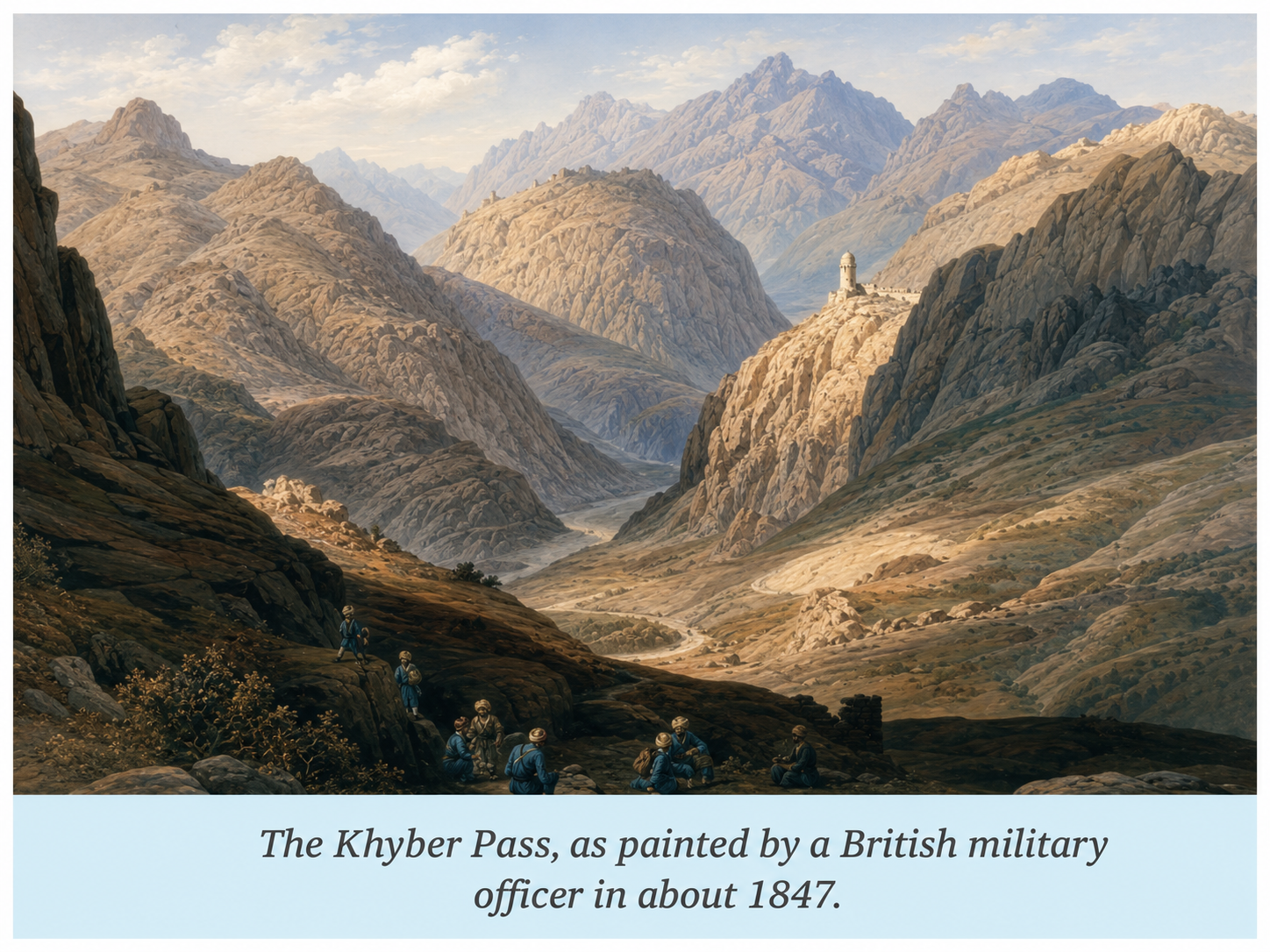
Answer: The sketch shows a rough and mountainous landscape with steep slopes, narrow valleys, rocky paths, and deep ravines. The Khyber Pass runs through a difficult section of the Hindu Kush mountain range. Travel through this terrain was possible only along a few narrow routes. Despite its challenging landscape, the pass was important because it connected Central Asia with the Indian subcontinent.
(b) What advantages would it offer to an army trying to reach the Indus plains? But also, what dangers?
Answer: The Khyber Pass offered armies a relatively direct route from Central Asia towards the Indus plains. It allowed soldiers, horses, weapons, and supplies to move through the mountains and enter the northwestern part of the subcontinent.
However, the pass also presented serious dangers. Its narrow paths restricted the movement of large armies and made them easy targets for defenders. Soldiers could be attacked from higher ground or trapped in narrow spaces. The rough terrain, harsh weather, shortage of supplies, and possibility of ambushes made the journey risky. Forces controlling the pass, such as the Hindu Shahis, could use their knowledge of the terrain to resist invading armies effectively.
(c) Thinking of the caravans of traders that passed through the Khyber Pass for many centuries, let’s ask the same questions about the advantages as well as dangers.
Answer: For traders, the Khyber Pass served as an important commercial route connecting the Indian subcontinent with Central Asia and other distant regions. For many centuries, merchants used it to transport valuable goods. It also encouraged the exchange of languages, ideas, religious beliefs, technologies, and cultural traditions.
At the same time, travelling through the pass involved many risks. The mountainous terrain made the journey slow and physically demanding. Extreme weather, steep paths, and shortages of food and water could endanger travellers and animals. Since caravans often carried expensive goods, they were also vulnerable to robbery and attacks, especially during periods of political instability.
Question 2. In later centuries, the Somanatha temple was rebuilt and destroyed again several times; the existing temple was built in 1950 and inaugurated the next year by the then President of India, Rajendra Prasad. Why do you think it was decided to fund the construction entirely from public donations? (Page 103)
Answer: The Somanatha temple was rebuilt using public donations so that the reconstruction could become a collective effort supported by ordinary citizens and devotees rather than being financed by the government.
The temple had been damaged and rebuilt several times throughout history. Therefore, inviting people to contribute allowed them to take an active part in restoring a site of cultural and religious importance.
Public funding also created a sense of shared responsibility and ownership. It demonstrated that the temple’s reconstruction was supported by the people and reflected their desire to preserve an important part of India’s cultural heritage. The donations thus transformed the rebuilding into a symbol of unity, participation, and cultural continuity.
Question 3. In the painting below can you make out who is the king and who is the guru? What does the king’s posture and general attitude express? (Page 112)
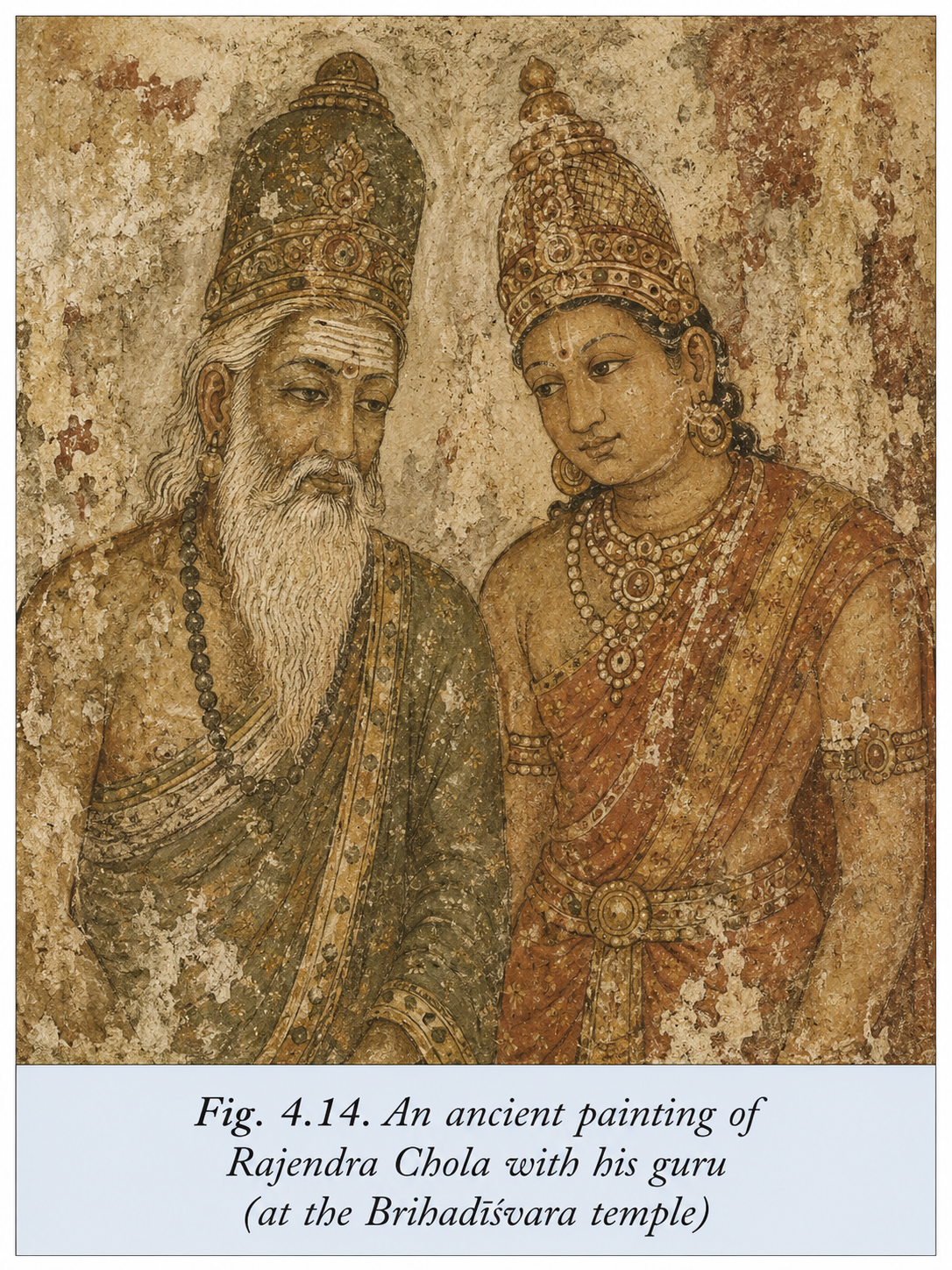
Answer: In the painting, the seated figure on the left appears to be the guru or spiritual teacher, while the figure on the right is King Rajendra Chola I.
The king’s posture expresses humility, respect, and devotion towards his guru. His hands are joined in anjali mudra, which is a traditional gesture of greeting and reverence. His slightly lowered head and attentive gaze show that he is listening carefully to the teacher. The scene suggests that even a powerful ruler respected spiritual wisdom and accepted the guidance of his guru.
Question 4. Writing some 60 years after Bakhtiyar Khilji’s campaign through Bihar, the historian Minhaj al-Siraj Juzjani, recorded in his Tabakat-iNasiri how Bakhtiyar’s forces captured a ‘fortress’ and “acquired great booty.” He adds, “The greater number of the inhabitants of that place were Brahmans, and all those Brahmans had their heads shaven; and they were all slain. There were a great number of books there. … It was found that the whole of that fortress and city was a college, and in [their] tongue, they call a college bihar.”
Remembering the meaning of vihara and noting that Nälanda was known in ancient inscriptions as ‘Nalanda Mahavihara’, can you find two more clues in the above passage to identify the ‘fortress’ near the Nalanda university? (Hint: Who do you think these ‘Brahmans’ actually were?) (Page 117)
Answer: The passage provides two important clues that the so-called fortress was actually a Buddhist centre of learning.
The first clue is that most of its inhabitants had shaven heads. Although Minhaj al-Siraj referred to them as “Brahmans,” they were probably Buddhist monks and scholars because Buddhist monks traditionally shaved their heads. The writer may have used the term “Brahmans” generally for religious scholars.
The second clue is the presence of a large number of books. Buddhist mahaviharas were major centres of education and contained libraries with many manuscripts. The words “college” and “bihar” also point towards the term vihara, meaning a Buddhist monastery and centre of learning.
These clues suggest that the place described was a Buddhist mahavihara, probably Odantapuri, located near Nalanda.
Question 5. In Kalyani, Basavanna established an anubhava mandapa (literally, ‘pavilion of experience’), where men and women from every social, economic, religious or linguistic background, including saints and philosophers, could assemble to discuss all aspects of life, including moral values and religion. (Page 121)
(a) Why, in your opinion, did Basava want people from all backgrounds to come together and exchange ideas?
Answer: Basava wanted people from different backgrounds to meet because he believed that every person was spiritually equal. He opposed discrimination based on caste, gender, wealth, occupation, or social position.
Through the anubhava mandapa, he created an open platform where ordinary people, saints, philosophers, men, and women could express their ideas freely. These discussions promoted equality, personal devotion, moral conduct, and social reform. Basava believed that knowledge should not remain limited to privileged groups but should be shared by everyone.
(b) If something like an anubhava mandapa existed today, what important topics do you think people ought to discuss there?
Answer: If an institution like the anubhava mandapa existed today, people could discuss important issues affecting society and the world. These might include social equality, caste and gender discrimination, poverty, education, unemployment, environmental protection, religious harmony, mental health, technology, corruption, and human rights.
People could also discuss how communities can resolve conflicts peacefully, support disadvantaged groups, and encourage responsible citizenship. Such an open forum would allow people from different backgrounds to share experiences and find practical solutions together.
(c) What lessons can we draw from the anubhava mandapa spirit to create a just and civil society today?
Answer: The anubhava mandapa teaches us that a fair society must provide equal respect and opportunities to everyone, regardless of caste, gender, religion, language, wealth, or social position.
It also shows the importance of open and peaceful discussion. Decisions affecting society should not be made only by powerful or privileged people. The opinions and experiences of ordinary citizens and marginalised communities must also be heard.
By encouraging equality, mutual respect, freedom of expression, and collective decision-making, the spirit of the anubhava mandapa can help create a more just, inclusive, and civil society.
Think About It
Question 1. We will meet later in this chapter the Persian scholar al-Buruni, who accompanied Mahmud in some of his campaigns. He wrote in his memoirs on India, “The Hindu Shahiya dynasty is now extinct, and of the whole house there is no longer the slightest remnant in existence. We must say that, in all their grandeur, they never slackened in the ardent desire of doing that which is good and right, that they were men of noble sentiment and noble bearing.” What conclusions can we draw from this remark by, someone in Mahmud’s entourage? (Page 101)
Answer: Al-Biruni’s observation shows that the Hindu Shahi rulers were respected even by people associated with the army that defeated them. He regarded them as honourable, principled, and noble rulers who sincerely tried to do what was fair and right.
This remark also shows that military enemies could still recognise and appreciate one another’s good qualities. Although the Hindu Shahi dynasty was defeated, its rulers were remembered for their courage, dignity, and moral character.
Turning Tides: 11th and 12th Centuries Class 7 Solutions (Exercise)
Question 1. Why is the period under consideration in this chapter regarded as a major transition in Indian history? Give two examples each of change and continuity from this period.
Answer: The 11th and 12th centuries are regarded as a major period of transition because the political structure of northern India changed significantly with the arrival and expansion of new Central Asian powers.
Two examples of change were:
The Ghurids established control over Delhi and parts of northern India, creating the foundation for the Delhi Sultanate.
Important Buddhist centres of learning, including major mahaviharas in Bihar, suffered destruction and decline during military campaigns.
Two examples of continuity were:
Literature, science, mathematics, philosophy, art, and temple architecture continued to develop. Scholars such as Bhaskaracharya made significant contributions during this period.
Agriculture and trade continued to support the economy. Indian merchants maintained commercial links with China, Southeast Asia, and other regions.
Question 2. Observe Fig. 3.27 in the previous chapter and draw a similar ‘star of dynasties’ gathering all or most of the dynasties that appear in this chapter.
Answer:
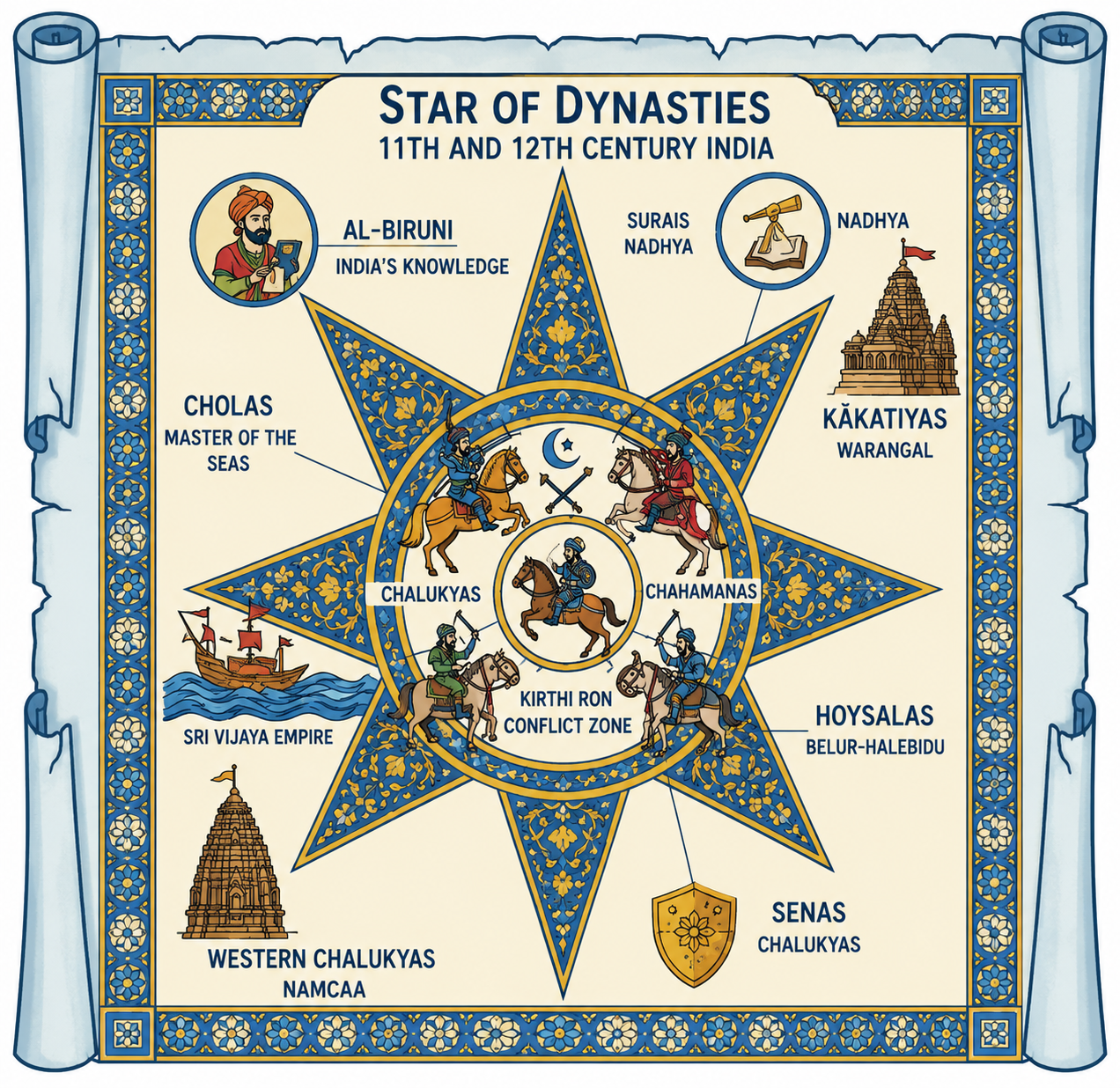
Students can draw a star and write the names of the major dynasties discussed in the chapter on its different points. These may include:
Ghaznavids
Ghurids
Chahamanas
Paramaras
Senas
Eastern Gangas
Kakatiyas
Hoysalas
Cholas
The heading “Star of Dynasties” may be written at the centre.
Question 3. Taking a map of the Subcontinent, draw a geographical tour that covers all or most dynasties in this chapter (you may draw inspiration from some of the ‘travels’ the chapter’s narration follows).
Answer: Take a map of the Indian subcontinent and mark the following regions and dynasties:
Northwest or entry region: Mark Ghazna, the Hindu Shahi territories, the Khyber Pass, and the route leading towards the Indus plains.
North India: Mark the Chahamana territories around Ajmer and Delhi. Also show the Paramara kingdom centred at Dhara in Malwa and the route followed by the Ghurids after the Battles of Tarain.
East India: Mark the Sena kingdom in Bengal and the Eastern Ganga kingdom along the Odisha coast.
Deccan region: Show the Kakatiya kingdom centred at Warangal and the Hoysala kingdom around Belur and Halebidu in Karnataka.
Far South: Mark the Chola Empire with its major centres at Thanjavur and Gangaikondacholapuram. Their coastal territories and naval routes towards Southeast Asia and the Shrivijaya kingdom may also be shown.
Question 4. With the help of a map of India and Southeast Asia, can you calculate the approximate distance that Rajendra I’s fleet of ships had to navigate to reach their objective?
Answer: Rajendra Chola I’s fleet probably travelled several thousand kilometres from the Coromandel Coast of Tamil Nadu to territories controlled by the Shrivijaya Empire in Southeast Asia.
The ships may have started from important Chola ports such as Nagapattinam. They crossed the Bay of Bengal, travelled near the Andaman and Nicobar Islands, and moved towards the Malay Peninsula and Sumatra.
Depending on the exact route and destination, the fleet may have covered approximately 3,000 to 4,000 kilometres. The journey required skilled sailors, strong ships, careful planning, supplies, and knowledge of monsoon winds and sea routes.
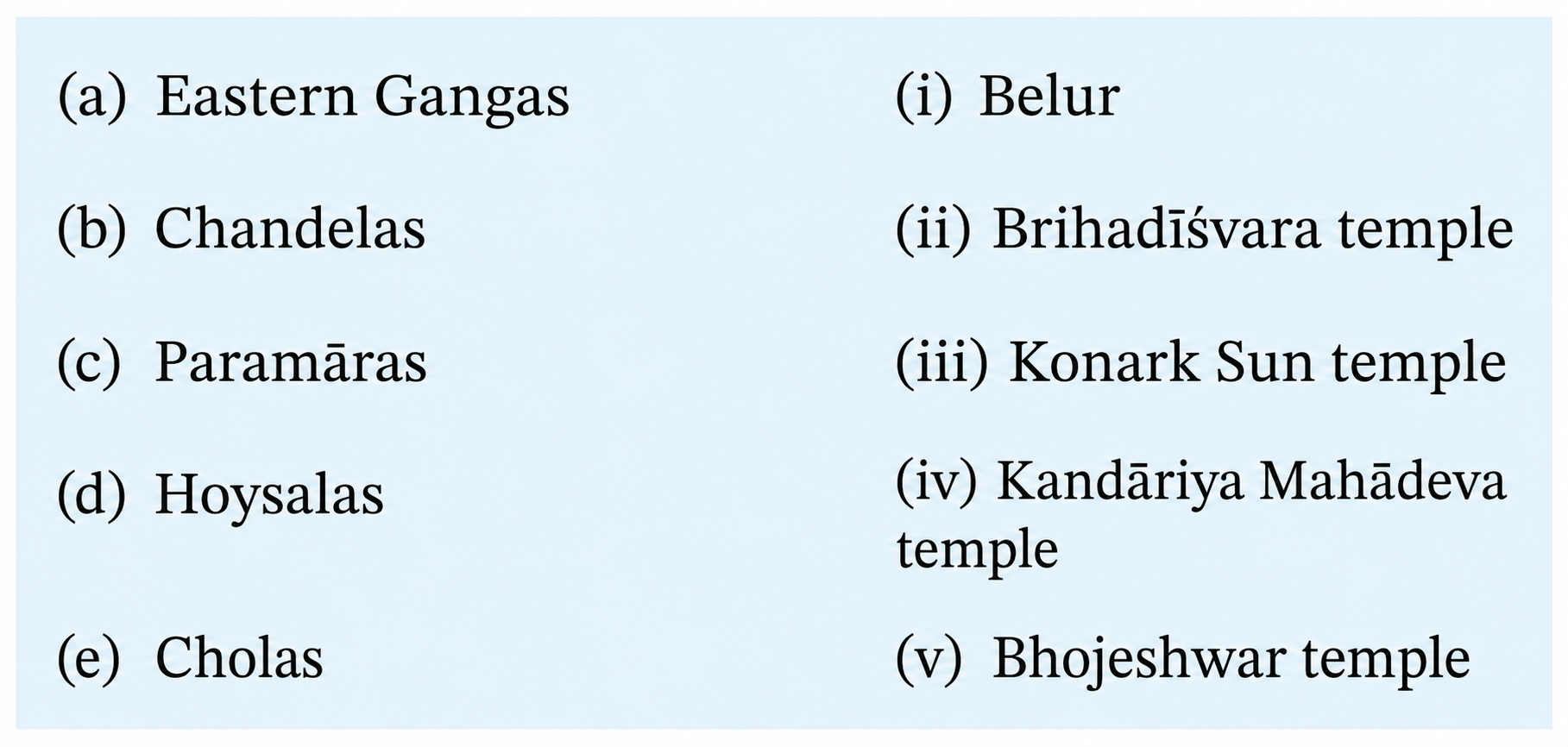
Question 5. Match these two pairs:
Answer:
(a) Eastern Gangas → (iii) Konark Sun temple
(b) Chandellas → (iv) Kandariya Mahadeva temple
(c) ParamAras → (v) Bhojeshwar temple
(d) Hoysalas → (i) Belur
(e) Cholas → (ii) Brihadishvara temple
Question 6. Working in groups, compare the dynasties in this chapter and in the preceding one; create a table to list the dynasties present in both, those that disappear from the preceding period, and those that appear in this chapter’s period.
Answer: The comparison shows that some dynasties continued from the earlier period, while others declined and several new powers emerged.
Question 7. Using the chapter and any additional reading, prepare a short note explaining (1) why centres of learning like Nalanda were important; (2) how their destruction may have affected education and culture in India.
Answer:
(1) Nalanda was one of the most important centres of higher learning in ancient India. Thousands of students and teachers lived and studied there. Learners from India and countries such as China, Tibet, and Korea travelled to Nalanda to study Buddhism, medicine, mathematics, astronomy, philosophy, grammar, and literature.
Its large libraries preserved valuable manuscripts and knowledge collected over many centuries. Nalanda also helped spread Indian ideas and learning to other parts of Asia.
(2) The destruction of major centres of learning led to the loss of libraries, manuscripts, classrooms, and organised communities of teachers and students. Many valuable texts and ideas may have disappeared permanently.
It also interrupted established traditions of education and weakened the network through which knowledge was shared across India and other countries. The decline of such institutions particularly affected Buddhist learning and reduced India’s importance as an international destination for higher education.
Question 8. Why do you think Mahmud of Ghazni carry out repeated raids from Afghanistan into India, while Muhammad Ghuri sought territorial expansion into India and long-term control? Write a short note on how their motives shaped the outcomes of their campaigns.
Answer: Mahmud of Ghazni mainly launched repeated raids into India to obtain wealth and resources. Rich cities and temples were attractive targets because their treasures could finance his army, strengthen his kingdom, and support construction projects in Ghazni. He captured Punjab but generally did not attempt to establish permanent control over most of the regions he attacked. As a result, his campaigns caused destruction and weakened several kingdoms but did not create a large, lasting empire in India.
Muhammad Ghuri, in contrast, aimed to conquer territory and establish long-term political control. After defeating Prithviraja III in the Second Battle of Tarain in 1192 CE, he appointed commanders such as Qutb-ud-din Aibak to govern and expand the conquered territories.
Thus, Mahmud’s motive resulted mainly in repeated raids and plunder, while Muhammad Ghuri’s ambition led to permanent territorial expansion and laid the political foundation for the Delhi Sultanate.
Key Rulers, Battles and Achievements in Class 7 SST Chapter 4 Turning Tides: 11th and 12th Centuries
Why Use Vedantu's NCERT Solutions for Class 7 Social Science Part 2 Chapter 4 Turning Tides?
Each answer is written in clear, exam-ready language by Vedantu's experienced teachers and follows the latest "Exploring Society: India and Beyond" Part 2 textbook for the CBSE 2026-27 session. The solutions explain the tricky source-based questions students often struggle with - the Khyber Pass terrain, the Bakhtiyar Khilji passage on the Nalanda "fortress," the Al-Biruni remark on the Hindu Shahis, and the map and matching activities. The full chapter is available as a free PDF download for offline revision before exams.
CBSE Class 7 Social Science Part 2 Chapter 4 Turning Tides: 11th and 12th Centuries Study Materials
Explore More NCERT Solutions for Class 7 Social Science Chapters
Related Study Material for Class 7 Social Science
FAQs on NCERT Solutions for Class 7 Social Science: Exploring Society India and Beyond Part 2 Chapter 4 Turning Tides: 11th and 12th Centuries 2026-27
1. Where can I download the Class 7 Social Science Chapter 4 Turning Tides NCERT Solutions PDF?
You can download the complete NCERT Solutions for Class 7 Social Science Part 2 Chapter 4 Turning Tides: 11th and 12th Centuries as a free PDF directly from this Vedantu page. The PDF includes answers to all the Big Questions, Let's Explore, Think About It, and Exercise activities, and can be saved for offline study.
2. Are these Chapter 4 Turning Tides solutions based on the latest CBSE 2026-27 syllabus?
Yes. All answers follow the latest "Exploring Society: India and Beyond" Part 2 textbook and the CBSE 2026-27 syllabus, so every question matches what students will face in their exams.
3. Why are the 11th and 12th centuries called a period of transition in Indian history?
This period saw Turkic powers like the Ghaznavids and Ghurids push deep into northern India, with Muhammad Ghuri's victory at the Second Battle of Tarain in 1192 CE laying the foundation of the Delhi Sultanate. At the same time, Indian society showed continuity — literature, mathematics, temple architecture, and trade with China and Southeast Asia kept flourishing.
4. Who defeated Prithviraj Chauhan in the Second Battle of Tarain in CBSE Class 7 SST Part 2?
Muhammad Ghuri defeated Prithviraj Chauhan (the Chahamana ruler) at the Second Battle of Tarain in 1192 CE. This victory established Ghurid power in northern India and prepared the ground for the Delhi Sultanate.
5. Who destroyed the Somnath temple according to Social Science Class 7 Chapter 4?
The Somnath temple was destroyed by Mahmud of Ghazni during his raids into India in the early 11th century. The present temple was rebuilt in 1950 and inaugurated by President Rajendra Prasad, funded entirely through public donations.
6. What was the difference between Mahmud of Ghazni and Muhammad Ghuri's campaigns?
Mahmud of Ghazni raided India mainly to seize wealth and treasure, capturing Punjab but not seeking permanent control over most regions. Muhammad Ghuri, in contrast, aimed at territorial conquest and lasting rule, appointing governors like Qutb-ud-din Aibak, which laid the political foundation of the Delhi Sultanate.
7. Who was Bhaskaracharya and what did he write?
Bhaskaracharya was a great mathematician and astronomer of this period. His major works include Lilavati (arithmetic), Bijaganita (algebra), and Siddhanta Shiromani (astronomy and mathematics), which show the continuity of Indian scientific learning during the 11th and 12th centuries.
8. What was the anubhava mandapa in Class 7 SST Chapter 4?
The anubhava mandapa, or "pavilion of experience," was set up by Basavanna in Kalyani. It was an open assembly where men and women from every social, economic, religious, and linguistic background could gather to discuss life, ethics, and religion, promoting equality and social reform.
9. How did these solutions help in Class 7 SST exam preparation?
The solutions answer every textbook question in structured, easy-to-follow language, explain the difficult source- and map-based activities, and come with a free downloadable PDF, making them well-suited for both regular homework and quick revision before exams.
