



Stepwise NCERT Solutions & Important Questions for How Nature Works in Harmony
How Nature Works in Harmony Class 8 Question Answer (InText)
NCERT Probe and Ponder Questions (Page 190)
Question 1. How might the loss of forest cover and changes in rainfall patterns lead elephants to enter human farms and villages? (Page 190)
Answer: When forests shrink, vegetation and living space decrease, and changes in rainfall can cause water sources to disappear. This reduces the availability of food and water for elephants in the wild. As their natural resources become scarce, elephants move into nearby fields and villages in search of food such as bananas and sugarcane. This often results in damaged crops and can create dangerous situations for both people and elephants.
Question 2. Imagine you are a tree in a dense forest. What kind of relationships would you have with water, sunlight, other animals, and other components of the forest? (Page 190)
Answer: As a tree, I would:
Water: Take up water from the soil to support photosynthesis and my growth.
Sunlight: Use sunlight to make my own food through photosynthesis.
Animals: Offer shade, food (like fruits and leaves), and shelter to animals. Birds and insects would help me by pollinating flowers and spreading seeds.
Other Natural Elements: Draw nutrients from the soil for strength and stability, improve air quality by giving out oxygen, and help the soil retain moisture and prevent erosion.
Question 3. Do you think the Earth can thrive without humans? Can humans survive without the Earth? (Page 190)
Answer:
Earth without humans:
Yes, Earth can survive and flourish without humans. Natural ecosystems—like forests, oceans, and grasslands—operate through processes such as food chains and nutrient cycles, requiring no human involvement. Even protected areas today show that ecosystems can maintain themselves.
Humans without Earth:
No, humans cannot exist without Earth. We rely entirely on its ecosystems for air, water, food, and all other essential resources needed for life.
Question 4. If two kinds of birds compete for the same fruit, how might their way of living change over time? (Page 190)
Answer: Competition can cause species to adjust their roles in the environment. One bird species might begin feeding at different times or on different parts of the fruit tree to avoid direct competition. Over time, they may develop different beak shapes or feeding habits, or one species may outcompete the other, pushing it to rely on new food sources or move to a different habitat.
Question 5. Can human actions cause natural disasters? (Page 190)
Answer: Human activities can worsen or even trigger events similar to natural disasters. For example, deforestation and pollution can intensify floods or storms by weakening soil stability and affecting weather patterns. Excessive use of pesticides can upset ecosystems, leading to environmental disturbances.
Keep the Curiosity Alive (Pages 207-208)
Question 1. Refer to the given diagram (Fig.) and select the wrong statement.
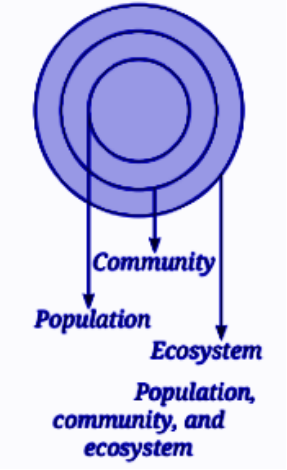
(i) A community is larger than a population.
(ii) A community is smaller than an ecosystem.
(iii) An ecosystem is part of a community.
Answer:
(iii) An ecosystem is part of a community.
Question 2. A population is part of a community. If all decomposers suddenly disappeared from a forest ecosystem, what changes do you think would occur? Explain why decomposers are essential.
Answer:
Changes: Without decomposers, dead plants and animals would pile up, nutrients would no longer be restored to the soil, and plant growth would suffer. This decline in plants would reduce food for herbivores and, in turn, carnivores.
Why They’re Essential: Decomposers such as bacteria and fungi break down dead matter and return important nutrients like nitrogen and carbon to the soil. Without this recycling process, the nutrient cycle would collapse, disrupting the entire food web.
Question 3. Selvam from Cuddalore district, Tamil Nadu, shared that his milage was less affected by the 2004 Tsunami compared to nearby milages due to the presence of mangrove forests. This surprised Sarita, Shabnam, and Shijo. They wondered if mangroves were protecting the village.
Can you help them understand this?
Answer:
Yes, the mangroves helped protect the village. Mangrove forests serve as natural shields, reducing the force of strong winds and waves during storms or tsunamis. Their roots hold the soil together, preventing erosion, and they absorb much of the water’s impact, safeguarding coastal regions. The mangroves of the Sundarbans, a World Heritage Site, are a well-known example of this protective function.
Question 4. Look at this food chain:
Grass → Grasshopper → Frog → Snake
If frogs disappear from this ecosystem, what will happen to the population of grasshoppers and snakes? Why?
Answer:
Grasshoppers: Their numbers would probably rise because frogs—one of their main predators—are no longer present to control their population.
Snakes: Their population would drop since frogs are a key part of their diet, leaving them with less food.
Reason: Removing an organism from the middle of the food chain disrupts the entire system. With fewer predators, prey like grasshoppers increase, while predators such as snakes decline due to lack of food.
Question 5. In a school garden, students noticed fewer butterflies the previous season. What could be the possible reasons? What steps can students take to have more butterflies on campus?
Answer:
Possible reasons: The decline could be due to pesticides harming caterpillars, fewer nectar-producing plants, or an increase in predators like birds. Pollution or monoculture farming may also degrade their habitat.
Steps we can take: Grow a variety of nectar-rich flowers such as marigolds, avoid using pesticides, provide sheltered spots, and set up butterfly feeders or shallow water sources to help attract and support butterflies.
Question 6. Why is it not possible to have an ecosystem with only producers and no consumers or decomposers?
Answer:
An ecosystem requires consumers to keep producer populations in check—for example, herbivores feeding on plants—and decomposers to break down dead material and return nutrients to the soil. Without consumers, plants would grow uncontrollably and eventually die from overcrowding; without decomposers, nutrients would stop cycling, causing the entire ecosystem to fail.
Question 7. Observe two different places near your home or school (e.g., a park and a roadside). List the living and non¬living components you see. How are the two ecosystems different?
Answer:
Around our homes and schools, we often notice:
Park:
Living things: trees, birds, squirrels, grass
Non-living things: soil, water, benches, sunlight
Roadside:
Living things: weeds, insects
Non-living things: asphalt, dust, vehicle emissions
Differences:
A park is a planned environment with a variety of plants and animals supported by soil and water. In contrast, a roadside is a disturbed, human-modified area with fewer species and higher levels of pollution.
Question 8. ‘Human-made ecosystems like agricultural fields are necessary, but they must be made sustainable.’ Comment on the statement.
Answer: Agreed. While agricultural fields supply food, many rely on unsustainable practices such as synthetic fertilizers and monoculture, which damage soil quality and reduce biodiversity. Sustainable approaches like organic farming and crop rotation help maintain long-term productivity and protect the environment.
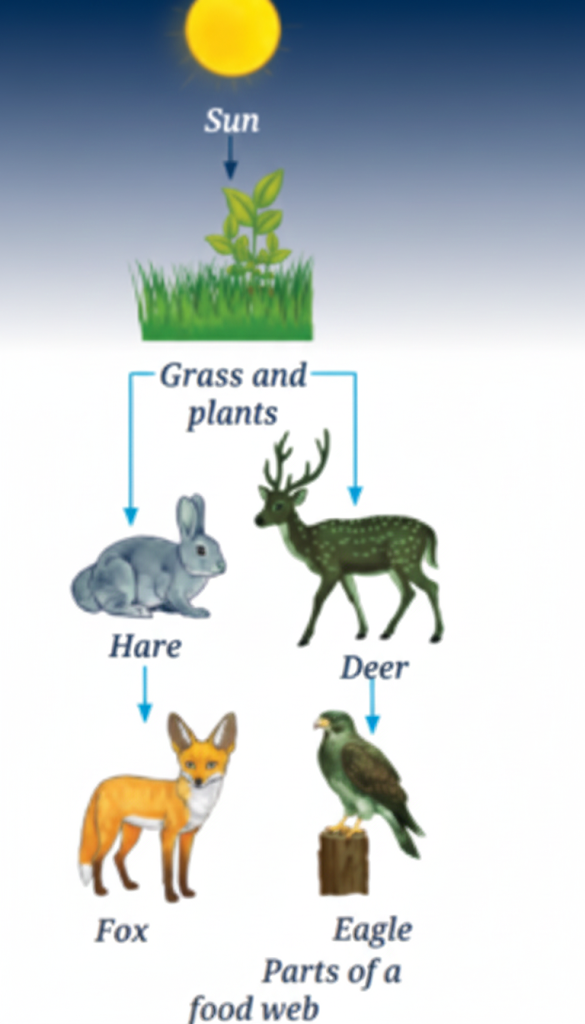
Question 9. If the Indian hare population (Fig.) drops because of a disease, how would it affect the number of other organisms?
Answer:
Predators: Fox and eagle populations would shrink because their main food source—hares—would be reduced, leaving them with less to eat.
Plants: With fewer hares feeding on them, grasses and other plants may grow more at first, but excessive growth could eventually change the structure of the habitat.
Deer: Since deer are not part of this predator–prey link, their role in this food chain remains largely unaffected.
Reason: When an important herbivore like the hare declines, it disrupts the balance of the food web, impacting both the predators that depend on it and the plants it normally consumes.
Activity 12.1: Let us Explore (Page 191)
Caution: Explore the habitat in groups with your teacher.
Identify two habitats in your surroundings.
These could be any two of the following: a pond, a forest, an agricultural farm, or even a large tree like a banyan, mango, or pilkhan (white fig) tree.
List the living beings and non-living things that you observe in these habitats.
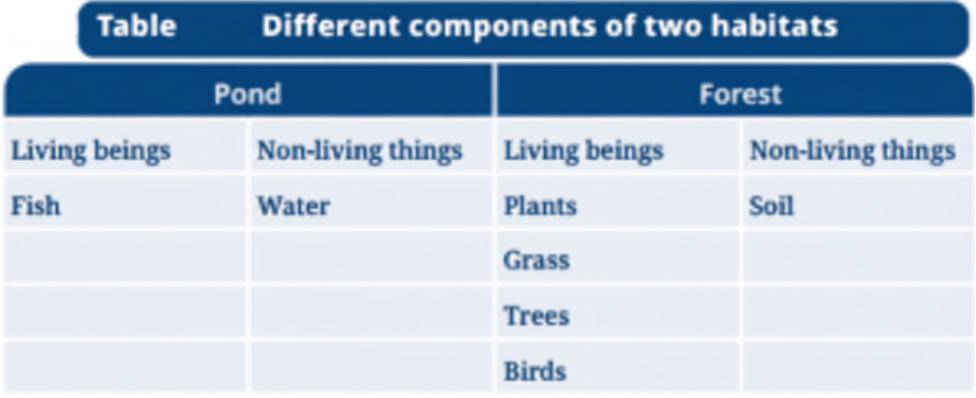
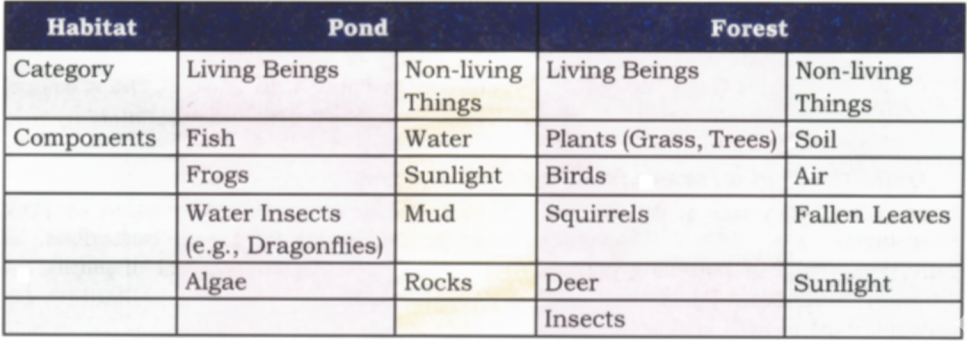
Record your observations in the Table.
Answer:
In the pond habitat, the main features observed were water and fish.
In the forest habitat, important components included various plants (like grasses and trees), birds, and soil.
These observations were organized in a table to compare the different elements found in the two habitats.
Activity 12.2: Let us Record (Page 193)
We can understand the population of a particular type of plant by counting them at a given place and time.
Divide students into four to five groups.
Each group may identify any two organisms, plant(s) or animal(s).
Mark an area of 1 m × 1 m in your school garden.
Identify four organisms in this area, and count their numbers.
Record the number of organisms in the Table.
Compile the data from all groups.
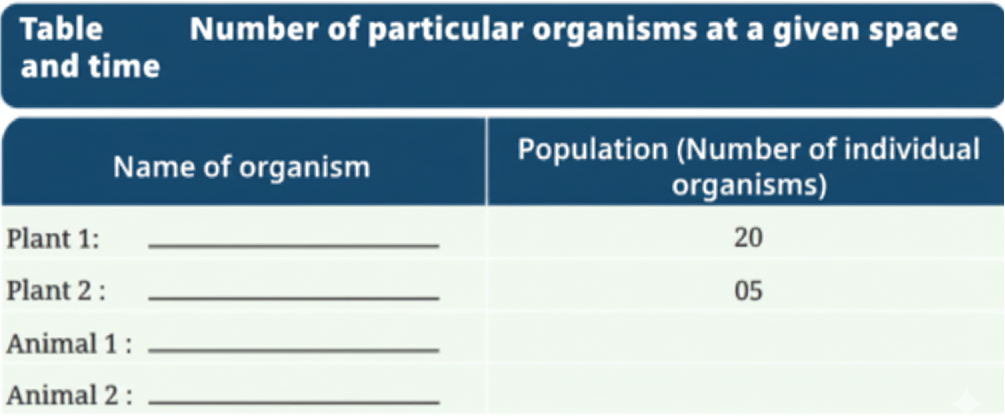
Answer: Number of particular organisms at a given space and time
Activity 12.3: Let us Read (Page 194)
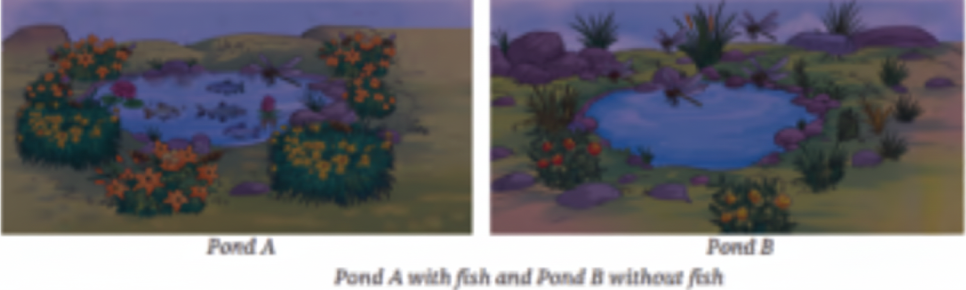
Researchers conducted a study to see how fish in ponds affect seed production in the plants nearby. They observed two ponds with fish and a large number of flowering plants around them; B without fish and fewer flowering plants around it (Fig.). Think of a reason for these observations.
Question 1. Compare the number of dragonflies, bees, and butterflies in both ponds.
Answer:
Pond A (with fish) has fewer dragonflies but more bees and butterflies.
Pond B (without fish) shows the opposite pattern—more dragonflies and fewer bees and butterflies.
Reason:
Fish in Pond A feed on dragonfly larvae, which lowers the number of adult dragonflies. With fewer dragonflies to prey on bees and butterflies, the populations of these pollinators increase.
In Pond B, where no fish are present, dragonfly larvae survive in larger numbers, resulting in more adult dragonflies. These dragonflies then prey on bees and butterflies, reducing their populations.
Question 2. Think of a reason for these observations.
Answer: In Pond A, fish keep the dragonfly population in check by feeding on their larvae. With fewer dragonflies, bees and butterflies face less predation and can pollinate more flowers, resulting in greater plant growth and seed production.
In Pond B, the absence of fish allows dragonflies to multiply, leading to fewer pollinating insects. With reduced pollination, plant growth and seed formation decline.
Question 3. What does this study show? How does the population of fish in a pond affect seed production in nearby plants?
Answer:
What it shows:
The study highlights an indirect chain of effects within the food web. By eating dragonfly larvae, fish reduce the dragonfly population. With fewer dragonflies, bees and butterflies experience less predation and can pollinate plants more effectively, resulting in increased seed production.
Effect of fish population:
When fish numbers are high, dragonfly populations drop, which leads to more pollinators and therefore greater pollination and seed output in nearby plants. In contrast, when no fish are present—as in Pond B—dragonflies become more abundant, pollinator numbers decline, and plant seed production decreases.
Activity 12.5: Let us Classify (Pages 197-198)
Observe Fig. (b), which illustrates a forest ecosystem.
Study the picture carefully and spot the organisms listed in the Table.
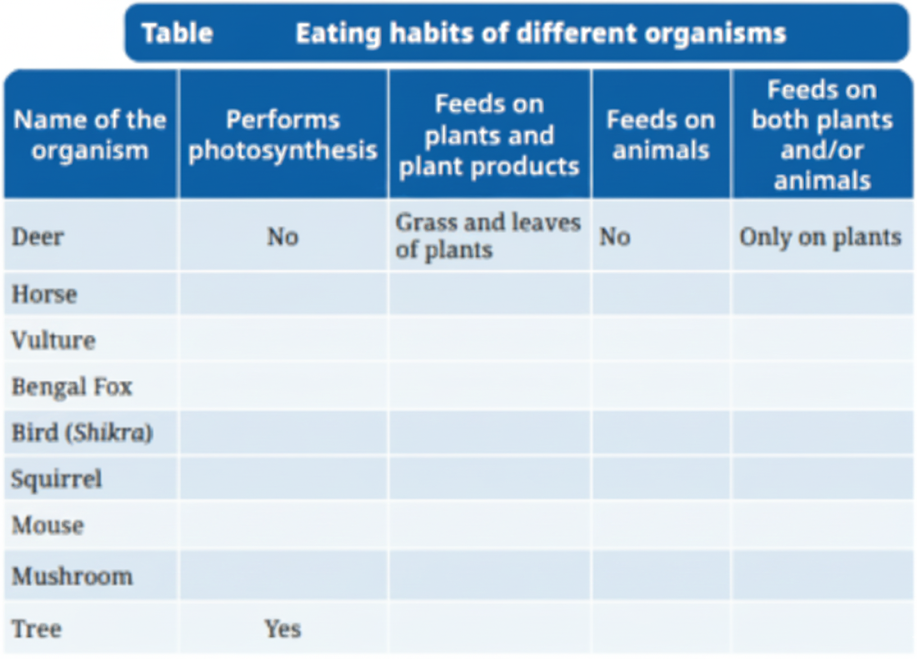
Using the internet or your school library, find out what these organisms eat.
Record your observations in the Table by identifying whether each organism feeds only on plants and plant products, only on animals, or on both.
Answer:
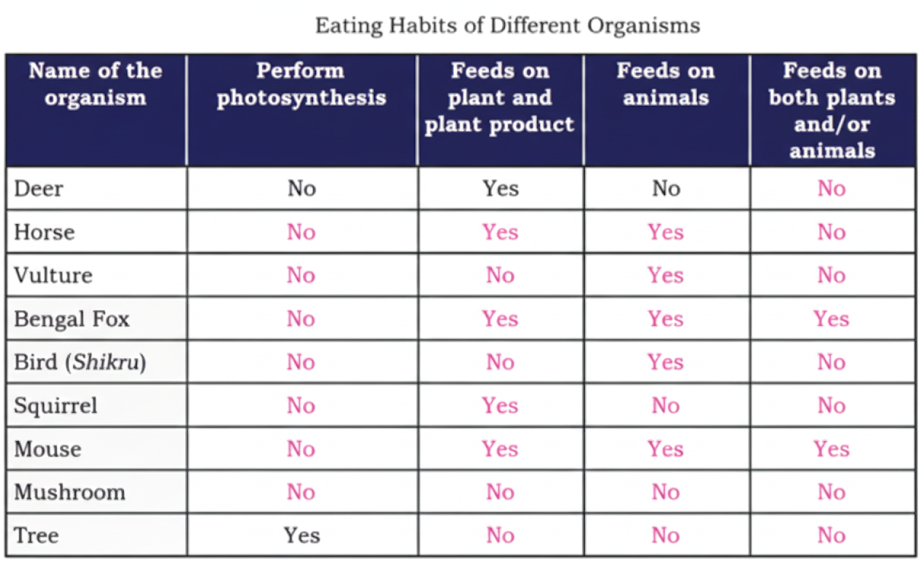
Deer: Feeds on grass and leaves — herbivore.
Horse: Eats grass and hay — herbivore.
Vulture: Consumes dead animals — carnivore.
Bengal Fox: Eats fruits as well as small animals — omnivore.
Shikra (bird): Hunts other birds and small animals — carnivore.
Squirrel: Eats seeds and nuts — herbivore (though some may occasionally eat insects).
Mouse: Eats seeds and insects — omnivore.
Mushroom: Breaks down dead organic matter — decomposer.
Tree: Makes its own food through photosynthesis — producer.
Activity 12.7: Let us Draw (Pages 199-200)
Figure (a) represents a crop field with millets, mice, and an eagle.
Count the number of each type of organism in Fig. (a).
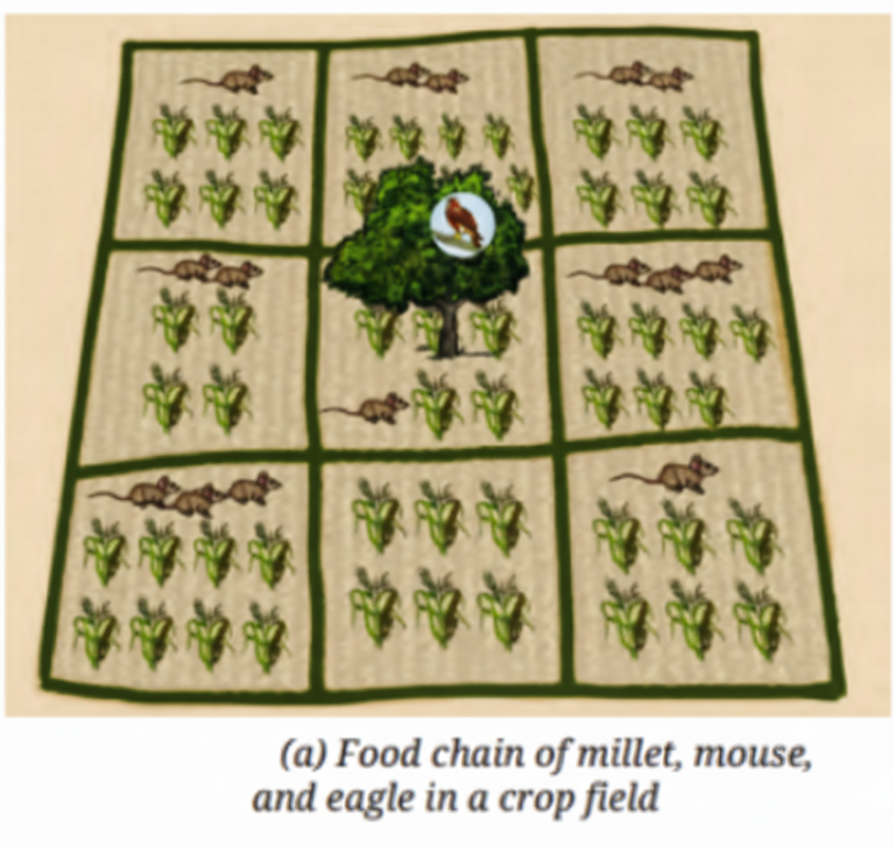
Make a table and set a number in the table against each of the organisms.
Arrange the numbers in ascending order, consider the highest number at the base, and the lowest at the top.
Place the mouse, millet, and eagle appropriately in Fig. (b).
What figure do you get? It looks like a pyramid. Complete the pyramid in Fig. (b).
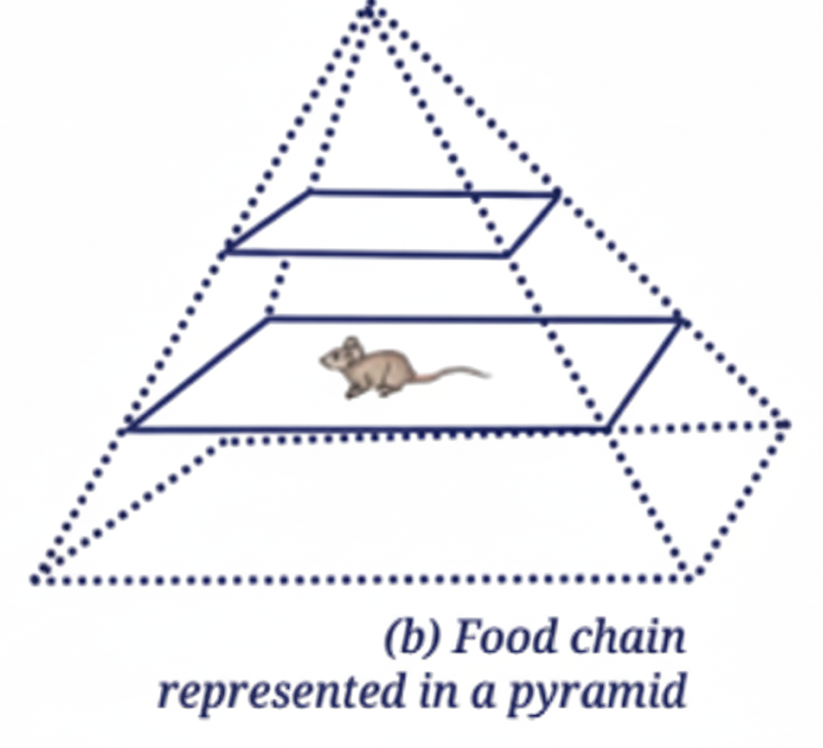
Each organism in a food chain has a specific position, called a trophic level (troph=food):
Producers (like green plants) are at the first trophic level.
Herbivores (like hares and deer) are at the second level.
Small carnivores (like frogs) are at the third level.
Large carnivores (like tigers or vultures) occupy the next level.
Answer:
Sample Observations (based on typical ecological pyramid patterns):
Millets: About 100 individuals, since producers are usually the most numerous.
Mice: Around 20 individuals, as herbivore populations are smaller than producer populations.
Eagles: Approximately 2 individuals, because top predators are always the fewest in number.
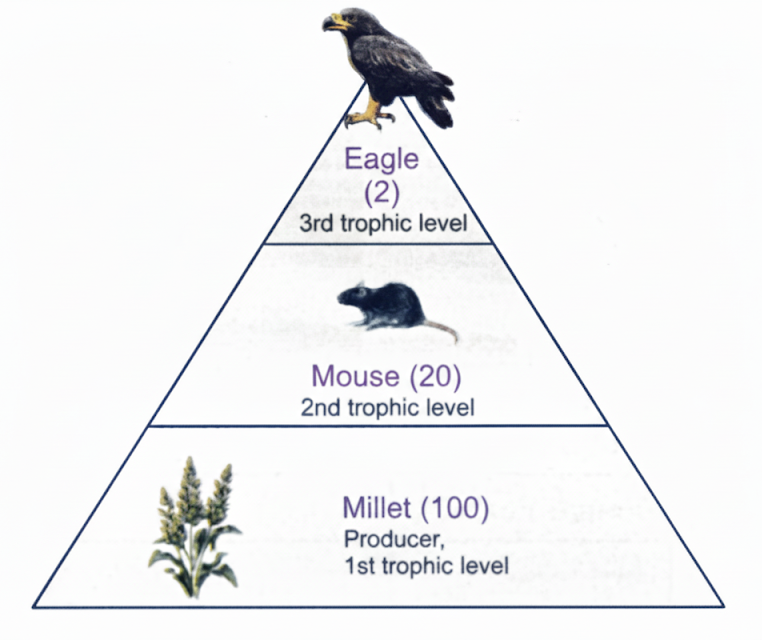
Recorded Data in Table
Mastering How Nature Works in Harmony – NCERT Class 8 Science Chapter 12 Solutions 2026-27
Understanding ecosystems, food chains, and interdependence is vital for scoring well in Class 8 Science. This chapter explains how living and non-living components connect, helping students build a solid foundation for higher studies and practical life.
From biotic and abiotic interactions to the importance of decomposers, every topic in this chapter is easily explained. Focusing on activities and examples helps you remember concepts, prepare strong notes, and boost retention for exams.
Practice NCERT exercises regularly and review key definitions and diagrams. This approach will help you answer application-based questions with confidence and improve your overall marks in Science tests and school assessments.
FAQs on NCERT Solutions For Class 8 Science Chapter 12 How Nature Works In Harmony - 2026-27
1. What are NCERT Solutions for Class 8 Science Chapter 12: How Nature Works in Harmony?
NCERT Solutions for Class 8 Science Chapter 12: How Nature Works in Harmony are stepwise answers to all textbook questions, designed as per the latest CBSE syllabus for 2026–27.
They help students:
- Understand key concepts about how nature maintains balance and harmony
- Revise using concise, exam-ready definitions and diagrams
- Prepare effectively for school exams and homework assignments
- Follow the CBSE marking scheme and answer structure for full marks
2. How should I write stepwise NCERT answers in Class 8 Science Chapter 12 to score full marks?
Writing stepwise answers is crucial for scoring maximum marks in CBSE exams.
Follow these tips:
- Start with a clear introduction using key terminology (e.g., ecosystem, symbiosis, food chain)
- Break your answer into logical steps or points, numbering each
- Include definitions and diagrams where relevant
- Conclude with a summary statement or importance
- Underline important keywords to align with the CBSE evaluation scheme
3. Which types of questions can be asked from Class 8 Science Chapter 12 in school exams?
Exam questions on Chapter 12: How Nature Works in Harmony can include:
- Short answer and long answer questions about food chains, food webs, symbiosis, natural balance
- Definition-based and diagram labelling questions (e.g., ecosystem diagram, food chain)
- Applications of conservation and environmental harmony
- MCQs and true/false based on textbook concepts
4. Do I need to draw diagrams or give definitions in Chapter 12 Science answers?
Including neat diagrams and accurate definitions can help score extra marks.
For full marks:
- Draw labeled diagrams (like food chains or food webs) wherever asked
- Write textbook definitions of key terms: ecosystem, habitat, symbiosis, etc.
- Follow CBSE diagram conventions and use rulers for neatness
5. Where can I download the free NCERT Solutions PDF for Class 8 Science Chapter 12?
You can download the free PDF of NCERT Solutions for Chapter 12: How Nature Works in Harmony from reputable educational websites that follow the CBSE syllabus.
Key steps:
- Visit a trusted educational platform with NCERT resources
- Locate the chapter by name/number for Class 8 Science
- Click on the download PDF option for offline study
6. How do I structure long answers for better marks in Science Chapter 12?
For long-answer questions, follow a structured approach:
- Begin with a definition or introduction of the main concept
- Break the answer into clear points with headings/subpoints
- Support your answer with diagrams, examples, and key terms
- Conclude by summarising the importance or impact of the topic
- Write neatly and underline important keywords for clarity
7. What are the most important topics from Class 8 Science Chapter 12: How Nature Works in Harmony?
The most important topics for exams in Chapter 12 include:
- Food chains and food webs
- Symbiotic relationships (mutualism, parasitism, commensalism)
- Balance in nature and the role of decomposers
- Conservation of environment and natural resources
- Definitions and diagram-based questions from the textbook
8. Are NCERT Solutions enough for Class 8 Science exams?
In most school exams, NCERT Solutions are sufficient if studied thoroughly.
Best exam results are achieved when students:
- Read the Chapter 12 textbook explanations and intext activities
- Practice all NCERT Solutions, diagrams and definitions
- Revise exemplar problems and CBSE sample questions if aiming for higher scores
9. How can I quickly revise Class 8 Science Chapter 12 before the exam?
Quick revision of Chapter 12: How Nature Works in Harmony is possible by:
- Reviewing summary notes and key definitions
- Practicing labelled diagrams (ecosystem, food web)
- Solving important questions from NCERT Solutions and exemplar exercises
- Memorizing keywords and important points using flash notes
10. Do examiners award partial marks for correct steps even if the final answer is wrong?
Yes, in CBSE marking, step marks are given for correct reasoning and steps.
To maximise marks:
- Write solutions in proper steps using required keywords
- Show working in calculations or diagrams in sequence
- Even if the final answer is incorrect, correct intermediate steps usually get partial credit
