



Stepwise Answers & Key Diagrams for Particulate Nature of Matter
Question 1.
Is every speck of this fine chalk powder still composed of the same substance, or has it changed into something else on breaking or grinding? (Page 99)
Answer:
Yes, even after the chalk is broken or ground into powder, each tiny particle is still the same substance as before. This is a physical change because only the size and shape of the chalk change—no chemical change takes place.
Question 2.
Are the units of chalk obtained in this manner considered the smallest units of chalk? (Page 100)
Answer:
No, the pieces of chalk formed after grinding are not the smallest units. Each piece is still made up of even smaller constituent particles, which are the true basic units of chalk.
Question 3.
Do gases also have a fixed volume? (Page 105)
Answer:
No, gases do not have a definite shape or a fixed volume. Their volume can change depending on how close the particles are to one another, which is influenced by the strength of the intermolecular attraction between them.
Question 4.
Sugar and sand are both solids. Why does sugar dissolve in water, but sand does not? (Page 108)
Answer:
Sugar is a solid, but when it dissolves in water, its particles spread out and fit into the spaces between water molecules. Water breaks the sugar particles down, so the total volume of the mixture does not increase much. In contrast, sand has a hard, rigid structure that water cannot break apart. As a result, sand settles at the bottom and adds to the overall volume of the mixture.
Keep the Curiosity Alive (Pages 113-114)
Question 1.
Choose the correct option.
The primary difference between solids and liquids is that the constituent particles are:
(i) closely packed in solids, while they are stationary in liquids.
(ii) far apart in solids and have fixed positions in liquids.
(iii) always moving in solids and have a fixed position in liquids.
(iv) closely packed in solids and move past each other in liquids.
Answer:
(iv) Closely packed in solids and move past each other in liquids.
Question 2.
Which of the following statements are true? Correct the false statements.
(i) Melting ice into water is an example of the transformation of a solid into a liquid.
(ii) The melting process involves a decrease in interparticle attractions during the transformation.
(iii) Solids have a fixed shape and a fixed volume.
(iv) The interparticle interactions in solids are very strong, and the interparticle spaces are very small.
(v) When we heat camphor in one corner of a room, the fragrance reaches all corners of the room.
(vi) On heating, we are adding energy to the camphor, and the energy is released as a smell.
Answer:
(i) True: Melting ice into water is an example of the transformation of a solid into a liquid.
(ii) True: The Melting process involves a decrease in interparticle attraction during the transformation.
(iii) True: Solids have a fixed shape and a fixed volume.
(iv) True: The interparticle interactions in solids are very strong, and the interparticle spaces are very small.
(v) True: When we heat camphor in one corner of a room, the fragrance reaches all corners of the room.
(vi) False: The correct statement is: On heating, energy is added to camphor, causing it to undergo sublimation. The camphor directly converts into gas, and the vapour carries its characteristic smell.
Question 3.
Choose the correct answer with justification. If we could remove all the constituent particles from a chair, what would happen?
(i) Nothing will change.
(ii) The chair will weigh less due to lost particles.
(iii) Nothing of the chair will remain.
Answer:
Correct option is (iii) Nothing of the chair will remain.
Justification:
A chair is built from tiny constituent particles such as atoms and molecules. If all these particles were removed, nothing would remain to give the chair its shape, structure, weight, or even its existence.
Question 4.
Why do gases mix easily, while solids do not?
Answer:
Gas particles are widely spaced, which allows them to move rapidly in all directions. Because the intermolecular forces in gases are very weak, the particles do not stick together. This is why gas particles spread out easily and mix with other particles.
Question 5.
When spilled on the table, milk in a glass tumbler flows and spreads out, but the glass tumbler stays in the same shape. Justify this statement.
Answer:
In this situation, milk spreads across the table because it is a liquid. Liquids flow and take the shape of the surface they are on since their molecules can move freely. That’s why the milk flows outward on the table. In contrast, the glass tumbler keeps its shape because it is a solid, and solids have tightly packed molecules that do not move around.
Question 6.
Represent diagrammatically the changes in the arrangement of particles as ice melts and transforms into water vapour.
Answer:
As ice melts and later turns into steam, the arrangement of water particles changes greatly. In ice, the particles are tightly packed in a fixed, crystal-like pattern and can only vibrate in place. When ice melts, the particles gain energy, break out of their fixed positions, and begin sliding past one another, forming liquid water. With further heating, the particles gain even more kinetic energy, move much faster, and spread apart until they escape into the air as water vapour—a gas in which the particles move freely and randomly.
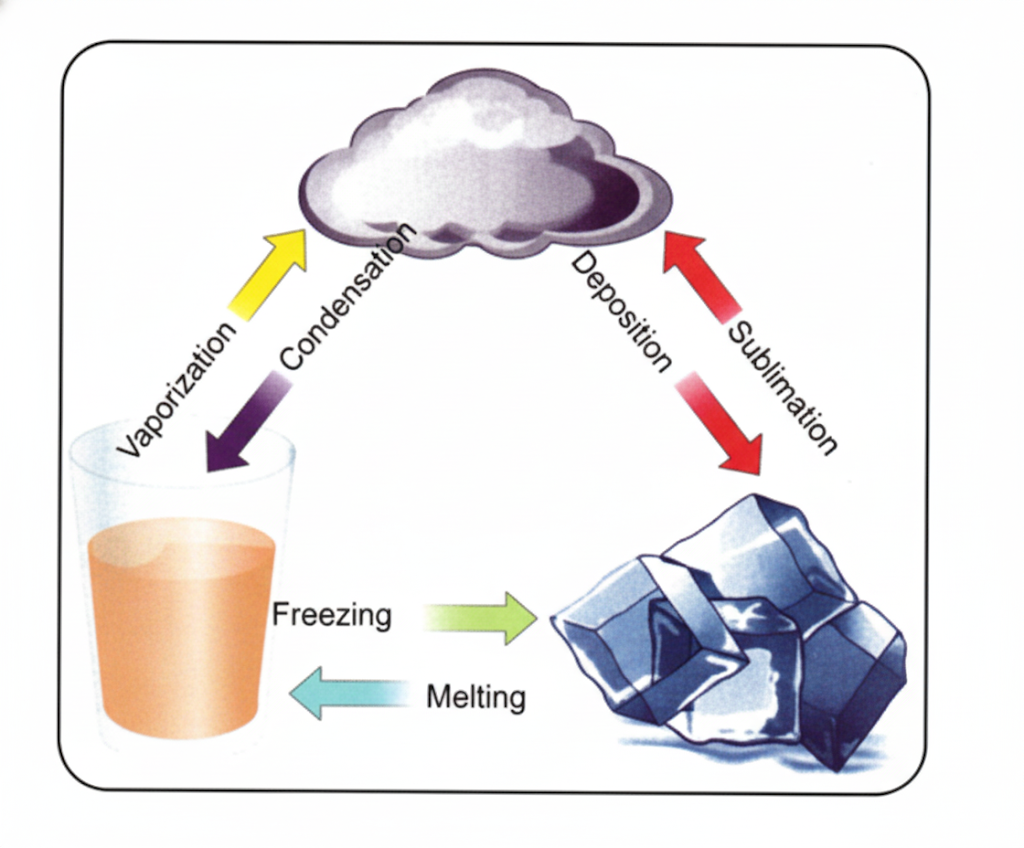
Ice (Solid)
Arrangement: Water molecules are packed tightly in a fixed, orderly crystal pattern.
Movement: Molecules only vibrate in place.
Liquid Water
Arrangement: Molecules remain close together but are not arranged in a fixed pattern. They have enough freedom to move around.
Movement: Molecules slide past one another and flow.
Water Vapour (Gas)
Arrangement: Molecules are widely spaced and have no definite arrangement.
Movement: Molecules move rapidly and randomly in all directions, frequently colliding with one another and with the container walls.
Question 7.
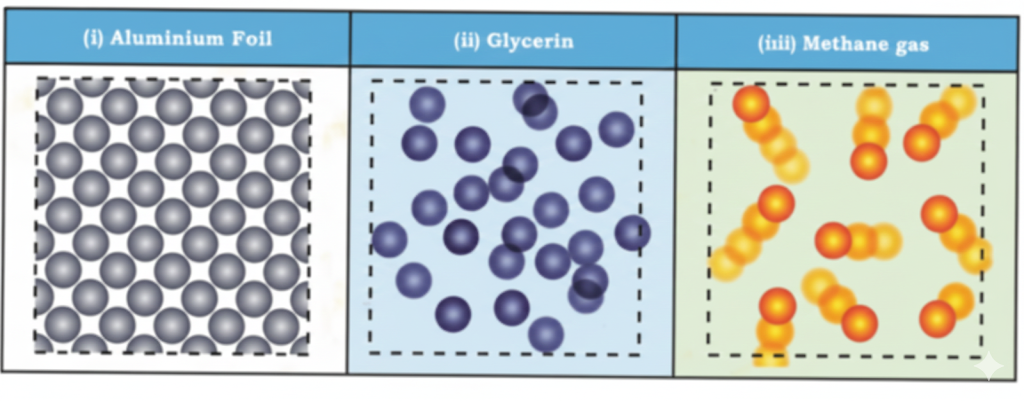
Draw a picture representing particles present in the following:
(i) Aluminium foil
(ii) Glycerin
(iii) Methane gas
Answer:
Question 8.
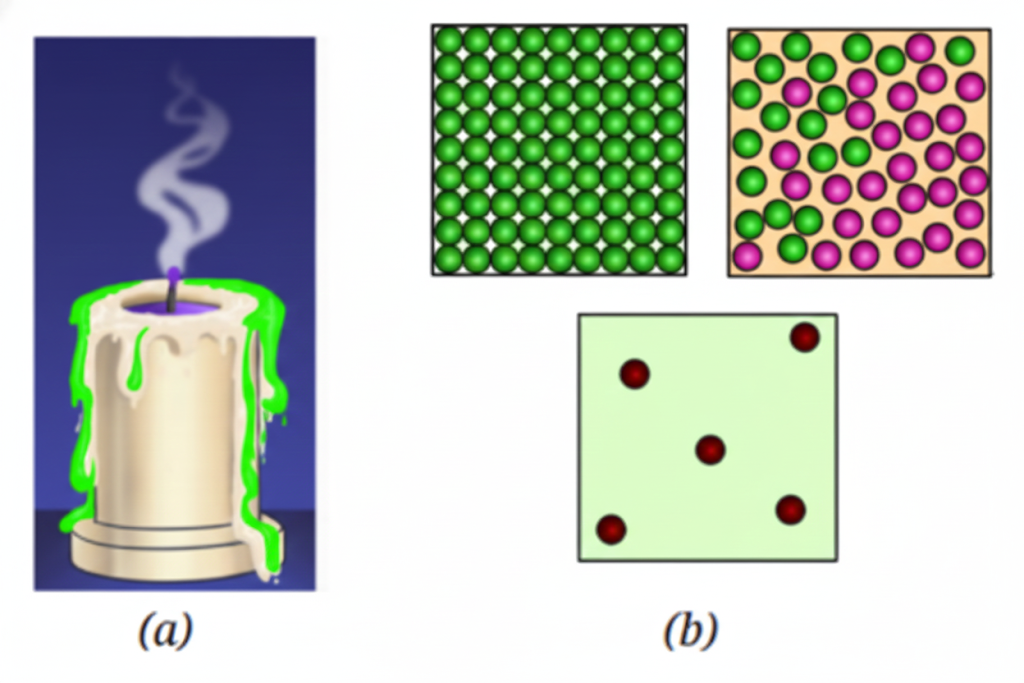
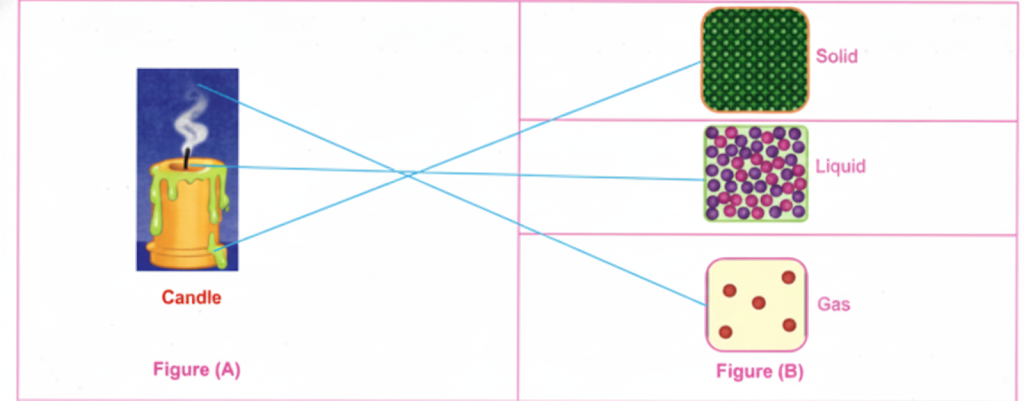
Observe figure (A), which shows the image of a candle that was just extinguished after burning for some time. Identify the different states of wax in the figure and match them with figure B, showing the arrangement of particles.
Answer:
Question 9.
Why does the water in the ocean taste salty, even though the salt is not visible? Explain.
Answer:
Ocean water tastes salty because it has a large amount of dissolved salts, mainly sodium chloride (table salt). These salts cannot be seen because they are broken down into tiny molecules and spread evenly throughout the water, making it look clear.
Question 10.
Grains of rice and rice flour take the shape of the container when placed in different jars. Are they solids or liquids? Explain.
Answer:
Rice grains and rice flour are still classified as solids, even though they seem to take the shape of their container. Each grain or particle keeps its own shape and volume. They appear to “flow” only because the small, irregular particles can slide past one another easily.
Activity 7.9: Let us find out (Page 110)
1. Light an incense stick in one corner of the room.
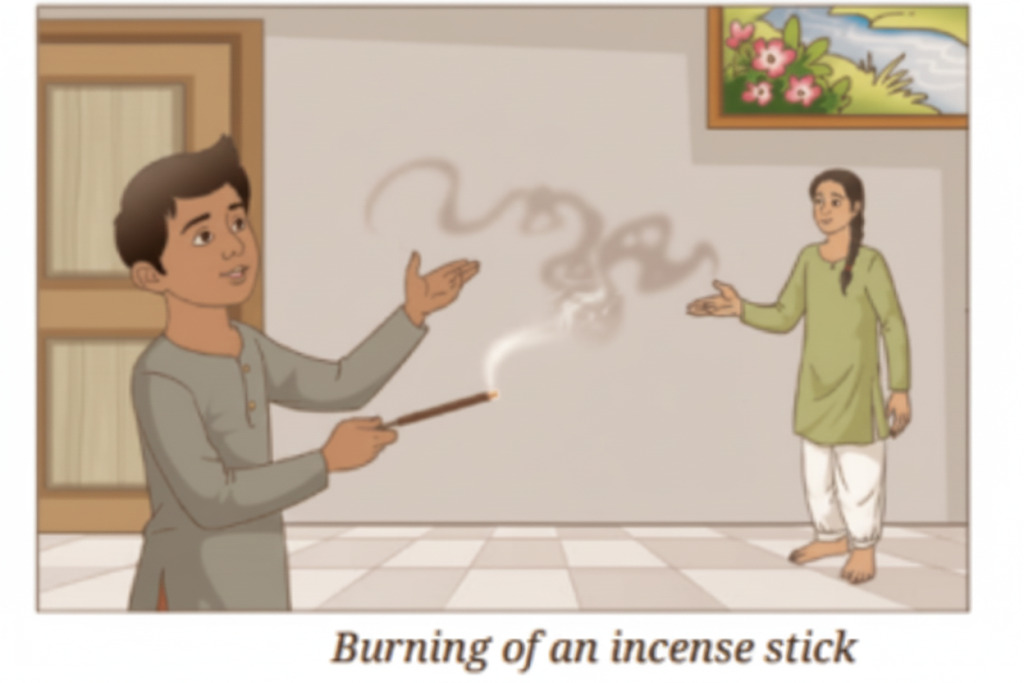
2. Wait for a few minutes and observe.
3. Do you notice the fragrance from a distance?
Answer:
Observations:
The fragrance of an incense stick can be sensed from a distance.
Gradually, the smell spreads throughout the entire room.
Conclusions:
The scent spreads because air particles move randomly in all directions.
Since the forces between particles are weak, they can move freely, allowing the fragrance to disperse across the room.
Particulate Nature of Matter – Key Concepts & Exam Tips (Class 8, 2026-27)
Understanding the particulate nature of matter is essential for mastering Class 8 Science. These concepts explain how solids, liquids, and gases differ in particle arrangement, movement, and behavior, making them crucial for strong exam preparation.
Learning about interparticle spaces and forces helps you answer application-based questions easily. Regular revision and drawing diagrams will boost your confidence and help you retain information effectively for the 2026-27 exam season.
Practice exercise-based NCERT questions and focus on keywords such as melting point, boiling point, and particles' movement. These strategies can help you score higher and understand the core ideas of Class 8 Science Chapter 7.
FAQs on NCERT Solutions for Class 8 Science Chapter 7 Particulate Nature of Matter - 2026-27 Free PDF Download (Sign-In Required)
1. What is the particulate nature of matter according to Class 8 Science Chapter 7?
The particulate nature of matter explains that all matter is made up of tiny particles which are in constant motion. Key points include:
- Matter consists of particles too small to be seen with the naked eye.
- These particles can be atoms or molecules.
- Arrangement and movement of these particles determines the state (solid, liquid, gas).
- This concept forms the foundation for understanding NCERT Solutions for Class 8 Science Chapter 7.
2. How do NCERT Solutions for Class 8 Science Chapter 7 help in exam preparation?
NCERT Solutions provide stepwise answers, cover key definitions, diagrams, and exercise questions, making exam preparation systematic. Main benefits include:
- Structured, exam-oriented answers matching CBSE marking schemes.
- Covers intext, back exercise, and exemplar questions.
- Helps in practicing diagrams and definitions for full marks.
- Available in free PDF form for offline revision.
3. Are diagrams and definitions mandatory in answers for Class 8 Science Chapter 7?
Including diagrams and definitions is highly recommended for Class 8 Science Chapter 7. They help:
- Clarify concepts visually (e.g., arrangement of particles in solids, liquids, gases).
- Score easy marks in CBSE exams.
- Follow exam presentation tips as per the NCERT Solutions for Particulate Nature of Matter.
4. What are the key definitions students must remember in Chapter 7: Particulate Nature of Matter?
Some important definitions for Class 8 Science Chapter 7 are:
- Atom: The smallest unit of matter.
- Molecule: A group of two or more atoms bonded together.
- Diffusion: The process by which particles intermingle due to their motion.
- Solid, Liquid, Gas: States of matter distinguished by particle arrangement and movement.
5. Where can I download the NCERT Solutions PDF for Class 8 Science Chapter 7?
You can download the free PDF of NCERT Solutions for Class 8 Science Chapter 7: Particulate Nature of Matter on educational platforms or official study portals. Benefits include:
- Offline study at any time.
- Easier revision of structured answers and diagrams.
- Access to stepwise, syllabus-aligned solutions.
6. How should I structure long answers in Class 8 Science Chapter 7 for better marks?
To score well, structure long answers as follows:
- Start with a definition or introduction.
- List key points in sequence or steps.
- Include labelled diagrams if possible.
- Conclude with a summary or final statement.
- Use keywords like 'particulate nature', 'atoms', 'states of matter', and underline them in your answer sheet.
7. What are some common mistakes to avoid in writing answers for this chapter?
To maximize your score in Class 8 Science Chapter 7, avoid these mistakes:
- Missing key definitions, diagrams, or steps.
- Incorrectly labelling diagrams or omitting labels.
- Writing overly brief or incomplete answers.
- Skipping essential keywords or not underlining them in exams.
- Not following the NCERT stepwise solution approach.
8. What topics or questions are most likely to come from Chapter 7: Particulate Nature of Matter in exams?
Frequently asked exam topics from Class 8 Science Chapter 7 include:
- States of matter and their characteristics.
- Definitions (atom, element, molecule, diffusion).
- Differences between solids, liquids, and gases.
- Diagrams showing arrangement of particles in different states.
- Intext and back exercise questions from the NCERT textbook.
9. Are NCERT Solutions enough for Class 8 Science exams?
NCERT Solutions for Class 8 Science Chapter 7 are sufficient for most CBSE school exams as they:
- Cover all textbook exercises and intext questions.
- Follow the latest CBSE marking scheme.
- Help in understanding concepts, definitions, and the format required for full marks.
- For higher-order practice, refer to NCERT Exemplar Solutions and extra questions.
10. How can I quickly revise the main concepts of Chapter 7 before an exam?
To revise quickly for Class 8 Science Chapter 7:
- Read through flash notes listing definitions and key points.
- Practice labelling diagrams of particles in different states.
- Attempt NCERT back exercise and intext questions.
- Use a 1-day or 3-day revision planner as suggested in top study guides.
- Highlight important keywords for faster recall.
