



Stepwise NCERT Answers, Diagrams & Key Tips for CBSE Class 8 Science Chapter 9
The Amazing World of Solutes, Solvents, and Solutions Question Answer (InText)
Question 1. We know air is a mixture. Would a mixture of gases also be considered a solution? (Page 135)
Answer: Yes, if it is a uniform mixture.
Question 2. What will happen if we keep adding more salt to a given amount of water? (Page 136)
Answer: It will dissolve only up to its maximum solubility, and any excess will settle at the bottom.
Question 3. Do gases also dissolve in water? (Page 139)
Answer: Oxygen dissolves in water only to a limited extent.
Question 4. Why are measuring cylinders always designed narrow and tall instead of wider and shorter like a beaker? (Page 144)
Answer: Tall, narrow cylinders provide more accurate volume measurements.
Question 5. I wonder how the level of a coloured liquid is measured? (Page 145)
Answer: For coloured liquids, the reading on the measuring cylinder should be taken at the top of the meniscus.
Keep the Curiosity Alive (Pages 149-151)
Question 1. State whether the statements given below are True [T] or False [F]. Correct the false statements.
(i) Oxygen gas is more soluble in hot water than in cold water.
(ii) A mixture of sand and water is a solution.
(iii) The amount of space occupied by any object is called its mass.
(iv) An unsaturated solution has more solute dissolved than a saturated solution.
(v) The mixture of different gases in the atmosphere is also a solution.
Answer:
(i) False: Oxygen is more soluble in cold water.
(ii) False: A Mixture of sand and water is not a solution. Sand does not dissolve in water but settles down.
(iii) False: The amount of space occupied by any object is called its volume.
(iv) False: A saturated solution has more solute dissolved than an unsaturated solution.
(v) True.
Question 2. Fill in the blanks:
(i) The volume of a solid can be measured by the method of displacement, where the solid is ____________ in water and the ____________ in water level is measured.
(ii) The maximum amount of ____________ dissolved in ____________ at a particular temperature is called solubility at that temperature.
(iii) Generally, the density ____________ with increase in temperature.
(iv) The solution in which glucose has completely dissolved in water, and no more glucose can dissolve at a given temperature, is called a ____________ solution of glucose.
Answer:
(i) placed; rise
(ii) solute, solvent
(iii) decrease
(iv) saturated
Question 3. You pour oil into a glass containing some water. The oil floats on top. What does this tell you?
(i) Oil is denser than water.
(ii) Water is denser than oil.
(iii) Oil and water have the same density.
(iv) Oil dissolves in water.
Answer:
(ii) Water is denser than oil.
Question 4. A stone sculpture weighs 225 g and has a volume of 90 cm³. Calculate its density and predict whether it will float or sink in water.
Answer:
Density of stone = \$$frac {225}{90}$$ = 2.5 g/cm³
It will sink in water.
Question 5. Which one of the following is the most appropriate statement, and why are the other statements not appropriate?
(i) A saturated solution can still dissolve more solute at a given temperature.
(ii) An unsaturated solution has dissolved the maximum amount of solute possible at a given temperature.
(iii) No more solute can be dissolved into the saturated solution at that temperature.
(iv) A saturated solution forms only at high temperatures.
Answer:
Statement (iii) is most appropriate.
(i) It is not appropriate as a saturated solution cannot dissolve more solute at a given temperature.
(ii) An unsaturated solution can have more solute dissolved at a given temperature.
(iii) Correct.
(iv) A Saturated solution can be formed at all temperatures.
Question 6. You have a bottle with a volume of 2 litres. You pour 500 mL of water into it. How much more water can the bottle hold?
Answer: A 2-litre bottle can still hold 1500 mL of water in addition to the 500 mL already inside.
Question 7. An object has a mass of 400 g and a volume of 40 cm³. What is its density?
Answer:
Density = \$$frac {mass}{volume}$$
= \$$frac {400}{40}$$
= 10 g/cm³
Question 8. Analyse Figures (a) and (b). Why does the unpeeled orange float, while the peeled one sinks? Explain.
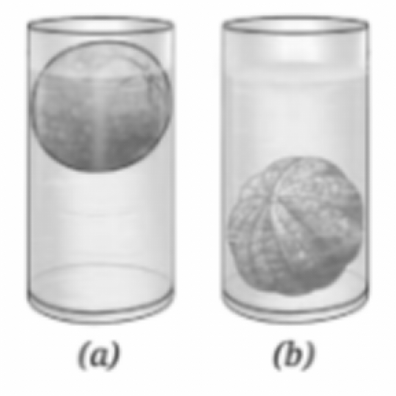
Answer: An unpeeled orange displaces enough water to support its weight, so it floats. A peeled orange displaces less water than its weight, causing it to sink.
Question 9. Object A has a mass of 200 g and a volume of 40 cm³. Object B has a mass of 240 g and a volume of 60 cm³. Which object is denser?
Answer:
Density of object A = \$$frac {200}{40}$$ = 5 g/cm³
Density of object B = \$$frac {240}{60}$$ = 4 g/cm³
Conclusion: Object A is denser, having more density than B.
Question 10. Reema has a piece of modeling clay that weighs 120 g. She first moulds it into a compact cube that has a volume of 60 cm³. Later, she flattens it into a thin sheet. Predict what will happen to its density.
Answer: When the clay is flattened, its density decreases because it displaces more liquid.
Question 11. A block of iron has a mass of 600 g and a density of 7.9 g/cm³. What is its volume?
Answer:
We know density = \$$frac {mass}{volume}$$
∴ Volume = \$$frac {mass}{density}$$
= \$$frac{600 \mathrm{~g}}{7.9 \mathrm{~g} / \mathrm{cm}^3}$$
= 75.94 cm³
Question 12. You are provided with an experimental setup as shown in Figures (a) and (b). On keeping the test tube (Figure b) in a beaker containing hot water (~ 70°C), the water level in the glass tube rises. How does it affect the density?
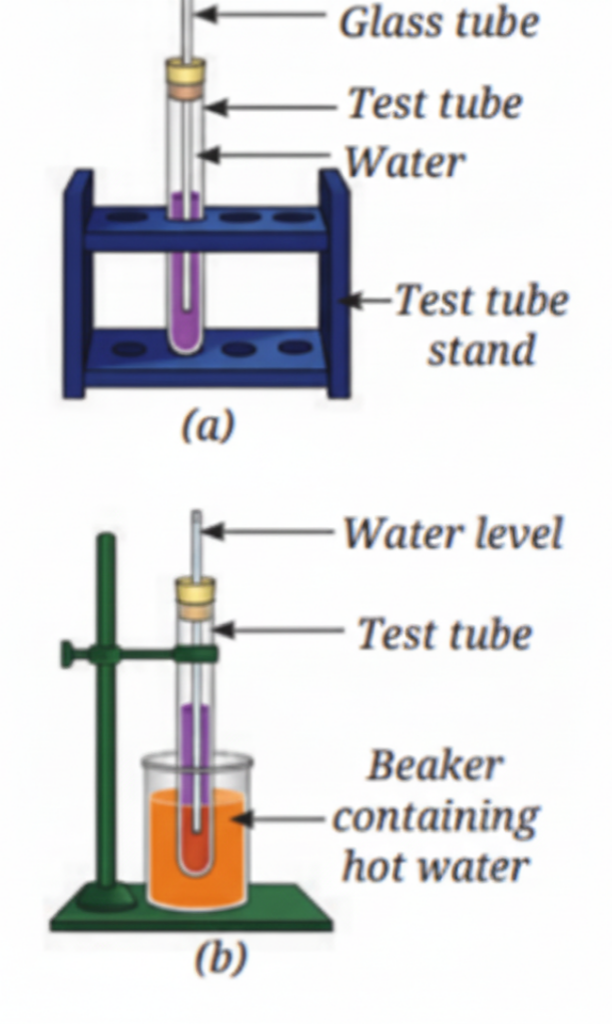
Answer: The density of the water in setup (b) will become lower.
Activity 9.1: Let us Investigate (Page 136)
Take a clean glass tumbler and fill it half with water.
Add one spoon of salt into it and stir well till it dissolves completely.
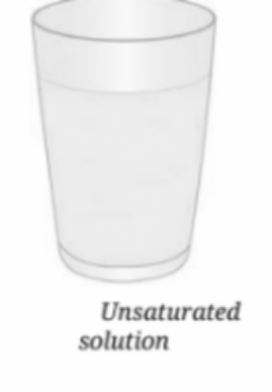
Gradually add a spoonful of salt into the glass tumbler and stir.
Observe how many spoons of salt you can add before it stops dissolving completely.
Record your observations in the Table.
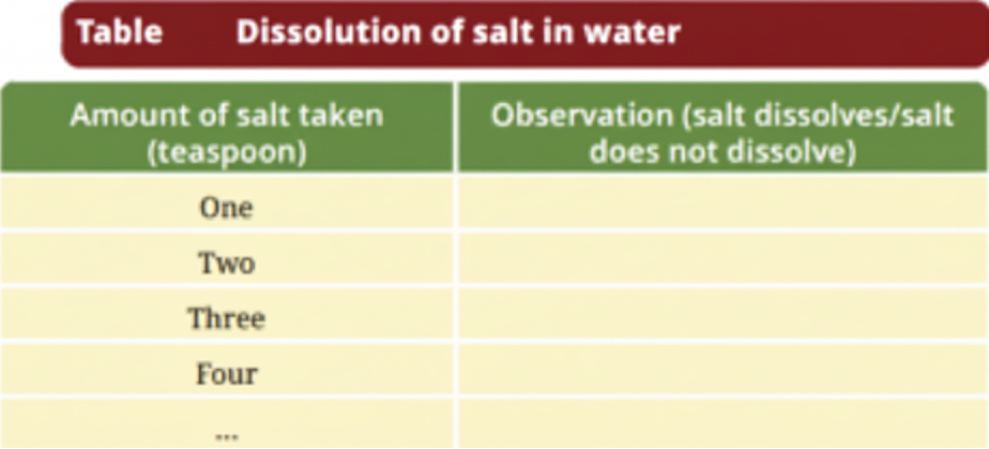
Answer:
Several spoonfuls of salt can dissolve before any remains undissolved.
Water has a strong ability to dissolve salts.
Activity 9.2: Let us Experiment (Demonstration Activity) (Page 137)
Take about 50 mL of water in a glass beaker and measure its temperature using a laboratory thermometer, say 20°C. Add a spoonful of baking soda (sodium hydrogen carbonate) to the water and stir until it dissolves. Continue adding small amounts of baking soda while stirring, till some solid baking soda is left undissolved at the bottom of the beaker. Now, heat the contents to 50°C while stirring (figure).
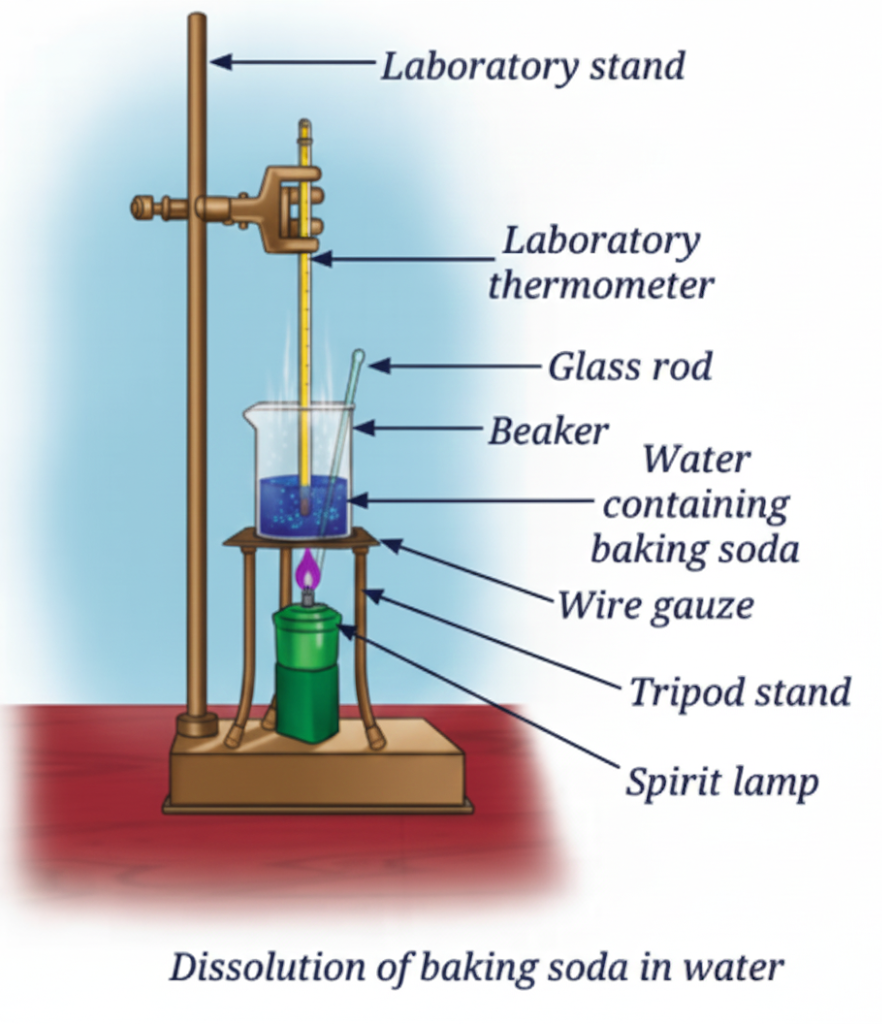
What happens to the undissolved baking soda?
You will observe that it has dissolved.
Continue adding more baking soda while stirring at this temperature until some solid baking soda remains undissolved.
Again, heat the contents further to 70°C while continuing to stir. What do you observe?
The undissolved baking soda dissolves.
What do you infer from this experiment?
Answer: Water at 70°C can dissolve more baking soda than water at 50°C. This shows that, for most substances, solubility increases as the temperature rises. It also indicates that a solution that is saturated at a lower temperature may become unsaturated when the temperature is increased.
Activity 9.3: Let us Measure (Page 142)
Switch ON the digital weighing balance.
Note the reading displayed on the balance, which gives the mass of the stone, say 16.400g.
Answer: The mass of an object is found by subtracting the weight of the empty watch glass from the weight of the watch glass with the object. For liquids, a measuring bottle is used instead of a watch glass.
Activity 9.4: Let us Observe and Calculate (Page 143)
a. What is the maximum volume it can measure?
Answer: The largest volume a measuring cylinder can hold is determined by the cylinder’s capacity.
b. How much is the volume difference indicated between the two bigger marks (for example, between 10 mL and 20 mL)?
Answer: The amount of liquid between two major markings—for example, from 10 mL to 20 mL—is equal to 10 mL.
c. How many smaller divisions are there between the two bigger marks?
Answer: There are ten minor divisions between each pair of major markings.
d. How much volume does one small division indicate?
Answer: Each minor division corresponds to 0.1 mL, and the smallest measurable volume on this cylinder is 1 mL.
Activity 9.5: Let us Measure 50 mL of Water (Page 144)
Place a clean, dry measuring cylinder on a flat surface.
Read the mark on the measuring cylinder that coincides with the bottom of the meniscus for water or other colourless liquids.
Answer: When taking a reading from a measuring cylinder, align your eye with the bottom of the meniscus for clear liquids, and with the top of the meniscus for coloured liquids.
Understanding Solutes, Solvents, and Solutions in Class 8 Science
Mastering the basics of solutes, solvents, and solutions is essential for scoring well in Class 8 Science Chapter 9. This chapter helps you identify how substances mix, why some dissolve and others don't, and why density matters for floating or sinking.
By exploring NCERT Class 8 Science Chapter 9 solutions, students can build conceptual clarity about mixtures, concentration, and measuring density. Focus on key topics like solubility, the effect of temperature, and how to calculate density for competitive exam preparation.
Regular practice of exercise-based questions boosts your confidence before exams. Revise important definitions, formulas, and real-life examples to enhance your understanding and improve your performance in school assessments.
FAQs on NCERT Solutions For Class 8 Science Chapter 9 The Amazing World Of Solutes Solvents And Solutions - 2026-27
1. What are the NCERT Solutions for Class 8 Science Chapter 9: The Amazing World of Solutes, Solvents, and Solutions?
NCERT Solutions for Class 8 Science Chapter 9 provide step-by-step answers to all textbook questions, aligning with the CBSE 2026–27 syllabus. These solutions help students:
- Understand concepts like solute, solvent, and solution clearly
- Write exam-ready answers with proper structure
- Practice intext and back exercises as per NCERT guidelines
- Prepare with diagrams, definitions, and important keywords for full marks
2. How do I score full marks using stepwise NCERT Solutions for Class 8 Science Chapter 9?
To score full marks in CBSE exams, follow these tips while using stepwise NCERT Solutions for Class 8 Science Chapter 9:
- Write each answer in logical steps as shown in solutions
- Highlight key terms and use scientific definitions
- Include neat diagrams and label them correctly
- Structure long answers properly with introduction, explanation, and examples
- Revise with practice questions and sample papers
3. Which topics are most important in Class 8 Science Chapter 9 The Amazing World of Solutes, Solvents, and Solutions?
The most important topics for CBSE Class 8 Science Chapter 9 are:
- Definition and examples of solute, solvent, and solution
- Types of solutions (saturated, unsaturated)
- Separation of components in solutions
- Differences between mixture and solution
- Application-based and diagram-based questions
4. Are diagrams mandatory in answers for Class 8 Science Chapter 9?
Including well-drawn, labelled diagrams is highly recommended for Science Chapter 9 answers:
- They clarify your concepts and fetch extra marks
- For questions on separation methods or types of solutions, diagrams are often essential
Always follow CBSE exam pattern and instructions in the textbook.
5. Where can I download the Class 8 Science Chapter 9 solutions PDF for free?
You can download the free PDF of NCERT Solutions for Class 8 Science Chapter 9 from trusted educational websites. Look for platforms offering:
- Exercise-wise answers and diagrams
- CBSE 2026–27 alignment
- Step-by-step solutions downloadable with a single click
6. How do I structure long answers in Science for better marks?
To score well in long answer questions in Class 8 Science Chapter 9:
- Begin with a clear definition or introduction
- Explain the concept in logical steps using examples
- Add relevant diagrams with labels
- Summarise with a conclusion or key point
- Underline or highlight keywords from the question
7. What is the difference between solute, solvent, and solution with examples?
A solute is the substance that dissolves, a solvent is the medium in which it dissolves, and a solution is the homogeneous mixture formed:
- Solute: Salt in saltwater
- Solvent: Water in saltwater
- Solution: Saltwater itself
These definitions are essential for CBSE exams.
8. Are NCERT Solutions enough for Class 8 Science exam preparation?
NCERT Solutions for Class 8 Science Chapter 9 cover all textbook exercises and key concepts as per the CBSE syllabus. For best results:
- Practice with revision notes and sample papers
- Use NCERT for conceptual clarity and exam-aligned answers
- Supplement with MCQs and previous year question practice
9. How can I avoid common mistakes in Science Chapter 9 answers?
Avoiding common mistakes in Class 8 Science Chapter 9 helps you score higher:
- Write definitions correctly and avoid mixing up solute, solvent, and solution
- Draw and label diagrams neatly
- Stick to stepwise answers and use CBSE marking scheme guidelines
- Don’t skip scientific terms or important examples
10. Do examiners award partial marks for correct steps even if the final answer is wrong?
Yes, as per the CBSE marking scheme, examiners often give partial marks for correct steps or diagrams, even if the final answer is incorrect. To maximise marks:
- Always show your working steps clearly
- Include diagrams where relevant
- Use scientific terms and structured answers
