


Class 9 Maths Chapter 5 Exercise 5.5 PDF Download: Practice with Confidence


Question 1.
Find the length of the chord of a circle where the radius is 7 cm, and the perpendicular distance is 6 cm.
Solution:
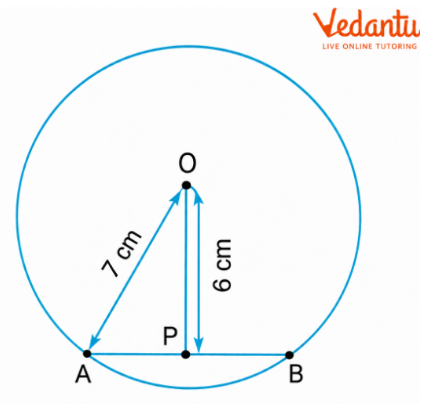
Given:
Radius OA = 7 cm
Perpendicular distance OP = 6 cm
Let AB be the chord, and P be its midpoint.
A perpendicular drawn from the centre of a circle to a chord bisects the chord. Therefore:
AP = PB
In right-angled ∆OPA, using the Baudhayana-Pythagoras theorem:
OA² = OP² + AP²
7² = 6² + AP²
49 = 36 + AP²
AP² = 13
AP = √13 cm
Since P is the midpoint of AB:
AB = 2AP
AB = 2√13 cm
AB ≈ 7.21 cm
Therefore, the chord length is 2√13 cm, or approximately 7.21 cm.
Question 2.
Explain why the following statement is true: If the perpendicular distance of a chord from the centre is d and the radius is r, then the chord length is 2√r² - d².
Solution:
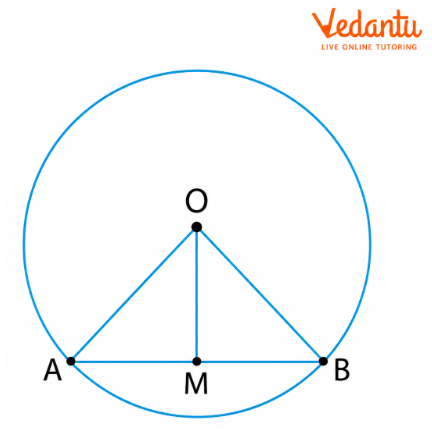
Let AB be a chord of a circle with centre O. Let OM be perpendicular to AB.
Given:
OA = r
OM = d
Since the perpendicular from the centre of a circle to a chord bisects the chord:
AM = MB
In right-angled ∆OMA, using the Pythagorean theorem:
OA² = OM² + AM²
r² = d² + AM²
AM² = r² - d²
AM = √(r² - d²)
Since M is the midpoint of AB:
AB = 2 AM
Therefore:
AB = 2√(r² - d²)
Hence, the length of a chord at a perpendicular distance d from the centre of a circle of radius r is 2√(r² - d²).
Question 3.
In a circle, if the distance of chord AB from the centre is twice the distance of another chord CD from the centre, can we conclude that CD = 2AB? Give reasons for your answer.
Solution:
No, we cannot conclude that CD = 2AB.
The length of a chord does not change in direct proportion to its distance from the centre. For a circle of radius r, the length of a chord at a perpendicular distance d from the centre is:
Chord length = 2√(r² - d²)
Let the distance of chord CD from the centre be x. Then the distance of chord AB from the centre is 2x.
Therefore:
AB = 2√(r² - 4x²)
and
CD = 2√(r² - x²)
The ratio of their lengths is:
CD/AB = √(r² - x²)/√(r² - 4x²)
This ratio depends on r and x and is not always equal to 2.
Therefore, CD is longer than AB because it is closer to the centre, but we cannot conclude that CD = 2AB.
What Makes Class 9 Maths Chapter 5 Exercise 5.5 Easier to Solve?
Connect radius and chord: See how the radius, perpendicular distance, and half-chord form a right-angled triangle.
Use the right-angle theorem: Apply the Baudhayana-Pythagoras theorem when a question involves the radius and distance of a chord from the centre.
Watch the relationship: A chord closer to the centre is longer, while a chord farther away is shorter.
Check the formula: For a chord at distance d from the centre of a circle with radius r, use the relationship explained in Exercise 5.5 rather than assuming the chord changes directly with d.
Download for quick access: Students searching for a Class 9 Maths Chapter 5 PDF or Class 9 maths chapter 5 solutions PDF can use Ganita Manjari's PDF download to access the relevant material conveniently.
For additional explanations, chapter resources, and other study material related to Ganita Manjari Class 9 Chapter 5 PDF solutions, you can visit Vedantu and explore the complete NCERT Solutions Class 9 Maths collection.
Access Exercise Wise NCERT Solutions for Chapter 5 Maths Class 9
CBSE Class 9 Maths Chapter 5 Other Study Materials
Chapter-Specific NCERT Solutions for Class 9 Maths
Additional Study Materials for Class 9 Maths
FAQs on NCERT Solutions for Class 9 Maths Chapter 5 Exercise 5.5 (2026-27)
1. What is the formula for finding the length of a chord in Exercise 5.5?
If the radius is r and the perpendicular distance from the centre to the chord is d, the chord length is 2√(r² − d²).
2. How do you find a chord when the radius is 7 cm, and the distance from the centre is 6 cm?
Using the right-angled triangle formed by the radius, perpendicular distance, and half-chord, the chord length is 2√13 cm, approximately 7.21 cm.
3. Why is the perpendicular distance from the centre important in Chapter 5 Exercise 5.5?
It helps determine half the chord length using the Pythagorean relationship. A smaller distance from the centre gives a longer chord.
4. Can two chords at different distances from the centre have the same length?
No. In the same circle, chords of equal length are equidistant from the centre.
5. Does a chord become twice as long if its distance from the centre becomes half?
No. Chord length does not change directly in proportion to its distance from the centre. You must use the formula involving the square root.
6. What concept is mainly tested in Class 9 Maths Chapter 5 Exercise 5.5?
The exercise mainly tests the relationship between a circle's radius, the perpendicular distance from the centre to a chord, and the chord's length.
7. How can I solve Class 9 Maths Chapter 5 Exercise 5.5 questions without memorising steps?
Draw the circle, mark the perpendicular from the centre to the chord, identify the resulting right-angled triangle, and then select the appropriate relationship.
8. Why do we take half of the chord while solving Exercise 5.5?
The perpendicular from the centre of a circle to a chord bisects it. Therefore, half the chord becomes one side of the right-angled triangle.
9. What happens to the chord length when its distance from the centre increases?
For a fixed circle, the chord becomes shorter as its perpendicular distance from the centre increases.
10. Is the Pythagorean theorem used in Class 9 Maths Chapter 5 Exercise 5.5?
Yes. It connects the radius, the perpendicular distance from the centre, and half the chord.
11. Where can I find Class 9 Maths Chapter 5 Exercise 5.5 solutions PDF?
The solved Exercise 5.5 content is available on this Vedantu page, and you can download the PDF for convenient access to the solutions.
12. Is Exercise 5.5 included in Ganita Manjari Class 9 Maths Chapter 5?
Yes. Exercise 5.5 belongs to Chapter 5, I’m Up and Down, and Round and Round, in Ganita Manjari Class 9 Maths.
13. How is Class 9 Maths Chapter 5 Exercise 5.5 different from earlier exercises?
Exercise 5.5 focuses more directly on calculating and comparing chord lengths using the distance from the centre and the circle's radius.
14. Can I use these solutions to prepare for CBSE Class 9 Maths?
Yes. The Class 9 Maths Chapter 5 Exercise 5.5 solutions CBSE preparation can help you understand the method and practise applying circle properties to similar questions.
15. Where can I get more Class 9 Maths Chapter 5 study material?
For more information, explanations, notes, and chapter-wise resources, you can visit Vedantu and explore its Class 9 Maths study materials.